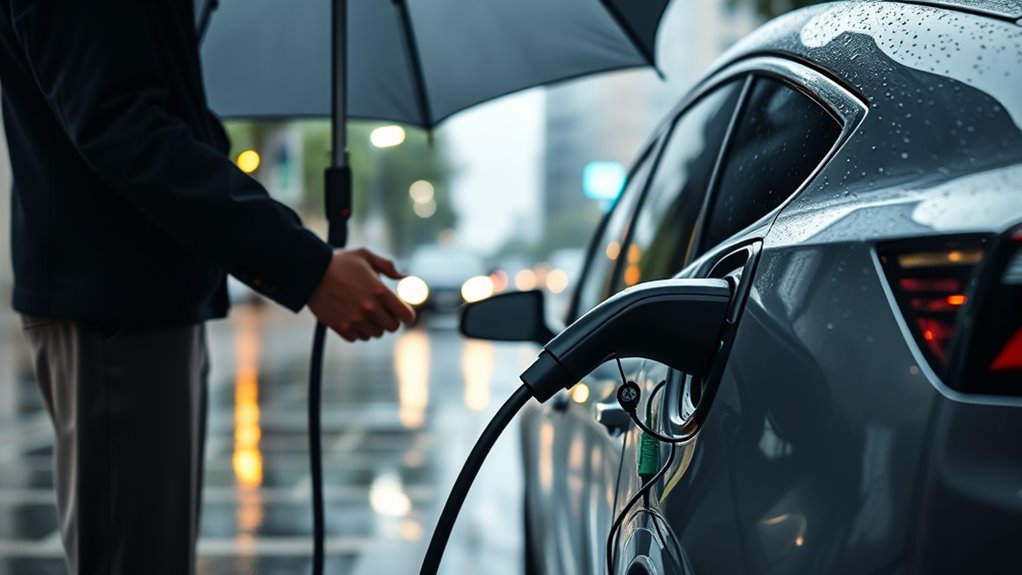
You can charge your EV in the rain when the charger, outlet, cable, connector, and vehicle charge port are rated for the location and in good condition. The U.S. Department of Energy’s Alternative Fuels Data Center says outdoor home EV charging can be safe in rain when you use outdoor-rated equipment, but rain-safe does not mean flood-safe. Inspect the setup first, keep cords out of standing water, and stop during lightning, flooding, or visible damage.
Quick Answer
Yes. You can charge an EV in normal rain if you use undamaged, outdoor-rated or safety-certified charging equipment and keep plugs, outlets, and cables out of standing water. Inspect the connector, charge port, cord, and outlet first. Do not charge during flooding, nearby lightning, storm surge, or with damaged equipment.
Key Takeaways
- Normal rain is not a reason to stop EV charging when the equipment is outdoor-rated, undamaged, and used as directed.
- Do not charge in standing water, flooding, storm surge, or nearby lightning.
- For home charging, use safety-certified equipment installed on a code-compliant circuit by a qualified electrician.
- Rain usually does not slow charging by itself, but battery temperature, charger type, state of charge, and station output can affect charging speed.
At a Glance
| Time Required | 30 to 60 seconds for a safety inspection before plugging in; charging time depends on charger level, battery state of charge, vehicle limits, and battery temperature. |
| Difficulty | Easy for normal use; professional help required for outlet, circuit, breaker, or charger installation issues. |
| Tools Needed | Outdoor-rated EV charger, dry hands, flashlight for inspection, wall hook or cable guide to keep the cord off wet ground. |
| Cost | No cost for a basic pre-charge inspection; costs vary if you need a weatherproof cover, cable management hardware, a new outlet, or a professionally installed Level 2 charger. |
Can You Charge an EV in the Rain?
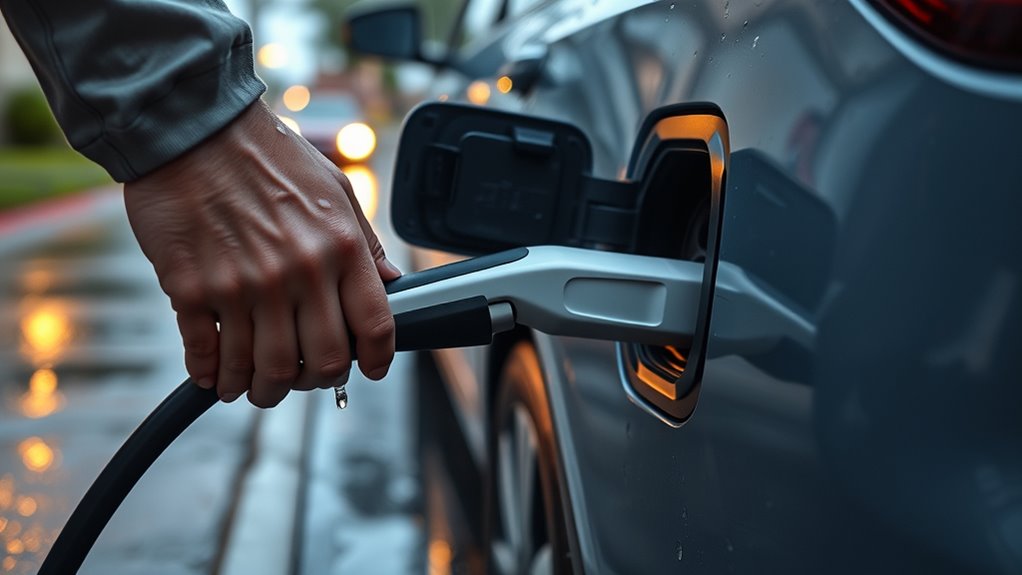
Yes, you can charge an EV in the rain when the charging equipment is designed for outdoor use and the setup is not damaged. Modern EV charging systems are built with protective housings, insulated cables, sealed connector designs, and fault-detection systems that help prevent unsafe power flow when something is wrong.
The key condition is proper use. Before you plug in, inspect the charge port, connector, cable, charging handle, outlet, and charger housing. Do not use cracked, burned, loose, corroded, or water-filled parts. Keep the cable path away from puddles and runoff so the cord, plug, and portable charging brick are not sitting in water.
For home charging, use outdoor-rated and safety-certified charging equipment when the unit is installed outside. For public charging, use the station as directed, follow the screen prompts, and report damaged equipment instead of trying to make it work.
Warning: Normal rain is different from flooding. Do not charge if the charger, cable, outlet, connector, or vehicle charge port is in standing water, has been submerged, or shows signs of damage.
How EV Chargers Stay Safe in Wet Weather
EV chargers stay safe in wet weather by combining physical barriers with electrical protection. Outdoor-rated units use weather-resistant enclosures, sealed cable entry points, insulated cords, recessed or protected contacts, and connector designs that reduce water exposure during normal use.
Charging equipment also relies on control systems. The charger and vehicle communicate before full power flows, and the system can stop charging if it detects a fault. Many installations also include ground-fault protection, which helps shut down power quickly when leakage current is detected.
Still, no rating gives you permission to ignore conditions. A weather-rated charger is made for rain and splashing within its rating, not for submersion, floodwater, storm surge, or damaged wiring.
Note: “Weather-rated” does not always mean “waterproof.” Check the charger label, owner’s manual, and installation instructions for the exact outdoor rating and allowed use conditions.
Check Your Outlet Before Plugging In
Before you plug in, make sure the outlet or wall connector is dry, secure, and free of visible damage. Even a small problem can become more serious when rain adds moisture around the charging area.
Inspect the outlet cover and confirm it closes securely. A loose, broken, or rusted cover can let water reach places it should not. Check the faceplate for cracks, heat discoloration, burn marks, corrosion, movement, or a loose fit when the plug is inserted.
Inspect the outlet cover, faceplate, plug fit, cable jacket, and connector before charging in rain.
If the outlet is GFCI-protected or the EVSE includes ground-fault protection, you have an added safety layer. That protection does not make damaged hardware safe. If the outlet looks compromised, stop and contact a qualified electrician before you charge.
Best Practices for Charging at Home in Rain
Home charging in rain is safest when your charger is installed correctly, rated for the environment, and inspected before use. The DOE AFDC recommends safety-certified EV charging equipment and notes that a qualified electrician can add circuits for EV charging when needed.
Use a Dedicated, Code-Compliant Circuit
For Level 2 charging, use a circuit designed for the charger’s continuous load. EV charging equipment is treated as a continuous electrical load, and installations must follow local codes, permit rules, manufacturer instructions, and National Electrical Code requirements, including Article 625 where applicable.
| Feature | Why it matters | Your action |
|---|---|---|
| Dedicated circuit | Handles sustained EV load | Do not share it with unrelated high-load devices |
| Ground-fault protection | Helps shut down unsafe leakage faults | Verify it is installed and working |
| Outdoor rating | Protects against normal rain exposure | Confirm the charger is rated for its location |
| Professional installation | Reduces wiring, breaker, heat, and code issues | Use a qualified electrician |
Keep Cables Elevated
Keep charging cables elevated off the ground so they do not sit in standing water or cross puddle paths. Use wall hooks, cable reels, clips, or charger-mounted cord storage to keep the cable organized and away from wet tires, runoff, and foot traffic.
If you use a portable Level 1 charger, place the charging brick on a dry, stable surface and protect it from direct water exposure as directed by the manufacturer. Never leave a portable charging unit in a gutter, driveway low spot, or puddle path.
Pro Tip: Before rainy season, add a wall hook or cable guide near your parking spot. Good cable management prevents the most common wet-weather mistake: letting the cord or connector rest in a puddle.
Inspect Outlets Before Charging
Once the cable path is safe, inspect the outlet or wall connector. Look for corrosion, burn marks, cracked housings, loose faceplates, buzzing, unusual heat, or a plug that does not fit firmly. Dry the outside of the connector handle if needed, but do not insert anything into the charge port or outlet.
- Confirm the cover closes fully and seals well.
- Check the plug, cable jacket, connector pins, and strain relief for damage.
- Keep the connector off wet ground before and after charging.
- Stop if the outlet smells hot, feels loose, or shows discoloration.
Follow a Safe Plug-In Sequence
Use the same simple sequence every time you charge in rain:
- Park away from standing water and runoff channels.
- Check the charger, cable, connector, outlet, and vehicle charge port.
- Keep your hands as dry as practical and avoid touching metal contacts.
- Connect the charger firmly without forcing the plug.
- Confirm the vehicle and charger show normal charging status.
- If the charger trips, stops repeatedly, or displays a fault, unplug only if it is safe and follow the charger or vehicle manual.
Public EV Charging in Wet Weather
Public EV chargers are usually built for outdoor exposure, so rain alone does not make them unsafe. The same inspection rules still apply. Before you plug in, check the pedestal, screen, cable, connector, holster, and parking area.
Do not use a public charger if the connector is cracked, the cable jacket is cut, the handle is loose, the unit is buzzing or sparking, or the base of the charger is surrounded by standing water. Choose another station and report the issue to the network operator through the app, phone number, or station screen.
The DOE AFDC notes that charging infrastructure planning and maintenance should account for site conditions, weather impacts, equipment operation, cable storage, and periodic checks. Good reporting helps keep public charging safer for the next driver.
Public Charger Rain Checklist
- Stand on dry ground where possible.
- Inspect the handle and cable before inserting the connector.
- Keep the connector out of puddles before and after use.
- Use only the station’s attached cable and approved connector.
- Move to another charger if anything looks damaged or unstable.
What Not to Do When Charging in Rain
Even good EV charging equipment can become unsafe if you use it the wrong way. Avoid shortcuts that add failure points or expose electrical parts to water.
- Do not use household extension cords for EV charging in rain unless the vehicle and charger manufacturer specifically allow that exact setup.
- Do not place a portable charging brick, adapter, plug, or connector in standing water.
- Do not bypass GFCI or ground-fault protection.
- Do not force a damaged connector into the charge port.
- Do not charge from an outlet with rust, burn marks, looseness, cracking, or heat damage.
- Do not continue charging if the charger repeatedly trips or shows a fault.
- Do not charge during flooding, storm surge, or nearby lightning.
Warning: If your EV, charger, outlet, or cable has been submerged, do not plug in or attempt to charge. Keep away from flood-damaged equipment and contact the vehicle manufacturer, charger manufacturer, utility, or a qualified professional for guidance.
Does Rain Affect Charging Speed?
Rain itself usually does not slow EV charging. A properly rated charger and vehicle should charge normally in wet weather when the equipment is undamaged and used within its rating.
Charging speed depends more on the charger level, charger output, battery state of charge, battery capacity, battery temperature, onboard charging limits, and the station’s available power. The DOE AFDC explains that EV charging time varies by these factors, with Level 1, Level 2, and DC fast charging delivering very different charging rates.
Cold weather can matter more than rain. If the battery pack is cold, the vehicle may limit charging current to protect the cells, especially at DC fast chargers. In that case, the slower session is caused by battery temperature and vehicle charging strategy, not rainwater on the charger.
Lightning, Flooding, and Severe Storms
Rain is usually manageable. Severe weather is different. If lightning is nearby, do not start a charging session outside. A surge can damage charging equipment or vehicle electronics, and standing next to exposed outdoor electrical equipment during lightning is not worth the risk.
Flooding is also a stop sign. Floodwater can hide damaged wiring, submerged outlets, unstable ground, and contaminated water. Saltwater flooding is especially concerning because it can increase corrosion and create serious battery and electrical risks after exposure.
Charge in normal rain only when the area is not flooded, the equipment is undamaged, and the charger is rated for outdoor use.
- Stop charging if water begins pooling around the charger or vehicle.
- Wait until lightning and severe storm alerts have passed.
- Do not reconnect after flooding until the equipment and vehicle are evaluated.
- Move to a safer charger if wind, debris, or standing water makes the station unstable.
Choose a Weather-Rated Home Charger
To charge safely in wet conditions, choose a home charger rated for its installation location. If the unit is outdoors or exposed to rain, confirm that the charger, plug type, enclosure, cable, and installation method are approved for outdoor use.
Also confirm whether your vehicle uses J1772, CCS, J3400/NACS, or another connector setup. Connector type does not change the rain rule: the charger must be compatible, undamaged, rated for the environment, and used according to the vehicle and charger manuals.
| Check | Why it matters | Action |
|---|---|---|
| Outdoor rating | Shows the charger is designed for normal weather exposure | Confirm the rating before installation |
| Safety certification | Shows the equipment has been tested by a recognized safety body | Choose safety-certified equipment |
| Code-compliant installation | Reduces overload, heat, and wiring risk | Use a qualified electrician and follow permits |
| Cable storage | Keeps the connector away from wet ground | Use a wall hook, holster, or cable reel |
| Weather protection | Reduces direct rain, sun, and debris exposure | Add a cover or enclosure only if allowed by the manufacturer |
If your wallbox is fully exposed, a weatherproof cover or sheltered mounting location can reduce wear. Do not trap heat or block ventilation unless the charger manual allows the cover or enclosure.
Troubleshooting Rainy-Day Charging Problems
If charging does not start or stops during rain, do not keep forcing the session. Use the problem as a warning sign and check the safest causes first.
| Problem | Likely cause | What to do |
|---|---|---|
| Charger trips or shuts off | Ground fault, water exposure, damaged cable, or electrical issue | Stop using it and follow the charger manual; call a qualified electrician if the issue repeats |
| Connector got wet on the outside | Normal rain exposure or dropped handle | Do not touch contacts; wipe the exterior if safe and inspect for damage before use |
| Connector fell into a puddle | Improper cable storage or standing water | Do not plug it in; let the equipment be inspected according to the manufacturer’s instructions |
| Public charger looks damaged | Broken connector, cut cable, vandalism, impact damage, or water intrusion | Use another charger and report the station to the operator |
| Charging is slower than expected | Cold battery, high state of charge, vehicle limit, shared station power, or charger output limit | Check the vehicle display and station output; rain alone is usually not the cause |
Frequently Asked Questions
Is it safe to charge an EV car while raining?
Yes, it is generally safe to charge an EV while it is raining if you use outdoor-rated, undamaged charging equipment and avoid standing water. Inspect the cable, connector, charge port, and outlet first. Stop if you see damage, flooding, sparks, heat, corrosion, or repeated fault messages.
How do you charge an EV in the rain?
Park away from puddles, inspect the charger and vehicle port, keep the cable off wet ground, connect the plug firmly, and confirm normal charging status. Use only equipment approved for the location. Do not use damaged cords, loose outlets, unsafe adapters, or household extension cords in wet conditions.
What happens if an EV charging port gets wet?
Light rain on the outside of the charge port is usually handled by the vehicle’s design, but visible water pooling, debris, corrosion, or damage is different. Do not insert objects into the port. If the vehicle reports a fault or the port was submerged, stop charging and follow the owner’s manual.
Can I Level 1 charge in the rain?
You can Level 1 charge in the rain only when the outlet, cord, portable charger, and connection point are approved for the conditions and kept out of standing water. A garage or sheltered, weather-protected outlet is safer than an exposed outlet. Stop if the outlet is loose, hot, wet inside, cracked, or corroded.
Can rain trip my EV charger?
Rain should not trip a properly installed outdoor-rated charger in good condition. If it trips during rain, the system may be detecting a ground fault, moisture problem, damaged cable, outlet issue, or installation fault. Do not keep resetting it. Inspect only what is safe to inspect and call a qualified electrician if the problem repeats.
Should I charge during lightning?
No. If lightning is nearby, wait until the storm passes before connecting or disconnecting outdoor charging equipment. Lightning can create surge risk, and standing near outdoor electrical equipment during an active storm is unnecessary exposure.
What should I do if my EV or charger was flooded?
Do not charge, plug in, or touch submerged charging equipment. Keep people away from the vehicle and charger if floodwater reached electrical parts. Follow the vehicle manufacturer’s guidance and have the EV and charging equipment inspected by qualified professionals before reuse.
Conclusion
Charging your EV in the rain is safe when the equipment is outdoor-rated, safety-certified, undamaged, and installed correctly. Normal rain is not the same as standing water, flooding, storm surge, or lightning. Before you plug in, inspect the outlet, cable, connector, charger, and vehicle charge port. Keep the cord out of puddles, avoid damaged equipment, and follow the vehicle and charger manuals. For reliable home charging, choose a weather-rated charger and have the installation completed according to local code by a qualified electrician.
Sources
- U.S. Department of Energy AFDC — Charging Electric Vehicles at Home — outdoor-rated equipment, safety-certified chargers, home charging, installation, and code guidance.
- U.S. Department of Energy AFDC — Electric Vehicle Charging Stations — charging levels, connector types, and charging-time factors.
- U.S. Department of Energy AFDC — Procurement and Installation for EV Charging Infrastructure — site planning, weather impacts, utility coordination, permits, and installation factors.
- U.S. Department of Energy AFDC — EV Charging Infrastructure Maintenance and Operation — cable storage, periodic checks, uptime, maintenance, and repair considerations.
- NFPA 70, National Electrical Code — electrical code reference for EV charging installation requirements, including Article 625.