
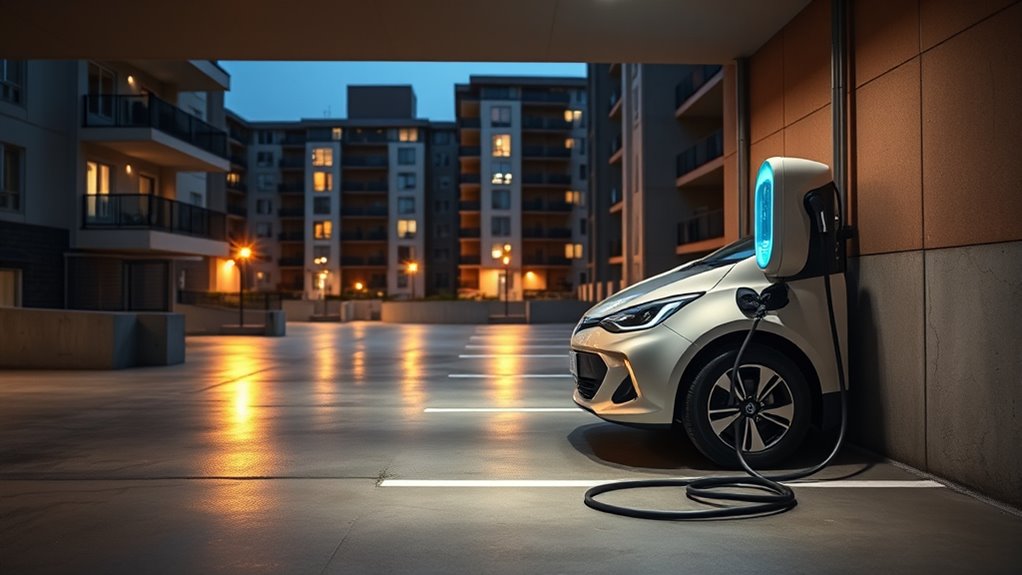
You can charge an EV in an apartment, but the best setup depends on your parking space, outlet access, landlord approval, local rules, and nearby public chargers. Most renters use a mix of Level 1 overnight charging, shared Level 2 charging, workplace charging, and public stations. Start with the safest option you can use consistently, then build a backup plan for longer trips.
Quick Answer
To charge an EV in an apartment, first check whether you have landlord-approved access to a safe 120-volt outlet near your parking space. If not, ask about shared Level 2 chargers, use workplace charging, and rely on public stations found through charging apps. Avoid improvised cords, and get approval before any installation.
Key Takeaways
- Level 1 charging can work for short daily commutes if you have approved access to a safe, grounded outlet.
- Shared Level 2 charging is usually the best apartment solution when a property manager can manage access, billing, and electrical capacity.
- Public and workplace chargers can fill the gap, but you should compare speed, connector type, price, and live availability before you drive there.
- Right-to-charge rules vary by state, city, lease, and property type, so check local law before making a formal request.
At a Glance
| Time Required | 15–30 minutes to compare options; several days to several weeks if landlord approval or electrical work is needed. |
| Difficulty | Easy if you use public charging; moderate if you request outlet access or a shared Level 2 charger. |
| Tools Needed | EV owner’s manual, charging cord, charging apps, lease or parking agreement, utility/incentive information, and a licensed electrician for new Level 2 work. |
| Cost | Often no extra equipment for approved Level 1 charging; public charging is pay-as-you-go; Level 2 installation cost depends on the building, permits, wiring, charger, and billing setup. |
Best EV Charging Options for Renters
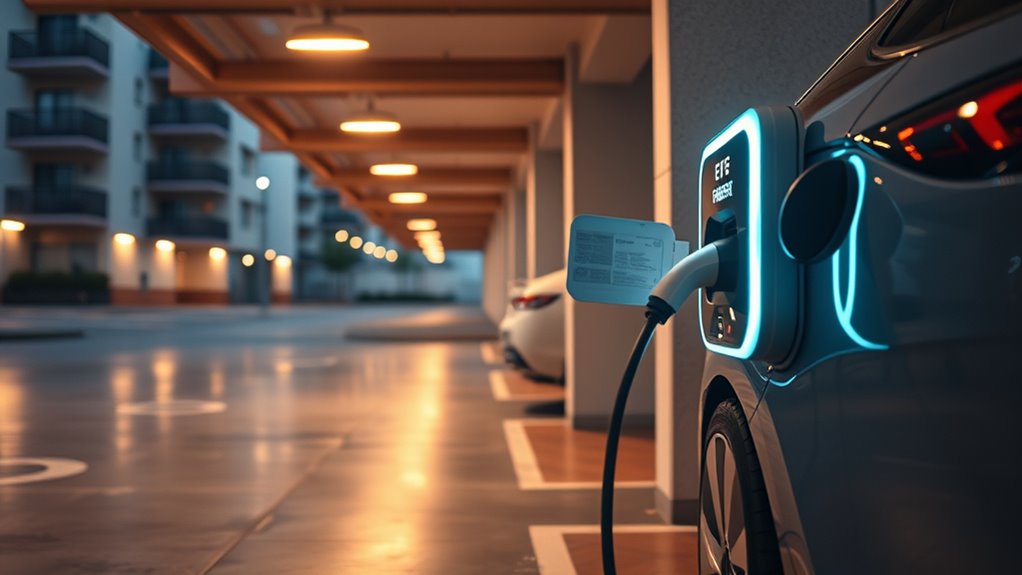
If you rent and cannot install a private home charger, you still have several practical EV charging options. The right choice depends on how many miles you drive each day, where you park, and how much control you have over your parking space.
| Option | Best For | Main Limit |
|---|---|---|
| Level 1 outlet charging | Short daily commutes and overnight parking near an approved outlet | Slow charging speed |
| Shared Level 2 charger | Apartment buildings with multiple EV drivers | Requires property approval, electrical review, and billing rules |
| Workplace charging | Drivers who park at work for several hours | Access, cost, and availability depend on employer policy |
| Public charging | Backup charging, road trips, and renters without home access | Can cost more and may require planning around queues or downtime |
Start with Level 1 charging only if you can park near a safe, landlord-approved outlet. According to the U.S. Department of Energy’s Alternative Fuels Data Center, Level 1 charging uses a 120-volt AC plug and provides about 5 miles of range per hour under typical assumptions.
If your building offers Level 2 charging, use it when you need faster turnaround. Level 2 charging usually runs on 240-volt residential service or 208-volt commercial service and can add much more range per hour than a standard outlet.
Pro Tip: Build your charging routine around your normal parking time. If your car sits for 8–10 hours overnight or during work, slower charging may be enough even if it looks weak on paper.
Step-by-Step Plan for Charging an EV in an Apartment
- Check your daily mileage. If you drive 20–40 miles most days, Level 1 charging may cover your routine if you can plug in overnight.
- Look at your parking situation. Note whether your spot is assigned, covered, outdoors, near an outlet, or in a shared garage.
- Read your lease or parking agreement. Look for rules about electrical use, parking modifications, cords, reserved spaces, and common areas.
- Ask before plugging in. Get written approval before using a shared outlet or making any electrical changes.
- Check public and workplace backups. Save at least two nearby public stations and one backup station in your charging app.
- Track your first two weeks. Watch your battery level, commute mileage, charging speed, and public charging costs so you know whether the plan works.
Warning: Do not run an EV charging cord across sidewalks, drive lanes, doors, landscaping, or wet areas. Avoid improvised extension-cord setups. EV charging is a long continuous electrical load, and unsafe wiring can overheat or create trip and shock hazards.
Public and Workplace Charging
Public and workplace charging can fill the gap when home charging is not practical. The AFDC public charging guide explains that public charging commonly uses Level 2 or DC fast charging, while workplace charging can increase the convenience of driving electric for employees.
Use apps such as PlugShare, ChargePoint, Electrify America, Tesla, EVgo, or your vehicle’s built-in navigation to check nearby stations. Before you drive there, confirm the connector type, charging speed, price, parking rules, and live availability.
For everyday use, Level 2 public charging is useful when you will be parked for a while, such as at work, a gym, a grocery store, or a city garage. DC fast charging is better for road trips and urgent top-ups, but it often costs more and is not ideal as your only daily charging method.
Public charging is a backup plan, not just a map pin. A useful station should be available, compatible with your car, priced clearly, and reliable when you need it.
If you can charge at work, ask whether access is free, paid, employee-only, time-limited, or first-come-first-served. Some employers also require a charging account or a parking permit.
EV Charging From a Standard Outlet
You can charge many EVs with Level 1 charging from a standard 120-volt outlet. The AFDC home charging guide notes that many EV owners can meet daily driving needs with overnight Level 1 charging when a suitable outlet on a dedicated branch circuit is available near the parking location.
This is the simplest apartment charging option when you have an assigned space near an approved outlet. It is also the slowest option, so it works best for drivers with predictable daily mileage.
Level 1 Charging Basics
Level 1 charging uses a 120-volt AC outlet and the portable cordset that comes with many EVs. A realistic expectation is about 3–5 miles of range per hour, depending on the vehicle, outlet, temperature, and charging equipment.
If you plug in for 8–10 hours overnight, you may add roughly 30–50 miles of range. That can be enough for a daily commute, errands, and school drop-offs, but it may not recover quickly after a long road trip.
Outlet Access Considerations
Outlet access is not just about distance. You need permission, a safe outlet, a grounded connection, and a circuit that can handle long charging sessions. Do not assume a garage, carport, laundry-room, or exterior outlet is available for EV charging just because it is physically close to your car.
Ask your property manager these questions before using Level 1 charging:
- Is this outlet assigned to my unit, shared by the building, or connected to common-area power?
- Is the outlet grounded, weather-protected, and suitable for long charging sessions?
- Who pays for the electricity?
- Can the cord stay fully within my parking space without crossing walkways?
- Does the building require a written agreement or proof of insurance?
Overnight Charging Range
Overnight Level 1 charging is best when your car sits for many hours and your daily driving is modest. If you drive 30 miles a day and can add about 30–50 miles overnight, the routine may feel easy. If you drive 70 miles a day, Level 1 may fall behind unless you also use workplace or public charging.
A full charge from a low battery can take a long time on Level 1. Treat it as a daily top-up method, not a fast recovery method.
Shared EV Charging in Apartments
Shared EV charging is often the strongest long-term solution for apartment buildings and condos. The AFDC multifamily housing guidance notes that apartment and condo charging involves parking, electrical service, billing, and legal considerations.
| Building Question | Why It Matters |
|---|---|
| Who can use the charger? | Access rules prevent one driver from blocking everyone else. |
| How is billing handled? | The property needs a fair way to recover electricity and service costs. |
| Can the electrical panel support it? | A licensed electrician may need to review load capacity and code requirements. |
| Can the charger be expanded later? | Load management and conduit planning can reduce future upgrade costs. |
When you evaluate a property, ask how billing, queueing, access control, maintenance, and guest use work. A building with clear rules is much easier to live with than a building that has chargers but no policy.
Renters’ EV Charging Rights
Some states and local governments have “right to charge” rules that limit how landlords or homeowner associations can restrict EV charger installation. These rules vary widely, so do not rely on a general online summary. Start with the AFDC laws and incentives database, then confirm the rule with your state, city, landlord, HOA, or a qualified local professional.
California is one example. California Civil Code 1947.6 says a landlord must approve a qualifying written request from a tenant to install an EV charging station at an allotted parking space, but the law includes exceptions and tenant obligations. Those obligations can include installation, maintenance, removal, electricity, damage, permits, and other costs.
Note: This article is general information, not legal advice. Lease terms, HOA rules, city codes, rent-control rules, insurance requirements, and state laws can change how your request is handled.
How to Ask for Charging in Your Building
Once you understand your options, make a clear written request. A vague “Can I charge my car?” is easy to reject. A practical proposal is harder to ignore.
Include these points in your message to the property manager:
- Your parking space: Identify whether it is assigned, deeded, leased, or shared.
- Your preferred option: Level 1 outlet access, shared Level 2 charging, or a dedicated charger.
- Safety plan: State that you will follow building rules, local code, and licensed-electrician requirements.
- Billing plan: Offer to pay for metered electricity, a flat charging fee, or a network-managed billing system.
- Demand: Ask whether other residents want EV charging and offer to help gather interest.
- Incentives: Mention that state, utility, or local incentives may help offset costs.
- Management benefits: Explain that charging can attract and retain residents, especially as more drivers consider EVs.
Keep the tone cooperative. Property owners worry about cost, liability, construction disruption, and unfair electricity use. Address those concerns directly, and you will have a stronger case.
What If Your Landlord Says No?
If your landlord rejects your request, ask for the reason in writing. The next step depends on the reason. If the issue is cost, you may be able to suggest a shared charger, utility incentive, or resident-paid setup. If the issue is electrical capacity, ask whether a licensed electrician can review load management. If the issue is building policy, check whether your state or city has right-to-charge rules.
While you work through that process, build a no-home-charger routine. Save public chargers near your home, work, grocery store, gym, and weekend routes. Try to charge during activities you already do so charging does not become a separate errand every time.
Frequently Asked Questions
How do people who live in apartments charge their EV?
Apartment residents usually charge with one or more options: an approved 120-volt outlet, shared Level 2 chargers in the building, workplace charging, public Level 2 stations, or DC fast chargers for backup and trips. The best routine is the one you can use consistently without unsafe cords or lease problems.
How can I charge my EV if I live in a flat?
If you live in a flat, first check whether your parking space has approved outlet access. If it does not, ask the building manager about shared Level 2 charging, use workplace charging, and save nearby public stations in a charging app. Do not run a cable from your flat across public or shared areas unless your building explicitly allows a safe setup.
How can I charge a Tesla if I live in an apartment?
You can charge a Tesla in an apartment with an approved 120-volt outlet, a shared Level 2 charger, Tesla Destination Charging, Tesla Superchargers, workplace charging, or compatible public charging. Check your Tesla app for nearby options and confirm whether you need an adapter for non-Tesla Level 2 stations.
How do I charge an electric car at an apartment without a charger?
Without an apartment charger, use workplace charging, public Level 2 stations, DC fast chargers, or an approved standard outlet if one is safely available near your parking space. If none of those works, ask your landlord about shared charging or a resident-paid installation. Do not use hidden outlets, overloaded circuits, or cords across walkways.
Is Level 1 charging enough for apartment living?
Level 1 can be enough if you drive modest daily miles and can plug in safely for many hours. It is usually not enough if you drive long distances every day, cannot charge overnight, or need quick recovery after trips. In that case, combine Level 1 with workplace or public charging.
Can my landlord charge me for EV electricity?
Yes, in many cases a landlord or property manager can require payment for electricity, equipment, installation, maintenance, network fees, or a reserved parking space. The exact rules depend on your lease, local law, and the charging setup. Ask for the billing method in writing before you start charging.
Conclusion
Charging an EV in an apartment is manageable when you treat it as a routine, not a last-minute problem. Start with your parking space, outlet access, lease rules, and daily mileage. If Level 1 is safe and approved, it may cover your normal driving. If it is too slow or unavailable, ask for shared Level 2 charging and use public or workplace stations as backups. The best apartment EV setup is safe, written down, fairly billed, and easy enough to repeat every week.
Sources
- U.S. Department of Energy Alternative Fuels Data Center: Electric Vehicle Charging Stations — charging levels, public station terminology, Level 1/Level 2/DC fast charging basics.
- U.S. Department of Energy Alternative Fuels Data Center: Charging Electric Vehicles at Home — Level 1 home charging, dedicated circuit guidance, code and NEC Article 625 considerations.
- U.S. Department of Energy Alternative Fuels Data Center: Electric Vehicle Charging for Multifamily Housing — apartment and condo charging considerations for owners and residents.
- U.S. Department of Energy Alternative Fuels Data Center: Charging Electric Vehicles in Public — public charging use cases and planning considerations.
- U.S. Department of Energy Alternative Fuels Data Center: Federal and State Laws and Incentives — current law and incentive lookup for EV charging by jurisdiction.
- California Civil Code Section 1947.6 — California tenant EV charging station request rules and conditions.