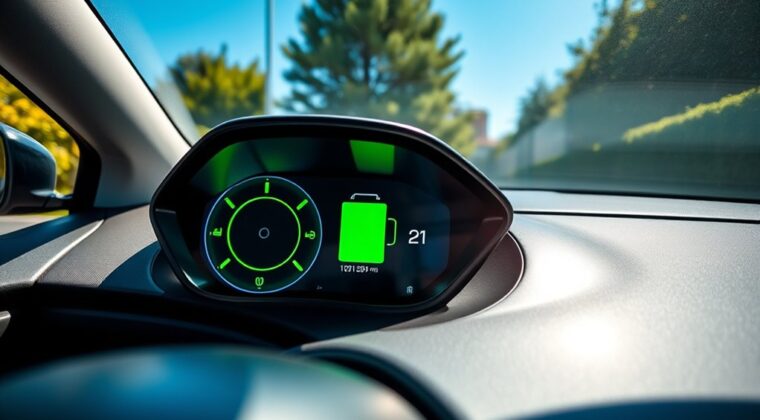
State of Charge (SoC) is the battery percentage you see on your electric vehicle’s dashboard or app. It tells you the estimated usable energy left in the high-voltage battery, much like a fuel gauge in a gas car. The number is simple, but the system behind it is not: your EV’s battery management system uses voltage, current, temperature, software models, and safety buffers to estimate that percentage.
Quick Answer
EV State of Charge, or SoC, is the estimated battery percentage available for driving. A higher SoC means more stored energy, but it is not the same as guaranteed miles. Weather, speed, terrain, battery temperature, and driving style all affect how far that charge will take you.
Key Takeaways
- SoC is your EV’s battery percentage, while the range estimate is a prediction based on conditions and recent driving.
- Your EV’s battery management system estimates SoC; drivers do not directly measure the battery pack themselves.
- Cold weather, high speed, towing, steep grades, battery age, and heavy HVAC use can make the range estimate change faster than expected.
- For many EVs, daily charging around the middle of the battery is easier on long-term battery health, but you should always follow your owner’s manual.
At a Glance
| Time Required | A few seconds to check SoC; several hours for normal home charging; longer for full charging. |
| Difficulty | Easy for daily use; more planning is needed for long trips, winter driving, or towing. |
| Tools Needed | EV dashboard, mobile app, owner’s manual, and a reliable charging plan. |
| Cost | No special cost to monitor SoC; charging cost depends on your electricity rate or public charger price. |
What Is State of Charge (SoC) and Why Does It Matter for EV Owners?
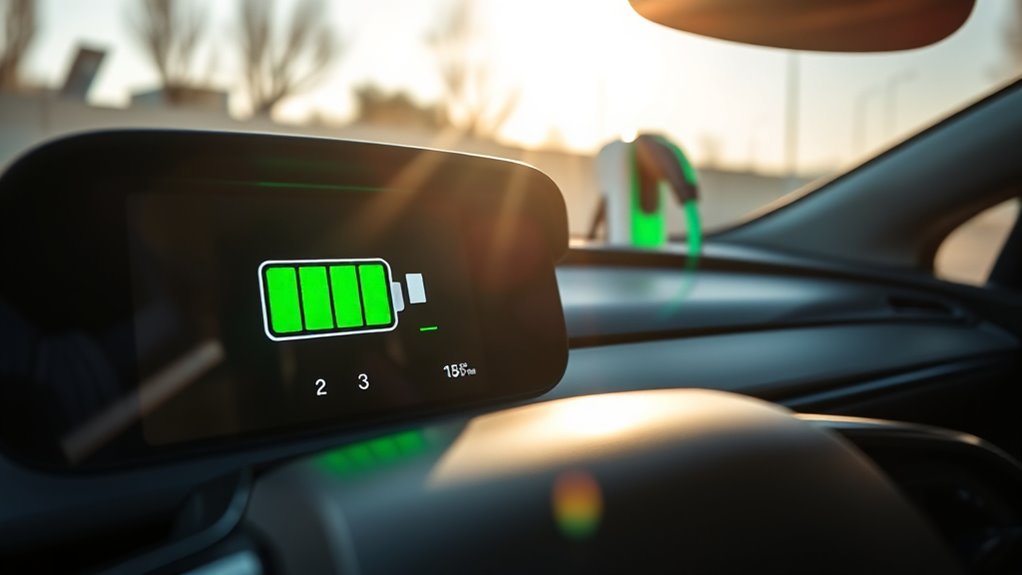
State of Charge is the estimated amount of usable energy left in your EV battery, shown as a percentage. If your dashboard says 60%, your vehicle is telling you that about 60% of the driver-available battery charge remains.
That percentage helps you decide when to charge, whether you can finish a trip, and how much reserve you should keep. It also helps the vehicle manage power, charging speed, thermal control, and regenerative braking.
Most all-electric vehicles and plug-in hybrids use lithium-ion batteries, although the exact chemistry varies by model. That matters because battery chemistry, software, and manufacturer guidance can change the best charging habits for your specific EV.
Note: SoC is not the same as your range estimate. SoC is battery percentage. Estimated miles are a prediction based on energy use, temperature, terrain, speed, accessories, and recent driving.
Displayed SoC vs. Actual Battery Charge
The SoC you see is usually a driver-facing number, not a raw cell-level measurement. EV makers often reserve hidden battery buffers at the top or bottom of the pack to protect the battery from overcharge, deep discharge, and high stress.
That means 0% on the display does not always mean every cell is truly empty, and 100% on the display does not always mean the battery has reached its absolute electrochemical limit. The battery management system, or BMS, controls those limits in the background.
This is why two EVs with similar battery sizes can behave differently at the same displayed SoC. One may keep a larger buffer, one may allow more usable capacity, and one may reduce power earlier to protect the pack.
How Your EV Estimates State of Charge
You do not directly measure SoC yourself. Your EV’s BMS estimates it by tracking the battery’s voltage, current flow, temperature, charging history, and internal software models.
One common method is Coulomb counting, which estimates charge by tracking current flowing into and out of the battery over time. This method is useful, but it can drift because of sensor error, timing error, battery aging, and uncertainty about the battery’s current usable capacity.
Voltage-based estimation also has limits. A battery’s voltage does not always map neatly to a single SoC, especially when the pack is under load, very cold, very hot, aging, or using a chemistry with a flatter voltage curve.
Modern EVs usually combine several methods instead of relying on one reading. The BMS may correct its estimate after charging, resting, balancing, software updates, or normal driving patterns.
Warning: SoC management is driver-level battery care. Never open, probe, modify, or attempt to service a high-voltage EV battery pack yourself. Use a qualified EV technician if the vehicle shows battery warnings or charging faults.
What Can Make Your EV’s SoC Reading Less Accurate?
SoC is an estimate, and several conditions can make the number or the range estimate feel less predictable. Some affect the battery itself, while others affect how quickly you use the stored energy.
| Factor | How It Affects SoC or Range Confidence | Common Example |
|---|---|---|
| Cold weather | Reduces available power, slows charging, and increases cabin-heating demand. | The same 50% SoC may deliver fewer miles in winter. |
| High battery temperature | Can trigger thermal protection and, over time, add stress to the battery. | Fast charging after highway driving on a hot day. |
| Battery aging | Usable capacity slowly declines, so each percent may represent less energy than when new. | An older EV shows fewer miles at 80% than it did when new. |
| Heavy load | Acceleration, towing, steep grades, and high speeds increase energy use. | Range drops faster during mountain driving or towing. |
| Recent driving history | The range estimate may adjust after a period of inefficient or efficient driving. | A highway trip lowers the next displayed range estimate. |
| BMS estimation drift | Small errors can build until the system corrects itself through normal operation or charging behavior. | The percentage seems to drop unevenly after long partial-charge use. |
Cold weather deserves special attention because it can reduce range and slow charging. If your EV offers battery preconditioning, use the navigation system or app to prepare the battery before DC fast charging, especially in winter.
State of Charge (SoC) vs. State of Health (SoH): Key Differences
State of Charge and State of Health sound similar, but they answer different questions.
SoC tells you how much charge is available right now. It is the percentage you use for daily driving and charging decisions.
SoH tells you how much battery capability remains compared with when the battery was new. It is usually tied to remaining capacity, energy, resistance, or a combination of battery-health indicators. EV pack-level SoH is still not measured the same way across every vehicle or brand, and researchers continue to call for more standardized methods for vehicle-level battery health reporting.
SoC is the charge you have for this drive. SoH is the battery condition that affects how much charge the pack can hold over the long term.
| Metric | What It Means | Why It Matters |
|---|---|---|
| SoC | Current estimated battery percentage. | Helps you plan today’s drive and charging stops. |
| SoH | Estimated battery condition compared with a new battery. | Helps explain long-term range loss and battery value. |
| Range estimate | Predicted miles or kilometers remaining. | Changes with weather, speed, route, and driving habits. |
Tips for Optimizing SoC to Extend Battery Life and Performance
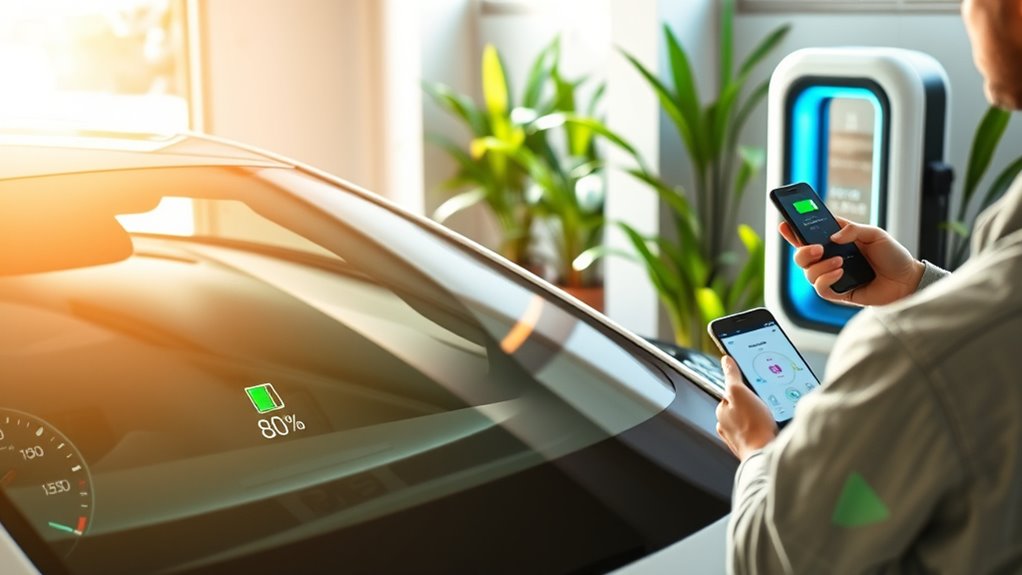
Good SoC habits can help you get more predictable range and reduce battery stress. The right target depends on your EV, battery chemistry, climate, and owner’s manual, but these habits work well for many drivers.
Use a Daily Charge Limit
For many lithium-ion EVs, charging to around 70% to 90% for daily use is enough. A common everyday target is about 80%, especially if you do not need the full range the next day.
Charging to 100% is usually fine before a long trip if you drive soon after charging. What you should avoid, unless your manual says otherwise, is leaving the car sitting at 100% for long periods in hot weather.
Pro Tip: Set your EV’s charge limit in the vehicle screen or mobile app. A daily limit removes guesswork and helps you avoid unnecessary full charges.
Avoid Regular Deep Discharges
Try not to run the battery very low as a habit. Arriving home or at a charger with a low SoC is normal on road trips, but daily deep discharges can add stress and may make range predictions less stable.
If the vehicle warns you to charge, take the warning seriously. Do not park the car for a long time at very low SoC.
Understand Fast Charging and High SoC
DC fast charging is most useful when the battery is low to mid-level. Charging usually slows as the battery gets closer to full because the BMS protects the pack and manages heat. That is why many road-trip charging stops are planned around the lower-to-middle part of the battery instead of waiting for 100%.
FuelEconomy.gov notes that even fast charging to 80% can take about 30 minutes, while full charging can take much longer depending on the vehicle and charger.
Watch Regenerative Braking Limits
Regenerative braking may be reduced when the battery is full, very cold, or unable to accept energy quickly. This is normal. If you charge to 100% before a trip, expect less regen at the start until the SoC drops.
Follow Your Battery Chemistry and Owner’s Manual
Not every EV should be treated exactly the same. Some vehicles with lithium iron phosphate, or LFP, batteries may recommend periodic charging to 100% to help the BMS stay calibrated. Other vehicles may recommend a lower daily charge limit for routine use.
Your owner’s manual and in-car charging settings should be the final guide. If your vehicle gives a specific battery-care recommendation, follow that over a generic rule.
Store the Car With a Moderate Charge
If you plan to leave your EV parked for more than a few days, avoid storing it nearly empty or completely full unless the manufacturer tells you otherwise. A moderate SoC is usually easier on the battery during storage.
Also keep the vehicle plugged in if the manual recommends it, especially if the car needs power for battery thermal management or 12-volt battery maintenance.
What to Do If Your SoC or Range Estimate Seems Wrong
If your battery percentage or range estimate seems unusual, do not panic. Start with the simple checks first.
- Compare the dashboard and mobile app to see if they agree.
- Think about recent driving: high speed, cold weather, towing, hills, or heavy HVAC use can lower the range estimate.
- Check whether the battery is very cold or very hot.
- Install available vehicle software updates.
- Review your owner’s manual for battery calibration or LFP charging guidance.
- Use the vehicle’s trip planner for long routes instead of relying only on the displayed miles.
- Schedule service if you see battery warnings, charging errors, sudden large SoC drops, or repeated unexpected shutdown warnings.
Modern EV batteries are designed for long life. FuelEconomy.gov notes that EV batteries are designed for extended life and cites a DOE estimate of about 12 to 15 years in moderate climates and 8 to 12 years in severe climates. That is not a guarantee for every vehicle, but it is useful context: good charging habits help, but normal battery aging is expected.
Frequently Asked Questions
What is EV State of Charge?
EV State of Charge, or SoC, is the estimated battery percentage available for driving. It helps you decide when to charge and how much reserve to keep for your trip.
What does battery State of Charge mean?
Battery State of Charge means the estimated amount of usable charge left in the battery compared with the charge available to the driver when full. In an EV, it is usually shown as a percentage on the dashboard or mobile app.
Is SoC the same as remaining range?
No. SoC is the battery percentage. Remaining range is an estimate of how far that percentage may take you. Range can change with speed, weather, terrain, tire pressure, cabin heat, air conditioning, and recent driving style.
Should I charge my EV to 100% every day?
For many EVs, daily charging below 100% is better for long-term battery health unless you need the full range. However, some LFP-equipped vehicles may recommend periodic 100% charging. Follow your owner’s manual and in-car battery-care settings.
Why does my EV charge quickly at first and then slow down?
Charging usually slows at higher SoC because the battery management system limits current to protect the pack, control heat, and reduce stress. This is most noticeable during DC fast charging above the middle of the battery.
Why is regenerative braking weaker when my battery is full?
Regenerative braking sends energy back into the battery. If the battery is already full, very cold, or unable to accept charge quickly, the EV may reduce regen to protect the battery.
Conclusion
State of Charge is one of the most important numbers on your EV dashboard, but it should be read with context. It tells you the estimated battery percentage available right now, not a fixed promise of miles. Use SoC with your range estimate, trip planner, weather conditions, and owner’s manual to make better charging decisions.
For daily use, avoid living at the extremes unless your vehicle maker recommends it. Charge enough for your routine, use 100% when you need it for a trip, avoid long storage at very low or very high charge, and pay attention to battery warnings. Those simple habits can make your EV easier to live with and kinder to the battery over time.
Sources
- Alternative Fuels Data Center: Batteries for Electric Vehicles — supports EV battery chemistry and lithium-ion battery context.
- FuelEconomy.gov: All-Electric Vehicles — supports EV battery life estimates and charging-time context.
- A Critical Look at Coulomb Counting — supports Coulomb-counting limitations and error sources in SoC estimation.
- Online SOC Estimation of Lithium-ion Battery — supports the role of BMS algorithms in lithium-ion SoC estimation.
- Why We Need a Standardized State of Health Definition for EV Battery Packs — supports SoH definition nuance and the lack of one universal vehicle-level SoH method.