
A charging curve shows how your electric vehicle’s charging speed changes during a session. The number on the charger is only part of the story. Your EV’s battery temperature, state of charge, battery management system, and maximum charge limit all decide how much power the car can actually accept.
In real use, the fastest part of an EV charging session is usually the low-to-mid battery range. As the battery gets closer to full, the car tapers power to protect the pack and manage heat. That is why many drivers plan road-trip charging around the 20% to 80% range instead of waiting for 100% at every stop.
Quick Answer
An EV charging curve is the pattern of charging power from plug-in to unplug. Power usually rises or holds strong when the battery is low to mid-level, then drops as the battery nears full. This taper protects battery health, controls heat, and explains why 80% is often faster than waiting for 100%.
Key Takeaways
- A charging curve shows power in kilowatts over time or battery percentage.
- Peak charging speed is less useful than average charging speed across the whole stop.
- Most EVs charge fastest when the battery is warm and not close to full.
- Charging above 80% can be useful before a long drive, but it is usually slower at public fast chargers.
- A 350 kW or 500 kW charger will not force your car to charge that fast if your EV cannot accept that power.
What Is a Charging Curve and How Does It Work?
A charging curve is a graph that shows how much power your EV accepts as the battery charges. The vertical axis is usually charging power in kilowatts (kW), while the horizontal axis is time or state of charge (SoC). State of charge is the battery percentage shown in your car, such as 20%, 50%, or 80%.
The curve is not flat because lithium-ion batteries do not accept maximum power from empty to full. The car’s battery management system watches cell voltage, battery temperature, current, pack condition, and safety limits. It then tells the charger how much power the battery can safely receive.
Most modern EV fast-charging sessions follow three broad phases:
| Charging Phase | What Usually Happens | Why It Matters |
| Ramp-up | Power may rise as the charger and vehicle communicate and the battery reaches its preferred conditions. | A low battery does not always hit peak power instantly, especially if the pack is cold. |
| High-power zone | The EV accepts its strongest charging power for part of the low-to-mid SoC range. | This is the most useful part of a road-trip fast-charge stop. |
| Taper | Power drops as the battery approaches a high state of charge. | The last 10% to 20% can take longer than drivers expect. |
This is why a charging curve tells you more than a peak charging number. A car that briefly reaches 250 kW but quickly drops may not charge as quickly as a car that holds 180 kW for longer.
Why Does Charging Speed Change Throughout the Session?
Charging speed changes because the battery is not a simple empty container. It is a high-voltage chemical system with limits. Your EV changes power throughout the session to balance speed, heat, voltage, and long-term battery life.
Battery State of Charge
The battery’s state of charge is one of the biggest reasons charging speed changes. At a low or mid-level SoC, the battery usually has more room to accept energy quickly. As the battery fills, cell voltage rises and the car starts reducing current.
That taper is normal. It is part of how the car avoids excess heat and stress near the top of the battery. Research on state-of-charge-based tapering describes this tradeoff as a way to reduce thermal stress and improve charging behavior at high SoC.
Battery Management System Limits
Your EV’s battery management system, often called the BMS, controls the charging request. The charger supplies power, but the car decides how much it can accept. If the pack is too cold, too hot, nearly full, or aging, the BMS can reduce the charge rate.
Note: A public charger may show a high rating, such as 150 kW, 350 kW, or even 500 kW, but your EV will only draw what the car, battery, cable, and charger can safely support at that moment.
Charger Type Variations
Charger type also affects charging speed. In the United States, the Alternative Fuels Data Center lists AC Level 1 charging at about 1.9 kW, AC Level 2 charging from about 2.9 to 19.2 kW, and DC fast charging at much higher power, with some DC units capable of up to 500 kW.
AC charging is usually best for home, work, and overnight charging. DC fast charging is best for road trips and quick top-ups. Even then, charging time depends on the battery size, the vehicle’s maximum DC charging rate, the pack temperature, and the starting SoC.
Battery Temperature and Weather
Temperature can change the curve dramatically. A warm battery can usually accept more power. A cold battery may charge slowly until it warms up. A very hot battery may also reduce charging power to protect itself.
Many EVs can precondition the battery before a fast-charging stop. In simple terms, the car warms or cools the battery so it reaches a better temperature before you plug in. This can make a major difference in winter.
Why the 20% to 80% Range Matters
The 20% to 80% range is not a magic rule, but it is a useful planning range. For many EVs, this is where DC fast charging gives you the best balance of speed, range added, and battery care.
The fastest road-trip stop is often not the stop that fills the battery. It is the stop that adds enough range quickly, then gets you moving again before the taper becomes slow.
Here is why this range matters:
- Better charging speed: Many EVs hold higher power in the low-to-mid SoC range than they do near full.
- Shorter stops: Charging from around 20% to 80% is usually much faster than waiting for 80% to 100%.
- Less charger congestion: Leaving when your speed has tapered helps free the charger for the next driver.
- Better daily battery habits: Many automakers recommend avoiding long periods near 0% or 100%, though you should always follow your owner’s manual.
There are exceptions. Charging to 100% can make sense before a long trip, when charging options are limited, or when your specific EV’s manual recommends occasional full charges for battery calibration. Some lithium iron phosphate (LFP) battery vehicles have different guidance than nickel-based lithium-ion packs, so the owner’s manual matters more than a generic rule.
Peak Charging Speed vs Average Charging Speed
Peak charging speed is the highest number your EV hits during a session. Average charging speed is the average power it holds over the full stop. Average speed is often more useful because it better predicts how long you will wait.
For example, one EV may peak at 250 kW for a short time and then fall quickly. Another may peak at 190 kW but hold strong power for longer. The second EV may add range just as quickly, or faster, even with a lower peak number.
When comparing EVs, look for:
- 10% to 80% charge time: This is one of the best real-world fast-charging comparisons.
- Average kW during the session: This shows how strong the curve is, not just how high the peak is.
- Taper point: This is the battery percentage where charging power begins dropping hard.
- Preconditioning ability: Route-based battery preconditioning can improve fast-charging results.
Comparing Charging Curves Across Different Electric Vehicles
Charging curves vary across electric vehicles because each model has its own battery chemistry, pack voltage, cooling system, software, and charging limit. Two EVs plugged into the same charger can charge at very different speeds.
Several design choices affect the curve:
- Battery chemistry: LFP, NMC, and other chemistries can have different charging limits and battery-care recommendations.
- Battery pack voltage: Some 800-volt EVs can accept high power on compatible DC fast chargers, but the curve still tapers near high SoC.
- Thermal management: Liquid-cooled packs often handle repeated fast charging better than simpler cooling systems.
- Software strategy: Automakers tune the curve to balance speed, warranty life, heat, and battery aging.
- Connector and station compatibility: CCS, CHAdeMO, and SAE J3400/NACS access can affect which fast chargers are available to your vehicle.
This is why charger shopping by power rating alone can be misleading. The best charger for your stop is the one your EV can use well at your current battery percentage and temperature.
Key Factors That Influence Your EV’s Charging Curve
Several factors work together to shape your EV’s charging curve. Knowing them helps you plan smarter stops and avoid slow charging surprises.
- Starting state of charge: A lower starting SoC usually gives the car more room to charge quickly.
- Ending state of charge: Charging beyond 80% often adds time because the taper is stronger.
- Battery temperature: Cold or overheated batteries accept less power.
- Vehicle maximum DC rate: Your EV has a built-in limit, even on a higher-power charger.
- Charger output: A 50 kW charger, 150 kW charger, and 350 kW charger can produce very different results if your EV can use the extra power.
- Battery age and condition: As batteries age, the car may adjust charging behavior to protect the pack.
- Shared station power: Some sites split power between stalls, so a busy station can lower your actual charging speed.
How Battery Temperature Affects Charging Speed
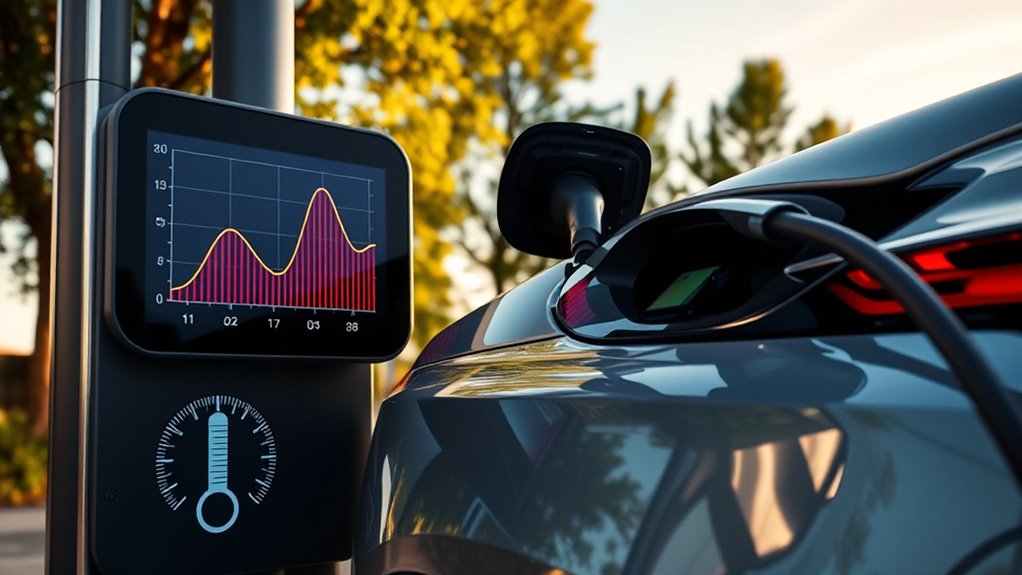
Battery temperature plays a major role in fast charging. Lithium-ion batteries work best within a controlled temperature window. If the pack is too cold, chemical reactions slow down and internal resistance rises. If the pack is too hot, the car may reduce power to protect the cells.
Cold weather is one of the most common reasons for poor fast-charging speed. You may plug into a high-power charger and still see low kW until the battery warms. This does not always mean the charger is broken.
Pro Tip: On a road trip, use your EV’s built-in navigation to route to a fast charger when possible. Many EVs start battery preconditioning only when the charger is selected as a destination.
Hot weather can also affect the curve. If the battery, charging cable, or charger hardware gets too hot, the system may throttle power. This is normal safety behavior, not always a fault.
Avoid Sitting at 100% Too Often
Most EV owners do not need to charge to 100% every day. The issue is not that your EV will casually “overcharge” like an unprotected battery. Modern EVs are designed to manage charging. The better concern is battery stress from regularly sitting at a very high state of charge, especially in hot conditions.
Tesla’s battery-care guidance, for example, says the charge rate can decrease when the battery is too cold, nearly full, or affected by age and usage. It also advises avoiding leaving the battery near 0% or 100% for long periods when possible.
Daily Charging
For daily use, many drivers set a charge limit around 70% to 90%, depending on the vehicle and commute. If your daily driving is short, staying below 100% can reduce time spent at high SoC and still leave plenty of range.
When 100% Makes Sense
Charging to 100% is fine when you need the range. Use it before a long trip, before driving through a charging desert, or when your owner’s manual recommends it for your battery type. The key is to avoid letting the car sit full for a long time. Try to finish charging close to departure.
Warning: Never open, modify, or service an EV high-voltage battery yourself. High-voltage components can be dangerous. Use the vehicle app, dashboard warnings, owner’s manual, and a qualified technician for battery or charging faults.
Tips for Maximizing Your Charging Efficiency
You can use the charging curve to spend less time waiting and more time driving. These habits help most EV drivers:
- Arrive at a DC fast charger with a lower SoC: Starting around 10% to 30% often gives better fast-charging speed than starting at 60%.
- Leave when charging tapers: If the power drops hard after 75% to 85%, it may be faster to drive to the next charger than wait for 100%.
- Precondition the battery: Use the car’s navigation system to prepare the pack before a fast-charging stop.
- Use the right charger: Do not block a 350 kW charger if your EV can only accept 50 kW and a lower-power stall is available.
- Check station reliability: A working 150 kW charger can be better than a crowded or throttled 350 kW site.
- Charge at home when possible: AC Level 2 charging is slower, but it is convenient and usually gentler for daily charging.
How Charger Type Affects Charging Speed
Charging speed depends heavily on the type of charger you use. For most EV drivers, the three practical categories are Level 1, Level 2, and DC fast charging.
| Charger Type | Typical Use | What to Expect |
| AC Level 1 | Standard 120-volt outlet | Slow charging, useful for emergencies, plug-in hybrids, or short daily driving. |
| AC Level 2 | Home, workplace, hotels, public parking | Best everyday option for most EV owners because it can often refill the car overnight. |
| DC Fast Charging | Highway stops and quick public top-ups | Fastest option, but speed depends on the EV’s curve, charger output, temperature, and SoC. |
Connector type can also matter. In North America, DC fast charging commonly involves CCS, CHAdeMO on some older vehicles, and SAE J3400/NACS. Adapters and access rules vary by automaker and charging network, so check your vehicle’s app before a trip.
Debunking Common Myths About EV Charging Curves
EV charging is easier to understand when you separate the charger rating from the car’s actual charging curve. These myths cause many slow-stop surprises.
Myth 1: A 350 kW Charger Always Charges at 350 kW
A 350 kW charger only means the station can offer up to that power under the right conditions. Your EV may be limited to 50 kW, 100 kW, 150 kW, 230 kW, or another number. Even if your EV has a high peak rate, it may only hold that rate for part of the session.
Myth 2: Charging Speed Is Linear
Charging speed is not linear. Adding 20% to 40% may be much faster than adding 80% to 100%. That is the entire point of the charging curve: speed changes as the battery fills.
Myth 3: 100% Is Always Best
A full battery feels reassuring, but it is not always the best use of time at a public fast charger. If you have enough range to reach your next stop, leaving around 80% can be faster and more considerate.
Myth 4: Fast Charging Is Always Bad
Fast charging is a normal feature of modern EVs. The problem is not occasional DC fast charging. The bigger concerns are heat, repeated high-power charging under poor conditions, and leaving the battery near very high or very low charge for long periods. Follow your owner’s manual for your specific vehicle.
Frequently Asked Questions
What is a charging curve?
A charging curve is the pattern of power your EV accepts during charging. It usually starts with a ramp-up, reaches a stronger charging zone, then tapers as the battery gets closer to full.
Why does EV charging slow down after 80%?
Charging slows after about 80% because cell voltage is higher and the battery has less room to accept energy quickly. The EV reduces current to control heat, protect the cells, and avoid stressing the pack near full charge.
Should I always stop charging at 80%?
No. Stopping around 80% is often efficient for road trips and daily charging, but 100% is useful before a long drive or when your owner’s manual recommends it. The best setting depends on your EV, battery type, route, and daily range needs.
Does a 350 kW charger mean my EV will charge at 350 kW?
No. The charger rating is only the station’s maximum output. Your EV’s battery, software, voltage, temperature, state of charge, and charge-port limits decide the real charging speed.
What charges faster, 1.0 A or 2.4 A?
For a compatible small device, 2.4 A usually charges faster than 1.0 A because it can deliver more current. For EVs, charging is measured in kilowatts, and the vehicle’s onboard systems decide how much power it can accept.
What charges faster, 5V or 2A?
Voltage alone does not tell you charging speed. Power equals volts multiplied by amps. A 5V charger at 2A can deliver 10W, while a different charger may deliver more or less depending on both voltage and current. EV chargers work the same way at much higher power levels.
Is 20W or 45W faster?
For a compatible device, 45W is faster than 20W because it can deliver more power. The same idea applies to EVs, but only if the car can accept that power. A higher-power charger does not override the vehicle’s charging curve.
Conclusion
An EV charging curve helps explain why your car charges quickly at one point and slowly at another. The best fast-charging results usually come from a warm battery, a low-to-mid starting state of charge, a compatible high-power charger, and a plan to leave before the taper wastes too much time.
For daily driving, follow your owner’s manual and use a charge limit that fits your routine. For road trips, think in terms of useful range added, not always a full battery. Once you understand the curve, EV charging becomes less confusing and much easier to plan.
Sources
- Alternative Fuels Data Center: Electric Vehicle Charging Stations — supports charger levels, charging-power ranges, and factors that affect charging time.
- Tesla Model 3 Owner’s Manual: High Voltage Battery Information — supports battery-care guidance, cold-battery limits, high-SOC tapering, and daily charge-limit nuance.
- Approximating CCCV Charging Using SOC-Dependent Tapered Charging Power Constraints — supports tapering at high state of charge and the tradeoff between speed and thermal stress.
- Integrated Optimal Fast Charging and Active Thermal Management of Lithium-Ion Batteries — supports the role of temperature and thermal management in fast charging.
- SAE J3400 Standard — supports current North American Charging System connector context.