In 2004, a taxi driver from Thessaloniki, Greece, handed his 1976 Mercedes-Benz 240D over to the Mercedes-Benz Museum. It was the sort of boxy sedan that once seemed to live outside every European train station. The remarkable part was the mileage: 4.6 million kilometers, enough for more than 100 trips around the planet.
That sounds like an instant victory for European diesel engineering. But the story needs a little honesty. The car had gone through two replacement engines and 11 rebuilds. It was not one untouched engine performing a mechanical miracle. What mattered was that the taxi kept working and kept earning. Mercedes exchanged it for a new diesel C-Class.
Ask someone in the Australian Outback, though, and they will probably point to a Land Cruiser. Ask a diesel enthusiast in Texas, and they will remind you what America can build. Everyone has a favorite, and everyone is a little bit right.
The answer depends on what we mean by “best.” Toughest? Most economical? Smoothest? Most influential? Those are different questions, and they do not all produce the same winner.
Key Takeaways
- Europe wins the passenger-diesel comparison through its combination of efficiency, refinement, and engineering innovation.
- Japan’s strongest diesel reliability reputation comes from older, simpler engines built for demanding conditions.
- The Chevrolet Tahoe Duramax is a standout American family diesel with substantial Italian engineering roots.
- Repeated short trips can cause particulate-filter problems in modern diesels regardless of their country of origin.
Table of Contents
- How I’m Comparing the Best Diesel Cars
- Japan: The Legend of Simple, Tough Diesel Engines
- America: World-Class Truck Diesels, a Messier Car History
- Europe: The Region That Made Diesel a Passenger-Car Habit
- The Diesel Scoreboard: Europe Wins Overall
- Which Diesel Should You Actually Buy?
How I’m Comparing the Best Diesel Cars
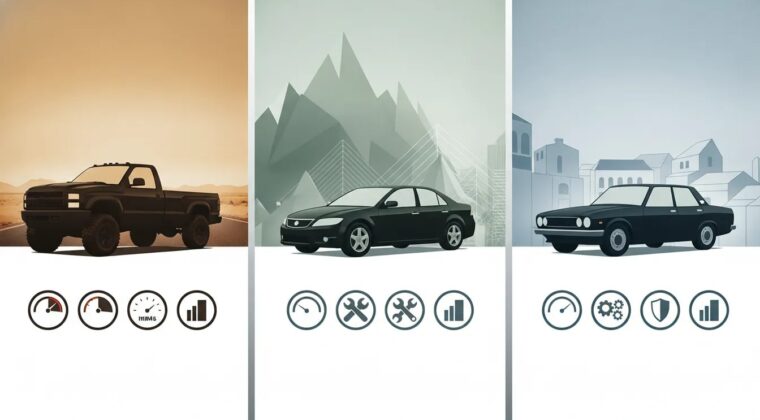
There is one important boundary here: this comparison is about hatchbacks, sedans, and family SUVs, not tractors or heavy-duty pickups. American truck diesels deserve their own contest. Including them would change the argument considerably.
I’m scoring Japan, America, and Europe out of 10 in four categories:
- Reliability: How convincingly have these engines proved their durability?
- Efficiency: How far can they travel on the fuel they use?
- Refinement: How quiet, smooth, and pleasant are they in an everyday passenger vehicle?
- Innovation: How much have they advanced diesel engineering?
That makes 40 points available. These are my judgments across each region’s passenger-diesel history, not a scientific prediction of how any particular used car will behave. A neglected example of a famous engine is still a neglected car.
Japan: The Legend of Simple, Tough Diesel Engines
Toyota’s 1HZ is the foundation of the reputation
Japan’s diesel reputation rests on several engines, but the Toyota 1HZ is the one that best explains it. Introduced in 1990, it is a 4.2-liter straight-six with mechanical fuel injection, no turbocharger, and roughly 130 horsepower.
Nothing about that specification is glamorous. That is rather the point.
The 1HZ continued to serve in new Land Cruiser 70 models for markets with poor-quality fuel and less restrictive emissions rules, including vehicles supplied to the United Nations and aid organizations. When people heading into disaster zones choose your engine, that is a stronger endorsement than a shiny brochure.
Toyota’s broader reputation for tough vehicles had already been reinforced in harsh conditions. During the 1987 conflict between Chad and Libya, Chadian forces used Toyota pickups to outmaneuver Libyan armor in the Sahara. The conflict became known as the Toyota War. That predates the 1HZ, but it helps explain why the Toyota name carries such weight in remote places.
Add Toyota’s turbocharged 1HD-T, Nissan’s TD42, and the later D-4D engines used in the Hilux, Fortuner, and Prado, and you have a diesel tradition that earned serious trust across Africa, Australia, and the Middle East.
Why Japan chose hybrids over small diesel cars
Here is the surprise: Japan never embraced small diesel passenger cars the way Europe did.
In 1999, Tokyo’s governor launched an anti-diesel campaign, even displaying diesel soot in a clear bottle to make the pollution problem tangible. Tougher rules followed, and enthusiasm for diesel cars collapsed.
Toyota had already launched the Prius in 1997. Japan’s major fuel-saving bet increasingly went toward hybrids rather than diesel hatchbacks and sedans. That was a strategic choice, not proof that Japanese engineers could not build an excellent small diesel.
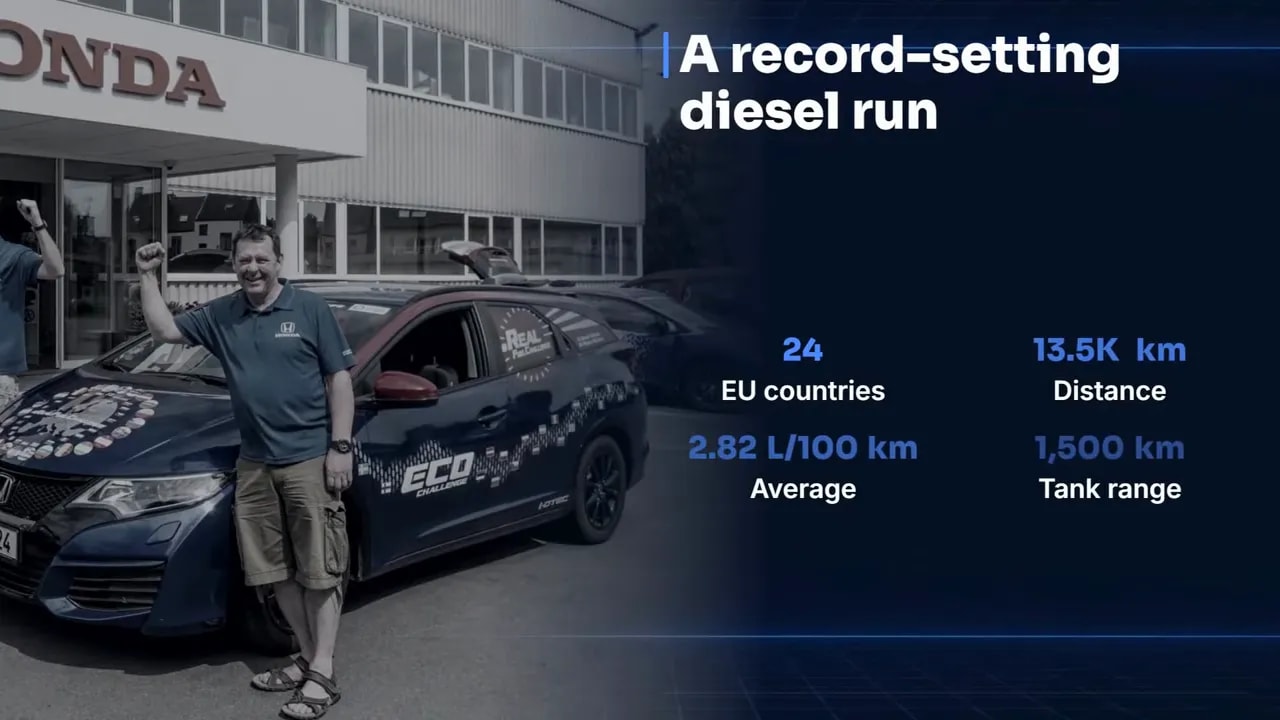
Honda demonstrated that rather spectacularly in 2015. Two engineers drove a Civic Tourer with a 1.6-liter diesel through all 24 EU countries connected by road, covering about 13,500 kilometers. Average consumption was just 2.82 liters per 100 kilometers, with roughly 1,500 kilometers available from a tank. The run earned a Guinness World Record.
Subaru took a different route, developing the first boxer diesel for a passenger car. Mazda went further into unconventional engineering with Skyactiv-D.
Mazda’s clever diesel engineering has a catch
Mazda’s Skyactiv-D used a compression ratio of just 14:1, exceptionally low for a mass-production diesel. That approach allowed it to meet Euro 6 requirements without the expensive nitrogen oxide treatment used by competitors.
The idea found an audience. In 2012, around 80% of Japanese buyers ordering a CX-5 or Mazda 6 chose diesel.
But clever engineering on paper does not always make ownership straightforward. Some owners whose driving consisted mainly of short trips experienced diesel fuel diluting the engine oil. The engine could be impressively efficient, but its suitability depended on how it was used.
That is the uncomfortable distinction in Japan’s diesel story: the newer engines are faster and cleaner, but they are not simply modern versions of the old 1HZ.
In 2022, an Australian court found that more than 260,000 diesel Hilux, Fortuner, and Prado vehicles sold between 2015 and 2020 had defective diesel particulate filter systems. The court’s finding at that stage included a 17.5% reduction in vehicle value.
Japan’s durability legend was built by older, simpler engines. Newer designs have to establish their own record rather than borrow it.
There are promising developments. Mazda’s newer 3.3-liter straight-six diesel produces around 250 horsepower and carries an official consumption rating of about 5.3 liters per 100 kilometers in a roughly two-ton SUV. That is a compelling combination of size, performance, and economy.
Japan’s diesel story is not finished. But its strongest claim remains old-fashioned toughness rather than complete dominance of the passenger-car market.
America: World-Class Truck Diesels, a Messier Car History
Let’s give America its due before criticizing it. Cummins engines, Ford’s 7.3-liter diesel, and the Duramax V8 are serious achievements. If towing were the main criterion, America would be fighting for first place.
Passenger cars are a different story.
The Oldsmobile shortcut that damaged diesel’s reputation
In 1978, with fuel prices creating pressure for more economical vehicles, Oldsmobile introduced its 5.7-liter diesel V8 based on its gasoline-engine architecture.
The trouble was in the compromises. To save on tooling, it retained the gasoline engine’s 10-bolt cylinder-head pattern despite operating at close to three times the compression. It also lacked a water separator, an important safeguard for a diesel fuel system.
The consequences were ugly: failed head gaskets, injection-pump damage from water-contaminated fuel, and dead engines.
GM installed the diesel across 29 models, reaching customers buying everything from Chevrolets to Cadillacs. Later improvements could not easily undo the first impression. A generation of Americans came away believing diesel cars were noisy, smoky, and unreliable.
Given what many of them had been sold, that was not an unreasonable conclusion.
American badges often hid imported diesel expertise
Other American manufacturers frequently sourced passenger-diesel engines from elsewhere:
- Ford Escort and Tempo: Mazda supplied their diesel engines.
- 1984 Lincoln Continental: Ford used a BMW turbodiesel.
- Chevrolet Chevette: Its diesel came from Isuzu.
- Duramax V8: It was developed through a joint venture with Isuzu.
- Jeep Grand Cherokee EcoDiesel: Its V6 was built by Italy’s VM Motori.
By 2015, Volkswagen, Audi, and Porsche together accounted for roughly three-quarters of the American diesel car and SUV market. America had diesel customers, but much of the passenger-car expertise serving them came from abroad.
The Chevrolet Tahoe Duramax is genuinely excellent
My pick for the best diesel family vehicle America has sold is the Chevrolet Tahoe with the 3.0-liter Duramax straight-six.
In its 2026 form, it produces 305 horsepower and more torque than the large 6.2-liter gasoline V8. The rear-wheel-drive version offers an EPA-rated highway range of up to 624 miles per tank, approximately 1,000 kilometers.
That is a three-row family SUV capable of covering serious distance between fill-ups. No excuses needed. It is a genuinely impressive engine.
There is, however, an awkward detail for a national engineering contest: it was engineered in Turin, Italy. Much of the development and calibration took place at GM’s diesel center there, established partly through collaboration with Fiat. The engine is built in Michigan, but much of its diesel know-how came from Italy.
An American family SUV with an Italian accent. Excellent vehicle, complicated passport.
Europe: The Region That Made Diesel a Passenger-Car Habit
Diesel became the default choice for millions
Europe did not merely offer diesel cars. For about two decades, it was hooked on them.
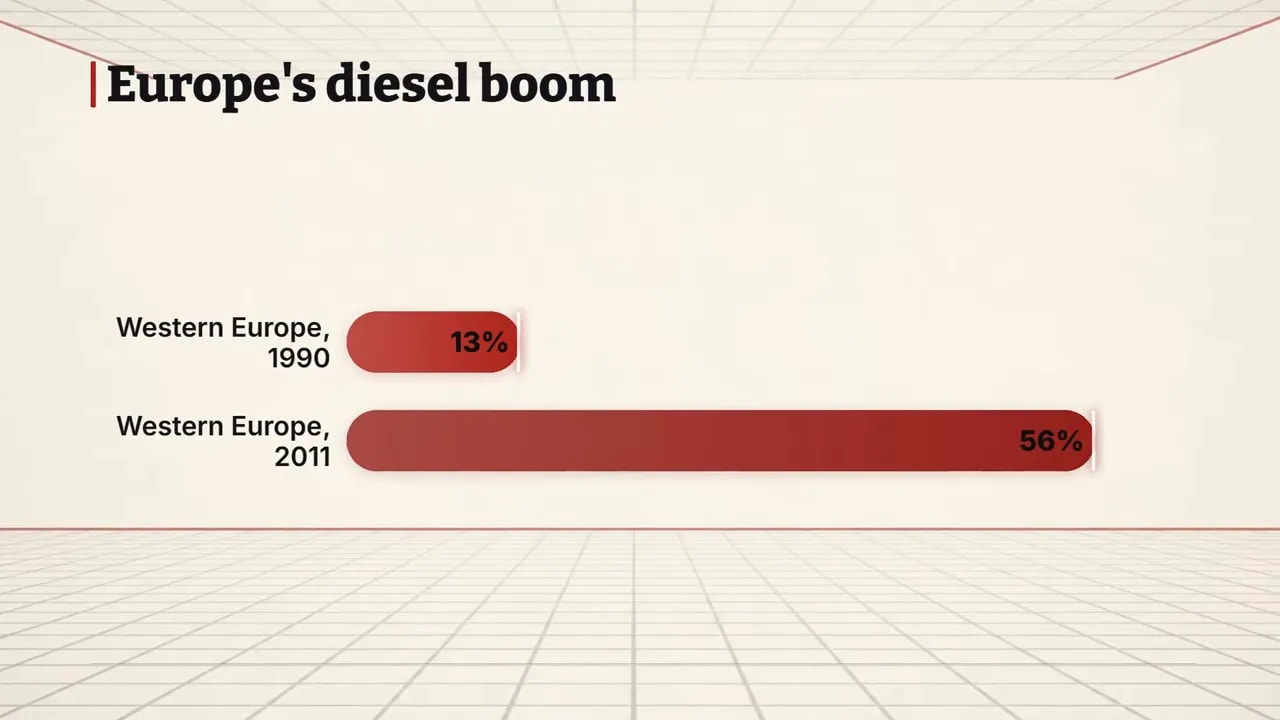
Diesel represented around 13% of new-car sales in Western Europe in 1990. By 2011, that figure had risen to roughly 56%. In France, Belgium, and Spain, the share exceeded 70%.
The reasons were practical. Fuel was expensive, diesel was often taxed less heavily, and long motorway journeys suited diesel economy. European manufacturers consequently invested in diesels specifically for ordinary passenger cars.
The old Mercedes diesel taxis, including the OM617-powered cars that helped establish the brand’s reputation, were part of that foundation. Then Volkswagen and Audi made the economical diesel an even more familiar everyday choice.
The 1.9 TDI became an everyday legend
In the early 1990s, Audi and Volkswagen brought a turbocharged, direct-injection 1.9-liter diesel to the Audi 80 and then the Golf. With around 90 horsepower and consumption near 5 liters per 100 kilometers, it offered a persuasive balance of usable performance and economy.
The 1.9 TDI went on to power millions of Golfs, Passats, Škodas, and Audis. More than three decades later, enthusiasts still mention it whenever diesel durability comes up.
If your answer to every diesel question is “1.9 TDI,” yes, I know. There is a reason it keeps coming up.
Common rail changed modern diesel engineering
The bigger technological turning point came from Italy.
Fiat’s engineers developed a system that kept diesel fuel under very high pressure in a shared rail. Electronically controlled injectors could then deliver fuel into each cylinder with precise timing.
Bosch industrialized the technology, and in 1997 the Alfa Romeo 156 JTD became the first passenger car customers could buy with common-rail injection.
The important change was control. Rather than accepting the noise and roughness traditionally associated with diesel, engineers could manage fuel delivery much more precisely. Common rail helped make diesel engines quieter, smoother, and stronger.
It became central to modern diesel design, including Japanese and American engines. That is why Europe scores so strongly for innovation: its contribution did not stop at European badges.
The technology also helped make small diesels genuinely good. Renault’s 1.5 dCi appeared in Clios, Dacias, Nissans, and even the Mercedes A-Class. Peugeot’s HDi engines served Fords, Volvos, and Minis. Volvo’s five-cylinder D5 deserves its place among the memorable European diesels, too.
Then Europe made diesel fast
Economy was only part of the story. European manufacturers also showed that diesel could deliver serious performance.
From 2006 through 2014, diesel-powered cars won the Le Mans 24 Hours nine times in succession, with Audi and Peugeot helping demonstrate what the fuel could do in endurance racing.
On the road, BMW’s quad-turbo M550d pushed the idea to an almost absurd conclusion. Its 3.0-liter straight-six used four turbochargers, produced 400 horsepower, and accelerated from 0 to 100 km/h in 4.4 seconds.
At the time, four turbochargers were the sort of detail associated with a Bugatti. BMW put them in a diesel family sedan, with more torque than the previous M5.
That is a long way from a rattling taxi outside a railway station.
Complexity and Dieselgate spoiled the success story
Europe’s diesel achievements came with increasingly expensive machinery attached. Particulate filters, EGR valves, dual-mass flywheels, and AdBlue systems made modern diesels more complicated to own as they aged.
Brilliant when everything works. Potentially expensive when it does not.
Then came September 18, 2015. The US Environmental Protection Agency announced that Volkswagen had used software to cheat emissions tests. Its Volkswagen enforcement information provides the official background to the case.
Around 11 million vehicles worldwide were affected by software that changed emissions behavior during testing. And no, this was not the old 1.9 TDI. It involved the engine family that replaced it.
By 2018, the scandal had already cost Volkswagen more than €27 billion. The damage extended beyond one manufacturer’s finances: it undermined confidence in diesel itself.
By 2025, diesel accounted for less than 9% of new-car sales in the European Union. Europe’s diesel era did not simply drift out of fashion. It suffered a spectacular collapse.
The Diesel Scoreboard: Europe Wins Overall
With the passenger-car boundary firmly in place, here is my final scoring:
| Region | Reliability | Efficiency | Refinement | Innovation | Total |
|---|---|---|---|---|---|
| Japan | 9 | 8 | 7 | 7 | 31/40 |
| America | 5 | 7 | 7 | 4 | 23/40 |
| Europe | 7 | 9 | 10 | 10 | 36/40 |
Japan leads on reliability. Its older, simpler engines are the toughest group here, but newer diesel problems cost it a perfect score. Its efficiency is strong, while its refinement and diesel innovation trail Europe. Toyota’s major investment in hybrids helps explain that last point.
America finishes third in this particular contest. The Oldsmobile experience weighs heavily on its passenger-diesel reliability history. The Tahoe earns respect for efficiency and refinement, but relying on overseas engineering reduces America’s innovation score.
Europe wins with 36 points. Its durability legends are real, even if modern examples can become costly to maintain. Its combination of economy, refinement, and technological influence is the strongest overall.
I went into this half expecting Japan to win. But once the question becomes “Who built the best diesel passenger cars?” rather than “Which old diesel survives the harshest conditions?”, Europe takes it.
Which Diesel Should You Actually Buy?
A regional victory does not automatically tell you which engine belongs in your driveway. Your use matters more than the scoreboard.
- For a hatchback or sedan covering substantial distance: A well-maintained European diesel can still offer excellent value, economy, and refinement.
- For an SUV facing rough roads and difficult fuel conditions: Japan’s older, simpler diesel designs make the strongest durability case.
- For a large American family SUV with long-distance range: The Duramax-powered Tahoe is an excellent option, Italian engineering roots included.
The word “well-maintained” is doing important work here. Neither an impressive engine code nor a national reputation cancels the consequences of poor maintenance.
Short trips are the warning that matters most
Modern diesels from every region can struggle with repeated short trips. This is not a German problem, a Japanese problem, or an American problem.
The diesel particulate filter captures soot and needs suitable heat to burn it off through regeneration. If most journeys are ten minutes to the shops, the exhaust system may not reach the conditions needed to complete that cleaning process.
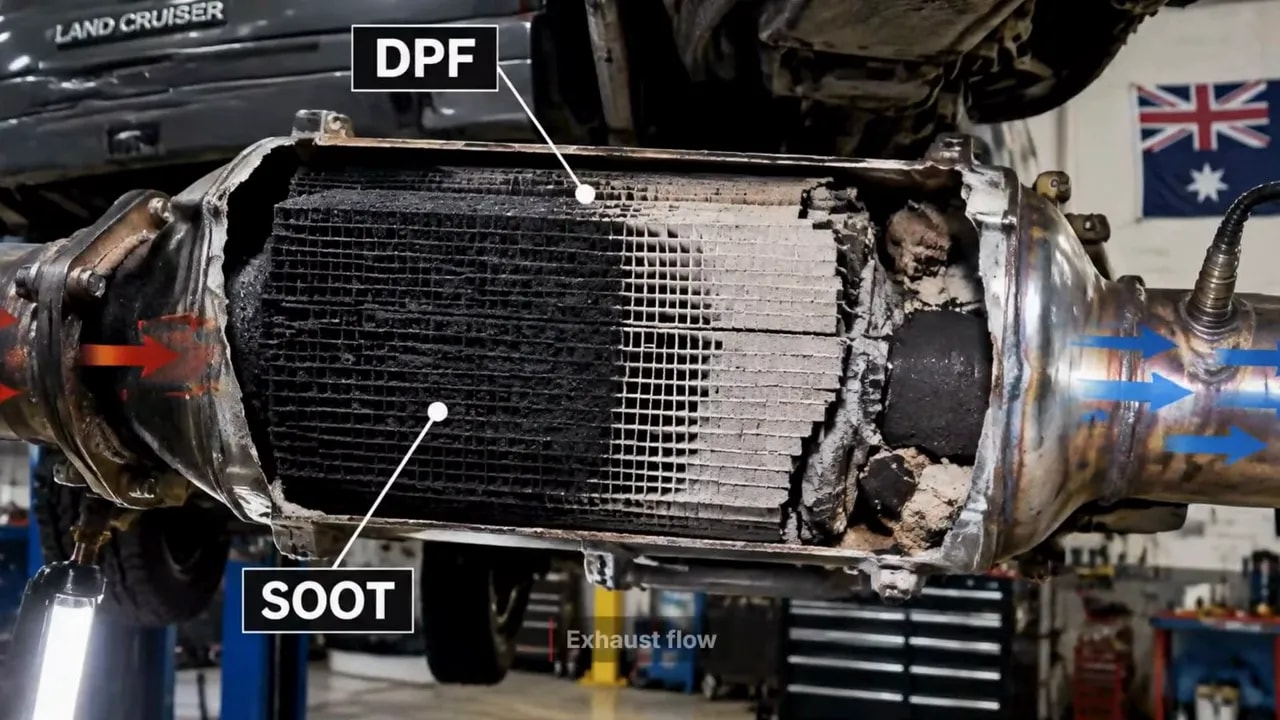
That is how a cheap used diesel can become an expensive ownership mistake. The RAC’s guide to diesel particulate filters offers useful background on regeneration and the problems associated with short journeys.
Regular proper highway driving suits a modern diesel much better than a life of brief cold runs. If short local trips make up most of your driving, a gasoline car or hybrid is often the more sensible choice.
Europe wins the overall passenger-diesel contest. Japan has the strongest old-school toughness claim. America offers a standout long-range family SUV. But the best diesel for you is the one that fits the work you will actually ask it to do.