
Quick answer: You cannot guarantee that any three habits will double a diesel engine’s life, but three maintenance practices can reduce avoidable wear: keep the fuel system clean, use the exact oil and filter specification required by the manufacturer, and avoid a driving pattern made up only of short, cold trips. For DPF-equipped diesels, follow the vehicle’s own regeneration instructions.
Diesel engines can deliver very high mileage when the engine, fuel system, lubrication system, and emissions equipment are maintained correctly. Contamination, neglected servicing, unsuitable fluids, and repeated incomplete warm-up cycles can all shorten component life.
The three habits that matter here are straightforward: keep the fuel clean, keep the oil correct and clean, and give the engine enough fully warmed operation for its design and emissions system. These practices can reduce preventable failures and improve the odds of long service life.
Engine life still varies widely by design, duty cycle, climate, load, maintenance history, and previous damage. Treat the advice below as general diesel-maintenance guidance, with your owner’s manual or manufacturer service information taking priority for specifications, intervals, warning lights, and regeneration procedures.
Key Takeaways
- Clean fuel and timely fuel-filter service help protect precision injectors and high-pressure fuel-system components from water and dirt.
- Use the exact manufacturer-specified engine oil and filter; do not rely on a generic mileage interval that may not fit your diesel.
- Repeated short trips can interfere with DPF regeneration on equipped vehicles, so follow the model-specific instructions for sustained driving or regeneration.
- For most modern road vehicles, prolonged cold-start idling is unnecessary; drive gently while the engine warms unless the manual says otherwise.
- A warning light, loss of power, rising oil level, or repeated failed regenerations calls for diagnosis rather than a harder drive.
Table of Contents
- 1. Clean Fuel: Protect the Injectors and High-Pressure Pump
- 2. Clean Oil: Use the Right Specification and Change It on Time
- 3. Give Your Diesel a Proper Run, Not Just Short Trips
- Bonus: Warm Up by Driving Gently, Not Idling for Ages
- The Diesel Longevity Routine That Matters
1. Clean Fuel: Protect the Injectors and High-Pressure Pump
Modern common-rail diesel fuel systems work at extremely high pressure. Bosch lists current common-rail systems operating at up to 2,500 bar and some piezo-injector systems at up to 2,700 bar. That level of precision makes clean fuel especially important.
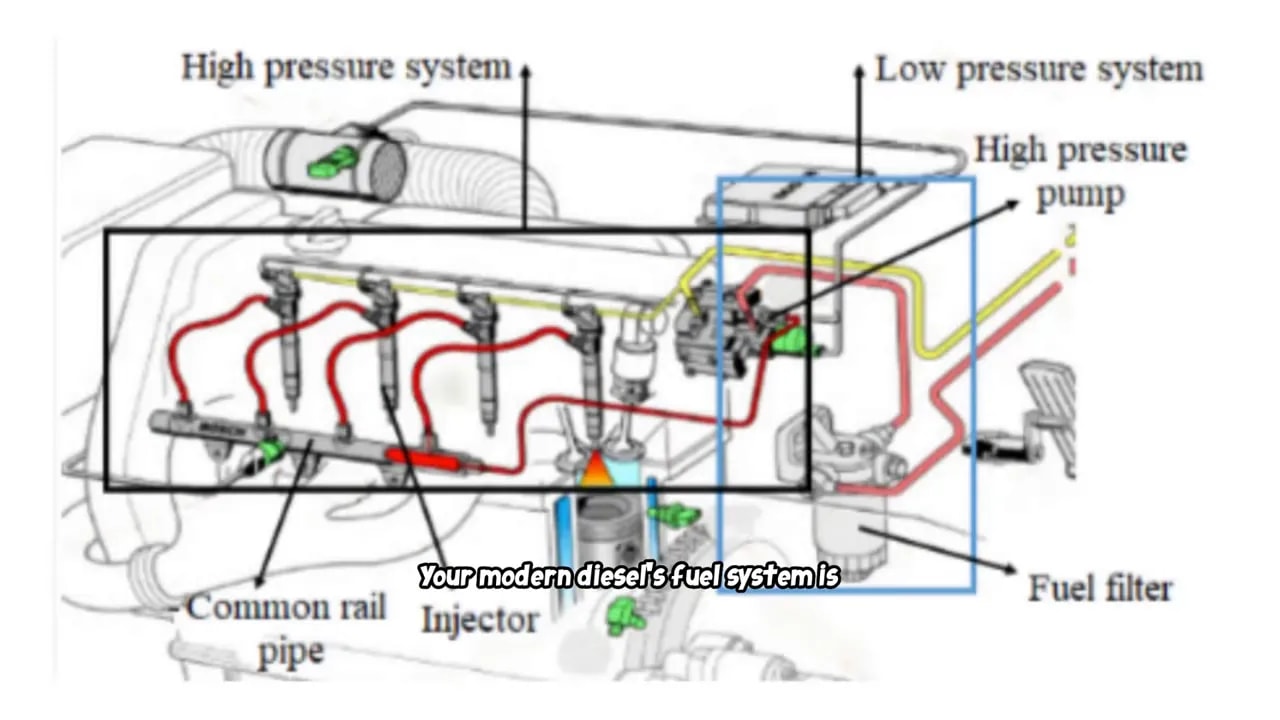
The two contaminants to watch most closely are water and dirt. Diesel injection systems have tight tolerances, and contamination can damage pumps and injectors or shorten their service life.
Why water does so much damage
In many diesel fuel systems, the fuel also contributes to lubrication of fuel-system components. Water can interfere with that lubrication and promote corrosion, although the exact pump design varies by engine.
Water in stored diesel can also support microbial growth, especially where fuel sits for long periods. The resulting material can contribute to filter blockage and fuel-quality problems. Keeping water out of the system is therefore more than a cleanliness issue; it helps protect expensive fuel-system components.

Why fine dirt is just as dangerous
Fine particles can act as abrasive contamination inside components built to close tolerances. Over time, this can contribute to injector wear, poor spray patterns, pressure-control problems, and pump damage.
Some high-pressure pump failures can also spread debris through other parts of the fuel system. The exact repair scope depends on the engine and failure mode, so a suspected pump failure should be diagnosed using the manufacturer’s service procedure rather than by replacing parts on guesswork.
The fuel-care routine worth following
- Replace the fuel filter on schedule. Use the filter specification and service interval listed for your engine, especially if the vehicle has a water-separating filter.
- Drain the water separator if your vehicle requires it. Follow the manufacturer’s procedure, warning indicators, and inspection interval.
- Buy fuel from reputable, well-maintained stations. No retailer can eliminate every contamination risk, but good fuel handling and storage practices matter.
- Do not intentionally run the engine out of fuel. Some fuel systems can be difficult to reprime after running dry, and the correct refueling guidance varies by vehicle.
- Use additives only when approved or appropriate. Do not assume a lubricity, injector-cleaning, water-control, or anti-gel additive is suitable for every diesel or every fuel standard.
No additive replaces a correct fuel filter, proper maintenance, or good-quality fuel. Start with the manufacturer’s requirements before adding anything to the tank.
Cold winters need an extra precaution
At sufficiently low temperatures, paraffin wax in conventional diesel can crystallize and restrict fuel flow through a filter. Winter-grade diesel and approved cold-flow treatments are designed to improve low-temperature operability.
If you operate in severe cold, use the fuel grade and cold-weather procedure specified for your region and vehicle. Additives should be compatible with the engine and fuel standard, and they work best as prevention rather than as a cure for an already plugged filter.
2. Clean Oil: Use the Right Specification and Change It on Time
Diesel engine oil works under demanding conditions that can include high cylinder pressure, heat, soot loading, fuel dilution, and contamination from combustion by-products. Its job is not only to lubricate moving parts but also to manage deposits and protect emissions-system compatibility where required.
Two costly mistakes are common: using oil that does not meet the engine’s required specification and keeping oil in service beyond the interval that applies to the vehicle’s actual use.
Black oil is not the whole story
Diesel engine oil can darken quickly because detergents and dispersants hold combustion by-products and particles in suspension. Dark color by itself does not tell you whether the oil has reached the end of its service life.
The important questions are whether the oil meets the required specification, whether the level is correct, and whether the oil is still within the manufacturer’s time, mileage, engine-hour, or oil-life-monitor interval.
Buy by specification, not guesswork
Diesel oils use additive systems that can help control soot, deposits, oxidation, wear, and other stresses. On DPF-equipped vehicles, the required formulation may also be important to aftertreatment durability.
Use the exact viscosity and performance specification called for by the manufacturer. A bottle labeled “diesel” is not automatically correct for every diesel engine, and API categories are not always interchangeable.
The American Petroleum Institute’s engine oil resources provide useful background on oil classifications and labeling. Your vehicle’s manual remains the deciding reference for what to buy.
Oil life depends on use, not a universal mileage number
There is no single oil-change interval that is correct for every diesel. Some manufacturers use fixed mileage and time limits, some provide separate severe-service schedules, and others use an oil-life monitoring system.
Short trips, heavy towing, prolonged idling, dusty operation, very cold use, or other severe duty can change the applicable maintenance schedule. Follow the schedule written for your engine and duty cycle instead of applying a generic 5,000- or 7,500-mile rule.
Fuel dilution can also occur in some operating conditions, including repeated interrupted regeneration on certain DPF-equipped diesels. If the oil level rises unexpectedly, the oil smells strongly of fuel, or the vehicle reports an oil or regeneration fault, use the manufacturer’s diagnostic guidance rather than simply extending the next drive.
The turbocharger depends on that same oil
Most turbocharged diesels rely on engine oil to lubricate the turbocharger bearings, so incorrect, degraded, contaminated, or insufficient oil can affect both the engine and turbocharger.
Turbocharger speeds and thermal loads vary widely by design. The practical maintenance point is simple: correct oil, correct oil level, and correct service intervals matter to the turbo as well as the rest of the engine.
After prolonged high-load operation, some engines or applications call for a short cool-down period before shutdown, while many modern vehicles do not require extra idling after normal driving. Follow the vehicle or engine manufacturer’s instructions instead of using one cool-down rule for every turbo diesel.
Do not overlook the filter or oil level
Fresh oil should be paired with the filter type and service procedure specified for the engine. The oil level also needs regular checks, especially between services or before towing and long trips.
- Match both oil and filter to the manufacturer’s requirements.
- Check the oil level as instructed. Investigate an unexplained drop or rise rather than continually correcting it without finding the cause.
- Do not overfill. Keep the level within the prescribed range and use the correct checking procedure.
- Use the severe-service schedule when your operating conditions meet its definition.
The goal is straightforward: the specified oil, the specified filter, the correct level, and the correct service interval for how the diesel is actually used.
3. Give Your Diesel a Proper Run, Not Just Short Trips
Repeated short journeys can be difficult for a modern diesel, particularly one equipped with a diesel particulate filter. The engine and exhaust may be shut down before they stay warm long enough for normal aftertreatment operation.
Short-trip use can also mean more cold starts and fewer long periods at stable operating temperature. The effect varies by engine, but for a DPF-equipped vehicle the most important concern is that regeneration may be interrupted or may not get the conditions it needs.
Why the DPF needs the right operating conditions
The DPF traps soot from the exhaust. Regeneration is the process used to oxidize accumulated soot when the system reaches the required operating conditions.

The required speed, engine load, RPM, temperature, and duration differ by manufacturer and model. Some guidance calls for roughly 20 to 30 minutes or more of suitable driving, while other vehicles use different conditions. A generic “30 to 45 minutes” rule should not replace the instructions in your manual or the message shown by the vehicle.
If regeneration is repeatedly interrupted, soot loading can rise. Depending on the vehicle, that may lead to a warning message, reduced power, a service regeneration, cleaning, or repair.
The RAC’s guide to diesel particulate filters offers additional background on regeneration and the problems associated with short journeys.
If a DPF message tells you to continue driving, follow the model-specific procedure when road and traffic conditions make it safe. Do not assume every DPF, engine, or emissions warning means “drive it harder.” Some warnings require service instead.
How to give a DPF-equipped diesel a useful longer run
If most trips are short, plan enough longer driving to let the engine reach normal operating temperature and to give the aftertreatment system the conditions specified by the manufacturer. Do not create an arbitrary weekly schedule if your vehicle does not need one; respond to its operating pattern, handbook guidance, and warning messages.
- Warm it through normal, gentle driving. Avoid heavy throttle while the engine is still cold.
- Choose a route that permits steady driving. The goal is sustained operation, not aggressive acceleration.
- Follow the prescribed speed or RPM guidance. If the manual gives a regeneration procedure, use that procedure rather than an internet rule of thumb.
- Stay within road laws and engine limits. A regeneration drive never justifies unsafe speed or excessive RPM.
- Allow an active regeneration to finish when practical and instructed. If warning lights escalate or power is reduced, consult the manual and seek service as required.
What an “Italian tune-up” should and should not mean
The phrase Italian tune-up is commonly used for running a fully warmed engine under higher load than it normally sees. For a modern diesel, the useful idea is sustained operation at the conditions the engine and aftertreatment system are designed to use.
It is not permission to abuse a cold engine, rev the engine hard while stationary, or ignore a fault. A blocked DPF, failed sensor, injector fault, boost problem, or other mechanical issue needs diagnosis.
A properly warmed, sustained drive may help a healthy DPF complete regeneration when the vehicle’s control system permits it. It is not a guaranteed cure for carbon buildup or a substitute for maintenance.
Know when driving is not the fix
Stop relying on a regeneration drive and check the owner’s manual or arrange diagnosis if the vehicle shows a red or escalating warning, enters reduced-power mode, repeatedly fails to complete regeneration, develops abnormal smoke or noises, or shows an unexplained rise in engine-oil level.
If nearly all of your trips are short urban journeys, consider whether a DPF-equipped diesel suits your normal use. That does not mean every short trip damages the engine, but a vehicle that rarely reaches the conditions required for its emissions system may need more attention than one used regularly for longer journeys.
Bonus: Warm Up by Driving Gently, Not Idling for Ages
For most modern road vehicles, prolonged idling is not the preferred cold-start warm-up method. A diesel generally warms more effectively once it is being driven, and unnecessary idling wastes fuel.
Start the engine according to the vehicle’s cold-start procedure, give it only the settling time the manufacturer recommends, and then drive gently while the engine and fluids warm. In severe cold, or with commercial and heavy-duty engines, the required warm-up procedure may be different.
That is separate from turbocharger cool-down after prolonged high-load operation. Some engine manufacturers specify a brief idle after heavy work, while normal road driving may already provide enough lower-load time before parking. Follow the instructions for your engine rather than applying a fixed idle time to every diesel.
The Diesel Longevity Routine That Matters
Long diesel life comes from consistent maintenance, not a single trick. The three habits in this guide are useful because they protect systems that are expensive when neglected.
| Habit | What it protects | Best practice |
|---|---|---|
| Clean fuel | Injectors, pumps, filters | Use reputable fuel, service the filter, and manage water as the manufacturer specifies. |
| Correct, clean oil | Bearings, turbocharger, valvetrain, aftertreatment compatibility | Use the exact oil and filter specification and the correct service schedule. |
| Suitable driving pattern | DPF and overall warm-operation cycle | Let the engine reach operating temperature and follow model-specific regeneration guidance. |
These habits work together. Correct oil cannot protect a fuel system full of contamination, and a new fuel filter cannot solve a DPF that repeatedly fails to regenerate because of a fault or unsuitable operating conditions.
The goal is simple: prevent avoidable contamination, lubrication problems, and interrupted aftertreatment operation from turning into expensive failures. Maintain the engine by specification, pay attention to warning messages, and use the vehicle in a way that matches its design.