Testing an AC EV charger safely requires a tool that matches the connector and the checks you need to perform. This guide compares two connector-specific EVSE test adapters: one for IEC Type 2 AC charging stations and one for SAE J1772 Level 1 and Level 2 equipment. Both are aimed at troubleshooting and commissioning work, not casual battery checks.
Affiliate disclosure: This article contains Amazon affiliate links. If you buy through a link, the publisher may earn a commission at no extra cost to you.
Safety note: EVSE testing can involve hazardous mains voltage. Use these tools only within their documented ratings and procedures. Live electrical work should be performed by a qualified electrician or EV charging technician using suitable personal protective equipment and test instruments.
A signal-simulation adapter is not automatically a high-current load tester. Confirm the current manual before connecting, measuring, or changing any test lead.
Top Picks
|
Category |
Product |
Best For |
|---|---|---|
|
🎯 Best for Type 2 AC |
Vehicle-state simulation and phase checks on compatible Type 2 AC stations |
|
|
🏆 Best for SAE J1772 |
Professional field and shop checks on compatible Level 1 and Level 2 EVSE |
Quick Verdict
Choose by connector first. The Denash Adapter is the more relevant option for compatible IEC Type 2 AC charging equipment. The EVSE 3840 is the better fit when your work centers on compatible SAE J1772 Level 1 and Level 2 chargers.
Neither tool should be treated as universally compatible with NACS, CCS, CHAdeMO, or every EVSE function. Check the current product manual, measurement ranges, included accessories, and supported test procedures before ordering.
How We Chose
You need a tester that fits the charger in front of you, so connector compatibility was the first filter. We then considered the type of diagnostic work each unit is described as supporting, including vehicle-state simulation, control-pilot checks, phase indication, voltage or current observation, and use with external meters.
We also considered field practicality, visible controls, honest limitations, and whether the tool is positioned for trained technicians rather than general vehicle maintenance. We did not use unverified ratings, review counts, prices, or numerical scores to rank the products.
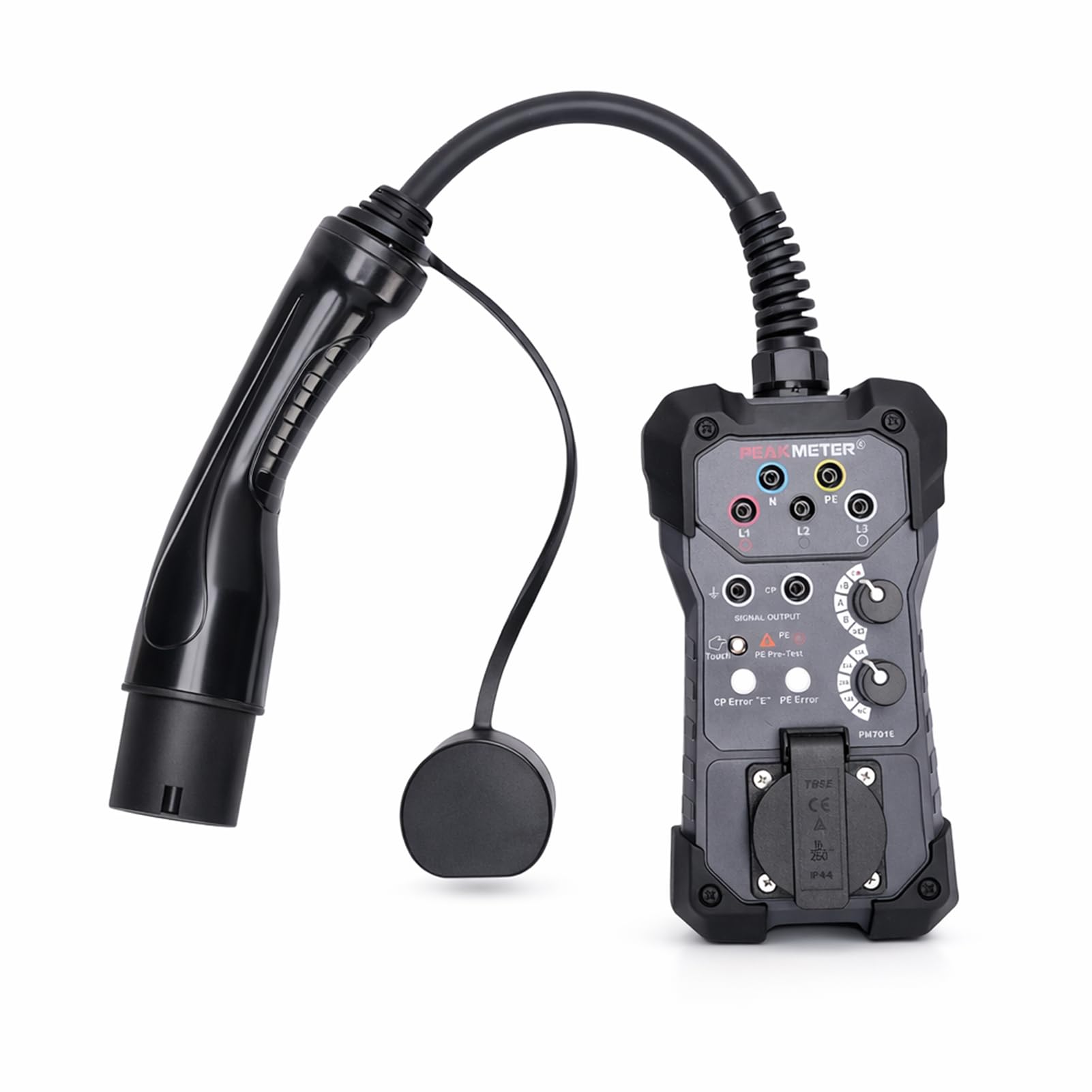
If you work with compatible European-style Type 2 AC stations, this adapter can help you simulate the vehicle side of the charging handshake without bringing a vehicle to every diagnostic job. Its controls are intended to help you step through supported cable and vehicle states while the phase LEDs provide a quick visual check.
The 4 mm connections can be useful when the documented procedure calls for a suitable multimeter or oscilloscope. The main limitation is scope: this type of adapter is primarily for signal, state, and phase checks. Do not assume it can apply or absorb a sustained charging load.
Why You May Like It
- Matches compatible IEC Type 2 AC charging equipment
- Lets you simulate supported vehicle and cable states without using an EV
- Provides visual phase indicators for faster first-pass checks
- Supports connection to compatible external instruments through designated 4 mm sockets
|
Pros |
Cons |
|---|---|
|
✅ Designed around compatible Type 2 AC signaling and connections |
❌ Not a substitute for a properly rated high-current load bank |
|
✅ Phase LEDs make basic supply checks easier to scan |
❌ Requires knowledge of CP, PP, meter setup, and safe live testing |
|
✅ Compact format suits commissioning and field troubleshooting |
❌ Compatibility and measurement limits must be confirmed in the current manual |
Who Should Buy This
Consider it if you are a qualified electrician, charging-station installer, or service technician who regularly works on compatible Type 2 AC EVSE and already owns the required external test instruments.
Who Should Avoid This
Skip it if you need J1772, NACS, CCS, CHAdeMO, DC fast-charging diagnostics, automated certification reports, or a full-power load test. It is also not a suitable beginner tool for anyone unfamiliar with live electrical measurements.
Safety Limits
Use only the sockets, switch positions, ranges, and procedures specified by the manufacturer. An ingress-protection rating does not make wet live work safe. Inspect the adapter and leads before every use, isolate power when the procedure requires it, and never exceed the ratings of the adapter or connected instrument.
Key Benefits
- Helps reproduce supported EV connection states during Type 2 AC troubleshooting
- Combines visual phase indication with access points for compatible meters or scopes
- Reduces the need to use a customer vehicle for every preliminary EVSE check
If your work centers on North American SAE J1772 charging equipment, the EVSE 3840 is the more relevant of these two options. Its product description emphasizes Level 1 and Level 2 EVSE testing, field use, self-powered operation, and current observation through a built-in ammeter.
That makes it a more specialized choice for commissioning, maintenance, or repeatable shop checks. It is not a universal EV charging analyzer, and the source information does not establish support for every fault test, reporting function, connector, or charging protocol.
Why You May Like It
- Connector focus matches compatible SAE J1772 Level 1 and Level 2 EVSE
- Self-powered design may reduce the need for a separate bench supply
- Built-in ammeter supports current observation within the unit’s documented limits
- Professional format suits recurring installation and maintenance work
|
Pros |
Cons |
|---|---|
|
✅ Purpose-built around compatible SAE J1772 AC charging equipment |
❌ More specialized than most homeowners need |
|
✅ Listed as self-powered for field or shop use |
❌ Not automatically compatible with Type 2, NACS, CCS, or DC fast chargers |
|
✅ Includes an ammeter according to the supplied product information |
❌ Exact ranges and supported tests must be confirmed before use |
Who Should Buy This
It is most relevant to qualified electricians, EVSE installers, fleet technicians, and repair professionals who repeatedly work on compatible SAE J1772 Level 1 and Level 2 charging equipment.
Who Should Avoid This
Choose another tool if your main work involves IEC Type 2, NACS, CCS, CHAdeMO, DC fast charging, network or OCPP diagnostics, or automated compliance reports. Casual drivers who only want to check a vehicle’s 12V battery also need a different product category.
Safety Limits
Confirm the ammeter range, duty cycle, maximum voltage, connector condition, and test sequence in the current manual. Do not infer that a professional enclosure makes every live test safe. Follow lockout, isolation, grounding, and personal-protective-equipment procedures required for the installation and jurisdiction.
Key Benefits
- Targets compatible SAE J1772 Level 1 and Level 2 EVSE diagnostics
- Supports field use without relying on an external power supply, as described
- Provides current observation through a built-in ammeter within documented limits
Before You Buy an EV Charger Tester
- Match the connector: Confirm whether the station uses SAE J1772, IEC Type 2, NACS, CCS, CHAdeMO, or another interface.
- Define the test: Decide whether you need pilot-state simulation, phase indication, voltage measurement, current measurement, fault simulation, load testing, or formal certification reporting.
- Check instrument requirements: Some adapters need a separate multimeter, oscilloscope, leads, or other accessories.
- Verify ratings: Review maximum voltage, current range, category rating, ingress protection, duty cycle, and supported charging modes in the current manual.
- Confirm support: Check warranty terms, calibration requirements, replacement leads, documentation quality, and technical support before relying on a tool professionally.
FAQ
What Does an EV Charger Tester Check?
Depending on the model, an EVSE tester may simulate a connected vehicle, step through supported control-pilot or proximity-pilot states, indicate phase presence, expose safe test points for compatible instruments, or display current. The exact functions vary, so the product manual is more important than the general product name.
Should You Choose J1772 or Type 2?
Choose the connector that matches the charging equipment you service. SAE J1772 is commonly used for North American AC charging, while IEC Type 2 is common on European AC equipment. Do not rely on appearance alone, and do not assume an adapter supports another connector through a simple mechanical conversion.
Can These Tools Perform a Full High-Current Load Test?
Do not assume so. A vehicle-simulation adapter can help an EVSE enter supported states without providing a sustained load equal to a charging vehicle. Use a properly rated load bank or dedicated test system when the job requires controlled high-current loading, and follow the EVSE manufacturer’s service procedure.
Can a Homeowner Use an EVSE Tester?
Basic visual checks and manufacturer-approved user tests may be suitable for a homeowner, but live EVSE diagnostics can expose hazardous voltage. Do not open panels, probe energized conductors, or simulate faults unless you are qualified and the tool’s instructions explicitly cover the procedure.
Will a J1772 or Type 2 Tester Work With NACS, CCS, or CHAdeMO?
Not unless the manufacturer specifically documents that compatibility and provides the required hardware and procedures. AC connector testers also do not automatically support DC fast-charging communication, isolation checks, or load testing.
How Do You Use an EVSE Tester Safely?
Read the tester and charger manuals, inspect connectors and leads, use instruments with appropriate ratings, wear required protective equipment, and follow the documented connection sequence. Keep test points dry, isolate power before changing connections when required, and stop if the charger, cable, or tester shows heat damage, contamination, cracking, or exposed conductors.
Wrapping Up
Your connector standard should decide the purchase. Choose the Denash Adapter for compatible IEC Type 2 AC charger signal and phase checks. Choose the EVSE 3840 when you need a professional tool described for compatible SAE J1772 Level 1 and Level 2 EVSE with current observation.
Before ordering either product, verify the latest manual, supported test states, measurement ranges, included accessories, warranty, and live Amazon listing. The right tester can shorten diagnosis time, but only when its connector, ratings, and functions match the exact charging equipment and procedure.
| EVSE Test Adapter | 3840 Electric Vehicle Charger Tester | |
|---|---|---|
 |
 |
|
| Connector Focus | IEC Type 2 AC | SAE J1772 Level 1 and Level 2 |
| Best For | Vehicle-state simulation, phase indication, and external instrument access | Professional J1772 EVSE checks and current observation |
| Power / Measurement | Test adapter used with compatible external instruments | Listed as self-powered with a built-in ammeter |
| Main Limitation | Not a full high-current load tester | Specialized for compatible J1772 AC equipment |
| Check Product Details | Check Product Details |
This roundup is reader-supported. When you click through affiliate links, the publisher may earn a referral commission on qualifying purchases.