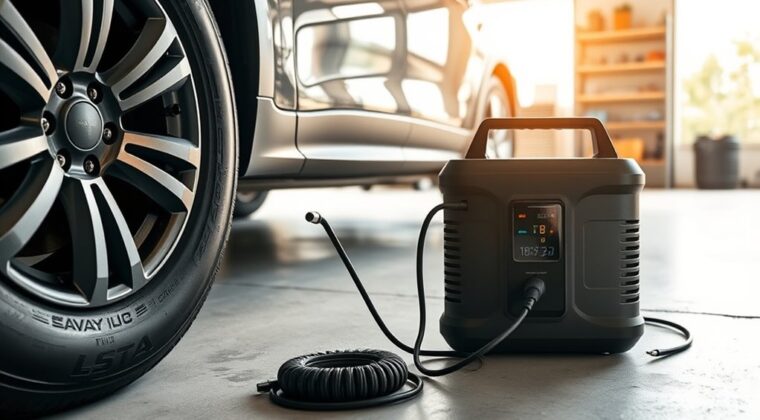
Yes, you can use a 12V tire inflator with a power station if the station matches the inflator’s voltage and can supply enough current. Many inflators draw up to 30A, while compact stations may cap DC output at 10A, which can trigger shutdown or damage. Check the inflator’s max input, connector type, and duty cycle first. AC-compatible inflators are often easier to run safely, and the details below show why.
Key Takeaways
- Yes, if the power station’s DC output matches the inflator’s voltage and current requirements.
- Most 12V tire inflators draw up to 30 amps, which exceeds many power stations’ 10-amp DC limits.
- Never connect a high-draw inflator directly to an underpowered DC port, as it can trigger shutdown or damage equipment.
- Check the inflator’s max input, connector type, and duty cycle before use to avoid overheating and incompatibility.
- AC-powered inflators or power stations with sufficient AC inverter output are usually the safest and simplest option.
Can You Use a 12V Tire Inflator With a Power Station?
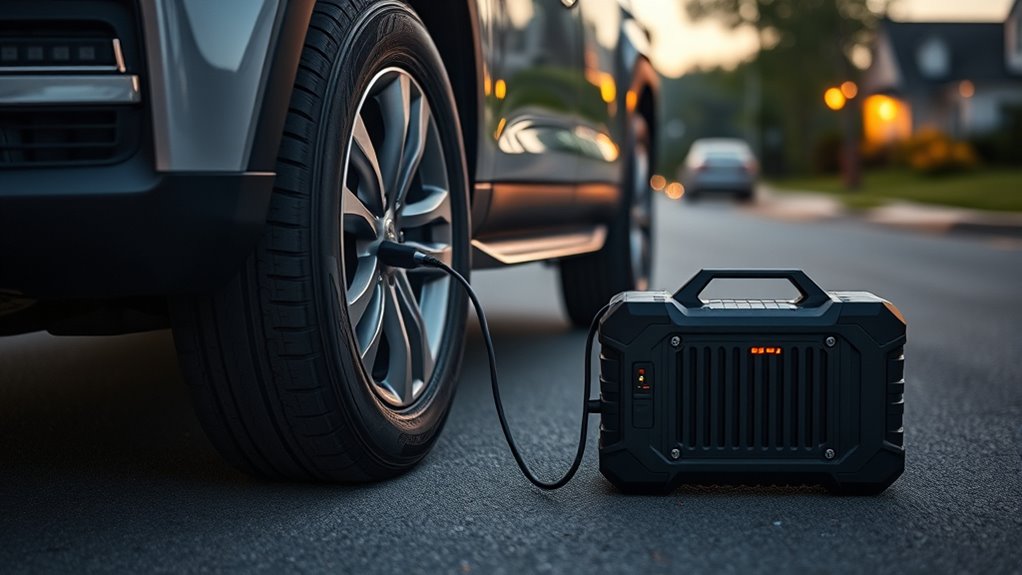
Not usually, because most 12V tire inflators can draw up to 30 amps, which exceeds the DC output limits of many power stations, including models like the Delta 2 that cap out at 10 amps.
If you connect a 12V tire inflator directly to a power station, you can push its power draw beyond safe limits and risk damage to both devices. That mismatch isn’t just inefficient; it can shut down the system or create a failure mode you don’t need.
In practice, you’ll get safer results with an AC-powered air compressor, since a power station can supply AC more reliably within its design envelope.
An adapter from alligator clips to a socket plug won’t fix the core power draw problem, so don’t assume modification guarantees compatibility.
You should always verify the inflator and power station specifications before use. That’s how you protect your equipment and keep your mobility independent.
What Specs Does the Tire Inflator Need?
You need to confirm the inflator’s voltage and current limits first: it should operate at no more than 13.8V and draw no more than 10A from your power station.
You also need the right connector type, since some inflators require AC compatibility if your station doesn’t provide battery terminals.
Check the duty cycle rating as well so you know how long you can run it without overheating or triggering a shutdown.
Voltage And Current Limits
A 12V tire inflator usually expects about 13.8V at the input and can draw as much as 30 amps under load.
So the key compatibility check is whether your power station can supply both the required voltage and enough current. Your 12V tire inflator’s current draw is the real bottleneck, not just nominal voltage.
- Verify the inflator’s max input rating.
- Compare it with the power station’s DC output limit.
- Check whether the station can sustain 30 amps, not just peak voltage.
- Reject setups that exceed adapter or output ratings.
Many units, like the Delta 2, cap DC output at 10 amps, which won’t run a 30-amp load safely.
If you’re using AC, confirm the inflator supports it.
Connector Type Matters
Once you’ve confirmed the voltage and current limits, the next compatibility check is the connector type. You need the air compressor’s plug to match your power station’s DC output, whether that’s a socket plug or alligator clips. A mismatch blocks power delivery, and a poor adapter can’t fix an undersized output. Check this:
| Connector type | Typical use | Risk |
|---|---|---|
| DC socket | Direct plug-in | Best fit |
| Alligator clips | Battery-style leads | Adapter needed |
| Adapter | Clip-to-socket conversion | Verify load |
Many stations, including the Delta 2, supply only 10 amps on DC, so your inflator’s power demand may still exceed limits. Read the spec sheet closely. If the connector type matches but the output can’t support the air compressor, you’ll need another source.
Duty Cycle Requirements
Duty cycle is the next spec to check, because a 12V tire inflator can pull up to 30 amps at a maximum of 13.8V, and it usually needs short run times to avoid overheating.
You need to verify that your power station can deliver enough much power without exceeding its 10-amp DC limit.
- Match voltage: 13.8V max.
- Limit current: 10A DC from the station.
- Confirm short duty cycles: brief inflation only.
- Use AC models if needed for freedom from incompatible battery terminals.
When you air up front tires or a rear tire, stop between runs and let the compressor cool.
If your inflator’s duty cycle is too long, choose a more compatible AC-powered unit.
Why Power Station Output Limits Matter
You need to compare the power station’s DC output current limit with the compressor’s actual draw, because a unit like the Delta 2 may cap at 10 amps while a tire inflator can demand up to 30 amps.
If the inflator’s current exceeds that limit, you can trigger shutdown, unstable operation, or hardware damage.
You should verify both amperage and connection method before using any adapter or plug conversion.
Output Current Limits
Power station output limits matter because the 12V accessory port may supply far less current than a tire inflator demands. You need current capacity considerations before you connect anything.
A device compatibility analysis shows that a Delta 2 class unit may cap DC output at 10 amps, while many inflators want up to 30 amps. That gap can trigger overloads, voltage drop, or damage.
Follow this safety precautions overview:
- Check the power station’s DC amp limit.
- Verify the inflator’s rated current and voltage.
- Compare both specs for real compatibility.
- Avoid adapters that bypass built-in limits.
If you want reliable inflation without surrendering control, match the load to the source. Many inflators also prefer 13.8 volts, so lower output can reduce performance and stress the system.
Compressor Power Draw
Compressor power draw is the key constraint because even a short inflation cycle can demand a surge far beyond what a power station can safely supply.
When you pair a 12V inflator with a Delta 2, its 10-amp DC limit can’t meet a compressor that pulls up to 30 amps. That mismatch raises power consumption, stresses compressor efficiency, and risks damage to both devices.
You need to compare inflator types before you connect anything: some portable units spike hard at startup, while AC-powered compressors usually match power stations better.
If you modify plugs, keep the wiring safe and respect the output ceiling. Liberation here means using gear that works within its limits, so you can inflate confidently without forcing your power station into failure.
How Do Voltage, Amps, and Watts Affect Compatibility?
Voltage, current, and power all have to line up for a 12V tire inflator to work safely with a power station. You need voltage compatibility between 12V and 13.8V, or the inflator may underperform or stall.
- Match output voltage exactly.
- Verify current requirements before connecting.
- Use wattage calculations: W = V × A.
- Don’t exceed the station’s DC limit.
If your inflator draws 30 amps, it demands 360 watts at 12 volts, and that load can outrun compact stations fast. Many units, including a Delta 2-style 10 amp DC output, can’t supply that current.
If you push beyond rated limits, you risk overheating, shutdown, or failure. You should treat adapters as risky shortcuts, not liberation tools, because they don’t expand the station’s electrical capacity.
Check the label, compare the amp rating, and confirm the wattage before you plug in. That’s how you keep control and prevent damage.
Can a 12V Tire Inflator Run on AC Power?
No, a 12V tire inflator can’t run directly on AC power because it’s designed for DC operation. If you want to use it from a wall outlet, you need AC conversion methods such as a compatible adapter or inverter that outputs 12V DC.
Standard AC outlets deliver 120V or 240V, while your inflator usually tops out near 13.8V, so voltage regulation techniques matter. You also need to verify tire inflator compatibility with the adapter’s current capacity; many units can draw up to 30 amps at startup, and an undersized supply can overheat or fail.
Standard AC outlets deliver 120V or 240V, so voltage regulation and current capacity must match your inflator.
Check the label before you connect anything. For simpler, safer use, choose an AC-compatible tire inflator instead of adding conversion hardware. That approach gives you cleaner operation, fewer failure points, and more control over your setup.
With the right electrical match, you keep your inflation workflow efficient, portable, and free from unnecessary dependence.
What Power Stations Work Best for Tire Inflation?
For tire inflation, the best power stations are the ones that can supply stable output without exceeding the inflator’s current demand, and that usually means favoring AC-compatible tire inflators over direct 12V models.
You want portable power solutions with enough AC wattage and inverter stability to run the inflator without stress.
- Choose AC output first.
- Verify amperage and voltage specs.
- Avoid 10-amp DC ports for 30-amp inflators.
- Prefer stations with clear load data.
Many stations, including the Delta 2, limit DC output to about 10 amps, so they can’t support many high-draw 12V units.
If your station lacks direct battery terminals, an AC inflator gives you a safer path to mobility.
Use inflator compatibility tips: match the tool’s rated input to the station’s output, then confirm surge tolerance.
If you consider adapters, handle them carefully and follow essential safety precautions to protect your gear and preserve freedom of operation.
How Do You Power a Tire Inflator Safely?
To power a tire inflator safely, you need to match the power station’s output to the inflator’s electrical requirements, especially its 12V DC voltage and current draw.
Verify that your power station’s DC port delivers the correct voltage and enough amps; some units cap output at 10 amps, and your inflator may exceed that limit. If it does, you risk overheating, shutdown, or damage.
Verify your power station’s DC output matches your inflator’s voltage and amperage to avoid overheating or shutdown.
Check power station features such as regulated DC output, surge handling, and protected ports before you connect anything.
When possible, use an AC-powered inflator if your station supports AC output, because it can simplify compatibility.
If you must adapt alligator clips to a plug, choose a heavy-duty adapter rated for the inflator’s maximum current. These safety precautions protect both your gear and your autonomy.
Keep your inflator maintenance routine intact by inspecting cords, plugs, and fittings before each use, and always confirm specifications before you inflate.
Frequently Asked Questions
What Can a 500 Watt Power Station Run?
You can run small appliances with a 500 watt power station, like a mini fridge, laptop, LED lights, phone chargers, and some 12V gear.
You’ll get solid portable power for camping or outages, but you should verify startup wattage before connecting anything.
For tire maintenance, a 12V inflator often works if its draw stays within limits.
That improves inflator efficiency, while excluding hair dryers, heaters, and similar high-draw loads.
How Many Amps Does a Portable Tire Inflator Use?
A portable tire inflator usually draws 10 to 30 amps, and some spike near 30 amps like a rampart breaker.
You’ll see lower power consumption when inflator efficiency rises and air pressure stays moderate.
Check the label for exact draw, because your unit’s voltage and duty cycle change demand.
If you want liberation from guesswork, match the source to the inflator’s peak amperage, not just its average load.
Can I Charge a 12 Volt Battery With a Generator?
Yes, you can charge a 12-volt battery with a generator if you match the battery charging voltage and current exactly.
You should check generator types, because DC outputs and inverter units behave differently. Use an ammeter to verify load, and don’t exceed about 14.4–14.7 volts for lead-acid cells.
You’ll also want solar compatibility if you plan to combine sources. Follow the manufacturer’s specs to keep your setup safe and autonomous.
How Big of an Inverter Do I Need to Run an Air Compressor?
You need an inverter sized for the compressor’s startup surge, not the fantasy on the box. For most 12V units, you should target at least 360 watts continuous, with extra headroom for startup.
You’ll choose inverter sizing by compressor types and their peak amps, then verify power efficiency and pure sine wave output. If your inverter sags, your compressor won’t run, and freedom waits at the tire shop.
Conclusion
Yes—you can use a 12V tire inflator with a power station if the station matches the inflator’s voltage, current, and wattage requirements. Check the DC output first, because that’s what usually determines compatibility. If your inflator draws more startup power than the station can supply, it may shut down or underperform. When the specs line up, you’ll get quick, reliable inflation without needing your car. It’s a simple match, and that’s no accident.