
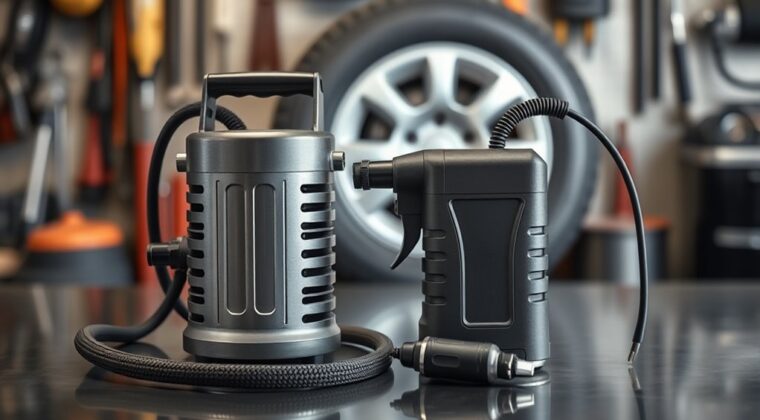
A 120V tire inflator plugs into a wall outlet, so you get higher power, faster inflation, and better performance for larger tires or repeated use at home. A 12V inflator runs from your vehicle’s outlet, so you get portable, compact emergency inflation on the road. If you want speed and steadiness, choose 120V. If you want mobility and convenience, choose 12V. The differences become clearer when you compare duty cycle, output, and use case.
Key Takeaways
- 120V inflators plug into wall outlets and usually inflate tires faster and more powerfully than 12V models.
- 12V inflators run from a vehicle’s outlet, making them portable and ideal for roadside emergencies.
- 120V units are better for home garages, larger tires, and repeated inflation tasks.
- 12V units are compact but typically slower and may need cooling during extended use.
- Choose 120V for speed and efficiency, or 12V for convenience and mobility.
What 120V and 12V Tire Inflators Are
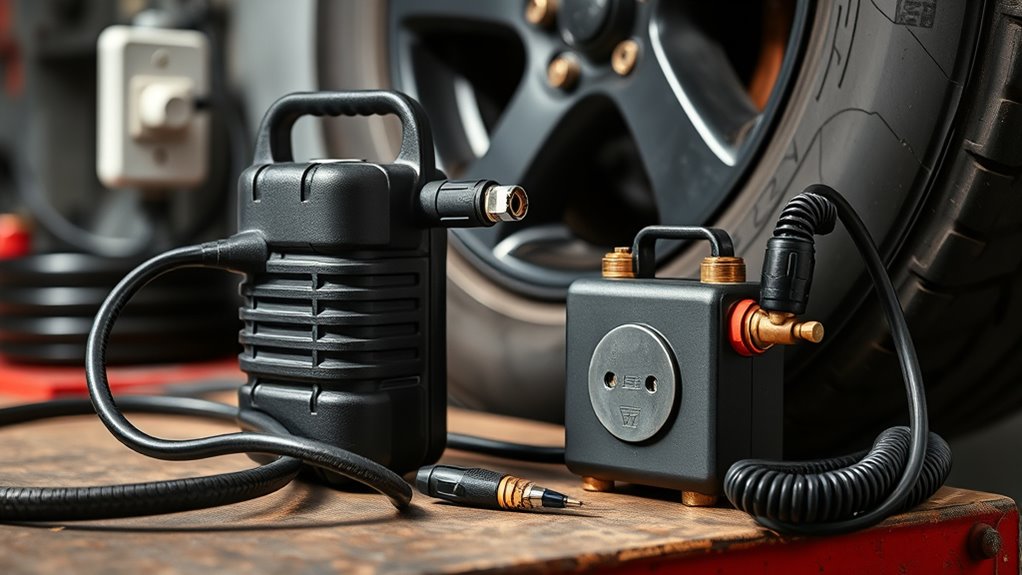
A 120V tire inflator plugs into a standard wall outlet and delivers higher power and airflow, making it better suited for home use, larger tires, and other inflation tasks such as sports equipment or air mattresses.
You use it as a stationary tool when your power source is an indoor outlet, and its higher airflow helps it raise air pressure efficiently.
By contrast, a 12V tire inflator draws from your vehicle’s 12-volt outlet, so you can keep it portable and ready for roadside use.
It trades raw output for mobility, which suits emergency top-offs and travel needs.
Both tire inflators measure and increase air pressure, but they serve different operating contexts.
If you want steady, high-capacity inflation at home, 120V fits that role.
If you need a compact unit that moves with you, 12V gives you that freedom without depending on household power.
120V Tire Inflator Pros and Cons
Because 120V tire inflators draw power directly from a wall outlet, you get faster inflation and stronger performance than with lower-voltage units, which makes them well suited for home garages and larger tires.
120V tire inflators deliver faster, stronger inflation, making them ideal for home garages and larger tires.
A 120V tire inflator gives you higher power output, so you can raise pressure quickly and with less strain on the motor. Many models also include built-in pressure gauges and automatic shut-off, which let you monitor inflation precisely and stop at your target PSI without constant supervision.
The main pros and cons are clear: you gain efficiency, accuracy, and capacity, but you sacrifice mobility.
Because these units are less portable, you’ll rely on them mostly where electricity is available. That limits use in rural settings, on long commutes, or during roadside emergencies.
If you want control, speed, and the freedom to maintain tires at home, a 120V inflator’s strengths outweigh its tradeoffs.
How 12V Tire Inflators Work
12V tire inflators plug into your vehicle’s 12-volt outlet, so you can inflate tires without relying on a wall socket. In operation, 12V tire inflators draw current from that power source and convert it with an electric motor into mechanical motion. The motor drives a piston, compresses ambient air, and sends it through a hose into the tire.
This compact design makes portable tire inflators practical for roadside tire inflation and other emergency tasks.
- You connect the unit to the outlet.
- You attach the hose to the valve stem.
- You switch on the motor to start compression.
- You monitor pressure and stop at the target.
Because the system stays lightweight and self-contained, you gain mobility and control.
Still, you should treat it as a duty-cycle device: after 5-10 minutes, let it cool so the motor doesn’t overheat. That limitation defines its operational envelope, not your independence.
12V vs 120V Tire Inflator Power and Speed
When you compare 12V and 120V tire inflators, the main difference is how their power source affects speed and runtime. A 120V inflator draws from household current, so you get higher inflation speed and steadier output. A 12V inflator runs from your vehicle, which improves portability but usually slows fill times and shortens duty cycles.
| Type | Key effect |
|---|---|
| 12V inflator | Compact freedom, slower output |
| 120V inflator | Faster pressure rise, longer runtime |
| 12V inflator | Usage limitations on flat tires |
| 120V inflator | Stronger power source, less mobile |
You can free yourself from delay with the right tool: 120V can reach target PSI in under 2 minutes, while 12V models may need several more. Still, your choice depends on access, not just speed. Use 12V for mobility; use 120V when runtime and power matter.
When a 120V Tire Inflator Makes Sense
A 120V tire inflator makes sense if you want faster inflation, longer run times, and consistent performance at home. When you plug a 120V tire inflator into a wall outlet, you gain higher output than most 12V units, so your garage workflow stays efficient and self-directed.
- Home use: you can inflate tires, sports gear, and mattresses without hunting for vehicle power.
- Larger motor: the unit can sustain load better, which supports longer sessions without overheating.
- Multiple inflation tasks: you can move from one item to the next without recharging or resetting power sources.
- Not suitable for on-the-go use: you should treat it as a stationary tool, optimized for workshops and garages.
If you value technical control and reliable throughput, this setup gives you practical autonomy at home.
When a 12V Tire Inflator Is Better
A 12V tire inflator is better when you need roadside emergency use, because it runs directly from your vehicle’s 12-volt outlet and doesn’t require external power.
You can rely on it for vehicle-powered convenience during road trips or in remote areas where outlets aren’t available.
Its compact, lightweight design also gives you on-the-go portability, so you can store it easily and use it for quick pressure top-offs.
Roadside Emergency Use
For roadside emergencies, a 12V tire inflator is usually the better choice because it plugs directly into your vehicle’s 12-volt outlet and can run while the engine is on, eliminating the need for a wall outlet.
You keep control when tire pressure drops and freedom matters most. A 12V inflator is compact, so you can store it in your trunk and reach it fast. It can inflate a tire in about 5-10 minutes, restoring usable pressure before traffic compounds the risk.
Many models include a pressure gauge and automatic shut-off, reducing guesswork.
- Connect to the outlet.
- Check tire pressure.
- Inflate to target PSI.
- Stop when the gauge confirms accuracy.
In roadside emergencies, that efficiency is liberation.
Vehicle-Powered Convenience
When you want inflation on the move, a 12V tire inflator is the more practical option because it plugs straight into your vehicle’s power outlet and doesn’t depend on a wall socket.
You gain vehicle-powered control wherever the road takes you, which matters when you need portable air in remote areas or during urgent tire checks. Because it draws from your car’s electrical system, you avoid searching for external power sources.
Most 12V models work best with the engine running, so you maintain stable output for efficient inflation. Many units also include built-in pressure gauges and automatic shut-off, letting you monitor pressure precisely without overinflating.
For you, that means less friction, faster action, and more freedom to handle tire maintenance on your terms.
On-The-Go Portability
With a 12V tire inflator, portability is the main advantage: it plugs directly into your vehicle’s 12-volt outlet, so you don’t need an external power source to get started.
You can carry this 12V tire inflator wherever you drive, because it’s compact, lightweight, and built for portable inflators in emergency situations.
- Store it in your trunk or glove compartment.
- Run it while the engine’s on for continuous airflow.
- Use built-in LED lights after dark.
- Skip the gas station when you need immediate pressure correction.
Compared with bulkier air pumps, this setup gives you autonomy on the road. It inflates more slowly than 120V units, but you gain practical freedom: fast access, low storage burden, and reliable roadside response when conditions don’t let you wait.
How to Choose the Right Tire Inflator
To choose the right tire inflator, you should first match the power source to your access pattern: 120V for wall outlets and higher-output home use, or 12V for vehicle-based operation through the cigarette lighter socket.
You should then weigh portability and size against duty cycle, since a compact 12V unit is easier to store but usually runs for less time before overheating.
Finally, select features based on your use case, whether you need faster inflation for larger tires and frequent jobs or a versatile unit for tires, sports gear, and air mattresses.
Power Source Options
Your first decision is the power source, because it directly affects speed, portability, and where you can use the inflator. A 120V unit draws from household outlets, so you get higher output and faster inflation. A 12V model uses your vehicle’s outlet, giving you freedom on the road but slower performance.
- 120V: best for home use, steady power, and larger jobs.
- 12V: best for emergency top-offs and portable tire support.
- Power source: match it to your charging needs and access.
- Air compressors: choose the one that fits your workflow and timing.
If you want liberation from delays, pick the source that fits your actual use. For a garage, 120V wins; for travel, 12V keeps you ready when pressure drops.
Portability And Size
Portability and size are often the deciding factors when you’re choosing between a 12V and a 120V tire inflator.
12V models are usually compact, lightweight, and easy to store in a trunk or small compartment, which makes them a strong fit for roadside emergencies and travel.
120V units are typically larger and heavier, so they’re better suited to a garage or dedicated storage area where portability matters less.
If you want freedom from dependence on fixed infrastructure, 12V inflators give you that mobility.
If you have stable access to outlets and prioritize a controlled setup, 120V inflators can fit your space.
Compare size, portability, and storage capacity before you decide, because the right choice should match your available room and your need for access.
Features And Use Case
When you’re choosing between a 12V and a 120V tire inflator, the key difference is how and where you’ll use it: 120V units plug into wall outlets and usually deliver higher power for faster inflation, while 12V models draw from a vehicle’s 12-volt outlet and favor roadside convenience.
A 120V inflator gives you greater inflation speed, longer continuous operation, and broader versatility for home garages or larger inflatables. A 12V inflator gives you portability, but it carries usage limits from heat and lower output.
Consider:
- Home use: choose 120V.
- Emergency use: choose 12V.
- Fast, repeated fills: choose 120V.
- Roadside freedom: choose 12V.
You gain control by matching power, runtime, and mobility to your actual task.
Frequently Asked Questions
What Are the Common Problems With 12 Volt Air Compressors?
You’ll commonly face weak Inflation speed, poor Power efficiency, and high Noise levels with 12-volt air compressors.
You may also deal with overheating during long runs, inaccurate pressure readings, and limited battery life.
Portability features help you move freely, but short Hose length can restrict access.
Durability concerns grow when you push the unit hard.
For reliable use, you’ll need to monitor temperature, pressure, and runtime closely.
What Is the Best Portable Tire Inflator According to Consumer Reports?
Consumer Reports names the Slime Cordless Pro Power the best portable tire inflator. You might think speed costs convenience, but this model proves otherwise with top inflation speed, strong consumer ratings, and practical portability features.
In tire inflator reviews, it leads despite noise levels and durability tests that matter for long-term use. If you want the most capable, liberated choice, you can trust its fast, automatic, cordless performance.
How Do I Choose the Right 12 Volt Air Compressor for My Needs?
You should match the compressor to your tire size, expected use, and vehicle power limits.
Check pressure capabilities first, then compare energy efficiency, portability features, noise levels, durability ratings, and brand comparisons.
Pick a unit that reaches your target PSI quickly, fits your trunk, and includes useful adapters.
Also verify duty cycle and cord length, so you can act independently on roadside repairs without sacrificing control or reliability.
What Is the Best 12V Tire Inflator?
The best 12V tire inflator for you is often the Slime Cordless Pro Power, because it balances inflation speed, battery performance, and inflator portability with almost smug efficiency.
You’ll also want to compare noise levels, safety features, and price comparison data; the Avid Power Cordless stays under $100 and delivers solid value.
If you need extra utility, the Wolfbox Megavolt 24 adds jump-start capability, helping you reclaim control fast.
Conclusion
You can see the difference clearly: a 120V tire inflator gives you higher power and faster fill rates, while a 12V inflator trades speed for portability and vehicle-side convenience. If you need dependable garage use, choose 120V; if you want an onboard backup for roadside jobs, choose 12V. In practice, the right choice is the key that opens smoother maintenance, not just another accessory. Match the tool to your needs, and you’ll avoid wasted time and effort.