
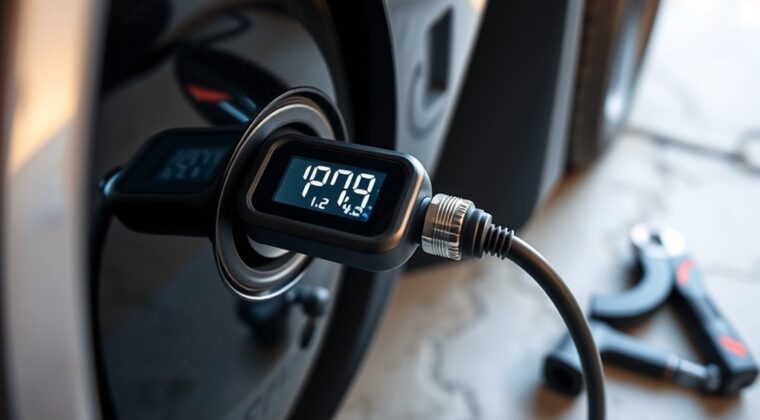
A digital tire inflator uses an electronic pressure sensor to measure PSI and convert tire pressure into a live digital signal. You set your target pressure with programmable buttons, then the unit inflates until it reaches that value and shuts off automatically. The backlit LCD gives you clear readings in low light, while temperature compensation improves consistency. Compared with analog gauges, you get faster setup, less guesswork, and better control, with more detail just ahead.
Key Takeaways
- A digital tire inflator uses an electronic pressure sensor to measure PSI and show the reading on a backlit LCD.
- The sensor converts air pressure into an electrical signal for fast, real-time readings with good accuracy.
- Programmable presets let you set a target PSI, and the inflator stops automatically when that pressure is reached.
- Backlit displays and clear digital readouts improve visibility and reduce guesswork in low light or bright conditions.
- Regular calibration and battery checks are important because temperature changes and low power can affect accuracy and reliability.
How a Digital Tire Inflator Works
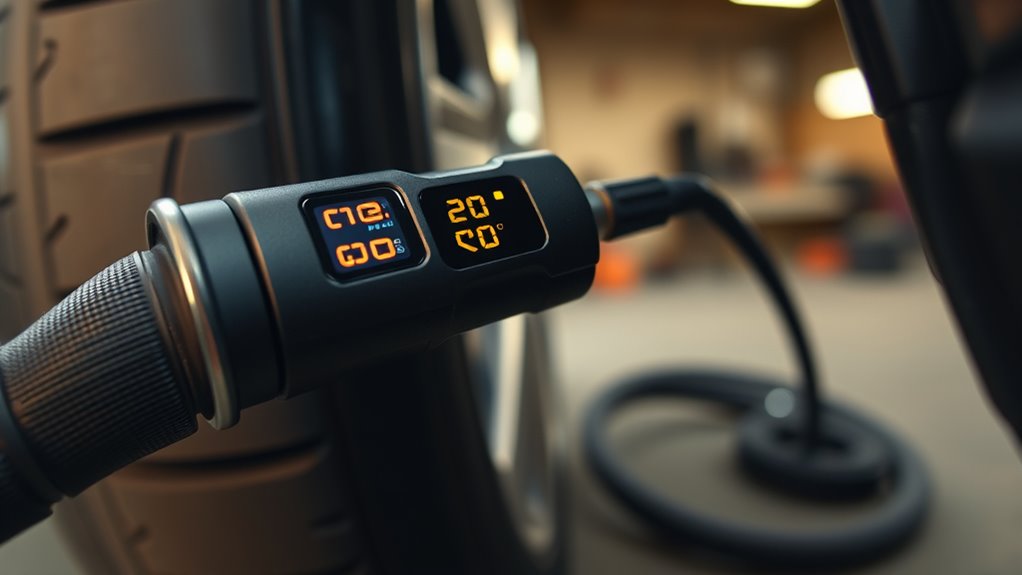
A digital tire inflator measures tire pressure with an electronic pressure sensor and shows the reading as a numerical value on a backlit LCD screen.
You use the Digital Tire Inflator Gauge to monitor tire pressure with ±0.3 PSI accuracy, so you’re not guessing. Programmable buttons let you set a target PSI, and the unit stops inflation automatically when it reaches that value. That control improves safety, performance, and ease of use, while reducing manual adjustment.
Most models cover 7 to 174 PSI, so you can apply one tool to cars, bikes, and equipment. Backlit displays improve visibility in low light, and the rechargeable lithium-ion battery keeps the device portable.
USB-C charging simplifies power access with standard cables. You stay in control of inflation, and the gauge gives you direct, precise feedback without unnecessary complexity.
What the Pressure Sensor Measures
At the sensor’s core, the gauge measures the air pressure inside the tire as force per unit area, typically in PSI. Your pressure sensor converts that mechanical load into an electrical signal through a strain gauge or piezoelectric element, so the inflator can interpret the tire’s condition without guesswork.
You get real-time measurements, which lets you add air with precision and avoid both underinflation and overinflation. Because digital displays can resolve readings to 0.1 PSI, you see finer changes than analog pointers can show, and you cut parallax error from the equation. That clarity supports accurate monitoring when you’re tuning pressure for load, speed, or terrain.
Many sensors’re temperature-compensated, so your readings stay consistent as ambient conditions change, helping you trust the numbers whether the tire’s cold or hot. In practice, the sensor gives you measurable control over pressure, not assumptions.
Why the Backlit LCD Helps
Because the display is backlit, you can read pressure data clearly in dim garages, roadside emergencies, or direct sunlight without straining to see the numbers. The backlit LCD boosts visibility by pairing strong contrast with illuminated digits, so your pressure readings stand out immediately.
You don’t waste time guessing, which helps preserve accuracy during inflation. Many units refresh in real time and resolve changes to 0.1 PSI, so you can verify small shifts before they become errors. The light usually activates automatically when you power the inflator, keeping the interface user-friendly and eliminating extra steps.
That matters when you need fast, precise checks in professional or emergency settings, where efficiency and safety depend on clear data. With this display, you stay in control, work with less friction, and make inflation decisions based on numbers you can trust.
How to Set Your Target PSI
Once you can read the display clearly, setting the target PSI is straightforward. First, check the recommended tire pressure on the driver’s side door jamb or in your owner’s manual.
Then power on the Digital inflator and confirm the tire pressure gauge is ready. Use the buttons to enter your target PSI; many units let you store common values for faster setup. This direct input improves accuracy because you’re telling the inflator exactly what pressure to pursue, not guessing under pressure.
Before you start, validate the displayed number matches your specification. A precise target helps you maintain control, avoid overinflation, and keep your tires operating within their designed range.
After inflation, double-check the reading on the gauge to verify it still matches your target PSI. That final verification gives you a clean, measurable result and supports safer, more efficient driving.
How Auto-Stop Prevents Overinflation
When you set a target pressure on a digital tire inflator, the auto-stop feature tracks inflation with an electronic pressure sensor and shuts the unit off the moment it reaches that preset PSI. That gives you precise control over tire pressure and blocks overinflation before it starts.
- You enter the desired PSI with programmable buttons.
- The electronic pressure sensor monitors tire pressure continuously.
- Real-time pressure readings appear on the backlit LCD.
- Auto-stop cuts power instantly at the target.
With digital inflators, you don’t need to guess or babysit the hose. The system samples pressure during inflation, compares it to your setpoint, and stops cleanly when the threshold is met.
That fast response protects the tire casing, preserves ride quality, and reduces stress from excess pressure. You keep authority over the process, but the inflator enforces the limit.
In practice, auto-stop turns inflation into a controlled, repeatable action instead of a manual balancing act.
Where Digital Inflators Work Best
Digital tire inflators work best where speed, repeatability, and accurate pressure control matter most, especially in automotive shops, fleet maintenance bays, and other high-volume service environments.
You get high accuracy when you need to move quickly through many tires without sacrificing consistency. Digital Inflator Gauges let you set target tire pressure, then the automatic stop feature ends inflation at the preset value, so you reduce variation and limit damage risk.
For performance vehicles, that precision supports handling, grip, and safety, while heavy-duty applications benefit from the wide 7 to 174 PSI range.
You can also read the backlit LCD display clearly in dim garages or bright outdoor bays, which keeps workflow efficient.
In practice, these tools free you from guesswork and make pressure management more disciplined, measurable, and reliable across mixed vehicle fleets and demanding service schedules.
Digital Tire Inflator vs. Analog Gauge
When you compare a digital tire inflator with an analog gauge, you’ll notice that digital units usually deliver finer accuracy, often to 0.1 PSI, while analog models are limited by full-scale error.
You’ll also see that backlit digital displays improve readability and reduce interpretation errors, whereas analog needles can introduce parallax.
Digital inflators cost more and rely on electronics, but they add programmable shut-off and convenience; analog gauges are cheaper, simpler, and often more rugged.
Accuracy and Precision
While both tools can measure tire pressure, a digital tire inflator typically gives you tighter control, with accuracy around ±0.3 PSI and 0.1 PSI resolution, so you can make fine adjustments without guessing. Your freedom comes from knowing the gauge reflects pressure with less error than an analog unit, which often targets ±2% of full scale.
- Digital readouts reduce parallax error.
- Analog Bourdon tubes can show hysteresis.
- Repeatable zeroing improves consistency.
- Annual calibration keeps accuracy aligned with standards.
Temperature compensation helps digital gauges stay stable, while analog pointers can drift or backlash at extreme pressures.
You don’t need to accept uncertainty when precision matters; you can verify, correct, and move on with confidence.
Speed and Readability
Speed matters just as much as accuracy once you start inflating a tire, and digital inflators make the process faster and easier to verify. You read tire pressure instantly, then adjust with confidence. Digital models deliver 0.1 PSI resolution and ±0.3 PSI accuracy, while automated shut-off ends inflation at your target without constant checking. Backlit LCDs improve readability in dim garages or bright sun.
| Feature | Digital Models | Analog Gauges |
|---|---|---|
| Readout | Instant | Slower |
| Resolution | 0.1 PSI | 1-2 PSI |
| Error risk | Low | Parallax-prone |
That cleaner interface lets you act decisively, reclaim time, and avoid guesswork. Analog gauges can work, but they demand careful alignment and can slow your workflow.
Durability and Cost
Durability is one area where digital tire inflators justify part of their higher price: they typically use more robust housings, sealed buttons, and shock-absorbing components to withstand daily use, moisture, and impact better than analog gauges, whose pointers and internal parts can be more fragile.
You’ll pay a higher initial investment, usually $70 to $200 versus $15 to $50, but you may reduce replacements over time.
- Better durability limits downtime.
- Calibration keeps digital readings reliable.
- Maintenance costs rise with routine calibration.
- Analog gauges can need fewer service checks.
For your shop, the tradeoff is clear: digital tire inflators demand more up front, yet they can deliver longer service life, tighter control, and labor savings that support freedom from repetitive rework.
Accuracy Problems and Battery Issues
Accuracy problems in digital tire inflators can emerge when you don’t regularly calibrate the unit, since even a typical ±0.5 to ±1.0 PSI tolerance can alter tire pressure enough to affect handling, wear, and safety.
You need to treat calibration as routine maintenance, not optional tuning, because uncorrected drift undermines reliable readings. Digital gauges also respond to temperature changes, so the sensor output may shift as the inflator warms, cools, or sits in sunlight.
To keep measurements trustworthy, you should verify readings against a known standard and apply compensation when the device supports it.
Battery issues add another layer of risk: rechargeable lithium-ion packs can deplete quickly in high-use settings, and drained cells can trigger sudden shutdowns or disable automatic shut-off features.
Check charge status before use, then inspect battery health on a fixed schedule.
When you manage calibration and power systematically, you keep the inflator accurate, operational, and aligned with your control over tire pressure.
Choosing the Right Digital Tire Inflator
Once you’ve accounted for calibration and battery reliability, the next step is choosing a digital tire inflator that supports consistent, low-friction use. You want a digital tire inflator with a backlit LCD so you can verify each pressure reading in glare, dusk, or shop light.
Prioritize high accuracy, because small errors compound across tires and affect handling. Look for programmable preset buttons so you can store target values and move fast without re-entering settings.
- automatic shut-off stops inflation at your target
- rechargeable lithium-ion power, ideally 2,200 mAh, reduces downtime
- compatibility with common tire valve types prevents adapter hassles
- a 7 to 174 PSI range covers cars, bikes, and light-duty uses
When you choose this profile, you control inflation instead of chasing it. That’s practical autonomy: precise pressure management, fewer interruptions, and a tool that works with your routine, not against it.
Frequently Asked Questions
How Does a Digital Tire Pressure Gauge Work?
You read pressure through pressure measurement technology: an electronic sensor converts tire air pressure into an electrical signal, then your screen shows PSI.
Compared with digital vs analog, you avoid parallax and common gauge errors.
For tire maintenance tips, use the backlit display, save presets, and let auto-stop prevent overinflation.
You’ll get the benefits of digital in accuracy and speed, so choosing the right gauge means matching resolution, power, and usability.
How to Use a Tire Inflator Gauge?
You remove the valve cap, attach the hose firmly, and set your target PSI from the door jamb.
Then you power the inflator, watch tire pressure climb, and stop at the preset value.
Different inflator types may need slight handling tweaks, so check the manual.
Follow safety precautions, watch for common issues like leaks, and use maintenance tips.
A smart buying guide helps you choose reliable gear.
How to Read a Tire Air Pressure Gauge?
You read a tire air pressure gauge by checking the PSI value directly, then comparing it with your vehicle’s recommended setting.
You’ll protect tire pressure basics by confirming gauge accuracy importance, avoiding common gauge mistakes like tilted viewing or skipping zeroing.
During seasonal tire checks, don’t trust tire pressure myths; instead, verify with a calibrated tool.
When choosing inflators wisely, read the display or dial, then recheck after filling.
How to Use a Digital Tire Depth Gauge?
You use a digital tire depth gauge by powering it on, zeroing it, then placing the probe straight into a tread groove and pressing measure.
Since 2/32 inch is the legal minimum in many places, you can’t ignore wear.
For tire maintenance tips, check digital gauge accuracy during seasonal tire checks, track inflation frequency, note common tire problems, and strengthen tire safety awareness by comparing results to your vehicle’s limit.
Conclusion
You see the pressure, you set the PSI, and you let the inflator do the rest. You gain faster fills, you gain clearer readings, and you gain better control. Digital tire inflators work best when the sensor is accurate, the display is easy to read, and the auto-stop functions correctly. If you choose a reliable model, check the battery, and verify the gauge, you’ll inflate with confidence, you’ll avoid overinflation, and you’ll drive safer.