
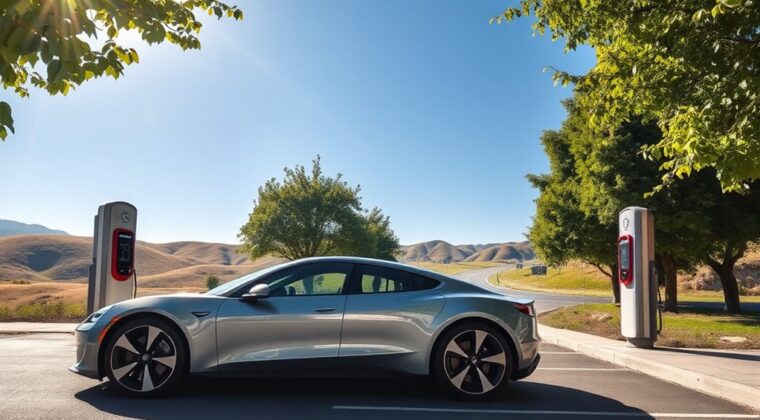
Planning an EV road trip is less about hoping you find a charger and more about knowing where, when, and how you will charge before you leave. A smooth trip comes from three habits: build a route with reliable charging stops, keep a sensible battery buffer, and know your vehicle’s charging limits, connector type, and weather range.
Quick Answer
For an EV road trip, plan DC fast-charging stops before you leave, aim to arrive with a 15% to 25% battery buffer, and use the faster 10% to 80% charging window when practical. Check charger speed, connector type, payment options, recent reliability notes, and backup stations along your route.
Key Takeaways
- Use your EV’s built-in navigation, A Better Route Planner, PlugShare, or the Alternative Fueling Station Locator to map chargers before you drive.
- For most road-trip stops, charging to about 80% is faster than waiting for the final 20%, because charging slows as the battery fills.
- Confirm each stop’s connector, power level, payment method, and recent user reports before relying on it.
- Cold weather, high speeds, roof cargo, heavy loads, and low tire pressure can all reduce practical range.
- Keep a backup charger in range, especially in rural areas, during holidays, or when towing.
At a Glance
| Time Required | 20 to 30 minutes of planning before departure, plus typical DC fast-charging stops of about 20 to 45 minutes depending on your EV, charger, temperature, and state of charge. |
| Difficulty | Easy to moderate. It becomes easier once your apps, payment methods, and preferred networks are set up. |
| Tools Needed | EV navigation, route-planning app, charging network apps, payment card, approved adapter if your vehicle requires one, tire-pressure gauge, and portable Level 1 cord for emergencies. |
| Cost | Varies by network, location, charging speed, idle fees, and electricity price. Check the posted $/kWh or session price before starting. |
Preparing for Your EV Road Trip: Key Steps to Take
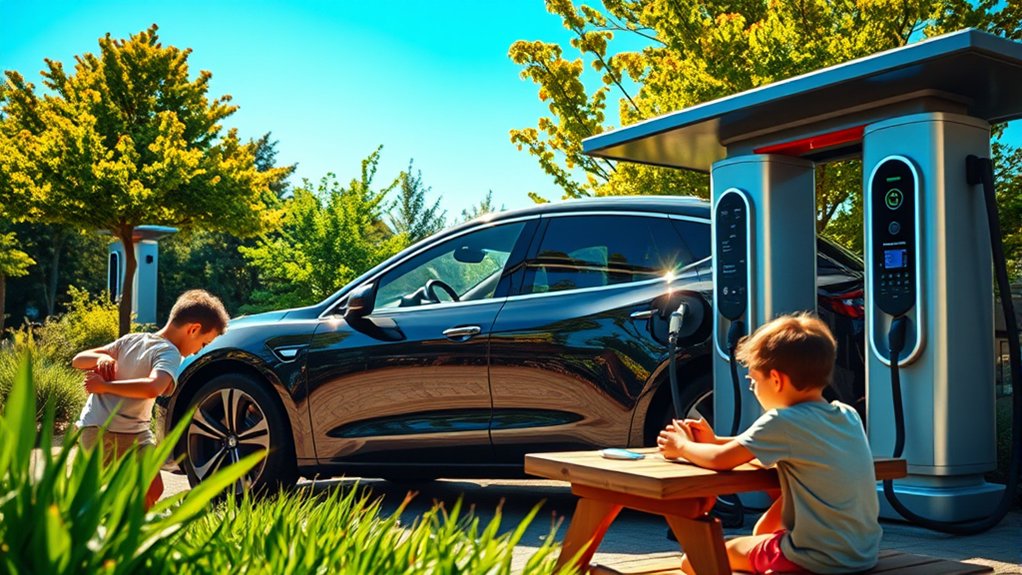
Start by checking your vehicle’s real-world highway range, not just the rated range on the window sticker. Highway speed, hills, headwinds, rain, snow, heat, cold, passengers, and cargo can all change how far you can drive before your next charge.
Next, map the full trip before you leave. Your car’s built-in navigation is often the best starting point because many EVs can precondition the battery when you navigate to a fast charger. You can also compare the route with apps such as PlugShare, A Better Route Planner, and the U.S. Department of Energy Alternative Fueling Station Locator.
Before a long travel day, it is usually fine to start at 90% to 100% if your owner’s manual allows it and you plan to drive soon. For normal daily charging, follow your vehicle’s charge-limit guidance. Many EV drivers use a lower daily limit and save a full charge for long trips.
Pro Tip: Build each charging stop around something you already need: a meal, restroom break, grocery stop, coffee, or short walk. This makes charging feel like part of the trip instead of wasted time.
How to Plan EV Charging Stops Before You Leave
A good EV route has a primary charger and a backup charger for each long leg. Do not plan every leg down to 1% or 2% battery. A safer road-trip target is to arrive at each charger with about 15% to 25% remaining, or more if the area is rural, cold, mountainous, or known for unreliable stations.
- Enter your destination into your EV navigation. Let the car estimate charging stops, arrival battery level, and battery preconditioning when supported.
- Check each charger in a second app. Look for recent successful check-ins, number of stalls, charger speed, connector type, and whether the site is open 24/7.
- Add one backup stop. Choose another charger you can reach if the first station is full, blocked, broken, or slower than expected.
- Set up payment before departure. Add your card to charging apps and carry a physical payment card. Some stations also support contactless card payment or Plug & Charge.
- Check your adapter. Use only adapters approved for your vehicle and charging power. A Level 2 adapter does not mean your car can use every DC fast charger.
- Confirm overnight charging. If a hotel advertises EV charging, call the front desk and ask how many chargers they have, whether they are working, whether they are shared with non-guests, and whether fees or reservations apply.
Note: A charger shown on a map is not always available when you arrive. Real-time status helps, but recent driver check-ins are still useful because they can reveal blocked stalls, broken screens, short cables, payment problems, or reduced charging speed.
Types of Charging Stations and Their Availability
Understanding charger types helps you avoid unrealistic stop times. According to the U.S. Department of Energy’s Alternative Fuels Data Center, EV charging time depends on state of charge, battery size, vehicle charging capability, charger power, battery temperature, and electrical service.
| Charging Type | Best Use | Typical Road-Trip Role |
|---|---|---|
| Level 1 | Standard 120V outlet charging, often around 5 miles of range per hour. | Emergency or overnight trickle charging, not the main plan for highway travel. |
| Level 2 | 208V or 240V AC charging, often around 25 miles of range per hour depending on the charger and vehicle. | Hotels, restaurants, parking garages, workplaces, and longer destination stops. |
| DC fast charging | High-power charging that sends DC power directly to the battery. AFDC estimates about 100 to 200+ miles of range in 30 minutes for many EVs. | Primary charging choice for long highway trips. |
Connector type matters as much as charger speed. Many non-Tesla EVs use J1772 for Level 1 and Level 2 charging and CCS for DC fast charging. Some older vehicles use CHAdeMO for DC fast charging. Tesla-style North American connectors are now standardized as SAE J3400, and many newer vehicles and networks are moving toward that connector. Always check your vehicle manual and network app before assuming a station will work with your car.
As of July 9, 2026, AFDC listed 81,252 electric station locations and 253,151 electric charging ports in the United States, excluding residential charging infrastructure.
Availability still varies by region. Urban areas and interstate corridors often have more choices, while rural areas may have fewer chargers and longer gaps between stations. Holiday weekends can also create lines at popular fast-charging sites.
Why Most Road-Trip Fast-Charging Stops End Around 80%
Fast charging is usually quickest when the battery is lower and slows as the pack fills. That is why many road-trip plans use a practical 10% to 80% or 20% to 80% rhythm instead of charging to 100% at every stop.
Charging from 80% to 100% can take a long time compared with the energy you gain. If the next charger is close, it is often faster to unplug around 70% to 80%, drive to the next stop, and charge again in the faster part of the curve.
There are exceptions. Charging higher can make sense before a remote stretch, mountain pass, winter drive, campsite, ferry route, or long leg with few backup chargers. The best rule is simple: charge enough to reach the next reliable charger with a buffer, not necessarily to the highest percentage possible.
Best Practices for Charging Etiquette on the Road
Good charging etiquette keeps public stations moving and reduces stress for everyone. The biggest courtesy is to use only the time and charger speed you need.
| Best Practice | Why It Helps | What to Do |
|---|---|---|
| Charge to about 80% when practical | The final 20% is usually slower and can hold up other drivers. | Charge higher only when the next leg requires it. |
| Move when your session is done | A plugged-in car that is no longer charging blocks a stall. | Set a phone alert and return before the session ends. |
| Avoid using a high-power stall if you cannot use its speed | Some EVs cannot accept the fastest charger output. | Choose a lower-power stall when available and appropriate. |
| Report broken chargers | Accurate reports help networks repair equipment and help other drivers plan. | Use the network app, station phone number, or map app report feature. |
| Keep cables neat | Loose cables can be damaged or create a trip hazard. | Return the connector and cable to the holster when finished. |
Friendly conversations with other EV drivers can be helpful, especially if a site is busy or one stall is down. Still, avoid unplugging another vehicle unless the driver clearly left permission and the session is complete.
What to Do When Charging Stations Are Unavailable
Even a well-planned trip can hit a problem: a charger may be full, offline, blocked by a non-charging vehicle, limited by weather, or unable to start a payment session. When that happens, stay calm and work through your options.
- Check nearby backup chargers. Search by connector, charging speed, and current battery level.
- Try another stall at the same site. A single port can fail while other ports still work.
- Restart the session. Unplug, close the app, try a card or RFID option if available, and follow on-screen instructions.
- Call the network support number. Some networks can remotely reset a charger or start a session.
- Slow down to stretch range. Reduce highway speed, avoid hard acceleration, and limit cabin heating or cooling if safe.
- Use Level 2 as a fallback. It may be slow, but it can add enough range to reach a working fast charger.
- Contact roadside assistance if you are stuck. Some plans can tow you to a charging site or provide limited emergency charging.
Warning: Do not use damaged charging cables, cracked connectors, standing-water locations, or unknown outlets without permission. Public EV chargers are high-power electrical equipment. If a station looks unsafe, leave it and report the issue.
For federally funded public charging projects covered by 23 CFR Part 680, rules include requirements for real-time price display, real-time port status data, and average annual uptime above 97%. That does not guarantee every charger will work every time, so a backup plan is still smart.
Tips for Extending Your EV’s Range on the Road
Range is not fixed. Your driving style, weather, tires, route, and cargo can change how much energy your EV uses. Use these habits to make each charge go farther.
Keep highway speed steady
Higher speeds increase aerodynamic drag, especially above typical highway speeds. Use a steady pace, avoid rapid acceleration, and use cruise control when road and traffic conditions make it safe.
Precondition before fast charging
If your EV supports battery preconditioning, navigate to the fast charger through the vehicle’s built-in system. A battery at the right temperature can accept power more quickly than a cold battery.
Manage climate control
Cabin heat and air conditioning use energy. In cold weather, preheat the cabin while plugged in when possible. Seat heaters and steering-wheel heaters often use less energy than heating the whole cabin, but visibility and comfort still matter. Never sacrifice defrosting, safe visibility, or driver alertness to save range.
Check tire pressure
Under-inflated tires increase rolling resistance and can reduce efficiency. Check tire pressure when the tires are cold and use the pressure listed on the driver’s door placard or owner manual, not the maximum number printed on the tire sidewall.
Reduce drag and extra weight
Remove roof boxes, roof racks, bike racks, and heavy cargo when you do not need them. External cargo can have a large effect at highway speeds because it adds wind resistance.
Use regenerative braking smoothly
Regenerative braking helps recover some energy when slowing down, especially in city or stop-and-go driving. On the highway, smooth driving and avoiding unnecessary speed changes usually matter more than heavy regen use.
Cold Weather, Hot Weather, and Mountain Route Planning
Cold weather can reduce EV range and slow charging. FuelEconomy.gov notes that EV fuel economy can drop sharply in cold mixed driving, especially when cabin heat is used. Plan shorter legs in winter, precondition the cabin while plugged in, and arrive at chargers with a larger buffer.
Hot weather can also affect range because the battery and cabin may need cooling. In summer, try to park in shade during long stops, use cabin preconditioning while plugged in, and avoid arriving at remote chargers with a very low state of charge.
Mountain driving needs extra planning. Climbing uses more energy, but descending can recover some energy through regenerative braking. Do not assume the downhill section will fully make up for the climb. Use your EV route planner and add a larger buffer in remote mountain areas.
Charging Apps, Payment, and Adapters to Set Up Before You Go
Before your trip, download the apps for the charging networks along your route and add a payment card. Also bring a physical credit card because some stations support contactless payment. If your vehicle supports Plug & Charge, set it up before the trip and still keep app and card backups.
If your EV needs an adapter for certain networks, check three things before relying on it:
- Vehicle approval: Use only adapters approved by your automaker or charging network.
- Charging level: Some adapters work only for Level 2 charging, not DC fast charging.
- Power rating: The adapter must be rated for the charger and vehicle. If it is not, do not use it.
Keep your portable Level 1 charging cord in the vehicle if your car came with one. It is not a fast road-trip solution, but it can help in an emergency when you have permission to use a safe, grounded outlet.
Frequently Asked Questions
What drains an EV battery the most on a road trip?
High highway speeds, cold weather, cabin heating, strong headwinds, steep climbs, roof cargo, heavy loads, and low tire pressure can all reduce range. The largest drain depends on your vehicle and conditions, but speed and weather are two of the biggest factors on long trips.
Is it good to charge an EV every day?
Yes, daily charging is normal if you follow your vehicle’s owner manual. Many drivers plug in at home and use a daily charge limit such as 70% to 90%, depending on the battery type and manufacturer guidance. For road trips, charging higher before departure can be useful if you plan to drive soon.
Are electric cars safe for pacemakers and ICDs?
Most people with pacemakers or ICDs can ride in and drive modern vehicles, but anyone with an implanted cardiac device should follow their cardiologist’s and device manufacturer’s guidance. The American Heart Association advises caution around certain electromagnetic sources, magnets, and power-generating equipment. Do not lean against charging hardware or place high-power cables across your device area.
What is the 80/20 rule for EV charging?
The 80/20 rule is a simple road-trip habit: avoid dropping much below 20% when possible, and stop fast charging around 80% unless the next leg needs more. It saves time because fast charging usually slows after 80%, while keeping enough buffer to avoid range stress.
How many times will I need to charge during an EV road trip?
It depends on your EV’s highway range, speed, weather, terrain, and how far you drive that day. Many drivers on long highway days stop every 150 to 220 miles, but some EVs can go farther and some conditions require shorter legs. Use your vehicle navigation and add a backup charger for each leg.
Should I fast charge to 100% on a road trip?
Usually no. Charging to 100% at a DC fast charger can take much longer than charging to 80%. Charge to 100% only when you need the extra range for a long or remote leg, and try to leave soon after the charge completes.
What should I do if a charger says available but does not work?
Try another stall, restart the session, use a different payment method, and call the network support number. If it still fails, report the charger in the app and go to your backup station. This is why it is smart to avoid arriving at a charger with a nearly empty battery.
Conclusion
An EV road trip is easiest when you plan charging before the drive, leave a battery buffer, and treat charger information as something to verify, not assume. Use DC fast chargers for highway legs, Level 2 chargers for overnight or destination stops, and a backup plan for rural areas or busy travel days.
The charging network is growing. As of July 9, 2026, AFDC listed 81,252 electric station locations and 253,151 charging ports in the United States, excluding residential charging. That growth helps, but good planning still matters. Check your route, confirm your connector, set up payment, watch the weather, and move your vehicle promptly when charging is complete.
Sources
- U.S. Department of Energy Alternative Fuels Data Center: Electric Vehicle Charging Stations — charging levels, connector types, and charging-speed estimates.
- U.S. Department of Energy Alternative Fuels Data Center: Station Counts by State — current U.S. electric station and charging-port counts.
- 23 CFR Part 680: National Electric Vehicle Infrastructure Standards and Requirements — federally funded charger requirements for uptime, pricing, payment, and real-time status data.
- FuelEconomy.gov: Fuel Economy in Cold Weather — cold-weather effects on EV range and energy-saving winter tips.
- FuelEconomy.gov: Keeping Your Vehicle in Shape — tire-pressure guidance and efficiency effects.
- American Heart Association: Devices That May Interfere With ICDs and Pacemakers — implanted cardiac-device precautions around electromagnetic sources.