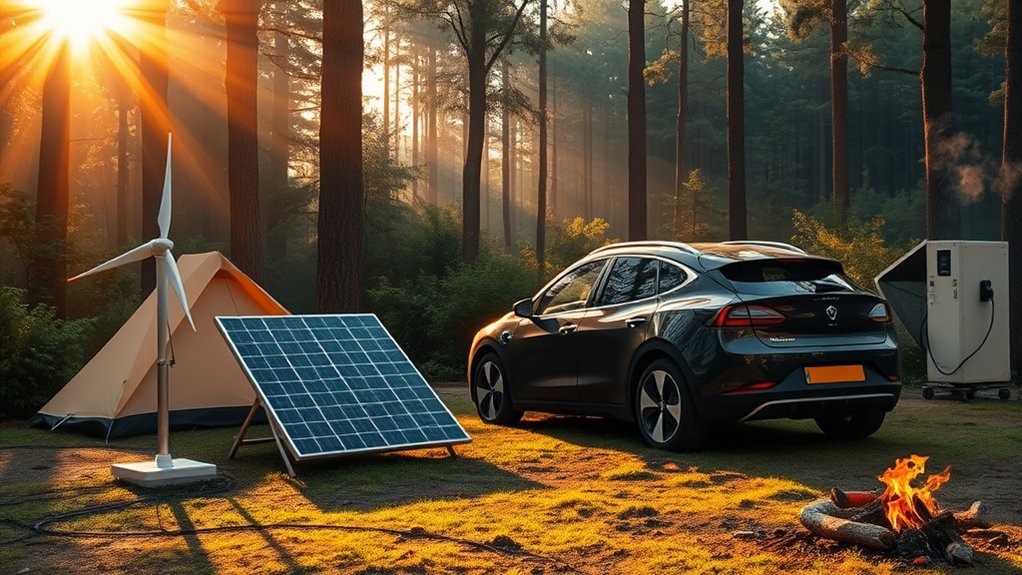
Charging an electric vehicle while camping off-grid is possible, but it is not as simple as unfolding one small solar panel and plugging in your car. You need to plan around your daily driving miles, your EV’s energy use, the campsite’s power rules, the sunlight available, and the safe output of your battery, inverter, and charger.
For many campers, the most realistic plan is a mix of route planning, campground charging, a portable power station for small top-ups, and a solar-battery setup for extended stays. A true off-grid Level 2 charging system can work, but it needs kilowatt-scale solar, a large battery bank, and equipment sized for continuous EV charging.
Quick Answer
You can charge an EV while camping off-grid, but meaningful charging usually requires more than a small portable panel. Plan your energy need first, then match it with a safe EV charger, battery storage, inverter capacity, and enough solar production. For most trips, use off-grid charging as a range buffer, not your only charging source.
Key Takeaways
- Start with energy math: miles you need to recover × your EV’s kWh per mile, plus charging losses and a safety reserve.
- Small 100W to 200W solar panels are useful for phones, lights, and portable stations, but they do not provide meaningful EV charging by themselves.
- Level 1 charging is slow but easier to power. Level 2 charging is faster, but it needs a larger inverter, battery bank, and safe 240V setup.
- Always confirm campsite rules, outlet type, charger compatibility, weather exposure, and backup charging stops before you leave.
At a Glance
| Time Required | 10 minutes to plug into an approved campsite outlet; several hours to set up and test a portable solar-battery system; longer for a permanent off-grid installation. |
| Difficulty | Easy for Level 1 at an approved outlet; moderate for low-power portable charging; advanced for true off-grid Level 2. |
| Tools Needed | EVSE charger, correct vehicle adapter, solar panels, charge controller or solar input, battery storage, inverter, weather-safe cables, monitoring app, and backup charger plan. |
| Cost | Low when using an approved existing outlet; much higher for a solar-battery system large enough to add meaningful EV range. |
Essential Components of an Off-Grid Charging System
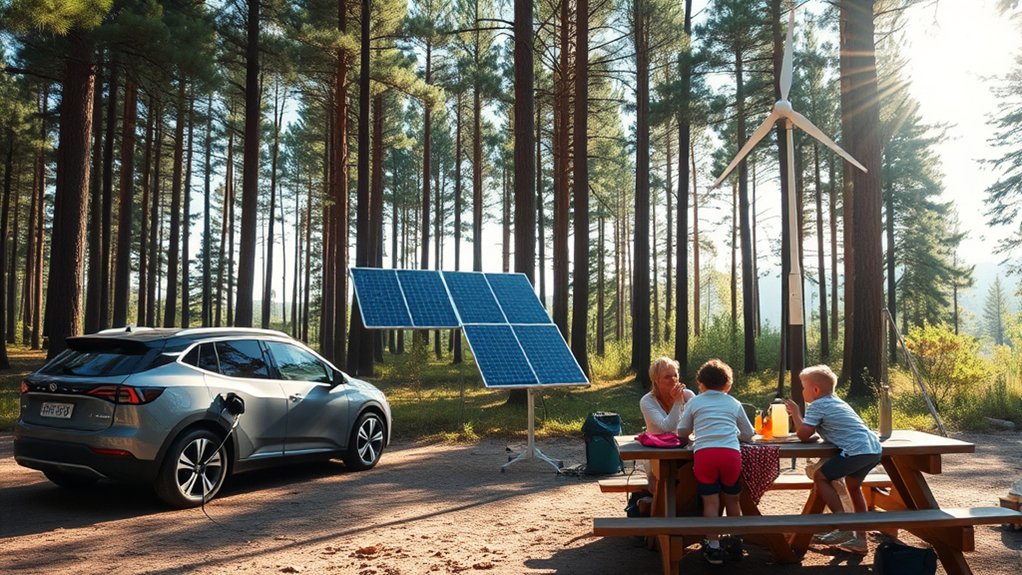
A safe off-grid EV charging setup has to move energy through several pieces of equipment in the right order. A simple way to picture it is: solar panels → charge controller or solar input → battery storage → inverter → EV charger → vehicle.
The exact size depends on how much range you want to recover. A small portable power station may add only a few miles of range. A larger off-grid system can add more, but it needs enough solar input, storage, and inverter power to support the charger without overheating, tripping, or draining the battery too deeply.
- Solar panels: Panels create DC electricity. For EV charging, think in kilowatts, not just watts. A 100W or 200W panel is useful for small camping loads, but it is not a practical main EV charging source.
- Charge controller or solar input: This protects the battery and manages the energy coming from the panels. Many portable power stations have this built in.
- Battery storage: The battery stores solar energy for cloudy periods, evening charging, and steady charger output. Lithium iron phosphate batteries are popular for off-grid systems because they are stable and long-lasting when used within their rated limits.
- Inverter: The inverter changes stored DC power into AC power for the EV charger. Its continuous output must exceed the charger’s draw.
- EV charger or EVSE: This is the safety device between your power source and your vehicle. Use equipment listed for EV charging and follow the charger manual.
- Monitoring tools: A battery monitor, solar app, or power station display helps you watch watts, state of charge, temperature, and charging faults.
Warning: Do not improvise EV charging with undersized extension cords, damaged outlets, non-weather-rated gear, or adapters that are not approved for your charger and vehicle. EV charging is a continuous high-current load. For permanent wiring, 240V outlets, or high-power off-grid systems, use a licensed electrician and follow local electrical code.
First, Calculate How Much Energy You Need
Before buying solar panels or a power station, calculate the energy you need to replace. The best number comes from your own EV’s efficiency screen or the official FuelEconomy.gov electric vehicle label guidance, which lists EV energy use in kilowatt-hours per 100 miles.
Use this simple planning formula:
Daily driving miles × EV energy use per mile + 10% to 20% charging loss + camping loads + reserve = daily energy target.
For a practical estimate, many EVs use roughly 0.25 to 0.35 kWh per mile in mild conditions. Cold weather, high speed, steep terrain, roof cargo, towing, mud, sand, and heavy climate-control use can raise that number.
| Range You Want to Recover | Approximate EV Energy | Planning Target With Losses |
| 10 miles | 2.5 to 3.5 kWh | 3 to 4.5 kWh |
| 25 miles | 6.25 to 8.75 kWh | 7.5 to 11 kWh |
| 40 miles | 10 to 14 kWh | 12 to 17 kWh |
This table shows why small camping solar panels are not enough for most EV charging goals. A phone, lantern, fridge, and fan are small loads. An EV is a large battery on wheels.
How to Set Up Off-Grid EV Charging for Camping
Set up your charging plan before you reach the campsite. The safest approach is to use known charging stops on the way in, arrive with a reserve, and treat off-grid charging as backup or range extension.
Essential Equipment Needed
Your equipment list depends on whether you are using a campground outlet, a portable power station, or a full solar-battery setup.
- EV charging cable or portable EVSE: Use the charger recommended by your vehicle manufacturer or a reputable listed EVSE.
- Correct adapters: Bring only adapters rated for the outlet, charger, and vehicle. In North America, many non-Tesla EVs use J1772 for Level 1 and Level 2 AC charging, while many newer vehicles and chargers are shifting toward J3400, also called NACS. DC fast charging may use CCS, CHAdeMO, or J3400 depending on the vehicle.
- Solar input: Use panels sized for the range you want to recover. For meaningful EV charging, this usually means a kilowatt-scale array.
- Battery storage: A small 1 to 3 kWh power station may provide an emergency top-up. A 10 to 20 kWh battery bank is more realistic for a modest off-grid EV buffer. Larger systems may be needed for frequent Level 2 charging.
- Inverter: Match inverter output to your charger. A 120V Level 1 charger often draws around 1.4 to 1.9 kW. A low-amp 240V charger can draw about 3.8 kW or more. A 30A Level 2 charger can draw about 7.2 kW.
- Weather-safe setup: Keep equipment dry, shaded when required by the manual, ventilated, and off the ground when rain is possible.
Pro Tip: If your EV lets you reduce charging current, start low. A lower-amp charge is slower, but it is easier on portable batteries, inverters, outlets, and campground circuits.
Site Selection Tips
Pick your campsite with charging in mind. A beautiful shaded site may be comfortable, but it may also cut solar output for most of the day.
- Sun exposure: Look for a clear southern view in the Northern Hemisphere, or open sky from late morning through afternoon.
- Campground rules: Ask before plugging into any outlet. Some campgrounds do not allow EV charging from RV pedestals, cabin outlets, or bathhouse outlets.
- Outlet condition: Do not use loose, burned, cracked, wet, or buzzing outlets.
- Distance to the car: Keep cables short and protected from foot traffic, tires, puddles, and sharp edges.
- Weather: Heavy cloud, smoke, snow, and tree shade can sharply reduce solar output.
- Security: Solar panels and power stations are easy to move, so lock or supervise portable gear.
Charging Options Overview
Your best charging option depends on where you camp, how long you stay, and how much range you need to recover.
| Charging Option | Best For | Main Limitation |
| Level 1 from approved 120V outlet | Slow overnight top-ups | Usually only about a few miles of range per hour |
| Low-amp Level 2 from approved 240V source | Campgrounds or private sites with suitable power | Needs correct outlet, permission, adapter, and circuit capacity |
| Portable power station | Emergency buffer and small top-ups | Limited battery capacity compared with an EV pack |
| Solar panels plus battery bank plus inverter | Extended stays and repeated off-grid charging | Needs careful sizing, good sun, and higher upfront cost |
| Public charger before or after camp | Most reliable range recovery | Requires route planning and charger availability |
The U.S. Department of Energy Alternative Fuels Data Center explains that Level 1, Level 2, and DC fast charging vary widely in power and charging time. For camping, Level 1 and lower-amp Level 2 are the most realistic options. DC fast charging is usually a commercial charging-station solution, not a DIY campsite setup.
Calculating Solar Panel Requirements for Effective EV Charging
Solar sizing depends on location, season, panel angle, shade, temperature, soiling, battery losses, and inverter losses. Use the NREL PVWatts Calculator to estimate production for your actual campsite region or home base.
For a rough planning estimate, use this formula:
Solar array size in kW = daily EV charging kWh ÷ peak sun hours ÷ system efficiency factor.
A conservative system efficiency factor is often around 0.70 to 0.80 after real-world losses. For example, if you want 12 kWh per day, expect 4 peak sun hours, and use 0.75 as your loss factor:
12 ÷ 4 ÷ 0.75 = 4 kW of solar panels.
That does not mean you must carry a 4 kW array for every trip. It means you should be realistic. A small foldable solar panel may keep camp electronics running, but it will not replace a long drive’s worth of EV energy.
Note: Solar output is not the same as panel rating. A 400W panel does not make 400W all day. Clouds, heat, shade, panel angle, and charging losses all reduce real output.
Choose the Right EV Chargers for Camping
The best camping charger is the one your power source can safely support for hours. Faster is not always better off-grid.
Level 1 Charging
Level 1 uses a standard 120V AC outlet. It is slow, but it is often the easiest option when a campsite or cabin has an approved outlet. The AFDC charging guide lists Level 1 at about 5 miles of range per hour under typical assumptions, though your result can be lower or higher.
Use Level 1 when you only need a small overnight top-up, when you can lower the charge current, or when your battery station cannot support 240V output.
Level 2 Charging
Level 2 uses 240V or 208V AC service and charges much faster. It can be useful at RV sites, private cabins, farms, workshops, or off-grid properties with a large inverter system. However, you must confirm the outlet type, circuit rating, campground rules, charger current, and adapter compatibility.
If your charger is adjustable, a low-amp setting may be more practical than trying to run a full-power Level 2 charger from a portable system.
DC Fast Charging
DC fast charging is best used before or after your camping stay at a public charging site. The hardware and power requirements are far beyond normal portable camping systems. Use the AFDC Station Locator or your vehicle’s navigation to identify backup chargers along your route.
Connectors and Adapters
Check your vehicle’s charging port before the trip. Many EVs use J1772 for AC charging. Many newer North American models are moving toward J3400, also known as NACS. DC fast charging may involve CCS, CHAdeMO, or J3400 depending on the vehicle and station.
Bring only adapters that are approved for your vehicle and charger. Do not stack adapters unless the manufacturer clearly allows it. If an adapter, plug, or cable gets hot, stop charging and inspect the setup.
Maximize Battery Storage for Off-Grid EV Charging
Battery storage is what turns solar from “only when the sun is strong” into a more useful camping power source. It lets you collect energy during the day and charge at a steadier rate later.
For EV camping, think about battery storage in three levels:
- Small emergency buffer: 1 to 3 kWh. Good for lights, fridge, devices, and a tiny EV top-up.
- Practical range buffer: 5 to 10 kWh. Better for adding a modest amount of range or supporting low-current charging.
- Serious off-grid EV setup: 10 to 20 kWh or more. More realistic for repeated charging, especially if paired with a larger solar array.
Do not plan to drain your storage battery to zero. Leave reserve for lights, communications, medical devices, fridge loads, weather changes, and the trip out. Also remember that your EV may limit charging speed when the battery is cold, hot, nearly full, or outside its preferred temperature range.
For day-to-day battery care, many EV owners avoid sitting at 100% state of charge for long periods unless they need the full range. Follow your vehicle manual, because recommendations vary by battery chemistry and model.
Real-Life Examples of Successful Off-Grid Charging Setups
Successful off-grid EV charging usually starts with realistic expectations. The setup that works for a weekend camper may not work for a remote cabin, and the setup that works in Arizona may not work in a shaded forest in October.
Innovative DIY Solutions
Here are practical examples that make sense for campers:
- Weekend buffer setup: A portable power station and foldable solar panels keep camp electronics running and may add a small emergency EV top-up.
- Low-amp AC setup: A larger battery station with a suitable AC output powers Level 1 charging overnight at a reduced current.
- Cabin or farm setup: A fixed solar array, LFP battery bank, and inverter support low-amp Level 2 charging when the system is properly sized.
- Hybrid trip plan: Public DC fast charging is used on the route, while campsite solar handles lights, refrigeration, laptops, and a range buffer.
Commercial Off-Grid Installations
Some remote lodges, parks, ranches, and private campgrounds use solar, batteries, and managed EV charging to serve guests. These setups are usually designed by professionals because they must handle weather, multiple users, payment rules, safety listing, maintenance, and high electrical loads.
If a campground advertises EV charging, confirm the charger type before booking. Ask whether the station is Level 2 or DC fast, whether it is public or guest-only, what connector it uses, and whether reservations or fees apply.
Common Mistakes to Avoid
- Buying too little solar: A small panel is great for phones, not for replacing 40 miles of EV range.
- Ignoring charging losses: Not every kWh from your panels reaches the EV battery.
- Forgetting weather: Cold, heat, wind, rain, shade, and smoke can reduce range or solar production.
- Assuming every RV outlet is available: Some campgrounds prohibit EV charging from pedestals or limit current draw.
- Using the wrong adapter: Outlet shape does not guarantee safe voltage, amperage, grounding, or wiring.
- Arriving nearly empty: Always keep enough range to reach a backup charger.
Troubleshooting Off-Grid EV Charging Problems
| Problem | Likely Cause | What to Try |
| Charger will not start | Ground fault, wrong adapter, low battery station output, or vehicle setting | Check manuals, reduce current, inspect plugs, reset the EVSE, and try an approved outlet. |
| Inverter shuts down | Charger draw exceeds inverter capacity | Lower charger amperage or use a larger properly rated inverter. |
| Solar output is low | Shade, poor angle, clouds, heat, dirty panels, or short winter days | Move panels, clean them, improve angle, and recalculate output with a larger weather buffer. |
| EV charges slower than expected | Low current setting, battery temperature, high state of charge, or limited EV onboard charger | Check vehicle settings, precondition if available, and confirm your EV’s onboard AC charging limit. |
Pre-Trip Checklist for EV Camping
- Check your EV’s average kWh per mile for similar roads and weather.
- Map public chargers before and after the campsite.
- Call the campground to ask about EV charging rules.
- Confirm outlet type, voltage, amperage, and whether the outlet is dedicated.
- Bring only approved adapters and chargers.
- Test your portable power station or solar setup at home before the trip.
- Pack cable covers or safe routing supplies to prevent trip hazards.
- Keep chargers and power stations dry and ventilated.
- Arrive with enough range to leave without depending on perfect solar weather.
Frequently Asked Questions
How do you charge an EV while camping?
You can charge an EV while camping by using an approved campground outlet, a public charger near the campsite, a portable power station for small top-ups, or a larger solar-battery-inverter setup. Confirm campsite rules first, use the correct EVSE and adapter, and keep enough reserve range to reach a backup charger.
Can a small portable solar panel charge an EV?
A small 100W to 200W portable panel can support camping electronics and may slowly refill a portable power station, but it will not provide meaningful EV charging by itself. To add useful EV range from solar, you usually need a much larger solar array, battery storage, and an inverter matched to your charger.
What is the 80/20 rule for EV charging?
The 80/20 rule is a common habit of keeping the EV battery roughly between 20% and 80% for everyday use when you do not need the full range. It can reduce time spent charging and may support long-term battery health. Follow your vehicle manual because battery chemistry and manufacturer guidance vary.
What drains an EV battery the most while camping?
Driving distance, speed, elevation gain, cold weather, hot weather, cabin heating, air conditioning, towing, roof racks, soft sand, mud, and heavy accessory use can all reduce range. Climate control while parked can also use energy, so use camp gear wisely and keep a reserve.
Can an off-grid solar system charge an EV?
Yes, an off-grid solar system can charge an EV if it is large enough. A practical system needs solar panels sized for your daily kWh target, battery storage, a compatible inverter, and a safe EV charger. Use PVWatts or a qualified solar designer to estimate output for your location and season.
Is Level 2 charging possible off-grid?
Level 2 charging is possible off-grid, but it is an advanced setup. You need a 240V-capable inverter, enough battery storage, enough solar production, and an EVSE set to a current your system can safely support. Many portable systems are better suited to Level 1 or reduced-current charging.
Conclusion
Off-grid EV charging can make camping more flexible, but it works best when you treat it as an energy-planning project, not a last-minute accessory. Start with your route, your EV’s kWh-per-mile use, the range you need to recover, and the backup chargers near your campsite.
For short trips, a campground outlet or nearby public charger may be enough. For longer stays, solar panels and battery storage can help, but the system must be sized honestly and used safely. Plan with a reserve, use approved charging equipment, and test your setup before you depend on it in a remote place.
Sources
- U.S. Department of Energy Alternative Fuels Data Center: Electric Vehicle Charging Stations — charging levels, charging speeds, connector types, and public charging terminology.
- Alternative Fueling Station Locator — backup public charger planning before and after camping trips.
- FuelEconomy.gov: Learn More About the Electric Vehicle Label — EV kWh-per-100-miles energy-use guidance.
- FuelEconomy.gov: All-Electric Vehicles — EV efficiency, range, recharge time, and battery-life context.
- NREL PVWatts Calculator — solar production estimates by location, system size, losses, tilt, and weather data.
- ENERGY STAR Certified EV Chargers — certified EVSE product lookup for efficient charging equipment.