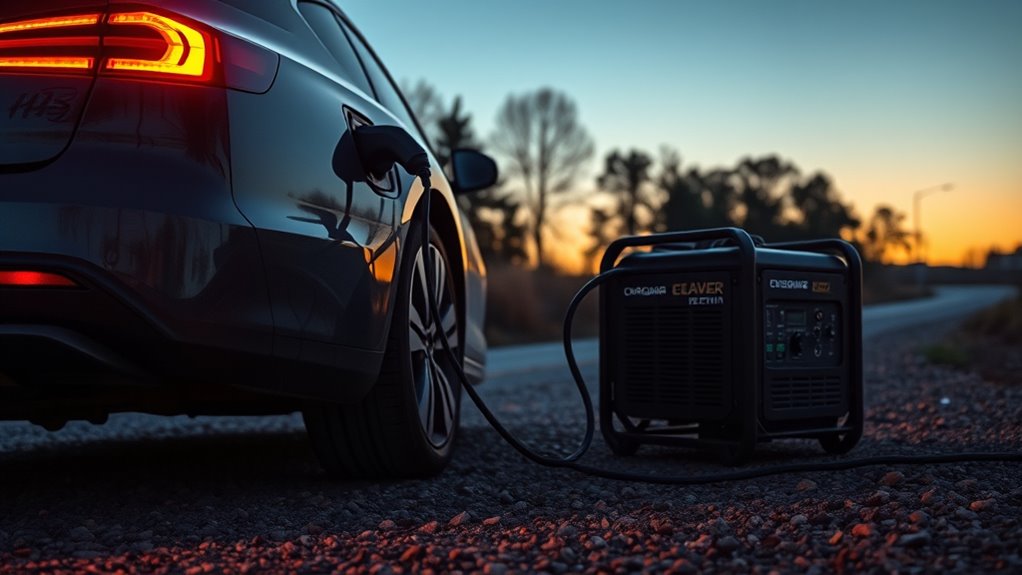
You can charge an EV with a portable generator, but it should be treated as an emergency backup method, not a normal charging plan. The generator must have enough running watts, clean and stable output, the correct outlet or adapter, and a safe grounding and bonding setup. You also need to run it outdoors because gasoline and propane generators create deadly carbon monoxide.
Quick Answer
Yes, a portable generator can charge an EV if it matches the charger’s voltage, amperage, grounding needs, and continuous power draw. For useful Level 2 charging, many drivers need a large generator rated around 7,500 to 12,000 running watts. Always charge outdoors, limit the EVSE amperage, and follow the vehicle, charger, and generator manuals.
Key Takeaways
- Use the generator’s running watts, not its peak or surge rating, when sizing it for EV charging.
- Level 1 charging can work from a smaller generator, but it is very slow. Level 2 charging usually needs a much larger 240-volt generator.
- A 30-amp generator outlet must be limited to 24 amps or less for continuous EV charging. Do not use an adapter to overload the circuit.
- Grounding and neutral bonding are setup-specific. If the EVSE reports a ground fault, stop and check the manuals or call a qualified electrician.
- Run the generator outdoors, more than 20 feet from windows, doors, and vents, and use carbon monoxide detectors inside your home.
At a Glance
| Time Required | 5 to 10 minutes to inspect and connect safely; several hours to more than a day to charge, depending on generator output and battery size. |
| Difficulty | Intermediate. Basic plug-in charging is simple, but grounding, bonding, adapters, and generator sizing require care. |
| Tools Needed | Generator manual, EV owner’s manual, EVSE manual, correct rated adapter, outdoor-rated cord only if allowed, CO detectors, and a qualified electrician for transfer-switch or bonding questions. |
| Cost | Fuel, maintenance, and any proper adapter or electrical work. If you do not already own a large compatible generator, home Level 2 charging is usually cheaper long term. |
Can a Generator Charge an EV?
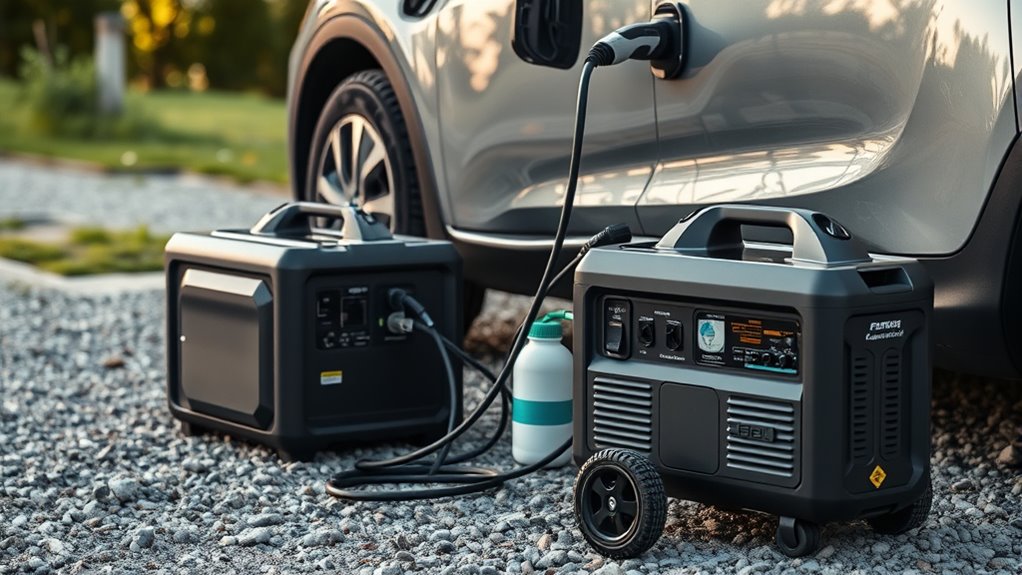
Yes, a portable generator can technically charge an EV. The catch is that the setup must match the EV charger’s electrical needs. Your EV does not care that the power comes from a generator, but the EVSE and onboard charger do care about voltage, current, frequency, grounding, and power quality.
A small 120-volt generator may support slow Level 1 charging if the EVSE allows it and the generator can hold the load. A larger 240-volt generator can support Level 2 charging, but only if its continuous running watts are high enough. Do not size the generator from the peak or starting-watt number printed in large type on the box.
A generator can charge an EV, but the safe question is not “Will the plug fit?” It is “Can this generator safely support this continuous charging load?”
For regular home charging, the U.S. Department of Energy’s Alternative Fuels Data Center notes that most EV drivers use Level 1 or Level 2 charging at home, with Level 2 equipment using 240 volts. A generator is best reserved for outages, remote work sites, camping situations where rules allow it, or a short emergency range boost.
Warning: Never run a fuel-powered generator inside a garage, basement, shed, carport, or near open windows. The CDC says generators should be used outside, more than 20 feet from windows, doors, and vents, and homes should have battery-powered or battery-backup carbon monoxide detectors.
What Size Generator Do You Need?
The right generator size depends on the EVSE amperage, charging voltage, battery energy you need, and the generator’s running-watt rating. Use this simple formula:
Watts = volts × amps.
Then add headroom because EV charging is a long continuous load. A generator that can barely meet the number may overheat, trip, sag in voltage, or shut down after running for a while.
| Charging setup | Approx. charging load | Practical generator target |
|---|---|---|
| 120V Level 1 at 12A | About 1.4 kW | 2,000+ running watts, but charging is very slow |
| 240V Level 2 at 16A | About 3.8 kW | 5,000+ running watts |
| 240V Level 2 at 24A | About 5.8 kW | 7,500+ running watts |
| 240V Level 2 at 32A | About 7.7 kW | 9,500 to 12,000 running watts is a more realistic range |
These are planning numbers, not permission to ignore the manuals. Your EVSE, vehicle, adapter, generator outlet, breaker, and cord all need to agree. Tesla, for example, lists its Mobile Connector NEMA 14-50 adapter as a 240-volt / 50-amp breaker connection with maximum 32-amp output. That is about 7.7 kW before losses.
Minimum Power Needs
For a practical Level 2 backup charge, think in terms of continuous power. A generator advertised as 12,000 starting watts may have a lower running-watt rating. EV charging is not like starting a refrigerator motor for a few seconds. It can pull steady power for hours.
If your EVSE can be set to 16 amps at 240 volts, a midsize generator may add useful range. If your EVSE is fixed at 32 amps, you need a much larger generator and the correct 240-volt receptacle. If your EV or EVSE lets you lower charging current, use that feature before you overload the generator.
Pro Tip: Start with the EV or EVSE set to the lowest practical amperage. After the generator warms up and the charge starts cleanly, increase current only if the generator, cord, plug, and EVSE stay cool and stable.
Portable vs Standby Sizes
A portable generator can help during a short outage or remote emergency, but it is noisy, fuel-dependent, and limited by outlet size. It also needs safe outdoor placement, weather protection that does not trap exhaust, and constant fuel planning.
A standby generator can provide steadier backup power, but connecting any generator to a home electrical system must use approved transfer equipment. OSHA warns not to attach a portable generator directly to a structure unless it has a properly installed transfer switch. If you want a standby generator to support home EV charging, hire a qualified electrician and confirm local code, load calculations, and the EV circuit size before relying on it.
Clean Power and EV Charger Compatibility
EV chargers need stable power. Voltage sag, frequency drift, excessive waveform distortion, or a poor ground reference can make the EVSE stop charging or show an error. Inverter generators often produce cleaner power than many conventional open-frame generators, but you still need to check the generator manual and the EVSE requirements.
Look for these items before you connect:
- Voltage: 120V for Level 1 or 240V for Level 2, matching the EVSE.
- Amperage: The EVSE draw must not exceed the generator outlet, breaker, adapter, or cord rating.
- Frequency: North American EVSE equipment expects stable 60 Hz power.
- Waveform: Clean sine-wave output is safer for sensitive electronics than rough or unstable output.
- Ground reference: Some EVSE units will not charge if they detect an open ground, floating neutral issue, or ground fault.
If the EVSE refuses to start, do not bypass safety features. Find the error code, stop the generator, and check the EVSE manual, vehicle manual, and generator manual.
How to Connect the EV Charger to a Generator
Before you connect an EV charger to a generator, verify that the generator can support the charger’s continuous load. Also confirm that the charger is allowed to operate from a generator. Some manufacturers may limit or warn against generator use.
| Step | Action |
|---|---|
| 1 | Read the EV, EVSE, generator, and adapter manuals before making the connection. |
| 2 | Match generator running watts to the EVSE load, then add headroom. |
| 3 | Place the generator outdoors, more than 20 feet from windows, doors, and vents. |
| 4 | Confirm grounding and neutral-bonding requirements for your exact setup. |
| 5 | Use only a properly rated adapter. If using a 30A receptacle, limit charging to 24A or less. |
| 6 | Start the generator, let it stabilize, set the EVSE to a low current, then begin charging. |
| 7 | Monitor the generator, cord, plug, adapter, and EVSE for heat, tripping, voltage errors, or unusual sounds. |
Be especially careful with adapters. A common mistake is adapting a 30-amp generator receptacle to a 14-50-style connector and then letting the EVSE pull too much current. A 30-amp circuit used for continuous charging should be limited to 24 amps or less. If your EVSE cannot limit current correctly, do not use that setup.
Why Grounding Matters for EV Charging
Grounding and bonding matter because the EVSE checks for a safe electrical path before it lets power flow to the vehicle. If the ground reference is wrong, the charger may refuse to start. If the setup is truly unsafe, the risk can include shock, equipment damage, or fire.
Grounding and bonding are related, but they are not the same:
- Grounding connects equipment to a reference ground or grounding system.
- Bonding connects conductive parts together so fault current has a low-resistance path.
- Neutral bonding describes where the neutral is connected to the grounding system.
The correct setup depends on whether the generator is powering only plug-connected equipment, feeding a structure through transfer equipment, or being used with an EVSE that needs a neutral-ground reference. OSHA’s portable generator grounding fact sheet explains that the frame of a portable generator may serve as the grounding electrode only under specific conditions. If those conditions do not exist, or if the generator powers a structure through transfer equipment, additional grounding and approved installation requirements apply.
Note: Do not assume a “bonding plug” is always the answer. Some setups need a neutral bond, while others can become unsafe if neutral is bonded in more than one place. When in doubt, stop and ask a qualified electrician.
How Long Generator Charging Takes
Generator charging time depends on how many kilowatt-hours you need to add and how much power actually reaches the battery. Use this estimate:
Charging time = kWh needed ÷ charging kW, plus about 10% to 20% for losses.
Here are practical examples:
- Level 1 at 1.4 kW: Adding 20 kWh can take roughly 16 to 18 hours after losses.
- 240V at 16A, about 3.8 kW: Adding 20 kWh can take roughly 6 hours after losses.
- 240V at 24A, about 5.8 kW: Adding 40 kWh can take roughly 8 hours after losses.
- 240V at 32A, about 7.7 kW: Adding 60 kWh can take roughly 9 to 10 hours after losses.
These are estimates. Your EV may slow charging near a high state of charge, the generator may not hold full output, and cold or hot weather can add losses. If you only need enough range to reach a public charger, stop once you have a safe buffer instead of trying to fill the battery from empty.
How Much It Costs to Charge an EV With a Generator
Generator charging is usually more expensive than normal home charging. You pay for fuel, oil changes, maintenance, noise, wear, and conversion losses. To estimate cost, use the generator’s fuel-use rate from the manual:
Fuel cost = gallons used per hour × charging hours × fuel price.
For example, if a generator uses 0.8 gallons per hour while charging and runs for 8 hours, it burns about 6.4 gallons. Multiply that by your local fuel price. The actual number can be lower or higher depending on load, fuel type, generator efficiency, altitude, temperature, and battery size.
There is also an environmental tradeoff. Battery-electric vehicles produce no tailpipe emissions, but a gasoline generator does. The EPA states that burning one gallon of gasoline produces about 8,887 grams of CO2. That does not mean generator charging is never useful, but it does mean it should stay a backup option.
Is Generator Charging Safe?
Generator-based EV charging can be safe only when the setup is sized, connected, grounded, ventilated, and monitored correctly. Treat it like temporary power equipment, not like a normal wall outlet.
| Safety factor | Requirement |
|---|---|
| Carbon monoxide | Run outdoors only, more than 20 feet from windows, doors, and vents. |
| Electrical load | Do not exceed the running watts, outlet rating, adapter rating, breaker rating, or EVSE limit. |
| Grounding and bonding | Follow the manuals and use a qualified electrician when the setup is unclear. |
| Weather | Keep the generator dry with manufacturer-approved protection that does not trap heat or exhaust. |
| Cords and plugs | Use only properly rated cords and adapters. Stop if anything gets hot, loose, discolored, or damaged. |
Never backfeed a house through a dryer outlet, range outlet, or homemade cord. That can injure utility workers, damage equipment, and create fire or shock hazards. If the generator is tied into a building, it needs approved transfer equipment installed according to code.
Troubleshooting Generator EV Charging Problems
If the EV will not charge from the generator, do not defeat the EVSE’s protections. Use the error as a warning that something may be wrong.
| Problem | Likely cause | What to do |
|---|---|---|
| EVSE shows ground fault or open ground | Floating neutral, bonding mismatch, damaged cord, or incompatible generator setup | Stop charging. Check manuals and consult an electrician before using any bonding device. |
| Generator breaker trips | EVSE amperage is too high for the outlet or generator | Lower charging current and restart only after the generator cools and stabilizes. |
| Charging starts, then stops | Voltage sag, unstable frequency, overheating, or low fuel | Reduce load, check fuel and oil, improve ventilation, and inspect the cord and plugs. |
| Plug or adapter feels hot | Loose connection, underrated adapter, damaged contacts, or overload | Stop immediately. Do not use that cord, plug, or adapter again until inspected or replaced. |
When Generator Charging Makes Sense
A portable generator makes sense for EV charging mainly as a contingency tool. It can help during a power outage, at a remote property, or when you need enough range to reach a safer location or a public charger.
It does not make sense as a daily charging strategy. It is slower, louder, dirtier, and usually more expensive than grid charging. It also adds fuel storage, engine maintenance, and safety risks that a properly installed Level 2 charger avoids.
Generator charging is most reasonable when:
- The grid is down and no public charging is reachable.
- You only need a partial charge or emergency range boost.
- The generator is already properly sized and maintained.
- You can place it outdoors safely and monitor it while charging.
- Your EVSE can limit current to match the generator outlet.
Why Level 2 Charging Is the Better Option
For everyday use, Level 2 charging is the better option because it provides dedicated 240-volt power from a properly installed circuit. It is quieter, cleaner at the point of use, easier to schedule, and less dependent on fuel. ENERGY STAR notes that Level 2 chargers are faster than Level 1 and typically add about 10 to 20 miles of range per hour, with faster charging possible on higher-amperage wiring.
A qualified electrician can confirm whether your panel has enough capacity and install the circuit according to local rules. The DOE’s home charging guidance also notes that charging equipment installations must comply with local and state codes, and that NEC Article 625 covers much of the information relevant to EV charging equipment.
If you want backup power without burning fuel, also compare battery storage, solar plus storage, and vehicle-to-home systems if your EV supports them. These options cost more upfront, but they avoid the exhaust and fuel-handling risks of a portable generator.
Frequently Asked Questions
Can you recharge an EV with a portable generator?
Yes, you can recharge an EV with a portable generator if the generator has enough running watts, the right voltage, clean output, compatible grounding, and a properly rated connection. It is best for emergency or remote backup charging, not daily charging.
How fast can a portable generator charge an EV?
Charging speed depends on output. A 120V Level 1 setup may add only a few miles of range per hour. A 240V setup at 16A to 32A can be much faster, but it needs a larger generator and correct current limits.
What size generator do I need to charge an electric vehicle?
For Level 1 charging, a 2,000-watt generator may work if the EVSE draw is low. For useful Level 2 charging, plan around the EVSE amperage: about 5,000 running watts for 240V at 16A, 7,500+ for 24A, and 9,500 to 12,000 running watts for 32A.
Can I use a 30-amp generator outlet with a 50-amp EV charger plug?
Only if the adapter is properly rated and the EVSE or vehicle is limited to 24 amps or less for continuous charging. Never use an adapter to pull 32, 40, or 48 amps from a 30-amp generator outlet.
Why does my EV charger show a ground fault on generator power?
The EVSE may be detecting an open ground, a floating neutral, a bonding mismatch, a damaged cord, or unstable generator output. Stop charging and check the manuals. Do not bypass the fault or use a bonding plug unless the manufacturer or a qualified electrician confirms it is correct for your setup.
Is there a better portable way to charge an EV?
For true portability, a mobile EVSE is useful when you have access to a safe outlet. For backup power, a home battery system, solar plus storage, or a vehicle-to-home system may be better than a fuel-powered generator if your budget and vehicle support it.
Conclusion
You can charge your EV with a portable generator, but only when the generator, EVSE, adapter, grounding setup, and safety conditions all match. Use running watts, not surge watts, to size the generator. Keep the unit outdoors, limit charging amperage, avoid unsafe adapters, and stop if the EVSE shows a fault. For routine charging, a properly installed Level 2 charger remains the safer, cleaner, and more practical long-term solution.
Sources
- U.S. Department of Energy Alternative Fuels Data Center — Charging Electric Vehicles at Home — supports Level 1/Level 2 home charging, 240V Level 2 equipment, and code-compliance guidance.
- ENERGY STAR — Electric Vehicle Chargers — supports Level 1 and Level 2 charging rate comparisons and safety-certified charger guidance.
- CDC — Carbon Monoxide Poisoning Basics — supports generator carbon monoxide warnings, outdoor-only use, 20-foot placement, and CO detector guidance.
- OSHA — Grounding Requirements for Portable Generators — supports grounding, bonding, transfer-switch, and safe generator-use guidance.
- Tesla — Mobile Connector — supports example adapter ratings and 240V / NEMA 14-50 maximum 32A output information.
- U.S. EPA — Greenhouse Gas Emissions from a Typical Passenger Vehicle — supports gasoline CO2 emissions data used in the fuel and emissions discussion.