Quick Answer
To charge two EVs at home, start with a load calculation, then choose one shared Level 2 charger, a Level 1 backup, a smart splitter, a dual-port charger, or two separate Level 2 chargers. Use listed equipment, follow local code, and let a licensed electrician verify that your panel and circuits can handle the load.
Key Takeaways
- One Level 2 charger can work for two EVs if your daily mileage is modest and your household can follow a clear charging schedule.
- A dual-port charger or smart load-sharing setup is often the cleanest way to charge two EVs at once without overloading one circuit.
- Two separate Level 2 chargers give the fastest turnaround, but they need enough panel capacity and properly sized dedicated circuits.
- Level 1 charging is useful as a backup, but it is usually too slow to be the main charging plan for two daily-use EVs.
- Electrical safety matters most: use listed EVSE, follow the manufacturer instructions, check permits, and have a licensed electrician handle 240V work.
At a Glance
| Time Required | Planning: 30–60 minutes. Installation: a few hours to a full day, depending on wiring distance, panel space, permits, and whether a panel upgrade is needed. |
| Difficulty | Easy for scheduling one charger; moderate to professional-only for new 240V circuits, hardwired EVSE, smart load management, or panel work. |
| Tools Needed | Your EV manuals, charger manuals, utility rate plan, panel information, parking measurements, and a licensed electrician for any new circuit or hardwired installation. |
| Cost | Lowest cost: share one existing charger. Midrange: smart splitter or dual-port charger. Highest cost: two dedicated Level 2 circuits or a panel upgrade. |
Can You Charge Two EVs at Home?
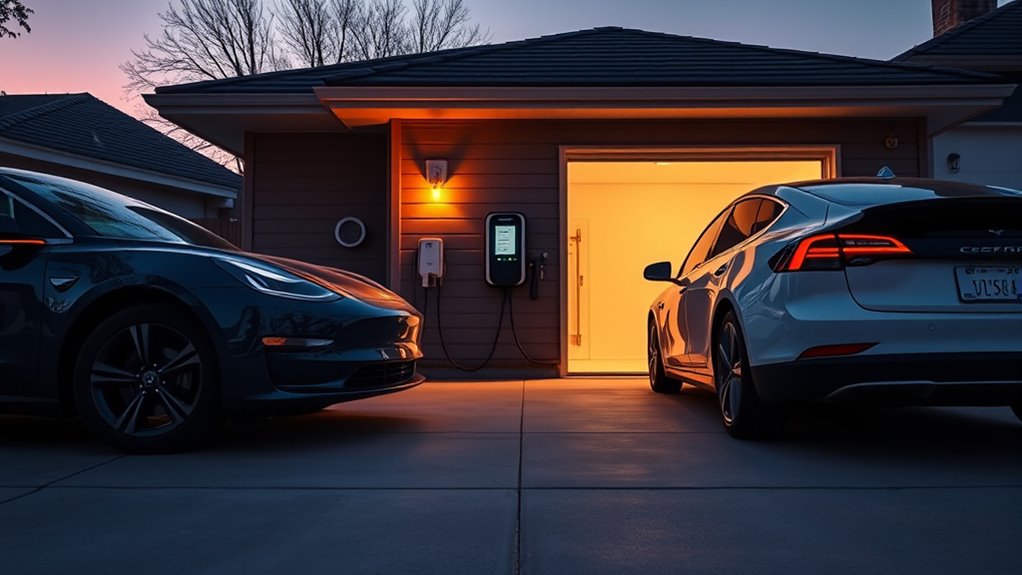
Yes, you can charge two EVs at home. The best setup depends on three questions: how far each vehicle drives each day, how quickly each battery must recover, and how much electrical capacity your home can safely support.
If both EVs only need light daily top-offs, one Level 2 charger may be enough. If both cars often arrive home low and need to leave full the next morning, you may need a dual-port charger or two separate Level 2 chargers. If panel capacity is tight, smart load management can reduce charging power automatically so the system stays within safe limits.
Level 1 and Level 2 charging are both AC charging methods, while DC fast charging is usually for public or commercial sites. For home use, most owners focus on 120V Level 1 as a backup and 208V or 240V Level 2 as the main charging option. The SAE J1772 charging standard defines common AC charging capabilities used by many North American EVs and EVSE systems.
Warning: Do not add a second EV charger just because your panel has open breaker spaces. EV charging is a long-duration electrical load. A licensed electrician should confirm the load calculation, conductor size, breaker size, grounding, GFCI requirements, equipment listing, and local permit rules before installation.
Start With a Load Calculation
Before you buy another charger, start with a load calculation. Your main service size, such as 100A, 150A, or 200A, does not automatically tell you whether two EV chargers are safe. Your home may already have large loads from air conditioning, electric heat, a range, a dryer, a water heater, a hot tub, or workshop equipment.
A proper load calculation checks how much electrical demand your home can carry under code rules. It also helps decide whether you can install:
- one shared Level 2 charger,
- one Level 2 charger plus Level 1 backup,
- a smart splitter on an existing 240V circuit,
- a dual-port Level 2 charger with load sharing,
- two dedicated Level 2 chargers, or
- a charger with an energy management system that reduces output when the home is using more power.
The National Electrical Code is the main U.S. electrical-code reference for EV charging installations. Your local authority may also require permits, inspections, utility notification, or specific equipment rules.
Compare Two-EV Home Charging Options
The fastest setup is not always the best setup. The right choice is the one that meets your daily range needs without overspending or overloading your electrical system.
| Setup | Best For | Main Tradeoff |
| One shared Level 2 charger | Low to moderate daily mileage and predictable schedules | Requires plug-swapping or alternating nights |
| Level 2 plus Level 1 backup | One main commuter EV and one low-mileage EV or plug-in hybrid | Level 1 is very slow |
| Smart splitter | Homes with one usable 240V circuit and no easy second circuit | Must be listed, compatible, and used within its rating |
| Dual-port Level 2 charger | Two EVs parked near each other that often charge overnight | Power is usually shared between ports |
| Two dedicated Level 2 chargers | High-mileage households that need both EVs charging quickly | Highest electrical-capacity and installation demand |
Share One Level 2 Charger
You can share one Level 2 charger by alternating vehicles on a fixed charging schedule. This works well when each EV only needs a partial top-off each day and one overnight session can restore the range that was used.
Many households overestimate how much charging they need. If one driver uses 25 miles per day and the other uses 40 miles per day, a single Level 2 charger may easily recover that energy over several nights. If one vehicle has a long trip coming up, give that car priority and shift the other EV to the next night.
Charging Schedule Basics
A simple charging routine makes one charger easier to share. Assign each vehicle specific nights, then adjust only when someone has a longer drive planned.
- Give the higher-mileage EV the first charging slot.
- Use the vehicle app to set a target charge limit when possible.
- Plug in during lower-cost utility hours if your rate plan rewards off-peak charging.
- Check the state of charge before unplugging the other driver’s vehicle.
- Keep the cable parked safely so it does not become a trip hazard.
This setup works best when drivers communicate. If one person needs an unexpected full charge, swap nights early instead of waiting until bedtime.
Daily Range Needs
Choose your setup based on daily driving, not battery size alone. A 300-mile EV does not need a full charge every night if it only drives 35 miles per day.
Level 1 charging from a standard 120V outlet is slow and often only restores a few miles of range per hour. Level 2 charging is much faster and can often restore typical daily commuting range overnight, but actual speed depends on the EVSE amperage, the vehicle’s onboard charger, temperature, battery state of charge, and charging limits set in the car.
A helpful rule is to list each EV’s daily miles for one normal week. If the combined daily use is low, one Level 2 charger may be enough. If both EVs often need 80–150 miles restored overnight, plan for a dual-port or two-charger setup.
Overnight Power Sharing
Overnight charging is where one shared charger performs best. Most cars sit parked for many hours, and that long window gives you flexibility.
- Charge the vehicle with the lowest state of charge first.
- Use scheduled charging to start after peak utility hours.
- Set reasonable charge limits, such as 70% to 90% for routine daily use when your vehicle manual allows it.
- Save 100% charging for long trips or when the manufacturer recommends it for your battery type.
If you keep running into conflicts, that is a sign that your household has outgrown a single-port setup.
Pro Tip: Put a small weekly charging calendar near the charger or use shared reminders in your phone. A simple schedule prevents most two-EV charging conflicts before they happen.
Use a Level 1 Charger as Backup
You can use a Level 1 charger as backup when one EV only needs a small amount of energy or when the Level 2 station is busy. Level 1 plugs into a standard household outlet, but it is slow, so it is better for short commutes, plug-in hybrids, emergency top-offs, or temporary gaps.
Before using Level 1 for long overnight sessions, inspect the outlet and circuit. Avoid damaged outlets, loose plugs, extension cords, and power strips. If the outlet is old, warm, loose, or shared with other large loads, have it checked.
When Backup Charging Helps
Backup charging helps when both EVs need power but only one needs a large charge. For example, the long-commute EV can use Level 2 while the short-commute EV gains a small overnight top-off from Level 1.
- Use Level 1 for a low-mileage second car.
- Use it while waiting for a Level 2 installation.
- Use it when one EV only needs enough range for local errands.
- Use it as a fallback during scheduling conflicts.
This plan keeps costs low, but it should not be your main strategy if both EVs drive far every day.
Level 1 Speed Limits
A Level 1 charger is convenient because it uses a common 120V outlet, but speed is its limit. It may add only a small amount of range per hour, and a large battery can take days to refill from a low state of charge.
Use Level 1 when the vehicle has plenty of time parked and only needs a small top-off. If a driver regularly comes home with a low battery and needs a full day of driving range by morning, Level 1 will feel frustrating.
Best Use Cases
Level 1 charging works best as a supplement, not a replacement for faster home charging.
- One EV uses Level 2 overnight while the other slowly tops off on Level 1.
- A plug-in hybrid needs only a small battery refill.
- A second EV drives fewer than 20–30 miles on many days.
- You need temporary charging before a dual-port or second Level 2 installation.
If Level 1 becomes a daily source of stress, upgrade your charging plan instead of forcing a slow setup to do a fast job.
Install a Dual EV Charger
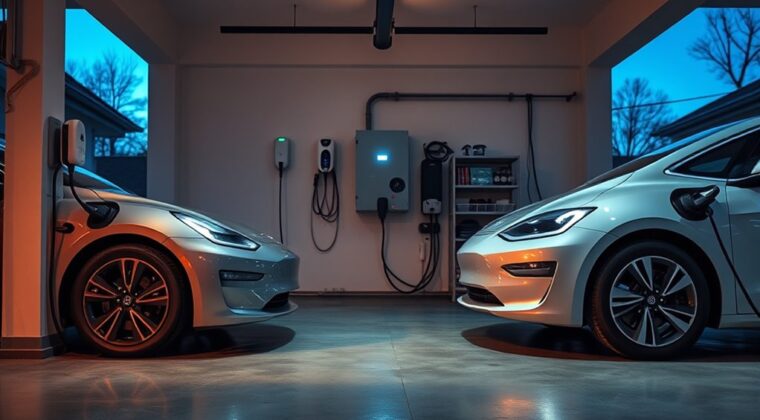
Installing a dual EV charger lets you charge two electric vehicles from one wall-mounted unit. Many dual-port chargers automatically split available power between the two ports, which helps both cars charge without requiring two separate wall boxes.
A dual-port charger is useful when both EVs park near each other and usually charge overnight. It also keeps the garage cleaner because you have one mounted unit, one circuit path, and two charging cables. The tradeoff is speed: when both vehicles are plugged in, each port may receive less power than a single vehicle would receive alone.
Check the charger manual before buying. Some dual-port units need a larger circuit than a single charger. Others use active load sharing to stay within a set amperage. Your electrician should confirm whether the selected charger, breaker, wiring, and panel capacity match the manufacturer instructions.
Add Two Level 2 Chargers
If you want each EV to charge independently, add two separate Level 2 chargers. This gives the most flexibility because each vehicle has its own cable, charging schedule, and circuit. It is the strongest option for two high-mileage drivers, rideshare use, long commutes, or households where both cars often return home low.
The downside is electrical demand. Each charger may need a dedicated 240V branch circuit, and two chargers running at the same time can use a large share of a home’s service capacity.
- Confirm the amperage for each EVSE.
- Confirm the vehicle’s maximum AC charging acceptance rate.
- Check whether the chargers can be configured to lower amperage.
- Ask whether the installation requires a permit or utility approval.
- Compare the cost of two full-speed circuits against a dual-port load-sharing unit.
Two Level 2 chargers are excellent when the home can support them. If the load calculation is tight, use lower-amperage settings or smart load management instead of forcing full-speed charging.
Let Smart Devices Balance the Load
Smart charging devices can balance power between EV chargers in real time. This is useful when the home does not have enough spare capacity for two chargers at full power.
Smart load sharing does not create extra electrical capacity. It controls how available capacity is divided so the home does not exceed safe limits.
With dynamic load management, the system monitors demand and reduces EV charging power when the home uses more electricity. When the dryer, oven, air conditioner, or water heater shuts off, the charger may allow more power to the EVs again.
Research on managed charging shows why this matters. Coordinated charging can reduce grid and feeder stress compared with uncontrolled charging, especially when many EVs charge during peak evening hours. Studies of EV charging control have found that shifting and managing charging loads can improve voltage and reduce stress on local infrastructure.
Smart load sharing can be built into some dual-port chargers, smart panels, energy management systems, or approved load-control devices. Use equipment that is listed for its purpose and installed according to the manufacturer’s instructions.
Match Your Setup to Home Power
Before you add a second EV charger, match the charging setup to your home’s electrical system. Do not assume that a bigger charger is automatically better. A lower-amperage Level 2 charger that runs safely every night is better than a high-output charger your panel cannot support.
Common home Level 2 setups may be configured at different amperages, such as 24A, 32A, 40A, or 48A depending on the EVSE, wiring, breaker, and local code. Higher amperage can charge faster, but it also demands more from the electrical system.
- Use one shared Level 2 charger if daily range needs are modest.
- Use a dual-port charger if both cars need regular overnight charging.
- Use two Level 2 chargers if both cars need faster independent charging and the panel can support it.
- Use smart load management if the panel is limited but simultaneous charging matters.
- Use Level 1 only as backup or for a low-mileage vehicle.
A licensed electrician can also help decide whether a panel upgrade, service upgrade, subpanel, smart panel, or managed charging device makes sense.
Check Connectors, Cable Reach, and Parking Layout
Two-EV charging is not only an electrical question. It is also a garage-layout question. Measure where each charge port sits when the vehicles are parked normally. Some EVs have the charge port at the front, some at the rear, and some on either side.
In North America, many non-Tesla EVs use J1772 for Level 1 and Level 2 AC charging, while many Tesla vehicles use NACS and can often charge from J1772 equipment with the correct adapter. Newer vehicles and chargers may vary, so check both vehicle manuals before buying equipment.
- Make sure the cable reaches both vehicles without crossing a walkway.
- Do not stretch the cable tightly across the garage.
- Keep the connector off the floor when not in use.
- Choose an outdoor-rated EVSE if the charger will be exposed to weather.
- Check whether the charger works with your vehicle connector or requires an adapter.
A dual-port charger is less useful if one cable cannot safely reach the second car. In that case, two charger locations or a different parking pattern may work better.
Use Utility Rates and Scheduling
Charging two EVs can raise your electric bill, but scheduling can help. Many utilities offer time-of-use plans, EV charging plans, or overnight rates. If your plan charges less at night, set both cars or chargers to start after the lower-rate window begins.
Smart chargers can also track energy use, estimate charging cost, and delay charging until off-peak hours. This is especially helpful when two EVs are plugged in because both vehicles may otherwise start charging at the same time in the early evening.
Note: Vehicle apps and charger apps can both control schedules. If both are active, confirm they do not conflict. A car-side schedule may prevent charging even when the wall charger is ready.
Compare Costs, Speed, and Safety
Once you know your electrical capacity, compare cost, charging speed, and safety.
The cheapest option is usually sharing an existing Level 2 charger. A Level 1 backup also keeps costs down, but it is slow. A smart splitter can be cost-effective if it is compatible with your circuit and equipment. A dual-port charger usually costs more than a single charger but may be cleaner than installing two separate units. Two separate Level 2 chargers give the most convenience, but they can require the most electrical work.
For speed, focus on daily range recovery. A common Level 2 setup may restore enough range overnight for most commuting, but full charging from a very low battery takes longer and depends on the battery size and charger output. If both EVs need high mileage every day, plan for more charging capacity.
For safety, choose listed EVSE, follow the manual, avoid damaged receptacles, do not use undersized extension cords, and keep outdoor equipment rated for the weather. New 240V circuits and hardwired chargers should be installed by a licensed electrician.
What If Both EVs Are Low at the Same Time?
If both EVs come home low, prioritize the vehicle that must leave first or drive farthest the next day. Then use the fastest safe charging option available.
- Plug in the first vehicle as soon as it arrives.
- Set a realistic target, such as enough range for the morning drive instead of a full battery.
- Switch to the second EV when the first has enough range.
- Use public DC fast charging only if home charging cannot meet the next-day need.
- Review the pattern. If this happens often, upgrade to dual-port charging or two Level 2 chargers.
One emergency night does not mean your setup is wrong. Repeated conflicts mean your charging plan does not match your driving habits.
Choose the Best Two-EV Charging Setup
The best two-EV charging setup depends on mileage, parking layout, panel capacity, and budget.
Use one shared Level 2 charger if both vehicles drive modest miles and your household can follow a schedule. Add Level 1 as a backup if one EV only needs light top-offs. Choose a smart splitter when you need to share one suitable 240V circuit with compatible equipment. Choose a dual-port charger when both EVs park close together and often charge overnight. Choose two separate Level 2 chargers when both vehicles need independent charging and your electrical system can support the load.
Before you commit, ask three simple questions:
- How many miles does each EV need to recover on a normal night?
- Can both cars park within safe cable reach?
- Can the electrical system support the setup without unsafe overload?
If the answer to the third question is unclear, pause the purchase and get a load calculation. Safe charging is the foundation of every good two-EV setup.
Frequently Asked Questions
Can you charge two EVs at the same time at home?
Yes, you can charge two EVs at the same time at home if the equipment and electrical system are designed for it. Common options include a dual-port charger, two dedicated Level 2 chargers, or a smart load-sharing system. A licensed electrician should verify the load calculation and installation requirements.
How do you charge multiple EVs at home?
Start by listing each vehicle’s daily mileage, then check your panel capacity with a proper load calculation. From there, choose one shared Level 2 charger, a Level 1 backup, a smart splitter, a dual-port charger, or two separate Level 2 chargers. Use scheduling and off-peak utility rates when available.
Can you have two EV chargers on one circuit?
Only if the equipment is specifically designed and listed for that kind of load sharing. Do not place two standard EV chargers on one circuit unless the charger system, smart splitter, or energy management device is approved for that use and installed according to code and the manufacturer instructions.
How many EVs can I charge at home?
You can charge one, two, or more EVs at home if your electrical system, parking layout, and charging equipment support it. The practical limit depends on service capacity, load management, charger amperage, daily mileage, and whether the vehicles need to charge at the same time.
Is a dual-port EV charger better than two separate chargers?
A dual-port charger is often better for two EVs parked close together because it saves wall space and can share power automatically. Two separate chargers are better when both EVs need full independent charging speed, but they usually require more panel capacity and installation work.
Is Level 1 charging enough for a second EV?
Level 1 can be enough for a second EV if it drives very little each day or only needs occasional top-offs. It is usually too slow for a high-mileage second EV, especially if the first EV already uses the main Level 2 charger every night.
Conclusion
To charge two EVs at home without problems, match your setup to your driving habits and your home’s electrical capacity. One shared Level 2 charger is enough for many low-mileage households, while a dual-port charger, smart splitter, or two dedicated Level 2 chargers can make sense when both EVs need regular overnight charging. The safest path is simple: calculate your daily range needs, verify the electrical load, use listed equipment, follow local code, and have a licensed electrician handle new 240V circuits or hardwired charger work.
Sources
- SAE International — SAE J1772 Conductive Charge Coupler — backs up Level 1 and Level 2 AC charging standards and connector context.
- NFPA 70: National Electrical Code — backs up the need to follow electrical-code requirements for EV charging installations.
- ENERGY STAR Certified EVSE Product Finder — supports choosing certified electric vehicle supply equipment.
- NREL: The 2030 National Charging Network — supports the importance of residential Level 1 and Level 2 charging in EV infrastructure planning.
- Residential Level 2 PEV Charging and Feeder Voltage Study — supports the value of managed charging and load-shifting strategies.
- Securing the Electric Vehicle Charging Infrastructure — supports smart charging, managed chargers, and grid-load control considerations.