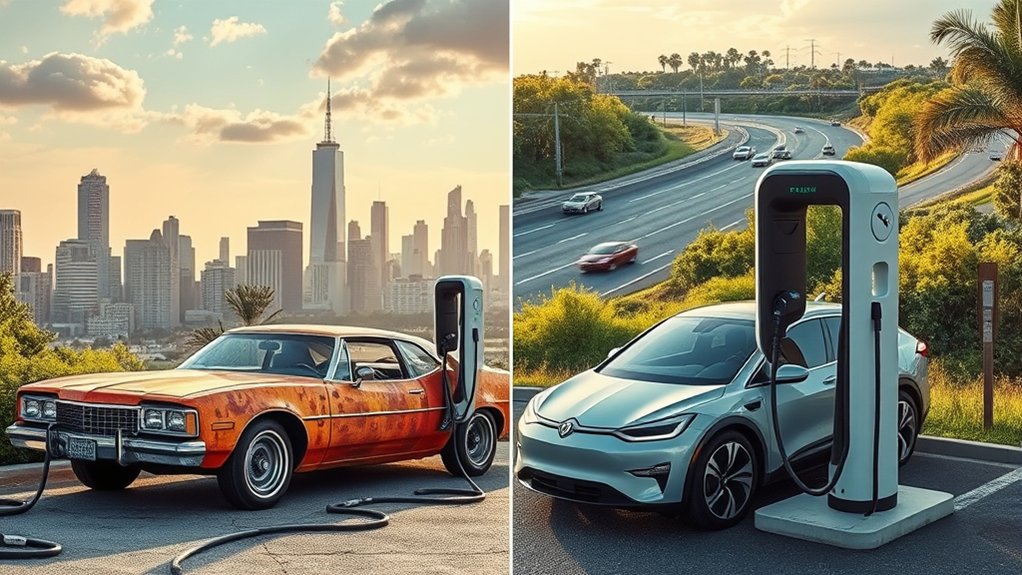
The history of EV charging in the United States starts long before today’s fast-charging hubs. Early electric cars were quiet and easy to drive, but charging was slow, batteries were heavy, and public infrastructure barely existed. Over time, better batteries, cleaner-air rules, federal funding, home charging, public networks, and Tesla’s Supercharger system changed how drivers think about electric vehicle ownership.
Quick Answer
EV charging in the U.S. evolved from slow, limited battery charging in the late 1800s to home Level 2 charging, public DC fast charging, Tesla Superchargers, and newer open-access networks. The biggest turning points were early EV popularity, gasoline’s rise, 1990s clean-air rules, Recovery Act funding, Tesla’s fast-charging network, NEVI funding, and NACS/J3400 standardization.
Key Takeaways
- Electric vehicles were popular in the early 1900s because they were quiet, easy to operate, and useful for short city trips.
- Gasoline cars gained the advantage after the Model T, cheaper fuel, better roads, and the electric starter made gas vehicles easier to own.
- Modern EV charging grew from 1990s emissions rules, battery advances, public funding, private networks, and faster DC charging.
- Tesla’s Supercharger network helped make long-distance EV travel more practical, and NACS is now tied to the SAE J3400 charging standard.
- Today’s charging ecosystem includes home charging, workplace charging, public Level 2 charging, DC fast charging, apps, subscriptions, and open-access payment rules.
Early Innovations: The Birth of Electric Vehicles

Electric vehicles did not begin with one single inventor. According to the U.S. Department of Energy, the first practical electric vehicles came from a series of 1800s breakthroughs in batteries and electric motors. Early work happened in several countries, including the United States, the Netherlands, France, England, and Hungary.
In the U.S., William Morrison of Des Moines, Iowa, built an early electric vehicle around 1890. It was a six-passenger electrified wagon that could reach about 14 miles per hour. That may sound slow today, but it helped prove that electric power could move people, not just small experiments.
By 1900, electric cars accounted for around a third of vehicles on U.S. roads. They were popular in cities because they were quieter than gasoline cars, easier to start, and cleaner at the tailpipe than early internal-combustion vehicles.
Early EVs were not a strange side path in automotive history. Around 1900, they were one of the main ways Americans imagined the future of personal transportation.
Why Early EV Charging Was So Hard
The main weakness was not the electric motor. It was the battery and the charging setup around it. Early lead-acid batteries were heavy, stored limited energy, and took a long time to recharge. Many early EVs were best for short city trips because long-distance travel required more range than the battery could provide.
Charging also depended on where electricity was available. Cities had better access to electricity than rural areas, so EVs made more sense for urban buyers. Outside cities, gasoline became easier to buy as fuel stations spread and roads improved.
Early EV ownership could involve slow charging, battery maintenance, and limited route planning. Those limits made electric cars convenient for some city drivers but frustrating for people who wanted longer trips.
EV Charging Timeline at a Glance
| Era | What Changed | Why It Mattered |
| Late 1800s to early 1900s | Early electric cars used heavy batteries and slow charging. | EVs worked well for short city trips but struggled with range and charging convenience. |
| 1908 to 1930s | The Ford Model T, cheaper gasoline, and better roads favored gas cars. | EV charging infrastructure faded as gasoline vehicles became cheaper and more flexible. |
| 1970s | Oil shocks revived interest in alternatives to gasoline. | Research returned, but batteries and charging were still not ready for mass adoption. |
| 1990s | Clean-air rules, California’s ZEV program, and battery research pushed EV development. | Automakers tested modern EVs and charging systems, including the GM EV1 era. |
| 2009 to 2013 | Recovery Act funding helped install more than 18,000 residential, commercial, and public chargers. | Charging moved from small pilots to a wider national buildout. |
| 2012 onward | Tesla launched its Supercharger network and built fast chargers along travel routes. | Long-distance EV travel became easier for Tesla drivers and pushed competitors to improve. |
| 2020s | NEVI funding, more DC fast chargers, and NACS/J3400 adoption changed the public charging market. | Charging is becoming more standardized, more open, and easier to find. |
How Gasoline Cars Took the Lead
Electric cars had early advantages, but gasoline cars improved quickly. The Ford Model T, introduced in 1908, made gasoline-powered cars more affordable for many buyers. By 1912, the electric starter also removed one of gasoline cars’ biggest problems: the dangerous and tiring hand crank.
Gasoline also became easier to find as filling stations spread. Better roads encouraged longer trips, which favored vehicles with more range and faster refueling. In contrast, many rural areas still had limited access to electricity.
By the 1930s, electric vehicles had mostly disappeared from the mainstream U.S. passenger-car market. Charging infrastructure never had time to mature because gasoline won on cost, range, speed, and convenience.
20th Century Charging Methods: From Slow Experiments to Modern Standards
For much of the 20th century, EV charging stayed small and experimental. Electric vehicles survived in limited uses such as delivery vehicles, industrial vehicles, and research programs. The charging problem was simple to describe but hard to solve: batteries needed to store more energy, charge faster, last longer, and cost less.
By the late 20th century, charging became more organized. Automakers and utilities tested conductive chargers, inductive paddle chargers, and early public stations. These systems were not always compatible with each other, which made public charging harder to scale.
That lesson still matters today. A charging network is not just a plug in a parking lot. It needs hardware, software, payment systems, safety standards, reliable maintenance, clear pricing, and connectors that match the vehicles using it.
EV Charging’s Resurgence in the 1990s
The 1990s did not bring mass EV adoption, but the decade helped restart the modern EV conversation. The key drivers were clean-air policy, state regulation, battery research, and pressure to cut urban pollution.
The California Air Resources Board’s Zero-Emission Vehicle Regulation began in 1990 and required automakers to deliver zero-emission vehicles to the California market. Federal policies, including the 1990 Clean Air Act Amendments and the 1992 Energy Policy Act, also helped renew attention on electric-drive vehicles.
General Motors introduced the EV1 in 1996. Toyota released the Prius in Japan in 1997, then brought it to more markets later. These vehicles were different, but they showed that electric motors, advanced batteries, and charging systems could return to serious automotive development.
Note: The 1990s revival was not mainly about high fuel prices. It was more about emissions rules, state policy, battery work, and automaker experiments that prepared the market for the 2000s and 2010s.
The Three Main Charging Levels Drivers Use Today
Modern EV charging became easier to understand once charging levels became more common in consumer language. The Alternative Fuels Data Center explains that many EV owners do most charging at home, while public stations, workplaces, hotels, shopping centers, and parking areas add flexibility.
Level 1 Charging
Level 1 charging uses a standard 120-volt household outlet. It is the slowest option, but it can work for drivers with short daily trips and enough overnight parking time. It is also useful as a backup when faster charging is not available.
Level 2 Charging
Level 2 charging usually uses 240 volts at home or 208 volts in many commercial settings. It is much faster than Level 1 and is common at homes, workplaces, apartments, parking garages, hotels, and shopping areas. For many EV owners, a Level 2 charger at home is the main reason daily EV use feels easy.
DC Fast Charging
DC fast charging, sometimes called Level 3 charging in casual use, sends direct current to the battery through off-board charging equipment. It is designed for road trips, highway stops, fleet use, and quick top-ups. It is not usually a home charging option because it needs much more electrical capacity and commercial-grade equipment.
Warning: Do not treat a home Level 2 charger like a normal appliance if it needs a new circuit. Use a qualified electrician, follow local code, and check permit rules before installing high-power charging equipment.
How Government Incentives Expanded EV Charging Access
Government support helped charging grow from scattered pilot projects into a larger national network. Through the American Recovery and Reinvestment Act, the Energy Department invested more than $115 million to help build charging infrastructure and install more than 18,000 residential, commercial, and public chargers across the country.
Later, the National Electric Vehicle Infrastructure (NEVI) Formula Program gave states funding to deploy EV charging along designated corridors. NEVI also matters because it focuses on public access, non-proprietary charging, open payment methods, uptime, operation, maintenance, and data sharing.
Tax incentives also played a role, but they should be described carefully. As of July 2026, the IRS says the individual Alternative Fuel Vehicle Refueling Property Credit applied to qualifying charging property placed in service from January 1, 2023, to June 30, 2026. That means it should not be described as a permanent, always-current rebate.
How Tesla’s Supercharger Network Changed EV Charging
Tesla’s Supercharger network changed expectations for public EV charging because it combined fast charging, route planning, charger availability data, and a plug-and-charge experience. Instead of making drivers search for random chargers, Tesla built a network around common travel routes and in-car navigation.
Tesla now states that its Supercharger network has 80,000+ global Superchargers. It also says Superchargers can add up to 200 miles of range in 15 minutes, depending on the vehicle, charger, battery condition, temperature, and state of charge.
The influence went beyond Tesla drivers. Other charging companies and automakers had to compete on speed, reliability, charger location, and app experience. Tesla also helped make fast charging part of the normal EV ownership conversation, not just a technical feature.
Rapid Charging Capability
The biggest Supercharger benefit was time. Early EV charging could take many hours. DC fast charging cut road-trip stops to a more practical window. Fast charging still slows as the battery fills, especially above roughly 80%, but the early part of the session can add range quickly.
Network Growth and Route Planning
Charging is most useful when it appears where drivers need it. Tesla placed many Superchargers along highways and popular travel routes, then connected them to in-car trip planning. That reduced range anxiety because drivers could see charging stops before leaving.
From Tesla Connector to NACS/J3400
Tesla’s connector was once mainly a Tesla-only advantage in North America. That changed when Tesla opened the North American Charging System, commonly called NACS, for wider adoption. Tesla Support now describes NACS as the common name for the SAE J3400 standard, and many non-Tesla EVs can use compatible Superchargers through NACS charge ports, approved adapters, or Magic Dock sites.
This matters because connector compatibility has always been one of EV charging’s biggest problems. A larger shared standard can reduce confusion for drivers and help automakers, charging networks, and hardware suppliers build toward the same system.
How Public Charging Became a Real Network
Public charging keeps growing because drivers need more than home charging. They need charging at apartments, workplaces, stores, hotels, highway stops, city parking areas, and fleet depots. The AFDC charging-stations page notes that tens of thousands of EV charging stations are available in the United States, and that public and workplace stations support residential charging.
A 2024 NREL report using AFDC Station Locator data counted 188,096 public EV charging ports in Q2 2024. It also found that public DC fast-charging ports grew by 7.4% in that quarter, while public Level 2 charging still made up most public ports.
Those details are important because “station” and “port” do not mean the same thing. A station is a site. A port is a connector that can charge a vehicle. One charging station may have several ports, just like one gas station can have several pumps.
How Charging Networks Handle Payment and Access
Early public charging often required the right network account, the right app, and the right connector. That made charging harder than buying gasoline. Modern charging networks are improving this with credit-card readers, mobile apps, roaming agreements, plug-and-charge systems, and membership plans.
Payment models vary by network. You may see:
- Pay-as-you-go pricing based on energy, time, or session fees.
- Membership pricing that lowers the per-session cost for frequent users.
- Automaker access plans tied to a vehicle brand or charging partner.
- Free or discounted charging at some hotels, workplaces, stores, or promotional programs.
Open payment rules are becoming more important. NEVI-funded chargers must support open-access payment methods, which helps drivers charge without needing a closed membership first.
What’s Next for EV Charging?
The next stage of EV charging is less about proving that EVs can work and more about making charging simple, reliable, and easy to understand. Several trends are shaping that future.
Faster and More Reliable Fast Charging
More DC fast chargers are being installed, and newer vehicles can often accept higher peak charging rates. Reliability matters as much as speed. A charger that is broken, blocked, or hard to start does not help drivers, even if it has impressive power ratings.
Better Home and Apartment Charging
Home charging remains one of the strongest advantages of EV ownership. The next challenge is giving renters, condo owners, and apartment residents better access to overnight charging. Shared parking lots, load management, smart panels, and utility programs can help.
Smart Charging and Grid Support
Smart charging can move charging to lower-cost or lower-demand hours. Bidirectional charging may also let some EVs send power back to a home, building, or grid, but availability depends on the vehicle, charger, utility rules, and local code.
Wireless Charging and Solid-State Batteries
Wireless charging and solid-state batteries are promising, but they are not the everyday norm for most drivers yet. Wireless charging could reduce plug-in friction in some parking locations. Solid-state batteries may improve charging speed, range, and durability if they reach mass production at reasonable cost.
Pro Tip: When comparing EV charging claims, look for three details: charger power, the vehicle’s maximum charging rate, and the battery’s state of charge. A charger can be fast, but the car and battery conditions decide how much power you actually receive.
Frequently Asked Questions
What are the main types of EV chargers?
The main types are Level 1, Level 2, and DC fast charging. Level 1 uses a standard household outlet and is slow. Level 2 is common at homes, workplaces, and public parking areas. DC fast charging is used for road trips, quick top-ups, and high-traffic public locations.
How do charging speeds vary between charger types?
Level 1 charging can take many hours or overnight for a small range gain. Level 2 is much faster and often works well for overnight home charging. DC fast charging can add a large amount of range in minutes, but the actual speed depends on the charger, vehicle, battery temperature, and battery state of charge.
What does it cost to install a home EV charger?
Cost varies by charger, wiring distance, panel capacity, labor rates, permits, and whether you need an electrical upgrade. A simple Level 2 installation can be much cheaper than a project that needs a panel upgrade. Get a quote from a qualified electrician before buying hardware.
Are there safety concerns with EV charging?
Yes. EV charging is safe when equipment is installed and used correctly, but high-power charging needs proper wiring, grounding, overcurrent protection, and code compliance. Do not use damaged cords, overloaded outlets, or unapproved adapters. For home Level 2 charging, use a qualified electrician when a new circuit is needed.
How do charging networks handle payment?
Charging networks may use mobile apps, credit cards, plug-and-charge systems, memberships, roaming agreements, or automaker accounts. Some sites charge by energy, some by time, and some add idle or congestion fees. NEVI-funded stations must support open-access payment methods.
What is NACS or SAE J3400?
NACS stands for North American Charging System. Tesla originally developed the connector, and it is now tied to the SAE J3400 standard. Many automakers have adopted or are adopting NACS/J3400 for North America, which should make future public charging easier for more drivers.
Why did Tesla’s Supercharger network matter so much?
Tesla’s network mattered because it combined fast charging, route planning, simple payment, charger availability data, and reliable station placement. That made long-distance EV travel easier and pushed the rest of the industry to improve public charging speed and reliability.
Conclusion
The history of EV charging is a story of solving the same problem again and again: how to make electric driving convenient. Early EVs proved that electric cars could be quiet, clean at the tailpipe, and easy to drive, but weak batteries and slow charging held them back. Gasoline won the first round because it offered lower cost, longer range, and faster refueling.
Modern EV charging is different. Home Level 2 chargers, public DC fast chargers, Tesla’s Supercharger network, federal infrastructure funding, and NACS/J3400 standardization have made EV ownership far more practical. The next challenge is not just adding more chargers. It is making every charger easy to find, easy to pay for, safe to use, and reliable when drivers arrive.
Sources
- U.S. Department of Energy: The History of the Electric Car — early EV history, William Morrison, Model T impact, EV1, Recovery Act charging buildout.
- California Air Resources Board: Zero-Emission Vehicle Regulation — California ZEV program background and 1990 start.
- Alternative Fuels Data Center: Electricity Basics — EV charging basics, home charging, public charging, and electricity as a transportation fuel.
- NREL/AFDC: Electric Vehicle Charging Infrastructure Trends, Q2 2024 — public charging port growth, DC fast charging growth, and infrastructure trend data.
- Tesla Supercharger — current Supercharger network size, charging speed claim, and max charging-rate information.
- IRS: Alternative Fuel Vehicle Refueling Property Credit — charger tax-credit eligibility dates and limits.