
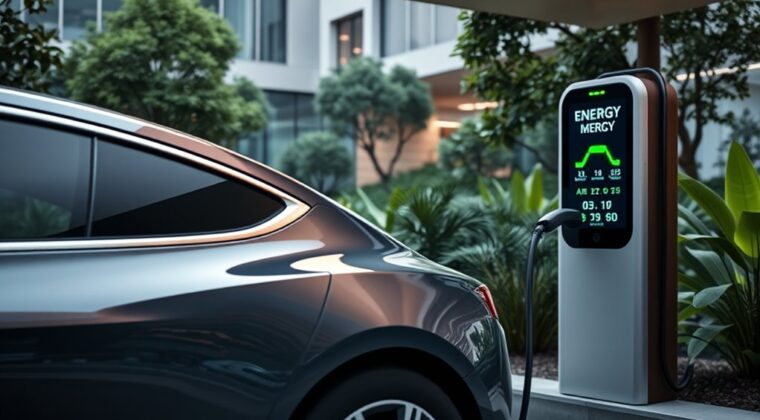
Amperage in EV charging means the amount of electrical current your charger can deliver to your electric vehicle. More amps can mean faster charging, but only when the voltage, circuit, charger, and your vehicle’s onboard charger all support that higher current.
Quick Answer
For most home EV charging, 32A or 40A Level 2 charging is the best balance of speed, cost, and practicality. A 32A charger provides about 7.7 kW at 240V, while a 40A charger provides about 9.6 kW. Your car, circuit, and electrical panel still set the real limit.
Key Takeaways
- Amps measure current. Kilowatts measure charging power. For single-phase AC charging, use this simple estimate: volts × amps ÷ 1,000 = kW.
- A 40A Level 2 charger can deliver about 9.6 kW at 240V, but less on 208V service and only if your EV can accept that much AC power.
- Home EV chargers are continuous loads, so the circuit breaker is larger than the charger output. For example, a 40A charger output usually needs a 50A circuit.
- Higher amperage is not always worth the cost. Your daily miles, vehicle onboard charger, panel capacity, and installation requirements matter more than choosing the biggest number.
At a Glance
| Best Home Range | 32A to 40A Level 2 for most EV owners |
| Difficulty | Moderate to high, depending on your panel, wiring route, permits, and charger type |
| Tools Needed | Vehicle manual, charger spec sheet, electrical panel review, and a licensed electrician for installation |
| Cost | Varies widely. A simple install costs less than one that needs new wiring, a load-management system, or a panel/service upgrade. |
Understanding the Basics of Amperage in EV Charging
Amperage, shown as amps or A, measures electrical current. In EV charging, it tells you how much current the charging equipment can send to the vehicle.
Charging power is usually shown in kilowatts, or kW. For single-phase home AC charging, the simple formula is:
Volts × amps ÷ 1,000 = kilowatts. A 240V charger at 40A delivers about 9.6 kW before real-world losses.
That means a 32A charger on 240V service delivers about 7.7 kW, a 40A charger delivers about 9.6 kW, and a 48A charger delivers about 11.5 kW. Tesla lists these same common 240V power levels for its Wall Connector output settings, with 32A, 40A, and 48A output tied to 40A, 50A, and 60A circuits respectively in its charging-speed table.
Voltage matters, too. Many homes use 240V service for Level 2 charging, while some apartments, workplaces, and commercial properties use 208V service. At 208V, the same 40A charger delivers about 8.3 kW instead of 9.6 kW.
The U.S. Department of Energy’s Alternative Fuels Data Center explains that EV charging time depends on battery state of charge, battery capacity, battery type, the vehicle’s internal charger capacity, charging level, charger power output, and the available electrical service.
Common Amperage Levels for EV Charging at Home
Home charging usually falls into two groups: Level 1 and Level 2.
Level 1 charging uses a standard 120V outlet. It is slow but simple, and it may work for plug-in hybrids or drivers with short daily trips. The AFDC estimates Level 1 charging at about 5 miles of range per hour, assuming about 1.9 kW of charging power.
Level 2 charging uses 240V service in typical residential settings or 208V service in many commercial settings. It is the usual choice for faster home charging because it can often recharge a typical EV overnight. AFDC lists Level 2 output as a wide range, about 2.9 to 19.2 kW, with many residential chargers operating at lower to midrange amperage settings.
| Charger Output | Power at 240V | Typical Circuit Size | Best For |
|---|---|---|---|
| 12A Level 1 | About 1.4 kW at 120V | 15A circuit | Short commutes, plug-in hybrids, backup charging |
| 16A Level 2 | About 3.8 kW | 20A circuit | Lower-capacity panels or slower overnight charging |
| 24A Level 2 | About 5.8 kW | 30A circuit | Moderate daily driving |
| 32A Level 2 | About 7.7 kW | 40A circuit | Most daily EV charging needs |
| 40A Level 2 | About 9.6 kW | 50A circuit | Faster overnight charging and longer commutes |
| 48A Level 2 | About 11.5 kW | 60A circuit | EVs with higher AC acceptance and homes with enough panel capacity |
Warning: EV chargers are continuous electrical loads. Do not size the breaker, wire, outlet, or hardwired connection by guesswork. Follow local code, permit rules, the charger manual, and a licensed electrician’s load calculation.
How Amperage Affects Charging Speed in Electric Vehicles
At the same voltage, more amperage usually means more charging power. A 40A Level 2 charger on 240V service can deliver about 9.6 kW, while a 32A charger delivers about 7.7 kW.
Range added per hour is not fixed, though. It depends on your EV’s efficiency. A charger delivering 9.6 kWh in one hour may add more miles to a very efficient sedan than to a heavy truck or large SUV.
A simple estimate is:
- Charging power: 240V × 40A ÷ 1,000 = 9.6 kW
- Energy delivered in one hour: about 9.6 kWh before losses
- Estimated range: 9.6 kWh × your vehicle’s miles per kWh
For example, an EV that averages 3.3 miles per kWh may gain roughly 32 miles of range per hour from a 40A Level 2 charger before accounting for charging losses and conditions. That same charger may add fewer miles per hour to a less efficient vehicle.
How Amperage and kW Ratings Work Together in EV Charging
Amperage tells you current. Kilowatts tell you charging power. Both matter because the car’s battery stores energy in kilowatt-hours, or kWh.
Here are common examples at 240V:
- 16A: about 3.8 kW
- 24A: about 5.8 kW
- 32A: about 7.7 kW
- 40A: about 9.6 kW
- 48A: about 11.5 kW
If your EV has a 77 kWh battery and you add energy at 9.6 kW, the math suggests a full empty-to-full charge would take about 8 hours before losses and charging taper. Real charging may take longer because EVs slow charging at certain battery levels, especially near full.
Also, the charger on the wall is technically electric vehicle supply equipment, or EVSE. On AC charging, your vehicle’s onboard charger converts AC power to DC power for the battery. That onboard charger often decides the maximum AC charging speed your vehicle can use.
Why the Right Amperage for Your EV Is Crucial
The right amperage gives you enough charging speed without paying for electrical capacity you cannot use.
Key Charging Speed Factors
Charging speed depends on four main factors:
- Voltage: 240V residential service gives more power than 120V Level 1 charging. Some commercial and multifamily Level 2 setups use 208V, which lowers kW at the same amperage.
- Charger output: A 40A charger can deliver more current than a 32A charger if the circuit supports it.
- Vehicle onboard charger: If your EV can accept only 32A on AC, a 48A wall charger will not make it charge faster.
- Battery and software limits: Temperature, battery state of charge, and the vehicle’s battery management system can reduce charging speed.
Vehicle Compatibility Matters
Before choosing a charger, check your vehicle’s maximum AC charging rate in the owner’s manual or manufacturer app. Some EVs accept 48A AC charging, some accept 32A, and some plug-in hybrids accept far less.
This is why a higher-amp charger does not always pay off. If your EV accepts a maximum of 32A on AC, a 40A or 48A charger may still work, but the vehicle will draw only what it can use.
Connector type is separate from amperage. In North America, many EVs use J1772 for AC charging, while Tesla vehicles and many newer models use or are moving toward SAE J3400, often called NACS. Either way, the actual charging speed still depends on the EV, the charger, and the electrical circuit.
Cost vs. Benefit Analysis
For many drivers, 32A or 40A is the practical sweet spot. It is usually fast enough for overnight charging and may avoid the added cost of a more demanding 48A or higher installation.
A higher-amperage charger may make sense if:
- You drive long distances every day.
- Your EV has a large battery and a high AC charging limit.
- Your utility offers short off-peak charging windows.
- Your home electrical panel has enough spare capacity.
- You want to future-proof for a second EV, with proper load management.
If your daily driving is 30 to 50 miles, even a lower-output Level 2 charger may refill that energy overnight.
Why Higher Amperage Doesn’t Always Equal Faster Charging
Higher amperage helps only when the whole charging path can use it. The wall charger, circuit, vehicle inlet, onboard charger, battery system, and software all have limits.
For example, a 48A charger can provide up to about 11.5 kW at 240V. But if your vehicle’s onboard AC charger accepts only 7.7 kW, the vehicle will not draw the full 48A. It will charge at the lower vehicle limit.
Battery state of charge also matters. Charging from 20% to 60% may be faster than charging from 85% to 100% because many EVs reduce power near the top of the battery to protect the pack.
DC fast charging is different. Public DC fast chargers send DC power directly to the battery system and do not use the vehicle’s onboard AC charger in the same way. That is why a car can charge much faster at a compatible DC fast charger than it can at home, even if the home charger is high amperage.
Upgrading Your EV Charger Amperage: Key Considerations
Upgrading from Level 1 to Level 2, or from a lower-amp Level 2 charger to a higher-amp charger, can be worthwhile. Start with the limits of your home and your EV, not the biggest charger you can buy.
Safety and Compliance Requirements
The AFDC home charging guide states that charging equipment installations must comply with local and state codes, may require permits, and should account for NEC Article 625. It also notes that EV charging infrastructure is considered a continuous load.
In practical terms, that means a charger output is usually lower than the breaker rating. Common examples include:
- 16A charger output on a 20A circuit
- 24A charger output on a 30A circuit
- 32A charger output on a 40A circuit
- 40A charger output on a 50A circuit
- 48A charger output on a 60A circuit
Do not install a 40A-output charger on a 40A breaker unless the charger manual and local code specifically allow the configuration at a lower programmed output. A licensed electrician should confirm wire size, breaker size, load calculation, grounding, GFCI requirements, permits, and whether hardwiring is required.
Cost and Installation Factors
The cost of upgrading amperage depends on your current electrical setup. A garage close to the panel may be simpler. A detached garage, long wiring run, full electrical panel, older service, or outdoor installation can increase complexity.
Before buying a charger, check:
- Your EV’s maximum AC charging rate
- Your daily and weekly driving needs
- Your panel capacity and available breaker space
- Whether your utility offers EV rates or off-peak charging discounts
- Whether the charger is safety certified
- Whether you need a plug-in charger or a hardwired unit
- Whether local permits or inspections are required
The ENERGY STAR EV charger guide recommends certified chargers because they are tested for safety by a nationally recognized testing laboratory. ENERGY STAR also notes that certified models can reduce standby energy use and may include smart features such as remote monitoring and demand-response capability.
Pro Tip: If your panel cannot support a larger dedicated circuit, ask an electrician about a load-management device. It may allow safe EV charging without a full service upgrade, depending on your home and local code.
Practical Tips for Efficient EV Charging at Home
Use these steps to choose the right EV charging amperage for your home:
- Check your vehicle’s AC limit. Do not pay for 48A charging if your EV can only accept 32A.
- Estimate your daily energy use. Divide daily miles by your vehicle’s miles per kWh to estimate the kWh you need to replace.
- Match charging time to your schedule. If you park for 10 hours overnight, you may not need the fastest charger.
- Confirm your electrical capacity. Have a licensed electrician evaluate your panel, wiring route, breaker size, and local permit requirements.
- Choose safety-certified equipment. Look for products tested by a nationally recognized testing laboratory, such as ENERGY STAR certified models.
- Use scheduled charging when possible. Many EVs and smart chargers let you charge during off-peak utility hours.
- Follow your automaker’s battery guidance. Many EVs use a daily charge limit around 80%, but some battery types and manufacturers recommend different habits.
For most households, the best charger is not the highest-amp charger. It is the charger that safely replaces your daily driving range by the time you need the car again.
Note: If your EV already lets you schedule charging, track energy use, and set a charge limit, you may not need every smart feature built into a wall charger. Prioritize safety certification, correct amperage, cable length, and installation quality first.
Frequently Asked Questions
What amperage should I charge my EV at?
Most EV owners do well with 32A or 40A Level 2 charging at home. Choose based on your vehicle’s maximum AC charging rate, daily miles, panel capacity, and installation cost. If your EV accepts only 32A, a 48A charger will not make it charge faster.
Does 1 amp or 2 amp charge faster?
At the same voltage, 2 amps can deliver twice the current of 1 amp, so it can charge faster if the device can accept it. These tiny amperage levels are common in small electronics, not normal EV charging. Home EV charging usually uses much higher current, such as 12A Level 1 or 16A to 48A Level 2.
Is 40A charging better than 48A charging?
40A charging is often the better value because it provides about 9.6 kW at 240V and usually meets overnight charging needs. 48A charging can be faster at about 11.5 kW, but it usually needs a 60A circuit and an EV that can accept 48A AC charging.
What charges faster, 1.0A or 2.4A?
At the same voltage, 2.4A charges faster than 1.0A if the device allows that input. For EVs, this comparison is mostly theoretical because EV chargers use far higher current. The same principle still applies: more current can mean more power, but only when voltage and device limits allow it.
Can I install a 40A EV charger on a 40A breaker?
Usually no. A 40A charger output commonly requires a 50A circuit because EV charging is treated as a continuous load. A 40A breaker is commonly paired with a 32A charger output. Always follow the charger manual, local code, permit rules, and a licensed electrician’s load calculation.
Why is my EV charging slower than the charger’s amp rating?
Your EV may be limited by its onboard AC charger, battery temperature, state of charge, software settings, voltage, shared power, or the charger configuration. A wall charger can advertise a high output, but the car decides how much AC power it can safely accept.
Conclusion
Amperage is one of the main numbers that controls EV charging speed, but it does not work alone. A 40A Level 2 charger can deliver about 9.6 kW at 240V and is a strong choice for many homes. A 32A charger may be enough for normal daily driving, while a 48A charger is useful only when your EV and electrical system can support it.
The safest approach is simple: check your EV’s AC charging limit, estimate your daily miles, confirm your home’s electrical capacity, and have the installation handled according to local code. The right amperage is the one that charges your EV reliably, safely, and cost-effectively by the time you need to drive again.
Sources
- U.S. Department of Energy Alternative Fuels Data Center: Electric Vehicle Charging Stations — charging levels, Level 1 and Level 2 speed estimates, 240V/208V Level 2 service, charging-time factors, and connector context.
- U.S. Department of Energy Alternative Fuels Data Center: Charging Electric Vehicles at Home — home installation, electrical capacity, local code, permits, NEC Article 625, and continuous-load guidance.
- ENERGY STAR: Electric Vehicle Chargers — buying guidance, Level 1 and Level 2 overview, safety certification, standby energy savings, and smart charger features.
- Tesla Wall Connector Support — manufacturer example of 32A, 40A, and 48A output levels, kW ratings, circuit breaker pairings, and onboard charger limits.