
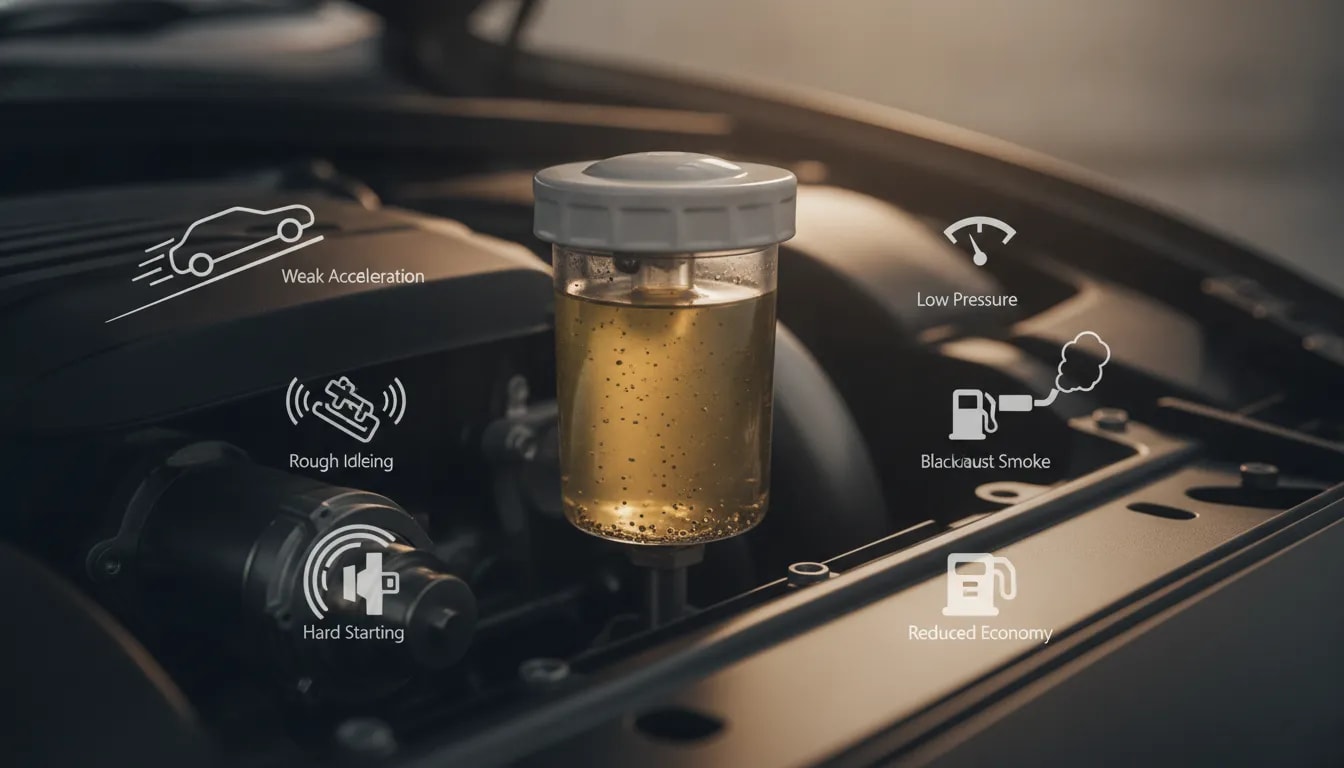
A clogged diesel fuel filter can cause weak acceleration, rough idling, hard starting, and low fuel pressure that triggers limp mode. Water in the fuel, worsening fuel economy, and black exhaust smoke are additional warning signs worth investigating, although they do not all prove the filter is blocked.
The most useful clue is often how the engine behaves under different conditions. A diesel that runs reasonably well at steady speed but struggles when climbing a hill may be getting enough fuel for light work, but not enough when demand increases.
Checking the filter’s service history early can help avoid unnecessary spending on a turbocharger or injectors. Just as importantly, acting before severe fuel starvation develops helps protect the fuel pump.
Key Takeaways
- Weak acceleration under load is an important early clue that a diesel fuel filter may be restricted.
- Water-in-fuel warnings need prompt attention, even when the engine still appears to run normally.
- P0087 indicates low fuel pressure but does not identify the fuel filter as the definite cause.
- Follow the vehicle’s filter replacement schedule and investigate symptoms before severe fuel starvation develops.
Table of Contents
- Seven Signs of a Bad Diesel Fuel Filter at a Glance
- Warnings That Need Prompt Attention
- How Fuel Restriction Changes Acceleration, Idle, and Starting
- Fuel Economy and Black Smoke: Supporting Clues, Not Proof
- Why Diesel Fuel Filters Matter So Much
- A Practical Check Order for Suspected Filter Problems
- How Often Should You Change a Diesel Fuel Filter?
- Common Diagnostic Mistakes to Avoid
- The Bottom Line
Seven Signs of a Bad Diesel Fuel Filter at a Glance
| Warning sign | What you may notice | What it tells you |
|---|---|---|
| Power loss under load | Hesitation during acceleration, overtaking, or hill climbing | A restriction may prevent fuel supply from keeping up with demand. |
| Rough idle or misfiring | Uneven running and shaking, especially when cold | Restricted or contaminated fuel supply deserves investigation. |
| Hard starting or no start | The engine cranks but takes longer to fire, or does not start | Insufficient fuel supply may prevent adequate injection pressure. |
| Water-in-fuel warning | A dashboard warning associated with the fuel separator | Accumulated water needs prompt attention, even if the filter is not clogged. |
| Limp mode | Severely reduced power and restricted engine speed | Low fuel pressure may have triggered protective engine management. |
| Increased fuel consumption | More frequent refueling or a rising consumption average | A supporting clue, not a reliable diagnosis on its own. |
| Black smoke under acceleration | Dark exhaust smoke when requesting power | A combustion problem that can have several causes beyond the fuel filter. |
You do not need to experience all seven symptoms before checking the filter. Power loss alone, particularly with overdue maintenance, is enough to make fuel filtration an early diagnostic consideration.
Warnings That Need Prompt Attention
Water-in-fuel warning light
A water-in-fuel warning is different from an ordinary performance complaint. It indicates that the separator has detected accumulated water, not necessarily that the filter element is blocked.
Many diesel fuel filter assemblies include a separator bowl and a sensor near its base. Because water is denser than diesel, it collects at the bottom. If allowed to enter the downstream fuel system, it can damage the high-pressure pump and injectors through corrosion and erosion.
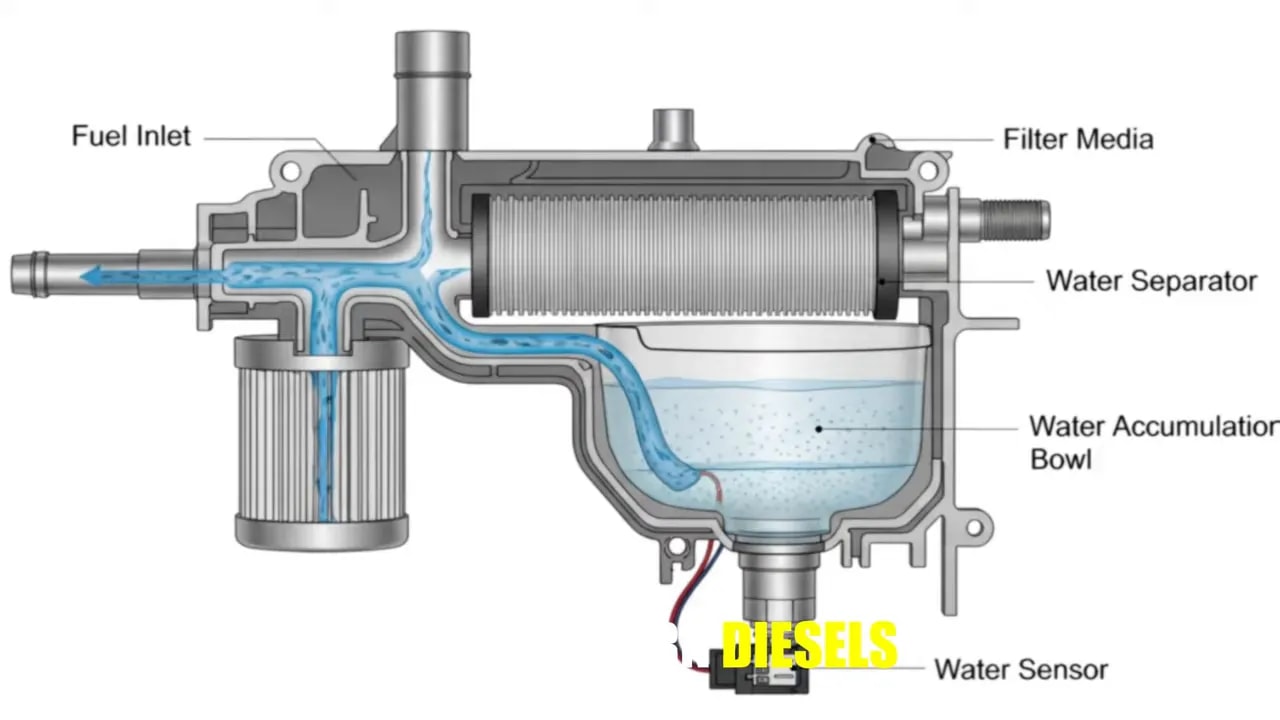
Address the warning promptly using the vehicle’s specified water-draining procedure. Many housings have a drain valve beneath the bowl, but the exact arrangement depends on the vehicle.
Draining accumulated water does not automatically require replacing the filter. If the warning repeatedly returns after draining, investigate the fuel source and have the filter assembly checked for replacement rather than treating each recurrence as routine.
Limp mode and fault code P0087
When fuel rail pressure becomes too low, the engine control unit may restrict power. Engine speed can also be limited, sometimes to around 2,000 rpm, although the behavior varies by vehicle.
The associated diagnostic code may be P0087, indicating fuel rail or system pressure is too low. This identifies a pressure problem. It does not, by itself, establish that the fuel filter is the cause.
A severely restricted filter is one possible explanation, especially when reduced acceleration and starting problems preceded limp mode. Do not keep requesting more power or assume that being able to move slowly means continued driving is harmless. Get to a safe stopping place and arrange assistance when severe fuel restriction is suspected.
Diesel fuel helps lubricate the fuel pump. Restricting that supply can place unnecessary strain on a component that is substantially more expensive than the filter.
How Fuel Restriction Changes Acceleration, Idle, and Starting
The three most direct drivability clues are reduced power, uneven running, and difficulty starting. They all relate to the same underlying issue: the engine cannot receive the fuel supply it needs under the conditions in which it is operating.
Power loss when accelerating or climbing hills
A partially clogged filter may still pass enough fuel for cruising or light throttle. The problem becomes more noticeable when demand rises, such as when:
- Accelerating onto a highway.
- Climbing a hill.
- Attempting to overtake.
- Requesting stronger acceleration than usual.
The engine may hesitate, feel unusually flat, or stop pulling as strongly as it normally does. On a common rail diesel, inadequate supply can cause rail pressure to fall, limiting the fuel available for injection.
This can resemble a turbo problem, a boost leak, or injector trouble. Check the fuel filter’s age and service status before assuming an expensive component has failed. That is a sensible starting point, not a reason to rule out other faults without testing.
Rough idle and misfiring
At idle, the engine needs relatively little fuel, so a modest restriction may initially go unnoticed. As the blockage worsens, even that lower demand can become difficult to meet.
You may feel an uneven shake through the seat or notice that the engine no longer runs smoothly. Cold conditions can make matters worse because diesel becomes more viscous, while water or wax accumulation can further restrict the filter.
Temperature behavior provides a useful comparison with glow plug problems:
- Roughness mainly after a cold start that improves as the engine warms: Glow plugs remain a possible cause.
- Roughness that persists when warm, particularly alongside weak acceleration: Fuel supply restriction deserves attention.
This distinction helps guide diagnosis, but it is not a conclusive test for either fault.
Long cranking or a diesel that will not start
A restricted filter can make starting take longer. With a more severe blockage, the engine may crank normally without firing because adequate fuel pressure cannot build for injection.
Cold weather introduces another mechanism. Diesel contains paraffin wax that remains dissolved under suitable conditions. As the fuel gets colder, wax can crystallize and collect in the filter, sharply reducing flow.
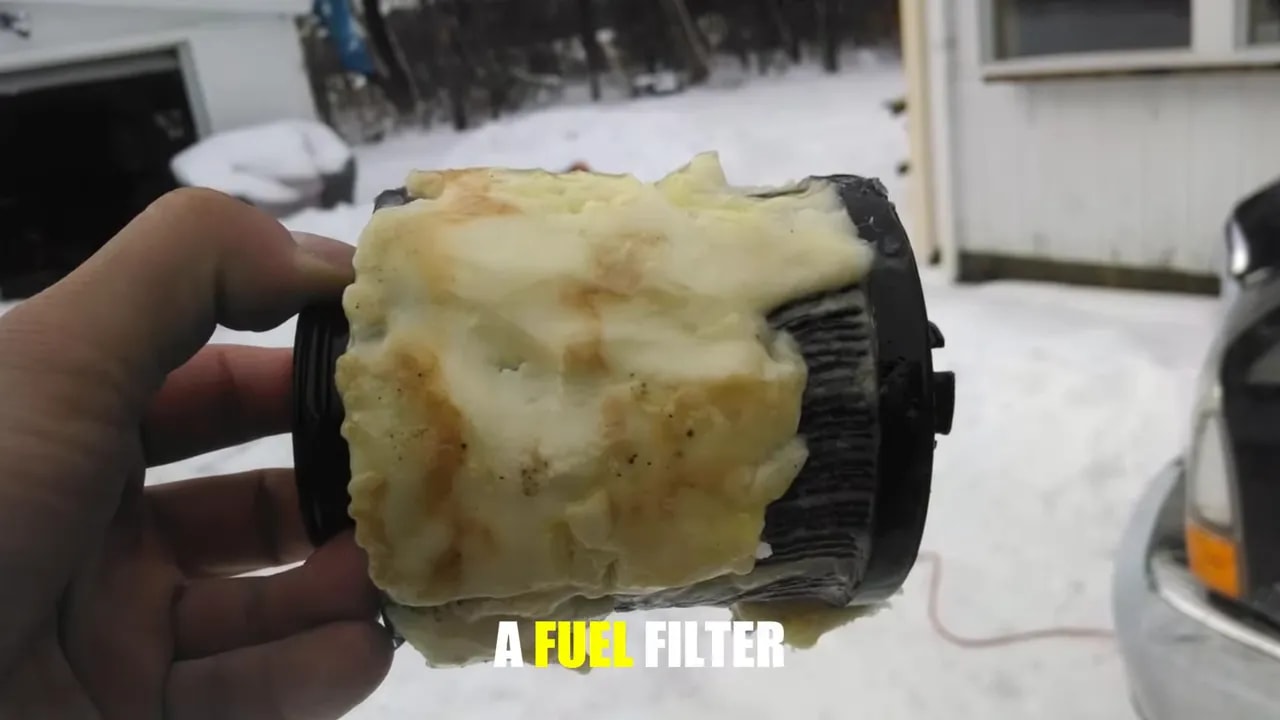
This helps explain why a vehicle with only mild performance problems can develop a sudden no-start problem during a cold spell. An already restricted filter has less remaining capacity to tolerate additional deposits.
Do not treat one outdoor temperature as a universal point at which every diesel filter will block. The practical clue is a starting problem that appears or becomes much worse in cold conditions, especially when the filter is already due for service.
Fuel Economy and Black Smoke: Supporting Clues, Not Proof
Increased diesel consumption
A gradual rise in fuel consumption may accompany deteriorating performance. You might notice more frequent fuel stops or a consumption average that has worsened over several months.
Changes in fuel pressure and the engine management system’s response can affect injection behavior. However, worse fuel economy alone does not confirm a clogged fuel filter. It becomes more useful when it appears with hesitation, rough running, or starting difficulty.
Use the combination of symptoms and maintenance history to decide whether filtration should be checked, rather than replacing the filter solely because one tank returned disappointing mileage.
Black smoke during acceleration
Black smoke points to a combustion problem, but it is less specific than load-related power loss. It can occur alongside poor diesel performance and warrants investigation, yet a blocked fuel filter should not be assumed to be the explanation.
Other possible causes include:
- A blocked air filter.
- A stuck or malfunctioning injector.
- Problems with the exhaust gas recirculation system, or EGR.
If smoke appears together with weak acceleration and rough idle, checking an overdue fuel filter is reasonable. If smoke is the only symptom, keep the diagnosis broader.
Why Diesel Fuel Filters Matter So Much
Common rail diesel injectors can operate at pressures exceeding 2,000 bar, approximately 29,000 psi. Their internal tolerances are measured in microns. One micron is one-thousandth of a millimeter, while a human hair is roughly 70 microns wide.
Particles small enough to be invisible to the naked eye can therefore threaten expensive injection components. The filter is a replaceable barrier designed to trap contamination before it reaches sensitive parts.
Primary and secondary filtration
Diesel fuel systems may use two filtration stages, although the number of filters and their placement vary by vehicle:
- Primary filtration: Captures larger contaminants such as dirt and rust, often with water separation.
- Secondary filtration: Provides finer particle removal before fuel reaches sensitive injection equipment.
Fine filtration may target particles around 2 to 4 microns. If your vehicle has two serviceable filters, both need attention according to its maintenance schedule. Replacing one does not establish that the other is clear.
The protection comes with a trade-off: as a filter captures contaminants, it can become restrictive. That is why filter replacement is scheduled maintenance rather than something to postpone until the engine stops running.
A Practical Check Order for Suspected Filter Problems
Use this sequence to organize the problem before authorizing expensive repairs:
- Identify urgent warnings. A water-in-fuel alert or severe reduced-power condition needs prompt attention rather than continued normal driving.
- Check the service record. Find the last filter replacement date and mileage, and determine whether the vehicle has more than one serviceable fuel filter.
- Describe the operating conditions. Note whether the problem occurs under load, only when cold, at idle, or during starting.
- Consider recent fuel quality and storage. Poor-quality fuel and extended periods parked can make the normal service interval less reliable.
- Record diagnostic codes if available. Treat P0087 as evidence of low fuel pressure, not automatic proof of filter failure.
- Address overdue filtration before jumping to costly components. If problems remain after the appropriate filter service, continue diagnosis rather than assuming the turbo or injectors must be responsible.
For example, a diesel that cruises normally but hesitates uphill, has an overdue filter, and is becoming harder to start presents a stronger case for investigating fuel restriction than a vehicle with black smoke alone.
How Often Should You Change a Diesel Fuel Filter?
Follow the replacement interval specified for your vehicle. A general reference range is about 15,000 to 30,000 kilometers, approximately 9,300 to 18,600 miles, but it is not a universal manufacturer requirement.
Normal intervals assume reasonably clean fuel and typical operating conditions. Earlier attention may be appropriate when the vehicle:
- Regularly receives poor-quality or potentially contaminated fuel.
- Operates in dusty conditions.
- Sits unused for long periods.
- Faces harsh winter conditions.
- Develops symptoms of fuel restriction before the scheduled replacement.
If the interval is unknown, around 15,000 kilometers can serve as a conservative planning reference while you obtain the correct maintenance information. It should not override the vehicle’s own schedule or be taken as a guarantee that the filter will remain clear until that mileage.
Filter cost versus fuel-system damage
A filter element may cost roughly £10 to £50 or $10 to $50, depending on the application. A high-pressure pump can cost several hundred to more than a thousand in replacement expenses, while injectors can also be costly. These are broad comparisons, not vehicle-specific repair quotes.
The important point is the difference in scale. Replacing a service item promptly is usually much less expensive than dealing with downstream damage after prolonged contamination or fuel starvation.
Common Diagnostic Mistakes to Avoid
- Waiting for a complete no-start: Restriction often produces useful warning signs earlier.
- Assuming every power-loss complaint is a turbo fault: An overdue fuel filter deserves an early check.
- Treating the symptoms as a fixed sequence: Power loss may precede rough idle and hard starting, but cold weather can make a blockage appear suddenly.
- Confusing water accumulation with clogging: A water warning requires attention even when fuel flow seems normal.
- Using black smoke or fuel consumption as a definitive test: Both have multiple possible explanations.
- Continuing to demand power in limp mode: Severe fuel restriction can place additional strain on the pump.
The Bottom Line
Load-related hesitation, rough running, and hard starting make a clogged diesel fuel filter worth checking early, especially when maintenance is overdue. Water warnings and severe low-pressure symptoms deserve prompt action.
Use the symptoms to guide diagnosis, not to declare a filter failure without further checks. The best next step is to verify the service history, follow the vehicle’s maintenance requirements, and address fuel restriction before it becomes a more expensive fuel-system problem.