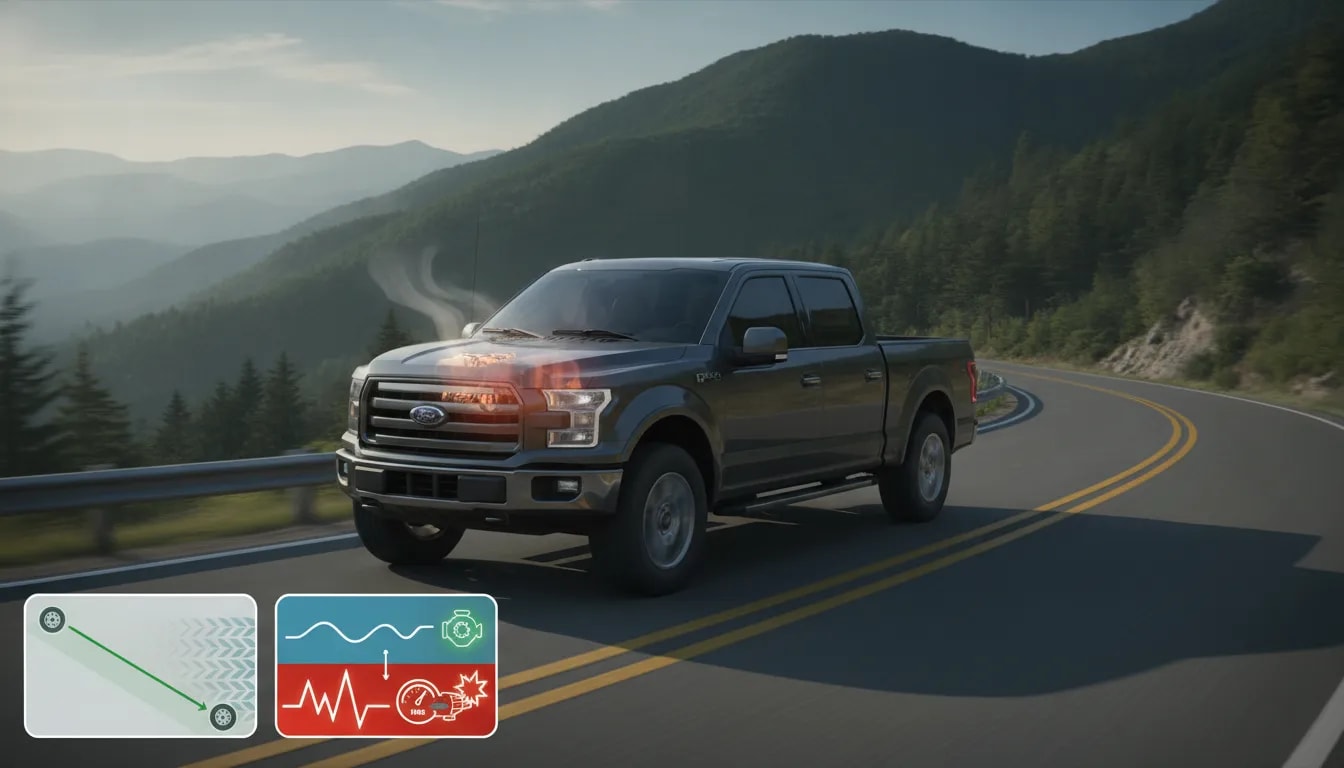
Engine braking does not normally damage a diesel engine when used correctly. Staying in gear, lifting off the accelerator, and selecting an appropriate lower gear can help control speed while reducing the workload on the friction brakes. A properly designed exhaust brake provides stronger slowing without making normal operation harmful to the engine.
The risks come from misuse: forcing an unsuitable downshift, exceeding the engine’s permitted speed, or using an aftermarket exhaust brake that creates excessive back pressure. Understanding those limits matters more than avoiding engine braking altogether.
For diesel cars, SUVs, vans, and trucks, the key is to distinguish ordinary engine braking from exhaust braking and the compression-release brakes used on heavy trucks.
Key Takeaways
- Properly used engine braking does not normally damage a diesel engine.
- Diesels often provide weaker natural braking because compressed air returns much of its energy.
- Exhaust brakes increase slowing by creating controlled resistance in the exhaust system.
- Smooth downshifts and appropriate gear selection help reduce brake workload without exceeding engine limits.
Table of Contents
- What Counts as Engine Braking in a Diesel?
- How to Engine Brake Safely in a Diesel
- Why Diesel Engine Braking Often Feels Weaker Than Petrol
- How Exhaust Brakes Create Stronger Diesel Braking
- Can Engine Braking Damage the Engine or Exhaust System?
- Benefits and Misconceptions
- Safety Mistakes to Avoid
- The Practical Bottom Line
What Counts as Engine Braking in a Diesel?
Engine braking is the slowing effect produced when the vehicle remains in gear and drives the engine after you release the accelerator. Instead of the engine delivering power to the wheels, the moving vehicle turns the engine against its internal resistance.
There are three related mechanisms, but they are not interchangeable:
| Braking method | How it slows the vehicle | Main distinction |
|---|---|---|
| Natural engine braking | Uses engine friction and pumping losses when you lift off in gear | Does not require a dedicated exhaust brake |
| Exhaust braking | Restricts exhaust flow so the pistons work against back pressure | Uses an exhaust valve or suitably controlled turbocharger |
| Compression-release braking, often called a Jake brake | Releases compressed cylinder air before it can return energy to the piston | A stronger system associated with heavy trucks |
A diesel does not need special braking hardware to provide some engine braking. However, its natural slowing effect may be modest. Strong exhaust braking depends on the equipment and controls fitted to the vehicle.
How to Engine Brake Safely in a Diesel
The basic approach is to stay in gear, release the accelerator, and use a suitable gear to achieve controlled slowing. Lower gears generally provide more braking at a given road speed because they turn the engine faster.
That does not mean the lowest available gear is the right choice. Gear selection must keep engine speed within the vehicle’s permitted limits.
For a Manual Transmission
- Lift off the accelerator while remaining in gear. Let the engine’s natural resistance begin slowing the vehicle.
- Use the brake pedal if more slowing is needed. Engine braking supplements the friction brakes rather than replacing them.
- Downshift progressively when appropriate. Choose a lower gear that suits the current road speed.
- Match engine speed to the lower gear. Release the clutch smoothly rather than abruptly forcing the engine to a much higher speed.
- Activate the exhaust brake if one is fitted. Follow the vehicle’s operating instructions.
Once the clutch is fully engaged, it is not slipping as it would during a poorly matched shift. The clutch-wear concern is primarily about how you make the downshift, not about remaining in gear afterward.
For an Automatic Transmission
Many modern diesel automatics manage downshifts to increase slowing, particularly in tow/haul mode. Depending on the vehicle, that mode may hold lower gears longer and make exhaust braking engage more readily.
- Release the accelerator and allow the transmission to respond.
- Use tow/haul mode when appropriate for towing or carrying a heavy load.
- If additional control is needed, use the available manual gear selection or lower range according to the owner’s manual.
- Enable the exhaust brake separately if the vehicle has a dedicated control.
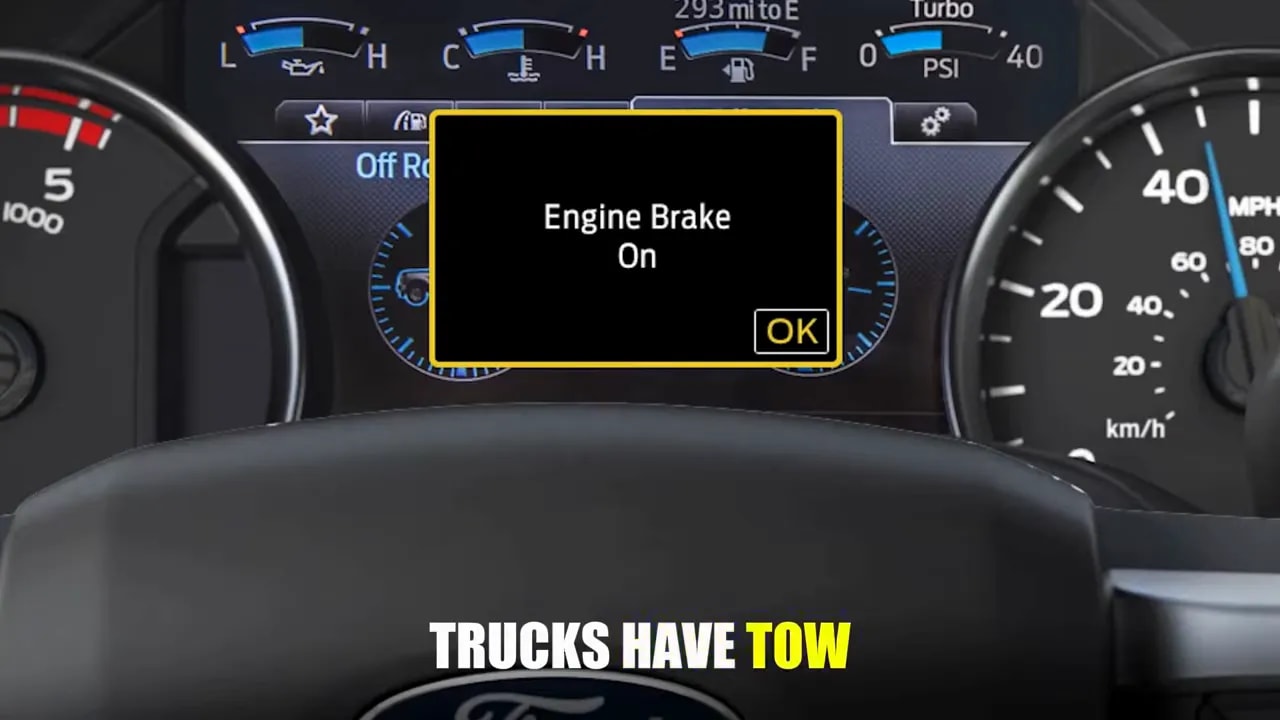
Some transmissions have ranges labeled L or 2; others use manual selection buttons or paddles. Do not treat a low-range setting as suitable at every speed. The correct selection depends on the vehicle and its operating limits.
For Long Descents and Towing
Engine braking is especially valuable on sustained downhill roads, where a loaded vehicle can put a large thermal burden on its friction brakes. Repeated or prolonged brake use can cause overheating and brake fade, reducing braking effectiveness.
Use an appropriate gear and the available exhaust-brake or tow/haul functions to help hold speed. Continue using the friction brakes as needed. If engine braking is not keeping the vehicle’s speed under control, do not assume that selecting an increasingly lower gear will safely solve the problem.
For example, a diesel truck descending with a trailer may slow only slightly when the accelerator is released in a high gear. A suitable lower gear and an activated exhaust brake can provide substantially more resistance without requiring a dangerous, abrupt downshift.
Why Diesel Engine Braking Often Feels Weaker Than Petrol
The main difference is how the engines control air and fuel.
Petrol Engines Create Intake Pumping Resistance
In a conventional petrol engine, releasing the accelerator nearly closes the throttle. The pistons continue drawing air into the cylinders, but the restricted intake creates low pressure. Working against that pressure difference absorbs energy and helps slow the vehicle.
This is why many petrol cars noticeably hold back as soon as you lift off the accelerator while in gear.
Diesels Return Much of the Compression Energy
A diesel controls power primarily through the quantity of fuel injected rather than by restricting intake air in the same way as a conventional petrol engine. On overrun, fuel injection can stop while air continues passing through the engine.
The pistons compress that air, but the compressed air then expands and pushes back on them. Much of the energy spent compressing it is returned, rather like energy stored and released by a spring.
The engine still absorbs energy through friction and pumping losses, so natural diesel engine braking is not zero. It is simply often weaker than the intake-restriction effect in a petrol engine.
High compression alone does not guarantee strong engine braking. What matters is how much of the compression energy is lost instead of returned.
The exact slowing effect varies by vehicle, gear, engine speed, and braking equipment. A diesel with an active exhaust brake can behave very differently from one relying only on natural engine resistance.
How Exhaust Brakes Create Stronger Diesel Braking
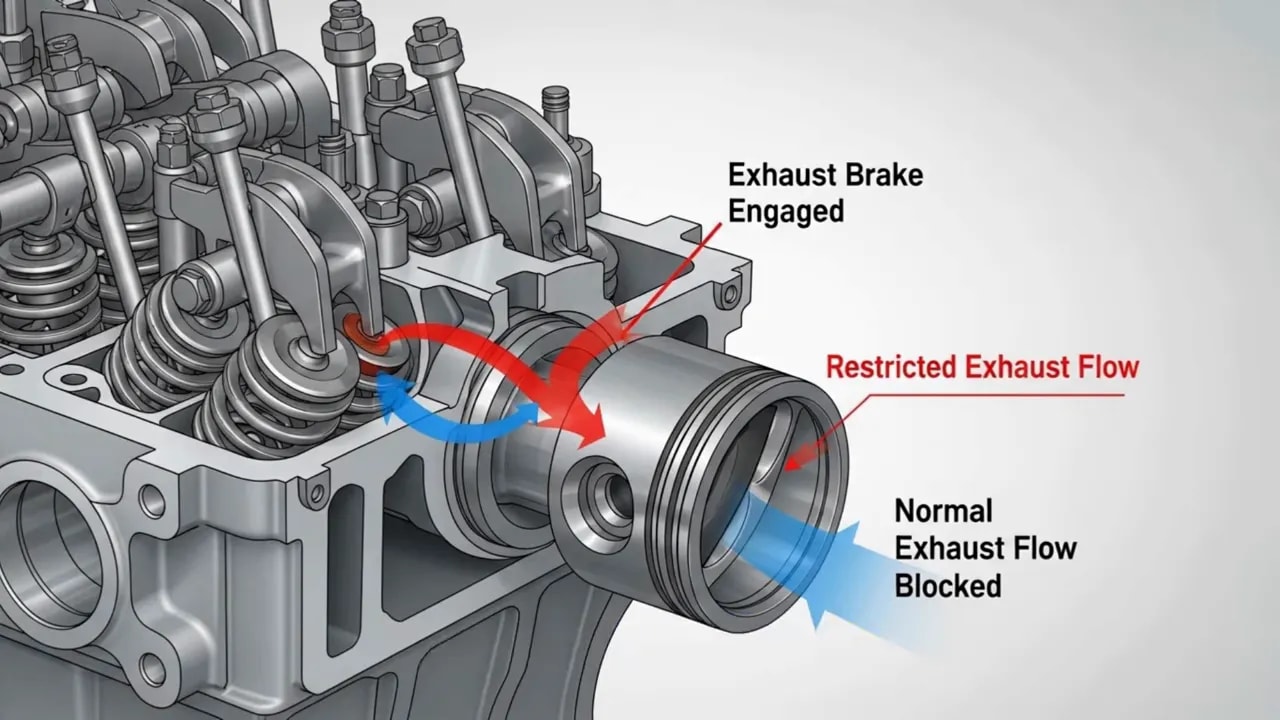
An exhaust brake adds a controlled restriction to the exhaust path. That restriction raises back pressure, forcing the pistons to work harder to expel air during the exhaust stroke.
The extra work absorbs energy from the moving vehicle through the drivetrain, producing stronger deceleration.
Exhaust-Pipe Butterfly Valves
A traditional exhaust brake uses a butterfly valve in the exhaust pipe. When activated, the valve restricts the passage and creates braking resistance.
This is a controlled braking system, not an invitation to obstruct the exhaust arbitrarily. Safe operation depends on the system being designed for the engine and limiting pressure appropriately.
Variable-Geometry Turbocharger Braking
Many modern diesel systems use a variable-geometry turbocharger to create exhaust braking. Its movable vanes adjust the exhaust passage, increasing restriction and back pressure when braking is requested.
By changing the vane position, the system can vary braking strength rather than providing only a fixed level of resistance.
Do not assume that every diesel passenger vehicle has a dedicated exhaust brake. Likewise, feeling resistance when lifting off does not by itself prove that exhaust braking is active. Natural engine losses and transmission behavior also contribute.
How a Jake Brake Differs
A compression-release brake works inside the engine’s valve cycle rather than simply restricting the exhaust downstream.
Near the end of the compression stroke, it opens an exhaust valve so the compressed air escapes. The engine has already spent energy compressing the air, but that air can no longer expand and return most of the energy to the piston.
This produces strong braking and is associated with the distinctive, rapid pulsing sound of heavy trucks. It is not the same mechanism as an exhaust brake, and it is not the typical system in a diesel passenger car.
Can Engine Braking Damage the Engine or Exhaust System?
Normal engine braking and a correctly operating exhaust brake are compatible with the engine’s intended operation. Diesel engines handle substantial pressures during combustion, and factory braking systems are designed around the engine’s operating limits.
Two situations deserve particular attention.
Excessive Engine Speed
A sudden downshift into a gear that is too low for the road speed can force the engine to turn too fast. The danger is the inappropriate gear choice, not engine braking itself.
Downshift progressively and monitor engine speed. There is no single safe braking RPM that applies to every diesel engine.
Excessive Exhaust Back Pressure
Too much exhaust restriction can damage components such as exhaust gaskets or manifolds. Manufacturers specify safe pressure limits, and those limits should be checked for the particular engine rather than assumed from a broad brand-level figure.
Factory exhaust-braking systems control pressure within their design limits. An aftermarket exhaust brake must be compatible with the engine and properly calibrated. More restriction is not automatically better or safer.
Benefits and Misconceptions
It Reduces Friction-Brake Work and Heat
When the engine absorbs some of the vehicle’s energy, the brake pads and discs have less work to do. This can reduce wear and help preserve braking effectiveness on long descents, particularly while towing or hauling.
The amount of extra brake life depends on load, route, equipment, and driving technique. It should not be treated as a guaranteed mileage increase.
It Can Use Less Fuel Than Neutral Coasting During Deceleration
Modern fuel-injected engines can stop fuel delivery during in-gear overrun. While fuel cut-off is active, the vehicle’s motion keeps the engine rotating without fuel being injected.
By contrast, an engine running at idle in neutral needs fuel to keep turning. This explains why shifting into neutral is not necessary to save fuel when you need to slow down.
The useful distinction is fuel cut-off during appropriate overrun conditions, not a promise that fuel delivery remains zero throughout every part of deceleration.
Proper Use Does Not Normally Harm the Turbo or DPF
A turbocharger used as part of a factory exhaust-braking system is designed to operate under that system’s controlled conditions. Proper operation is not, by itself, a reason to expect turbo damage.
Modern factory exhaust brakes are also integrated with the vehicle’s emissions controls. Normal use should not be confused with an incompatible modification or an existing diesel particulate filter fault.
Safety Mistakes to Avoid
- Relying on engine braking for every stop. Use the friction brakes whenever the situation requires them, including a complete stop.
- Skipping several gears at high speed. A severe downshift can over-rev the engine and upset traction.
- Using abrupt braking on slippery roads. Sudden drivetrain resistance can make the driven wheels lose grip.
- Assuming brake lights will illuminate. Accelerator-release slowing may not activate them. Brake-light behavior depends on the vehicle and system.
- Ignoring traffic behind you. When appropriate, a light brake-pedal application can signal slowing as well as provide additional deceleration.
- Expecting strong braking in a high gear at low RPM. Gear selection affects how much resistance reaches the wheels.
- Treating aftermarket pressure settings as universal. Follow the specifications for the exact engine and brake system.
The Practical Bottom Line
Use diesel engine braking as a normal part of controlled deceleration, not as a substitute for the brake pedal. Stay in gear, downshift smoothly when appropriate, and use the exhaust brake or tow/haul mode if fitted.
The important limits are engine speed, traction, and exhaust-system compatibility. Within those limits, engine braking can reduce brake wear and help maintain control, especially on downhill roads and while towing.