
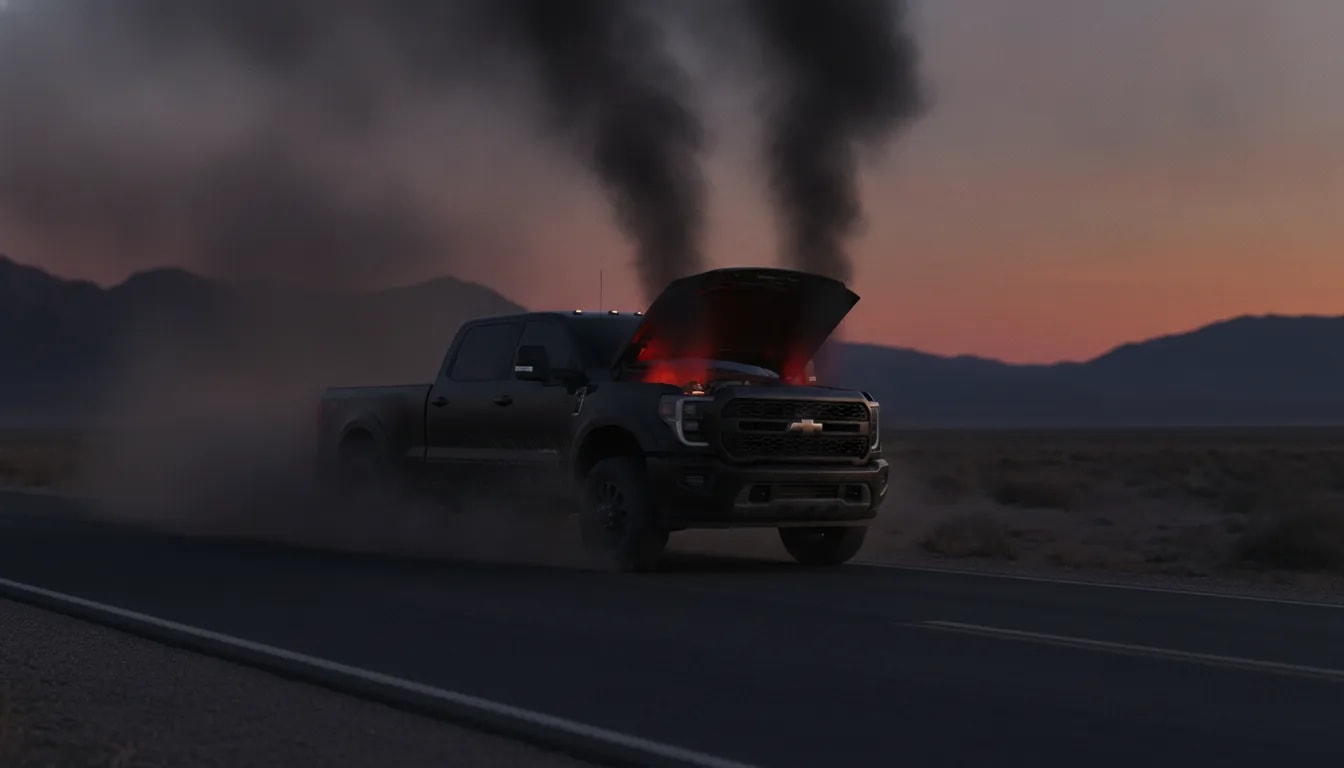
Diesel engine runaway is uncontrolled engine acceleration caused by fuel the engine can no longer properly regulate. That fuel is often engine oil entering the intake, although flammable vapors and some fuel-system failures can also cause it.
The defining danger is that the engine may keep accelerating after you release the accelerator or switch off the ignition. Severe damage can happen within seconds. Runaway is rare in modern diesels, but knowing how to recognize it and respond safely matters for anyone driving a diesel car, truck, or SUV.
Key Takeaways
- Diesel runaway can continue after ignition shutdown because oil or external vapors supply uncontrolled fuel.
- A fitted air shutoff can stop combustion, but personal safety takes priority over intervention.
- Investigate increasing oil consumption, unusual smoke, and turbo noise before faults become more serious.
- Never restart an engine after runaway until it has been thoroughly inspected.
Table of Contents
- What to Do If a Diesel Engine Runs Away
- How to Recognize Diesel Runaway
- Why Turning Off the Key May Not Stop the Engine
- What Causes Diesel Engine Runaway?
- How to Reduce the Risk of Diesel Runaway
- What Happens After a Runaway Stops?
- The Most Important Mistakes to Avoid
What to Do If a Diesel Engine Runs Away
Prioritize getting people to safety, not saving the engine. An overspeeding engine can suffer violent mechanical failure or catch fire. Do not approach it simply to attempt a repair.
- If you are driving, pull over as safely and promptly as possible. Get out of traffic and bring the vehicle to a stop.
- Use a fitted emergency air shutoff if it can be activated safely. This is different from switching off the ignition.
- Once stopped, leave the vehicle. Move yourself and others a safe distance away rather than remaining inside.
- Call for help. Avoid approaching the engine while it is racing, smoking, or showing signs of fire.
- Do not restart it, even after it stops. Arrange recovery and a thorough mechanical inspection.
Switching off the ignition can stop normal fuel injection, but it may not stop a diesel burning oil or external vapors. Do not assume the danger has passed because the key is off.
Which shutdown methods can work?
Stopping the air supply addresses the central problem: even uncontrolled fuel cannot burn without enough oxygen. However, the available method and the risks depend on the vehicle.
| Method | How it works | Important limitation |
|---|---|---|
| Purpose-built air shutoff valve | Closes the intake air path to stop combustion. | Only available if fitted. Know its controls before an emergency. |
| CO2 fire extinguisher directed into the intake | Displaces oxygen in the incoming air. | Requires suitable equipment and access near a dangerous engine. It is not a reason to risk approaching one. |
| Physically obstructing the intake | Attempts to prevent air entering the engine. | Dangerous because it requires working near a violently shaking engine. Improvised intake blocking is not a safe general recommendation. |
| Stalling through a manual transmission | Uses drivetrain resistance to stop engine rotation. | A last-resort measure that can damage the clutch, gearbox, and drivetrain. It does not apply to automatic transmissions. |
The manual-transmission method relies on loading the engine through a high gear while the brakes hold the vehicle stationary. It is not a routine shutdown technique, and attempting it must not take priority over controlling the vehicle or escaping danger.
Commercial diesel equipment may have a dedicated air shutoff; many passenger vehicles do not. Check whether your vehicle has one and how it operates before you need it.
How to Recognize Diesel Runaway
The strongest warning is an engine that accelerates without accelerator input and does not respond normally to attempts to shut it down.
- Rapidly rising RPM: engine speed climbs on its own and may pass the redline.
- Heavy exhaust smoke: substantial blue or black smoke can accompany the event.
- Harsh mechanical noise: loud rattling, screaming, or other abnormal sounds may develop.
- Loss of normal engine control: releasing the accelerator does not bring the speed down, and switching off the ignition may have no effect.
Smoke alone does not establish that an engine is running away. The critical combination is uncontrolled acceleration and loss of normal control. There may be little time between recognizing those signs and serious engine damage.
Why Turning Off the Key May Not Stop the Engine
A diesel engine uses compression ignition. Compressing the air in its cylinders creates enough heat to ignite the fuel; it does not rely on spark plugs to initiate combustion.
Diesel power is normally regulated primarily by how much fuel is injected, rather than by restricting intake air as in a typical gasoline engine. The important point is not whether a particular diesel has an intake valve, but whether it can shut off the air during a runaway.
When engine oil or flammable vapor reaches the cylinders, it can become an alternative fuel source. The engine still has air, compression, and heat, so combustion can continue independently of normal injection control.
That explains why an electrical shutdown can fail to stop an oil-fed runaway:
- The ignition switch stops normal fuel delivery.
- Oil or vapor continues entering through the intake.
- Compression ignites that uncontrolled fuel.
- The engine continues running, potentially at destructive speed.
A runaway may eventually stop when its unintended fuel supply is exhausted or a component fails. Neither is a safe outcome to rely on.
What Causes Diesel Engine Runaway?
1. Turbocharger oil leakage
Turbochargers need engine oil for lubrication. If the turbo’s sealing system fails on the compressor side, oil can enter the intake air stream and travel into the combustion chambers.
Once that oil burns, it supplies energy outside the engine’s normal fuel-control system. Continued oil delivery can sustain the runaway.
This is why oil leakage around the turbo, oil in the intake piping, unusual turbo noise, and increasing oil consumption deserve investigation.
2. Excessive blow-by and crankcase ventilation problems
Blow-by is gas escaping past the piston rings into the crankcase. As rings wear, blow-by can increase, contributing to more oil mist in the crankcase ventilation system.
If blow-by becomes excessive or the ventilation system is restricted, too much oil mist can reach the intake. The engine may then burn that oil as fuel.
Overfilling the crankcase can worsen the problem. Correct oil level and properly maintained breathers and oil separators are therefore important parts of prevention.
3. Mechanical fuel-injection faults
Not every runaway starts with engine oil. A mechanical injection pump can stick or malfunction and deliver excessive fuel.
This type of fault is more associated with older mechanically controlled diesels. Modern electronically controlled common-rail systems are less prone to it because fuel delivery is more precisely regulated.

There is an important distinction: a fuel-control fault and an oil-fed runaway do not have the same fuel source. Electronic control can reduce injection-related risk, but cutting injection cannot eliminate oil already entering the intake.
4. External flammable vapors
A diesel can also draw in combustible vapors from its surroundings. Gasoline vapor, propane, natural gas, and other hydrocarbons can act as fuel if they enter the cylinders in sufficient concentration.
This is a particular concern around industrial sites where a flammable vapor release is possible. The engine can become both a consumer of the vapor and a potential ignition source.
The 2005 Texas City refinery disaster illustrates this concern. A diesel pickup engulfed by a vapor cloud has been cited as a possible ignition source after its engine reportedly accelerated on the vapors. The explosion killed 15 people. That suspected mechanism should not be treated as a conclusively established cause.
How to Reduce the Risk of Diesel Runaway
Prevention focuses on keeping oil out of the intake, maintaining fuel control, and investigating changes before they become severe.
| Check | What needs attention | Why it matters |
|---|---|---|
| Oil consumption | A noticeable increase in oil use | May indicate oil leakage or worn components allowing oil to reach combustion. |
| Oil level | An overfilled crankcase | Can worsen oil carryover into the intake. |
| Turbocharger and intake piping | Oil leaks, oil residue, unusual noise, or excessive shaft play | Can indicate turbo wear or a route for oil entering the intake. |
| Crankcase ventilation | Restricted breathers, overdue filters, or faulty ventilation components | Can allow excessive crankcase oil mist to reach the intake. |
| Exhaust smoke | Persistent blue smoke or unusual black smoke | Blue smoke can indicate oil burning; black smoke can indicate excessive fueling. |
| Engine sounds | New turbo whine, rattling, or knocking | May signal a fault that needs diagnosis. |
Follow the service schedule for crankcase ventilation components, including breather filters and PCV components where fitted. Have turbocharger condition and shaft play checked as part of appropriate inspection rather than attempting checks on a running engine.
Do not wait for several warning signs to appear together. Increased oil consumption, unusual smoke, or a new turbo noise is enough reason to seek diagnosis.
Are modern diesels protected from runaway?
Modern diesels are much less prone to runaway than older designs. Electronic fuel metering, sensor monitoring, improved turbocharger sealing, and oil-separation systems reduce several of the conditions that can cause it.
Some systems can also detect abnormal engine speed and cut injection. However, that protection has a limit: it cannot necessarily stop an engine burning oil or environmental vapors.
Older mechanically injected engines and high-mileage engines with worn components are more vulnerable, but age alone does not mean runaway is inevitable. Maintenance remains important for both old and modern diesels.
What Happens After a Runaway Stops?
Do not restart the engine to see whether it still works. The original fault may still be present, and another runaway could begin immediately.
Even a brief event puts severe stress on the engine. Inspection may need to cover:
- The turbocharger and the source of unwanted oil or fuel.
- Pistons and connecting rods.
- Bearings.
- Valves and related engine components.
Arrange a tow and have the engine thoroughly assessed before it runs again. An engine becoming quiet is not evidence that it is undamaged or safe to restart.
The Most Important Mistakes to Avoid
- Relying on the ignition switch: it cannot reliably stop combustion supplied by oil or external vapors.
- Approaching the engine to save it: improvised intervention can expose you to mechanical failure or fire.
- Assuming electronics make runaway impossible: injection control does not control every possible fuel source.
- Ignoring changes in oil use, smoke, or noise: these can reveal faults that deserve prompt attention.
- Restarting after the event: both the underlying cause and serious damage may remain.
Diesel runaway is uncommon, but its consequences can be severe. Recognize uncontrolled acceleration, know whether a proper air shutoff is fitted, and treat personal safety as the first priority.