
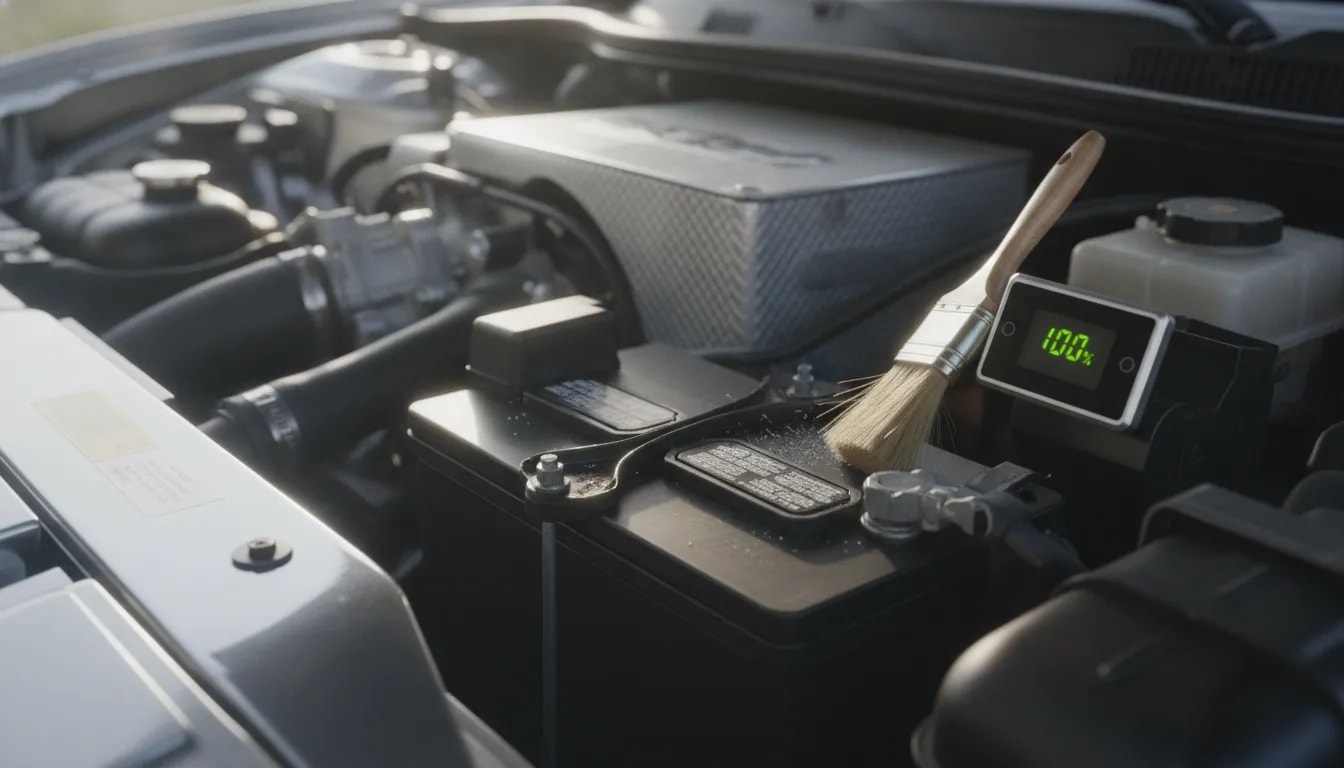
Most standard car batteries last about 3 to 5 years. To help yours last longer, focus on keeping it charged, limiting heat exposure, cleaning the terminals, and catching problems before they cause a complete discharge.
A quality battery can sometimes reach 7 or 8 years with favorable conditions and consistent care. Ten years is possible, but exceptional. The goal is to prevent premature failure, not to keep an unreliable battery in service just to reach a particular age.
These tips apply to the vehicle’s lead-acid starting battery, including AGM and EFB types, rather than an electric vehicle’s high-voltage traction battery.
Key Takeaways
- Most standard car batteries last three to five years; ten years is exceptional.
- Longer drives and automatic maintainers help prevent chronic undercharging and damaging discharge.
- Limit heat exposure, clean corroded terminals, and keep the battery firmly secured.
- Test annually after year three and buy fresh batteries that meet the vehicle’s requirements.
Table of Contents
- How Long Can a Car Battery Realistically Last?
- Keep the Battery Charged: The Most Important Daily Habit
- Reduce Heat Exposure Before It Shortens Battery Life
- Maintain Clean Connections and a Secure Battery
- Test the Battery Before You Depend on It
- Choose a Replacement That Starts With the Right Advantages
- Mistakes That Can Undo Good Battery Maintenance
- A Simple Car Battery Maintenance Schedule
How Long Can a Car Battery Realistically Last?
Battery life depends on more than the brand or purchase price. Climate, driving habits, storage, and previous discharge damage all affect how long it remains useful.
| Battery or operating condition | Reasonable lifespan expectation |
|---|---|
| Standard lead-acid starting battery | Typically 3 to 5 years |
| Premium AGM or EFB battery | Often around 4 to 7 years, depending on conditions |
| Quality battery with favorable conditions and diligent care | May reach 7 to 8 years |
| Exceptionally favorable conditions | 10 years is possible, not typical |
Hot climates tend to push batteries toward the shorter end of those ranges. Cooler conditions can help them last longer, particularly when the battery stays charged and avoids significant damage.
Maintenance protects the capacity you still have. It does not erase years of heat exposure or guarantee recovery from repeated deep discharges. For additional battery-care guidance, Interstate Batteries provides manufacturer resources on automotive batteries.
Keep the Battery Charged: The Most Important Daily Habit
Starting the engine takes a substantial burst of battery power. The alternator replenishes that energy while the engine runs, but frequent short journeys can leave the battery persistently undercharged.
Prolonged undercharging encourages sulfation, a buildup of lead sulfate crystals on the battery’s internal plates that can reduce its ability to store and deliver energy. This is different from the visible corrosion around the terminals.
1. Combine short trips into longer drives
If most of your journeys last only 5 to 10 minutes, combine errands where practical. A drive of roughly 30 minutes once a week is a useful maintenance habit for a car otherwise used mainly for short trips.
That does not mean 30 minutes guarantees a full recharge. Meaningful charging can take 20 to 30 minutes of driving, while replenishing a significantly depleted battery can take many hours. The starting charge level and charging conditions matter.
- Group several errands into one outing instead of making repeated short trips.
- Favor a sustained drive over several separate engine starts.
- Do not assume a brief drive after a jump-start has restored the battery completely.
A longer, steady drive gives the charging system more opportunity to replenish the battery than repeated short journeys. If the battery remains undercharged despite regular driving, have the battery and charging system checked.
2. Use an automatic battery maintainer when the car sits
A car does not have to be driven to lose battery charge. Batteries self-discharge during storage, and the vehicle’s electrical systems can add to that loss.
For a seasonal vehicle or a car left unused for extended periods, use an automatic battery maintainer suitable for its battery type. A quality unit commonly costs about $30 to $60.
The important distinction is how the charger controls its output:
- Automatic maintainer: Monitors the battery and adjusts charging as needed to maintain its charge.
- Older constant-output trickle charger: Continues supplying current and can overcharge a battery if left connected too long.
Choose equipment intended for long-term maintenance, not merely a device labeled as a low-current charger. Follow the maintainer’s instructions and the vehicle’s specified connection points. Identify positive and negative connections carefully before attaching any leads.
Keep the battery near full charge rather than waiting for it to become weak. Roughly 75% to 100% charge is a useful maintenance target, not a precise boundary at which damage suddenly begins.
Reduce Heat Exposure Before It Shortens Battery Life
3. Park in shade or a garage when practical
Cold weather gets much of the blame for failed batteries because it makes engine starting harder. However, heat is a major cause of the damage that shortens battery life. A battery weakened during summer may reveal that weakness when winter arrives.
High temperatures accelerate deterioration and can contribute to electrolyte loss in flooded lead-acid batteries. Under-hood battery temperatures may be substantially higher than the outdoor air temperature, sometimes by 30 to 40°F.
To limit unnecessary exposure:
- Use shaded parking when available.
- Park in a garage when practical.
- Consider an appropriate battery insulation blanket if it is suitable for the vehicle and climate.
Battery insulation blankets commonly cost around $20 to $40. They are an option to evaluate, not a substitute for keeping the battery charged and in good condition.
In very hot regions, even careful maintenance may not produce the lifespan possible in a moderate climate. Set expectations accordingly rather than treating an early replacement as proof that maintenance was pointless.
Maintain Clean Connections and a Secure Battery
The battery needs both a reliable electrical connection and a stable mounting. Corroded terminals restrict current flow, while a loose battery can suffer damage from vibration.
4. Inspect and clean the terminals twice a year
White, blue, or green crust around the terminals is a sign of corrosion. This buildup increases electrical resistance and can interfere with charging and starting.

Inspect the terminals at least twice a year and clean them when buildup is present. A basic cleaning typically takes about 15 minutes.
Supplies
- Gloves and safety glasses
- An appropriate wrench
- A brush
- 1 tablespoon of baking soda
- 1 cup of warm water
- Clean water and a drying cloth
- Petroleum jelly or a suitable protective grease
Cleaning procedure
- Turn the vehicle off. Check the owner’s manual for battery-disconnection instructions before beginning.
- Disconnect the negative cable first, then the positive cable. Keep tools from bridging terminals or touching unintended metal surfaces.
- Mix the baking soda and warm water. Use 1 tablespoon per cup of water.
- Apply the solution to the corroded areas with a brush. Fizzing indicates that acidic residue is being neutralized.
- Scrub away the buildup. Clean the posts and cable clamps.
- Rinse carefully and dry completely. Keep cleaning solution out of battery openings and avoid soaking nearby electrical components.
- Reconnect the positive cable first, then the negative cable. Make sure both connections are secure.
- Protect the assembled connections. Apply a thin external coating of petroleum jelly or suitable protective grease to help discourage corrosion.
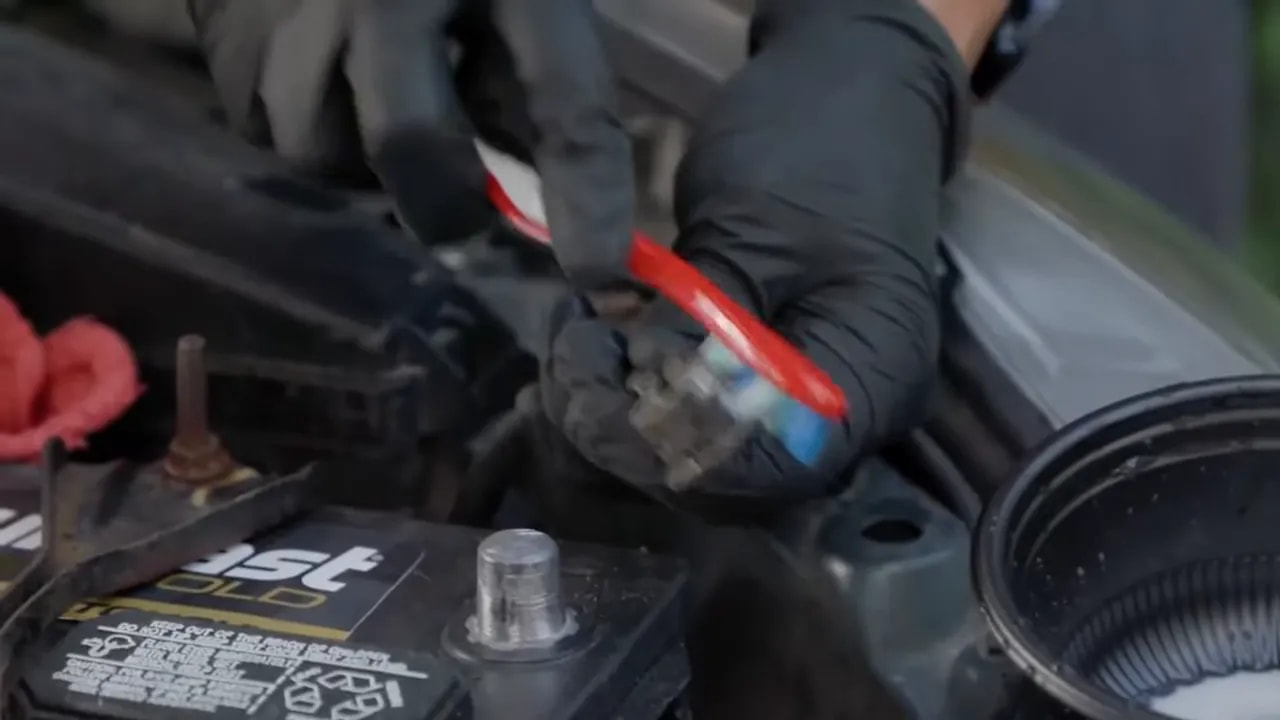
If you are unsure about disconnecting the battery or working around its terminals, have a technician perform the cleaning.
5. Check the battery hold-down every few months
The hold-down bracket keeps the battery from shifting as the vehicle moves. Excessive vibration can damage internal plates and connections.
With the vehicle off, check that the battery is firmly mounted. It should not slide or rock loosely in its tray. Inspect the hold-down every few months and secure it according to the vehicle’s instructions if needed.
This check takes only a few minutes. Clean terminals cannot compensate for a battery that is bouncing around in its mounting.
Test the Battery Before You Depend on It
6. Arrange annual testing once the battery is 3 years old
After the battery reaches about three years of age, have it tested annually. Many auto parts stores offer free battery testing, often in just a few minutes.
A multimeter can also provide a useful initial voltage check, but voltage alone does not prove that a battery can deliver enough power to start the engine.
| Test condition | General reference reading | What it suggests |
|---|---|---|
| Engine off | Approximately 12.4 to 12.7 volts | Charge level is within a commonly used checking range; the higher end is closer to fully charged |
| Engine off | Below 12.4 volts | The battery may be partially discharged and needs further checking |
| Engine running | Approximately 13.8 to 14.5 volts | A common reference range indicating charging activity |
Use these figures as general reference points, not universal pass-or-fail limits. Interpret readings using the vehicle’s charging-system specifications, and seek a proper battery test if starting performance is questionable.
The purpose of testing is to make a replacement decision before the battery leaves you stranded. It reduces uncertainty but cannot guarantee that an unexpected failure will never happen.
Choose a Replacement That Starts With the Right Advantages
7. Buy a fresh, correctly specified battery from a high-turnover seller
Battery care begins at purchase. A battery can lose charge while sitting on a shelf, and poor storage can reduce its useful capacity before installation.
Look for recently manufactured stock, preferably within roughly 3 to 6 months, from a seller that moves inventory regularly. Ask the retailer to explain the date code rather than assuming every brand uses the same format.
Some date codes use letters for months, such as A for January and B for February, with numbers representing the year. Confirm the coding system with the seller or manufacturer.
Do not compromise on cold cranking amps
Cold cranking amps, or CCA, describe starting-power delivery at 0°F. Never select a battery with a CCA rating below the vehicle’s requirement.
Check the specified battery type and fitment as well. A premium battery is only a sensible purchase when it is appropriate for the vehicle.
Compare cost per year, not just the price tag
Basic batteries may cost around $100 to $150, while premium AGM batteries may cost around $200 to $300. Prices and actual service life vary.
For an illustrative comparison, a $150 battery lasting three years costs $50 per year. A $250 battery lasting seven years costs about $36 per year. The more expensive battery offers better value only if it delivers enough additional service.
Do not base the purchase on an assumed ten-year lifespan. Evaluate freshness, compatibility, quality, and realistic operating conditions first.
Mistakes That Can Undo Good Battery Maintenance
Letting the battery repeatedly go completely dead
A successful jump-start does not mean the battery escaped damage. Deep discharge can permanently reduce a starting battery’s capacity and shorten its remaining life.
After a dead-battery event, address the cause and restore the charge properly. Repeatedly jump-starting the car without investigating the problem is not a maintenance strategy.
Ignoring electrical drain while the car is parked
Leaving lights on or running accessories with the engine off can drain the battery quickly. Smaller continuous draws can also add up over weeks.
If the battery repeatedly goes flat while parked, request a parasitic draw test. The time it takes to discharge depends on the battery’s capacity, starting charge, and the amount of current being drawn.
Confusing terminal corrosion with internal sulfation
Cleaning the crust off the terminals improves the connection. It does not remove sulfation from the internal plates. Preventing chronic undercharging requires better charging habits, not just cleaner terminals.
Keeping a failing battery solely because of its age
Seven, eight, or ten years should be a possible outcome of good care, not a replacement deadline. If testing indicates that the battery is failing, replace it rather than trying to extend service at the expense of reliability.
A Simple Car Battery Maintenance Schedule
| When | What to do |
|---|---|
| During everyday use | Favor shaded parking and avoid unnecessary electrical drain with the engine off. |
| Weekly, if most trips are short | Combine errands or make a sustained drive of roughly 30 minutes. |
| During extended storage | Use a compatible automatic battery maintainer according to its instructions. |
| Every few months | Check that the battery hold-down remains secure. |
| Twice a year | Inspect the terminals and clean corrosion as needed. |
| Annually after age 3 | Have the battery tested. |
| When replacing the battery | Confirm freshness, battery type, fitment, and the required CCA rating. |
The best way to extend car battery life is to prevent avoidable damage. Keep it charged, reduce heat exposure, maintain its connections and mounting, and investigate repeated discharge. Those habits give a quality battery its best chance of lasting longer without sacrificing dependable starting.