

A diesel engine can be a better choice for long highway trips, frequent towing, and high annual mileage. Gasoline usually makes more sense for short trips, lower mileage, and buyers who want a lower purchase price. The deciding factor is not simply fuel economy or torque. It is whether your everyday driving suits the engine and its emissions equipment.
Diesel offers real advantages, but those advantages come with higher upfront costs, specialized maintenance, and potentially expensive repairs. Comparing the complete ownership cost matters more than comparing miles per gallon alone.
Key Takeaways
- Driving pattern matters more than diesel’s reputation for efficiency, torque, or longevity.
- Longer journeys support DPF regeneration, while repeated short trips can increase soot-related problems.
- Fuel savings must cover the purchase premium and additional running costs to justify diesel financially.
- A durable diesel engine can still require expensive fuel-system, turbocharger, and emissions-system repairs.
Table of Contents
- Should You Buy a Diesel? Start With Your Driving Pattern
- What Makes a Modern Diesel Different?
- The Main Advantages of Diesel Engines
- Does Diesel Save Money? Calculate the Break-Even Point
- Diesel Maintenance and Repair Costs to Budget For
- Cold Weather Adds Another Ownership Consideration
- Common Diesel-Buying Mistakes
- A Practical Checklist for Buyers and Existing Owners
- The Bottom Line: Diesel Is Better for the Right Job
Should You Buy a Diesel? Start With Your Driving Pattern
Before weighing individual diesel engine pros and cons, consider how you actually use your vehicle. Annual mileage affects the financial payoff, while trip length affects whether a modern diesel’s exhaust system gets the conditions it needs.
| Your driving habits | What they mean for diesel ownership |
|---|---|
| About 15,000 miles or more annually, mostly longer trips | A stronger case for diesel because fuel savings accumulate and sustained driving supports DPF regeneration. |
| About 10,000 miles or less annually, mostly trips under 10 miles | A weaker case because the purchase premium takes longer to recover and short trips can create DPF problems. |
| Frequent towing or hauling | Low-rpm torque can make diesel particularly useful. |
| Keeping the vehicle for many years | More time to benefit from fuel savings and potential engine longevity. |
| Replacing vehicles every three to five years | Less time to recover the upfront premium, although resale value may offset part of it. |
These mileage figures are screening guidelines, not guaranteed break-even points. A driver covering 15,000 miles through repeated short journeys may still have an unsuitable usage pattern. Someone driving fewer miles on longer routes may suit the emissions system better, but still struggle to justify the purchase premium financially.
What Makes a Modern Diesel Different?
Diesel engines operate at high compression ratios and are built to withstand substantial internal loads. Their blocks, pistons, connecting rods, and crankshafts are designed around those demands. They also tend to deliver strong torque at relatively low engine speeds.
However, a modern diesel is more than a durable engine block. Depending on the model, the complete system includes:
- A turbocharger and intercooler.
- High-pressure fuel pumps and injectors.
- A diesel particulate filter, commonly called a DPF.
- Exhaust gas recirculation, or EGR.
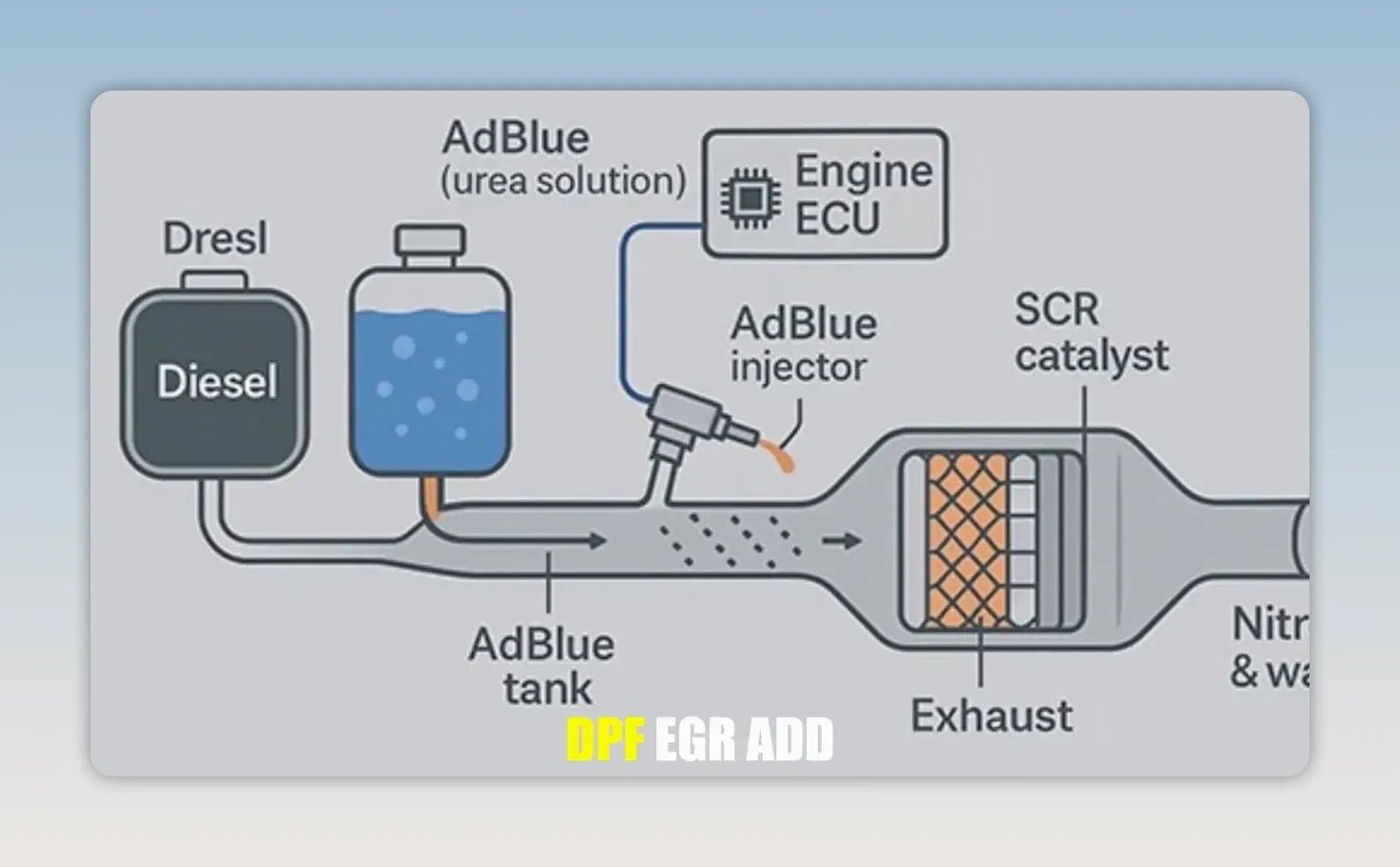
- AdBlue injection and associated emissions components.
- NOx sensors, temperature sensors, and electronic controls.
This distinction explains an apparent contradiction: a diesel engine can have a long mechanical life while its supporting systems generate substantial repair bills.
Why the DPF matters so much
The diesel particulate filter captures soot from the exhaust. Periodically, it needs to burn off accumulated soot through a process called regeneration, which requires sufficiently high exhaust temperatures.

Longer, sustained journeys help provide suitable operating conditions. Repeated short trips can prevent regeneration from completing, allowing soot to accumulate until the filter needs attention.
Highway use is therefore helpful, but it should not be treated as a universal repair procedure. Follow the regeneration instructions for the specific vehicle, especially if a warning light appears. There is no single driving duration or engine-speed target that should be assumed to apply to every diesel.
The Main Advantages of Diesel Engines
Better fuel economy
A key reason to choose diesel is its fuel-efficiency advantage over a comparable gasoline engine. A roughly 20% to 30% improvement is a useful starting estimate, but the actual difference depends on the vehicles and driving conditions being compared.
Illustrative comparisons include a diesel sedan returning 45 mpg versus a gasoline version returning 32 mpg, or a diesel pickup returning 28 highway mpg versus 21 mpg for a gasoline alternative. These examples are not ratings for every sedan or pickup.
The practical benefit is straightforward: using fewer gallons becomes more valuable as annual mileage increases. But better mpg does not automatically mean lower total ownership cost.
For a model-specific comparison, use the U.S. Department of Energy and EPA vehicle comparison tool, then calculate costs using fuel prices in your area.
Strong torque at low rpm
Diesels commonly produce their strongest torque around 1,500 to 2,500 rpm. That can give them a relaxed, responsive feel during highway driving and when pulling a load.
For example, an engine producing 400 lb-ft at 1,600 rpm delivers its pulling strength much earlier than one producing 350 lb-ft at 4,000 rpm. This helps explain diesel’s appeal for towing trailers, boats, and campers.
Low-rpm response can also make everyday driving feel less dependent on high revs. However, pleasant performance in traffic does not make repeated short urban trips ideal for the DPF. Driving feel and emissions-system suitability are separate questions.
Potential for a long engine life
Properly maintained diesels can reach very high mileages, including 300,000 to 500,000 miles in suitable applications. Their heavy-duty construction is one reason they appeal to long-distance commuters and high-use operators.
That range is a possibility, not a promise for every modern diesel. Maintenance history and usage remain important, and a long-lasting core engine does not eliminate injector, turbocharger, or emissions-system expenses.
Resale value in diesel-friendly markets
Diesel can retain value well where buyers actively want its towing ability, efficiency, or durability. North American diesel pickups are a notable example, while diesel demand also exists in markets across Europe, Australia, and parts of Asia.
An illustrative five-year resale comparison is 60% to 70% of the original price for a diesel pickup versus 50% to 60% for a gasoline equivalent. Do not assume those percentages apply to your vehicle. Compare local prices for the same model, age, mileage, and condition.
Potentially lower CO2 emissions per mile
A diesel’s efficiency can translate into lower CO2 emissions per mile than a comparable gasoline vehicle. A reduction of roughly 15% to 20% is a useful illustrative range rather than a universal result.
This is specifically a CO2 comparison. It should not be interpreted as proof that diesel is better on every emissions measure. The DPF, EGR, and NOx-related systems are also part of the ownership picture.
Does Diesel Save Money? Calculate the Break-Even Point
Diesel vehicles can cost roughly $2,000 to $5,000 more than comparable gasoline models, with pickup premiums sometimes exceeding that range. Whether the premium pays back depends on actual fuel savings and how long you keep the vehicle.
A worked fuel-cost example
Assume the following:
- Annual distance: 15,000 miles.
- Diesel fuel economy: 45 mpg.
- Gasoline fuel economy: 32 mpg.
- Both fuels cost $3.50 per gallon.
| Calculation | Diesel | Gasoline |
|---|---|---|
| Annual gallons: miles divided by mpg | 333.3 | 468.8 |
| Annual fuel cost | About $1,167 | About $1,641 |
The diesel uses approximately 135 fewer gallons and saves about $474 per year. Over ten years, that is approximately $4,740 in fuel savings, assuming unchanged mileage, efficiency, and prices.
If diesel instead costs $3.70 per gallon while gasoline remains $3.50, the annual saving falls to approximately $407. Diesel still wins on fuel cost in this example, but by a smaller amount.
How long does the purchase premium take to repay?
Use this basic calculation:
Fuel-only payback period = extra purchase price ÷ annual fuel savings.
With a $3,000 premium and $474 in annual fuel savings, the fuel-only payback is approximately 6.3 years. At 10,000 miles annually under the same assumptions, the saving falls to about $316 and payback stretches to roughly 9.5 years.
This is only the starting point. A fuller comparison needs to account for:
- Additional scheduled maintenance.
- AdBlue spending, where applicable.
- Potential repair costs.
- Any resale-value advantage.
If additional running costs consume most of the fuel savings, the diesel may never recover its purchase premium within your planned ownership period.
Diesel Maintenance and Repair Costs to Budget For
Diesel servicing can cost more because of oil capacity, oil requirements, fuel-system maintenance, and model-specific components. The figures below are illustrative budgeting ranges in U.S. dollars, not quotes. Actual prices depend on the vehicle, parts, labor rates, and repair scope.
Routine servicing and wear items
| Item | Illustrative cost | Planning consideration |
|---|---|---|
| Diesel oil change | $80 to $120 | Compared with an illustrative $40 to $60 gasoline oil change; use the specified oil. |
| Fuel filter replacement | $30 to $60 | A 15,000 to 20,000-mile interval is an example, not a universal schedule. |
| Glow plug replacement | $400 to $800 | May become necessary at higher mileage; 80,000 to 120,000 miles is an illustrative range. |
| Dual-mass flywheel replacement | $1,200 to $2,000 including labor | A potential expense on diesel manual-transmission vehicles equipped with this component. |
| AdBlue fluid | $150 to $300 annually | An example annual allowance for equipped vehicles, rather than a fixed cost for every owner. |
AdBlue adds both a consumable expense and another system that may need repair. Its tank, injector, controls, and related components should be considered alongside ordinary servicing.
Potential major repairs
| Repair | Illustrative cost range |
|---|---|
| DPF cleaning | $400 to $800 |
| DPF replacement | $1,500 to $3,500 |
| Injector replacement work | $1,200 to $2,500 |
| Turbocharger replacement | $1,500 to $3,000 |
| EGR valve replacement | $400 to $800 |
| High-pressure fuel pump repair or replacement | $1,000 to $2,000 |
These are potential expenses, not a list of failures every diesel will experience. Injector costs, in particular, should be checked against the exact scope of the quote rather than assumed to cover the same work on every engine.
Some faults require manufacturer-level diagnostic capabilities. Before buying, identify a workshop with experience and appropriate equipment for that engine. General repair experience alone may not be enough.
Cold Weather Adds Another Ownership Consideration
Diesels can operate in cold climates, but winter conditions make fuel preparation, starting-system health, and trip length more important.
- Fuel flow: Diesel can gel in sufficiently low temperatures and restrict the fuel system. Temperatures around or below 10°F can be a concern, but the exact threshold should not be treated as universal.
- Glow plugs: These help preheat the combustion chambers. Failed plugs can make cold starting difficult.
- Battery condition: High cranking demands can expose a weak battery, especially in winter.
- DPF regeneration: Cold conditions can make reaching suitable exhaust temperatures harder, particularly during short trips.
Use suitable winter fuel and follow the vehicle manufacturer’s guidance on additives. If your normal use consists of brief winter journeys, that combination deserves particular scrutiny before choosing diesel.
Common Diesel-Buying Mistakes
Choosing on mpg alone
A more efficient vehicle can still cost more overall. Compare the purchase premium, maintenance, AdBlue, repair exposure, and resale value alongside fuel spending.
Assuming high annual mileage solves short-trip problems
Accumulating miles through many brief journeys is different from covering them on sustained longer routes. Assess both distance and trip duration.
Confusing durability with inexpensive ownership
Strong engine internals do not make every attached component cheap or trouble-free. Budget for the complete vehicle, not just the engine’s reputation.
Planning around hypothetical highway trips
Buy for the driving you already do, not the longer journeys you hope to add later. If your real routine is unsuitable, occasional extra trips should not be the foundation of the purchase decision.
A Practical Checklist for Buyers and Existing Owners
Before buying a diesel
- Record your real annual mileage. Use your recent driving history rather than an optimistic estimate.
- Review typical trip lengths. Note whether most journeys are short, stop-and-go trips or longer routes.
- Compare equivalent vehicles. Obtain actual purchase prices and realistic fuel-economy figures.
- Calculate local fuel costs. Use separate gasoline and diesel prices.
- Get servicing estimates. Include oil, filters, and any AdBlue requirement.
- Check maintenance history. This is especially important when buying a used diesel.
- Confirm specialist support. Locate a workshop equipped to diagnose the model.
- Compare payback with your ownership plans. Do not rely on ten years of savings if you expect to sell after three.
If you already own one
Follow the diesel-specific maintenance schedule, use the required oil, and give the vehicle suitable sustained driving opportunities as directed by its manufacturer. Address warning lights and developing problems promptly instead of allowing them to become larger failures.
If your driving has changed from long-distance commuting to mostly short trips, reassess whether diesel still suits your needs. The right vehicle for a previous routine may not be the right vehicle now.
The Bottom Line: Diesel Is Better for the Right Job
Choose diesel when its efficiency, low-rpm pulling power, and long-term capability match your actual use. Longer journeys, substantial annual mileage, and regular towing make the strongest case.
Choose gasoline when lower upfront cost and short-trip suitability matter more. Neither engine type wins universally. The best decision comes from matching your driving pattern to the vehicle, then checking whether the total ownership numbers support the choice.