
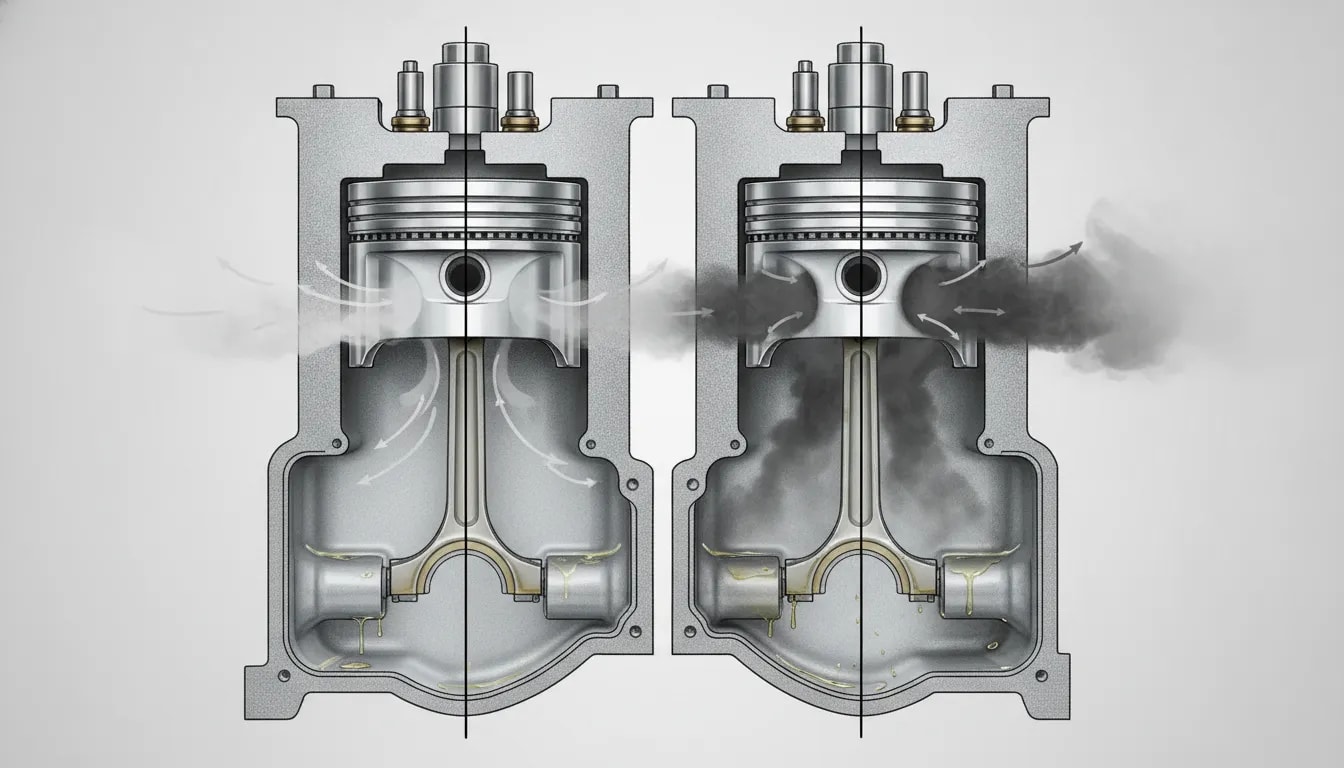
Diesel blow-by is combustion gas that escapes past the piston rings into the crankcase. Some leakage is unavoidable, even in a healthy engine. The concern is excessive leakage, especially when it comes with rising oil consumption, reduced power, rough running, or unusually high crankcase pressure.
A little vapor at the oil filler opening does not automatically mean the engine needs rebuilding. Equally, an engine that still starts and runs can have a developing ring-sealing problem. The useful distinction is between normal behavior for that engine and a measurable change that needs investigation.
Key Takeaways
- Some blow-by is normal; increasing leakage combined with oil consumption or performance changes needs investigation.
- The oil cap check is a preliminary screen, not proof that piston rings are healthy or worn.
- Measured blow-by must be compared with the correct engine specification and test conditions.
- Deposit-related ring sticking may respond to treatment, while damaged cylinders require mechanical repair.
Table of Contents
- What Is Blow-By in a Diesel Engine?
- How Much Diesel Blow-By Is Normal?
- Symptoms of Excessive Diesel Blow-By
- How to Test for Diesel Blow-By
- What Causes Excessive Blow-By?
- Can Excessive Diesel Blow-By Be Fixed Without a Rebuild?
- Can Blow-By Lead to Diesel Runaway?
- How to Reduce the Risk of Excessive Blow-By
- The Practical Next Step
What Is Blow-By in a Diesel Engine?
Piston rings form a moving seal between each piston and its cylinder wall. The piston itself needs clearance to accommodate heat expansion, so the rings do much of the work of keeping combustion pressure above the piston.
That seal is not completely gas-tight. During combustion, some hot gases pass the rings and enter the crankcase, where the crankshaft and lubricating oil are located. This leakage is called blow-by.
The escaping mixture can contain combustion byproducts, water vapor, carbon compounds, and unburned fuel. As leakage increases, these contaminants can accelerate oil deterioration, contribute to deposits, and reduce lubrication quality.
The crankcase ventilation system gives these gases a controlled escape path. For background on its purpose, see this overview of crankcase ventilation systems.
How Much Diesel Blow-By Is Normal?
There is no single blow-by limit that applies to every diesel engine. A meaningful reading depends on the engine, its temperature, and the operating conditions used during the test.
Blow-by flow is often measured in cubic feet per minute, or CFM. However, a generic CFM figure should not be treated as a universal pass-or-fail specification. Compare a measured result with the manufacturer’s limit for the particular engine and test procedure.
Temperature also matters. Cold components have not yet reached their operating clearances, so a cold-engine observation may differ from one taken after warm-up. For repeat checks, use consistent conditions.
| Observation | What it suggests | Useful next step |
|---|---|---|
| Light vapor at the filler opening, with stable oil use and normal running | May be normal crankcase vapor | Monitor for changes rather than diagnosing wear from vapor alone |
| Stronger vapor or pressure than previously observed | A change worth investigating | Check ventilation and arrange a measured test |
| Strong pressure alongside rising oil consumption, power loss, or rough idle | A more concerning combination of symptoms | Seek prompt diagnosis |
| Blow-by flow above the engine’s specified limit | Excessive leakage under the tested conditions | Identify the leakage source before choosing a repair |
The best owner-level reference is a baseline: how the engine behaves when healthy, how much oil it uses, and whether those observations are changing.
Symptoms of Excessive Diesel Blow-By
Excessive blow-by can develop gradually. These symptoms are useful warning signs, but they do not have to appear in a fixed order, and none proves ring failure on its own.
Increasing oil consumption
An engine that needs progressively more frequent oil top-ups deserves attention. For example, a change from adding oil every 4,000 miles to every 1,500 miles is a significant shift in behavior, even before the cause is known.
Record both the distance traveled and the amount added. Top-up frequency alone is less useful if the quantity varies each time.
Reduced power
Diesels rely on compression to produce the heat needed for ignition. Poor ring sealing allows pressure to escape rather than contribute fully to the power stroke.
You may notice weaker acceleration or more downshifts on a familiar climb. Those changes justify testing, but they should not be attributed to blow-by without diagnosis.
Rough idle or misfiring
If a cylinder loses enough compression, combustion can become unreliable. That can produce an uneven idle, new vibration, or misfiring.
Blue or black exhaust smoke
- Blue smoke: Indicates oil burning and can be consistent with poor ring sealing.
- Black smoke: Indicates incomplete combustion, which can accompany inadequate compression.
Smoke color is a clue, not a complete diagnosis. It does not identify the exact leakage path or establish that a rebuild is necessary.
New oil leaks and high crankcase pressure
When gas cannot leave the crankcase adequately, pressure can force oil past seals and gaskets. Leaks may appear around valve covers, timing covers, or the rear main seal.
Several new leaks appearing alongside stronger crankcase vapor should prompt investigation of pressure and ventilation, not just replacement of the leaking seals.
How to Test for Diesel Blow-By
1. Use an oil filler check as a preliminary screen
The oil cap check is a quick way to notice changes, but it is not a substitute for a measured blow-by test.
Only perform a running-engine check if the filler opening can be reached safely and the vehicle’s service instructions permit it. Keep hands, clothing, and loose objects away from belts, fans, and hot components. Avoid breathing the escaping vapor.
- Bring the engine to operating temperature. Use warm-engine observations for consistent comparisons.
- Let it idle. Do not increase engine speed during this simple check.
- Carefully remove the oil filler cap. Observe the vapor and any obvious pressure or oil discharge.
- If the opening safely supports it, rest the cap loosely upside down over the opening. Do not press it into place or allow it to fall into the engine bay.
- Observe its movement briefly, then refit it securely. Stop the check if oil splashes out or the cap cannot be kept safely in place.
A faint haze or slight cap movement can be consistent with normal operation. Strong gas flow or a cap repeatedly pushed away warrants further testing.
However, cap weight, opening shape, engine vibration, and ventilation behavior affect the result. A cap staying put does not certify healthy rings, and a moving cap does not by itself prove excessive cylinder leakage.
2. Measure blow-by flow
A blow-by flow meter measures gas leaving through the crankcase vent. It provides a numerical reading rather than relying on the appearance of vapor.
For a useful result, ask the technician to document:
- The measured flow and its units.
- Engine temperature and test operating conditions.
- The applicable manufacturer specification.
- Whether the crankcase ventilation system was checked.
Visible vapor, gas flow, and crankcase pressure are related, but they are not interchangeable measurements.
3. Locate leakage with a cylinder leak-down test
A leak-down test introduces compressed air into a cylinder under controlled conditions. The technician checks how much leaks and where it escapes.
| Leakage location | Possible fault |
|---|---|
| Air escaping into the crankcase or through its vent | Piston ring or cylinder sealing problem |
| Air escaping through the exhaust | Exhaust valve sealing problem |
| Bubbles entering the coolant | Head gasket leakage or a crack affecting the coolant passage |
Some ring leakage is expected. The amount, differences between cylinders, and service limits matter more than hearing any air at all.
What Causes Excessive Blow-By?
Worn piston rings and cylinder walls
Rings repeatedly slide against the cylinder walls while maintaining a seal under combustion pressure. Wear can reduce their ability to seal. Cylinder wear can also enlarge or alter the bore, leaving a less effective fit between the rings and the cylinder surface.
Carbon-stuck rings
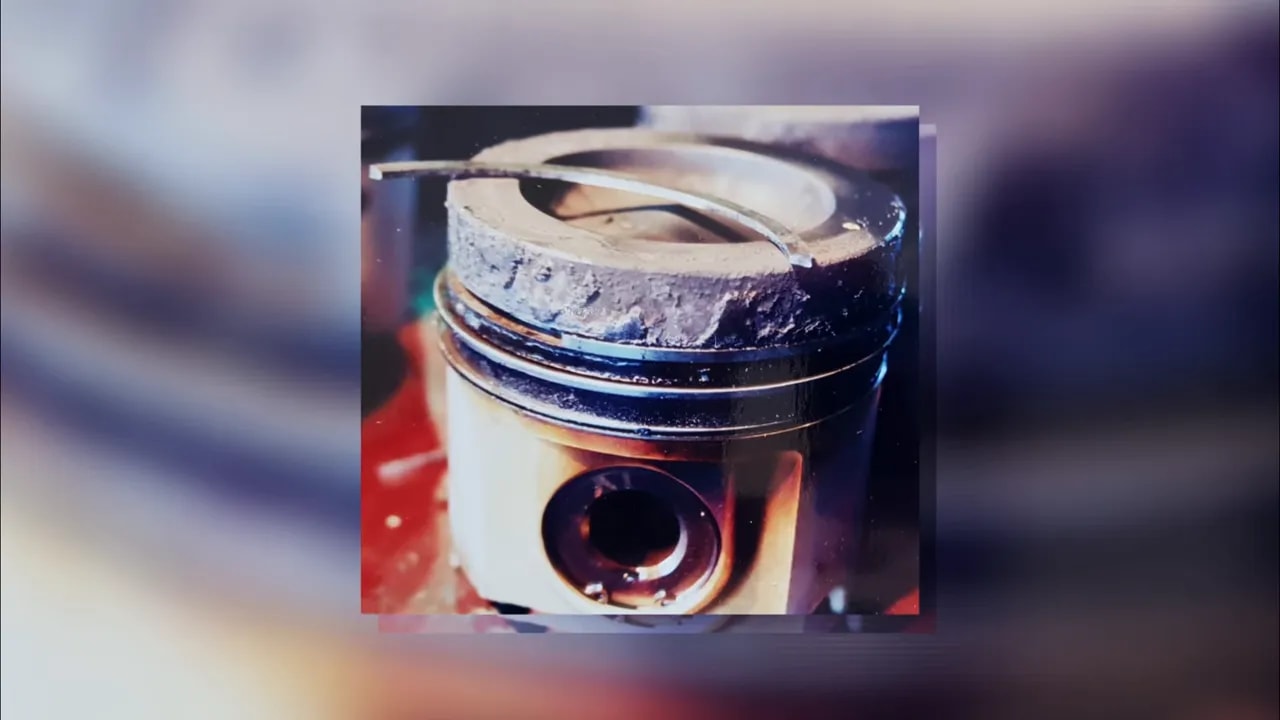
Carbon deposits can accumulate in the grooves that hold the piston rings. When deposits restrict ring movement, the rings cannot follow the cylinder wall as effectively.
Incomplete combustion and prolonged idling can contribute to deposit formation. This distinction matters for repairs: a ring restricted by deposits is not the same problem as a mechanically worn ring or damaged bore.
Oil dilution and accelerated wear
Fuel carried into the crankcase can mix with lubricating oil, reducing its viscosity and its ability to maintain a protective film.
This can create a damaging feedback loop:
- Ring sealing deteriorates.
- More combustion gases enter the crankcase.
- Oil contamination and fuel dilution increase.
- Lubrication becomes less effective.
- Ring and cylinder wear accelerate, allowing more leakage.
That is why increasing oil use and delayed maintenance should not be dismissed simply because the engine still runs.
Overheating damage
Severe overheating can distort pistons and cylinder bores, disrupting the clearances needed for sealing. Cooling the engine afterward does not necessarily reverse the damage.
A new blow-by symptom following an overheating event deserves prompt assessment.
Can Excessive Diesel Blow-By Be Fixed Without a Rebuild?
Sometimes, but the cause determines the repair. Maintenance or deposit treatment may help a carbon-related problem caught early. It cannot restore worn metal or correct substantial cylinder damage.
| Finding | Repair direction |
|---|---|
| Deposits restricting ring movement, without established mechanical damage | A suitable cleaning treatment and oil change may help, followed by reassessment |
| Crankcase pressure concern with ventilation problems | Address the ventilation system and repeat testing before concluding that the rings have failed |
| Worn rings or damaged cylinder surfaces | Mechanical repair based on inspection and measurements |
| Extensive cylinder damage or severe wear | A rebuild or replacement may be necessary |
Avoid choosing an additive or authorizing a rebuild solely from an oil cap check. Establish the leakage source and extent of damage first.
Will a catch can cure blow-by?
Managing crankcase gases is not the same as restoring cylinder sealing. A catch can should not be treated as a repair for worn rings or damaged cylinder walls, or as a reason to ignore persistent pressure and oil-consumption symptoms.
Can Blow-By Lead to Diesel Runaway?
In a severe case, oil can enter the combustion process in enough quantity to become an uncontrolled fuel source. The engine may accelerate independently of the commanded diesel fuel supply. This is diesel runaway.
Turning the key off may not stop an engine that is burning its own oil. A diesel does not depend on spark ignition, and shutting down normal fuel injection does not necessarily remove the alternative fuel source.
Runaway is not the expected result of a little crankcase vapor. It is a dangerous possible consequence of severe oil ingestion, not a diagnosis to make from an ordinary oil filler check.
Stopping combustion requires removing the uncontrolled fuel source or depriving the engine of air. That principle is not an invitation to approach a racing engine or improvise an intake blockage with hands or loose objects. Move away, keep others clear, and follow the equipment’s emergency procedure. Use a fitted emergency air shutoff only if trained to do so.
How to Reduce the Risk of Excessive Blow-By
- Follow the specified oil-change schedule. Fresh oil helps limit the buildup of contaminants and deposits. Use the schedule and oil specification for your engine rather than a universal mileage interval.
- Use suitable diesel fuel. Fuel quality can affect combustion and deposit formation, but changing fuel will not repair existing mechanical wear.
- Limit unnecessary prolonged idling. Extended idle periods can contribute to carbon accumulation.
- Respond promptly to overheating. A serious overheating event can cause lasting sealing damage.
- Track oil consumption. Record mileage and oil added so gradual changes become visible.
- Investigate symptoms together. Rising oil use combined with pressure, smoke, or power loss is more informative than any one observation.
For a high-mileage engine, a monthly observation under consistent conditions can help establish a trend, provided the check is safe and permitted. Treat it as monitoring, not a definitive mechanical test.
The Practical Next Step
Some diesel blow-by is normal. The warning sign is a change in behavior, especially when stronger crankcase pressure appears alongside higher oil consumption, rough running, smoke, or reduced power.
Start by recording the symptoms. Have the ventilation system checked, obtain a flow measurement against the correct specification, and use cylinder testing to locate leakage. That approach helps distinguish a manageable deposit or ventilation issue from wear that requires mechanical repair.