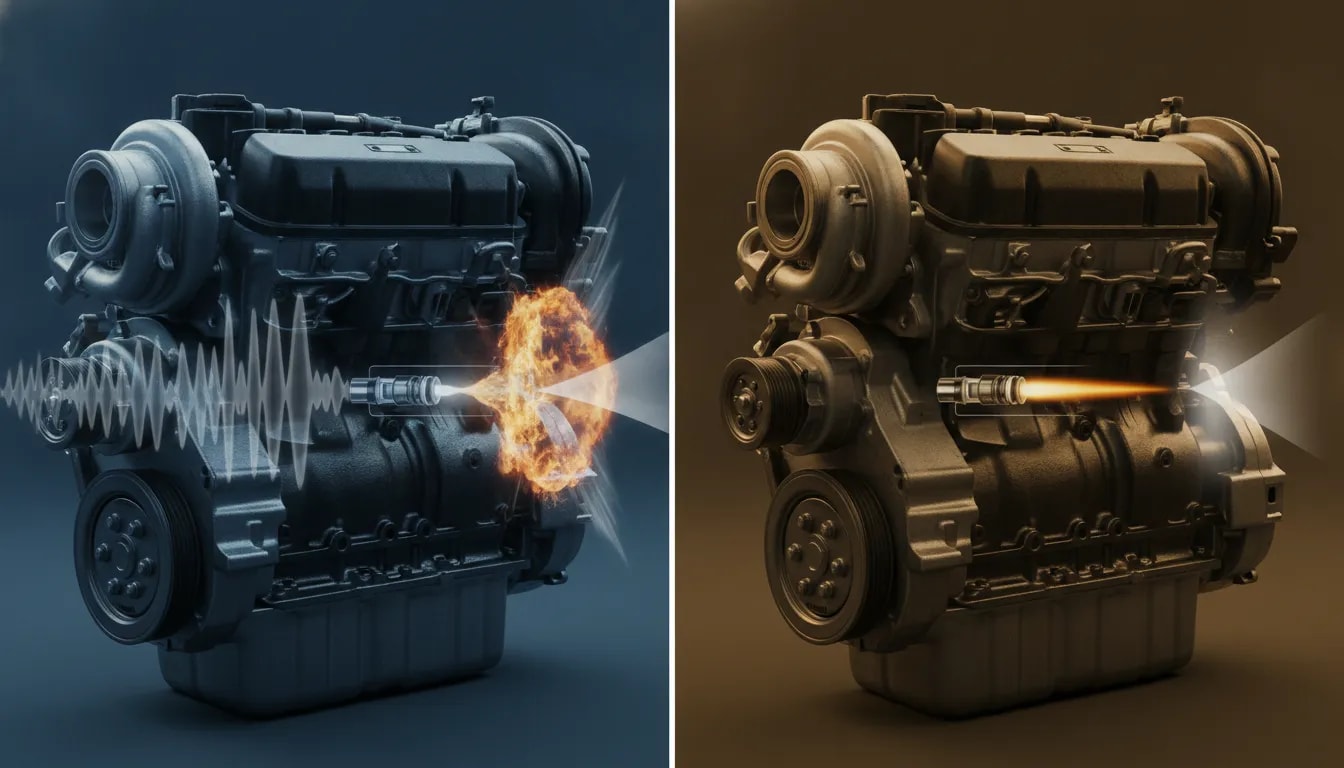
Diesel engines can sound remarkably different. One car idles with a muted hum, while another produces a sharp, tractor-like rattle. Engine design and sound insulation explain part of that difference, but diesel fuel’s cetane rating also affects how smoothly and quietly combustion happens.
The key is ignition delay: the brief interval between fuel injection and the start of combustion. A longer delay allows more fuel to collect before it burns, creating a sudden pressure rise and the familiar diesel clatter. Higher-cetane fuel shortens that delay and can reduce the noise, especially during cold starts and at idle.
That does not make premium diesel a universal solution. Understanding what produces diesel knock, and what cetane can actually change, helps you decide whether a different fuel is worth trying.
Key Takeaways
- Longer ignition delay allows more fuel to accumulate, creating the abrupt pressure rise behind diesel clatter.
- Higher cetane can reduce combustion noise and improve cold starting without guaranteeing more power or fuel savings.
- Common-rail injection, engine design, mounts, and insulation also explain differences in diesel refinement.
- Compare actual cetane specifications and similar operating conditions before deciding whether premium diesel is worthwhile.
Table of Contents
- What Causes the Tractor-Like Sound in a Diesel Engine?
- What Is Cetane, and How Does It Affect Diesel Noise?
- Why Modern Diesels Can Sound Quiet on Ordinary Fuel
- Why Diesel Clatter Is Worse During Cold Starts
- Is Premium Diesel Worth It for a Quieter Engine?
- Stored Diesel and Cetane-Boosting Additives
- Common Mistakes When Trying to Reduce Diesel Noise
- The Bottom Line
What Causes the Tractor-Like Sound in a Diesel Engine?
The characteristic diesel knock is combustion noise associated with a rapid rise in pressure inside the cylinder. To understand why it happens, it helps to distinguish diesel ignition from petrol ignition.
A petrol engine uses a spark plug to initiate combustion. A diesel engine instead compresses air until it becomes hot enough to ignite injected fuel. This is called compression ignition.
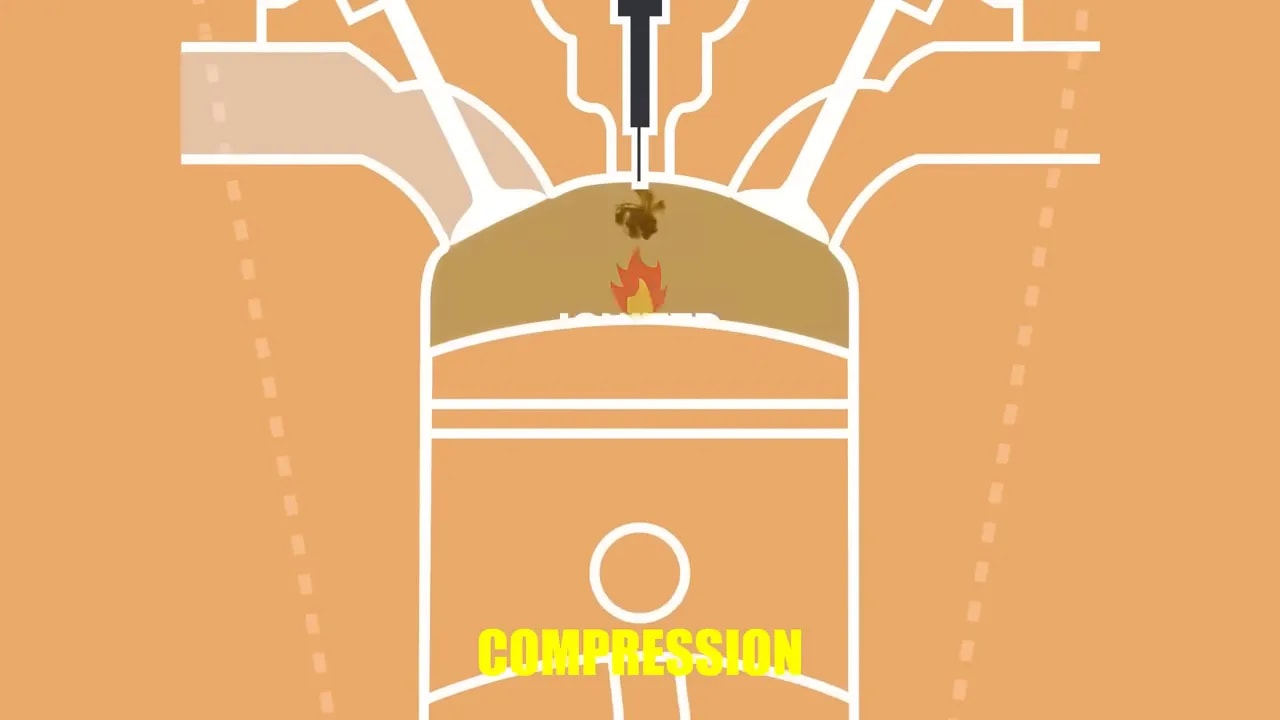
However, fuel does not begin burning at the exact instant it leaves the injector. There is a short ignition delay, measured in milliseconds, while the fuel spray disperses and mixes with hot air.
That delay affects the initial combustion event:
- Fuel enters the cylinder. The injector delivers a finely dispersed spray into compressed air.
- Ignition takes time. Some fuel mixes with air before combustion begins.
- A longer delay allows more fuel to accumulate. More of the injected fuel is ready to burn when ignition finally starts.
- The initial burn raises pressure rapidly. That abrupt pressure rise produces the sharp knocking or clattering sound.
A diesel can therefore sound rough without its noise being explained solely by age or poor engineering. Fuel ignition quality is another part of the picture.
What Is Cetane, and How Does It Affect Diesel Noise?
Cetane number measures the ignition quality of diesel fuel. In practical terms, it indicates how readily the fuel begins burning after injection under test conditions.
| Combustion characteristic | Lower-cetane fuel | Higher-cetane fuel |
|---|---|---|
| Ignition delay | Longer | Shorter |
| Fuel accumulated before ignition | More, under otherwise comparable conditions | Less, under otherwise comparable conditions |
| Initial pressure rise | More abrupt | More controlled |
| Likely audible effect | Sharper diesel clatter | Smoother, quieter combustion |
Higher cetane does not make diesel burn more slowly. Rather, it helps combustion start sooner after injection, reducing the amount of fuel involved in the sudden initial burn.
What cetane rating is typical?
Road diesel commonly falls within a cetane range of approximately 40 to 55, but the useful comparison depends on where you buy fuel.
- United States: A minimum of 40 is common, with regular fuel often around 42 to 45.
- Europe: The usual minimum for road diesel is 51, so regular diesel already has a relatively high cetane number.
- Premium diesel: Some products offer ratings around 50 to 55, depending on the supplier and market.
These figures are not interchangeable global definitions of “regular” and “premium.” A premium label alone does not tell you how much higher the cetane rating is than the standard fuel sold beside it.
Not every station displays a cetane number. When it is absent, check the supplier’s product information rather than assuming the more expensive option has a particular rating. For additional technical context, DieselNet’s diesel fuel overview explains fuel properties and ignition quality.
Why Modern Diesels Can Sound Quiet on Ordinary Fuel
Cetane matters, but it does not determine engine sound by itself. Two engines using the same fuel can still sound very different because they manage combustion differently and transmit different amounts of noise into the cabin.
Common-rail injection softens the initial combustion event
Modern common-rail systems can divide fuel delivery into multiple injections rather than delivering it as one main event.
- Pilot injection: A small amount of fuel is delivered before the main injection.
- Main injection: The principal fuel delivery follows.
- Post injection: Additional injections may occur afterward, depending on the system’s operating strategy.
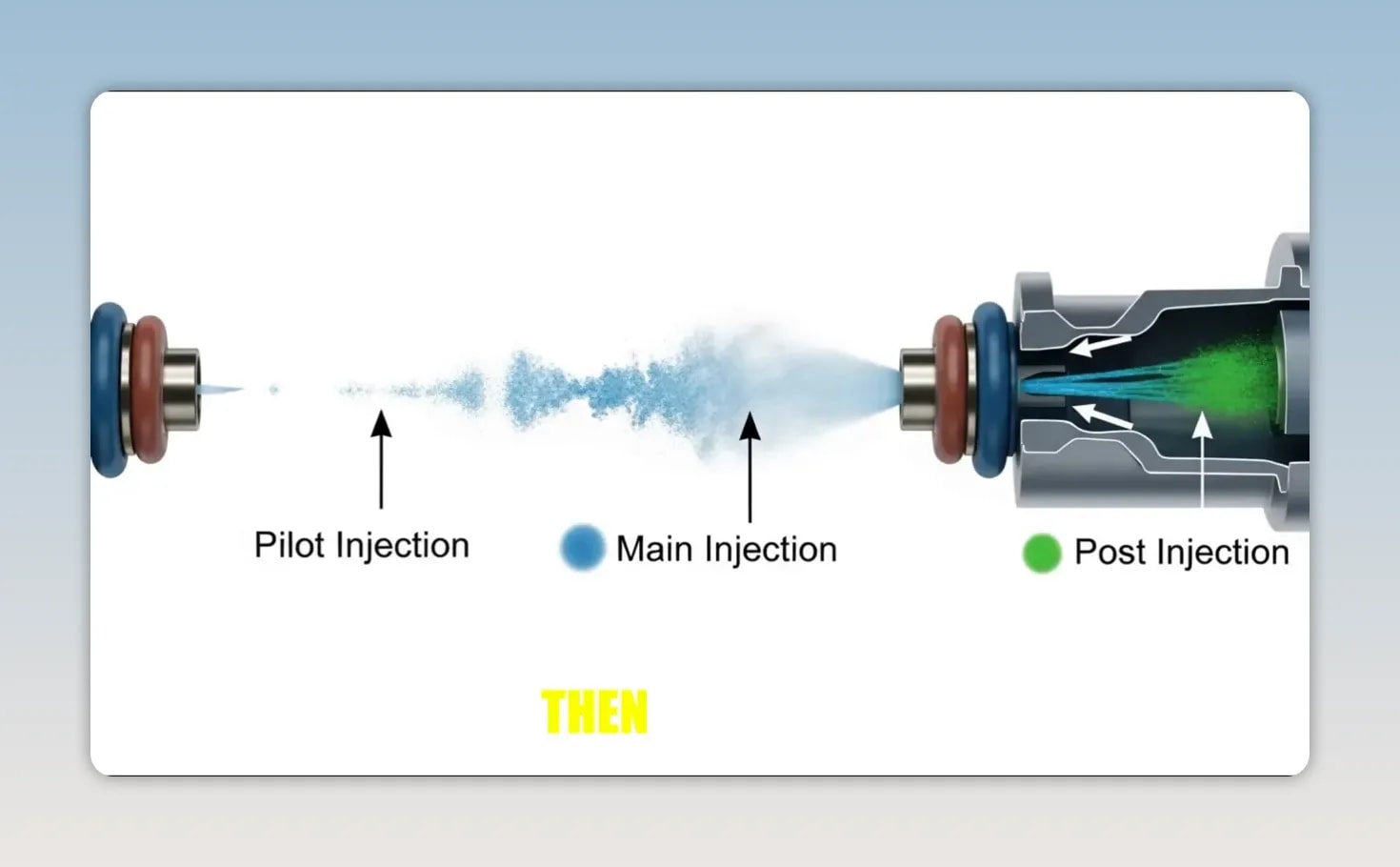
The pilot injection helps soften the pressure rise associated with the main combustion event. This is a major reason modern common-rail diesels can sound more refined than older engines with mechanical injection, even when both use relatively modest-cetane fuel.
Engine design changes the combustion noise
Combustion chamber shape, piston design, and compression ratio influence how fuel and air interact and how combustion develops. Turbocharging also affects the engine’s overall sound.
Engine speed changes how the noise is perceived. At higher rpm, individual combustion pulses blend together, making distinct knocks less noticeable. That does not mean the engine becomes quieter overall.
Cabin refinement is not the same as quiet combustion
Engine mounts and sound insulation influence how much vibration and noise reaches the occupants. A well-insulated car may sound quiet inside even though its engine is clearly audible from outside.
Comparing cabin noise between different vehicles is therefore not a reliable way to compare their fuel’s cetane rating.
Why Diesel Clatter Is Worse During Cold Starts
A cold engine creates less favorable conditions for ignition. Although compression heats the air, the cylinder environment is colder than it is after the engine has warmed up. Ignition delay can consequently be longer.
Lower-cetane fuel can make that delay more pronounced. The result may include louder clatter, rough running, or uneven combustion during warm-up.
Higher-cetane fuel can help by igniting more readily under those conditions. Its benefits are often easier to notice during:
- Starting after the engine has cooled completely.
- Idling immediately after a cold start.
- Cold-weather operation.
Improved ignition quality can also reduce white smoke associated with incomplete combustion during warm-up. Some suppliers use higher-cetane winter blends to improve starting behavior, but do not assume every winter diesel product has the same rating.
Most importantly, cold-start roughness does not prove that cetane is the only cause. Fuel quality is a possible contributor, not a diagnosis based on sound alone.
Is Premium Diesel Worth It for a Quieter Engine?
Premium diesel is most worth considering when your goal is less cold-start clatter, smoother idle, or easier starting, and the product actually offers a higher cetane rating than your usual fuel.
Some premium fuels also include additional detergent additives. Those are separate features: detergent content and cetane number should not be treated as the same thing.
What higher cetane can and cannot deliver
| Goal | Reasonable expectation |
|---|---|
| Reduce combustion clatter | Higher cetane can help, particularly when ignition delay contributes to the noise. |
| Improve cold starting | More readily ignited fuel can improve starting and initial running. |
| Increase horsepower | A higher cetane number alone is not a power upgrade. |
| Improve fuel economy dramatically | Do not expect a large or guaranteed improvement. |
| Increase energy content | Cetane number does not measure the energy contained in the fuel. |
Power depends on factors such as engine design, turbocharging, injection pressure, and fuel quantity. Cetane primarily changes ignition behavior, not how much energy the fuel contains.
Small fuel-economy improvements are possible, but any gain should be treated as modest rather than assured. A change on the order of 1 to 3 percent would still be a small benefit, not a reason to expect premium fuel to pay for itself.
The price premium also varies by supplier and location. Judge the purchase against the improvement you actually notice, not an assumed increase in performance.
A practical way to compare regular and premium diesel
- Identify the fuel difference. Look for a stated cetane rating or a clear supplier claim of improved ignition quality.
- Note your normal symptoms. Pay attention to starting behavior, cold idle, and warm idle with your usual fuel.
- Try the higher-cetane option. Compare the same vehicle rather than comparing it with a different diesel model.
- Keep conditions comparable. A cold morning and a warm afternoon are not equivalent tests.
- Assess refinement separately from economy. Quieter running can be worthwhile even without measurable fuel savings.
This comparison helps answer a practical question: does the additional cost buy an improvement that matters in your particular car?
Stored Diesel and Cetane-Boosting Additives
Fuel condition deserves attention when a diesel vehicle has been unused for months. Diesel can deteriorate during storage, and its ignition quality may change. Older fuel is therefore one possible contributor to rough running when an engine returns to service.
Storage time alone, however, does not establish the fuel’s current cetane number. Nor does it prove that any new noise comes from the fuel.
Cetane-boosting additives are another way to change ignition quality. Some can provide an increase of several cetane points, potentially around three to seven, but the result depends on the product and the starting fuel.
Treat an additive as a targeted fuel treatment, not a guaranteed cure for diesel noise. Compare its cost and stated effect with those of higher-cetane pump fuel, and follow the product’s application instructions.
Common Mistakes When Trying to Reduce Diesel Noise
- Blaming every rattle on low cetane. Combustion design, injection strategy, mounts, and insulation all affect what you hear.
- Assuming louder means worn out. A sharper combustion sound can reflect ignition behavior rather than engine age alone.
- Assuming “premium” means much higher cetane. Check the actual product specification and local regular-fuel baseline.
- Expecting more energy or horsepower. Cetane describes ignition quality, not fuel energy content.
- Comparing unlike conditions. Engine temperature and rpm can obscure the effect of a fuel change.
- Using quieter running as proof that every problem is solved. An improvement shows that fuel may influence the sound; it does not establish the condition of every engine component.
The Bottom Line
Some diesels sound like tractors because their initial combustion event produces a sharper pressure rise. Longer ignition delay can contribute to that clatter, and lower-cetane fuel can lengthen the delay.
Higher cetane can improve refinement, particularly when cold, but injection technology and vehicle design remain important. If noise is your main concern, compare a genuinely higher-cetane fuel in your own car under similar conditions. Expect a possible improvement in smoothness, not a transformation in power or fuel economy.