When comparing NACS and CCS charging standards, the best choice depends on your vehicle, where you charge, and how often you take road trips. NACS, now commonly tied to the SAE J3400 standard in North America, has gained major momentum because many automakers are moving toward it and Tesla’s Supercharger network is opening to more non-Tesla EVs. CCS still matters because many electric vehicles already on the road use it, and many public fast chargers still support it.
Quick Answer
For most North American EV shoppers, NACS/J3400 is becoming the easier future choice because it uses a compact connector and gives many newer vehicles access to Tesla’s large Supercharger network. CCS is still important because millions of current EVs use it, and many public DC fast chargers still offer CCS plugs.
Key Takeaways
- NACS/J3400 is compact, easy to handle, and increasingly common on new North American EVs.
- CCS remains widely used by many existing non-Tesla EVs and public fast-charging networks.
- Charging speed depends on the charger, vehicle, battery temperature, and state of charge, not only the connector.
- Use only Tesla-approved or automaker-approved DC fast-charging adapters.
- The best standard for you depends on your EV, local chargers, road-trip routes, and whether your automaker has Supercharger access.
NACS vs. CCS: Which Charging Standard Should You Choose?
If you are buying a new EV in North America, NACS/J3400 is becoming the more future-friendly option. Tesla says the North American Charging System, or NACS, is the common name for the NACS J3400 standard published and maintained by SAE. Many major automakers have moved toward NACS ports or approved adapters for North American vehicles.
If you already own a CCS-equipped EV, CCS is not suddenly obsolete. The U.S. Department of Energy Alternative Fuels Data Center explains that the CCS connector, also known as SAE J1772 combo, can support Level 1, Level 2, and DC fast charging equipment. That means many current EVs and charging networks will continue supporting CCS for years.
The simple answer is this: choose based on access, not hype. If your vehicle can use Tesla Superchargers through a built-in NACS port or an approved adapter, NACS will often be more convenient for road trips. If your area has strong CCS coverage and you already own a CCS vehicle, CCS can still work well.
Note: NACS and CCS are connector standards, not guaranteed charging speeds. A 350 kW charger will not deliver 350 kW if your EV cannot accept that much power, the battery is cold, or the battery is already at a high state of charge.
NACS vs. CCS Comparison Table
| Category | NACS / SAE J3400 | CCS / SAE J1772 Combo |
| Connector design | Smaller, lighter, and easier to handle | Larger connector with separate DC fast-charge pins |
| Charging levels | Supports AC and DC charging through one compact connector | Supports AC and DC charging through the J1772 combo layout |
| Best fit | Newer North American EVs, Tesla owners, and road-trippers with Supercharger access | Many existing non-Tesla EVs and drivers near strong CCS fast-charging coverage |
| Main drawback | Access may depend on automaker approval, software support, and adapter availability | Connector is bulkier, and public reliability can vary by network and location |
How Do NACS and CCS Differ in Design?
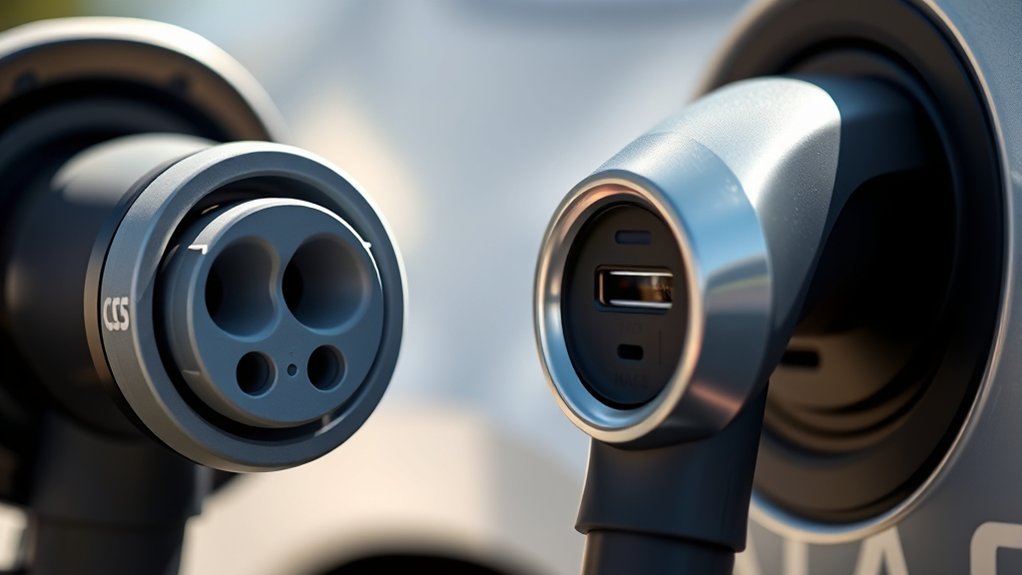
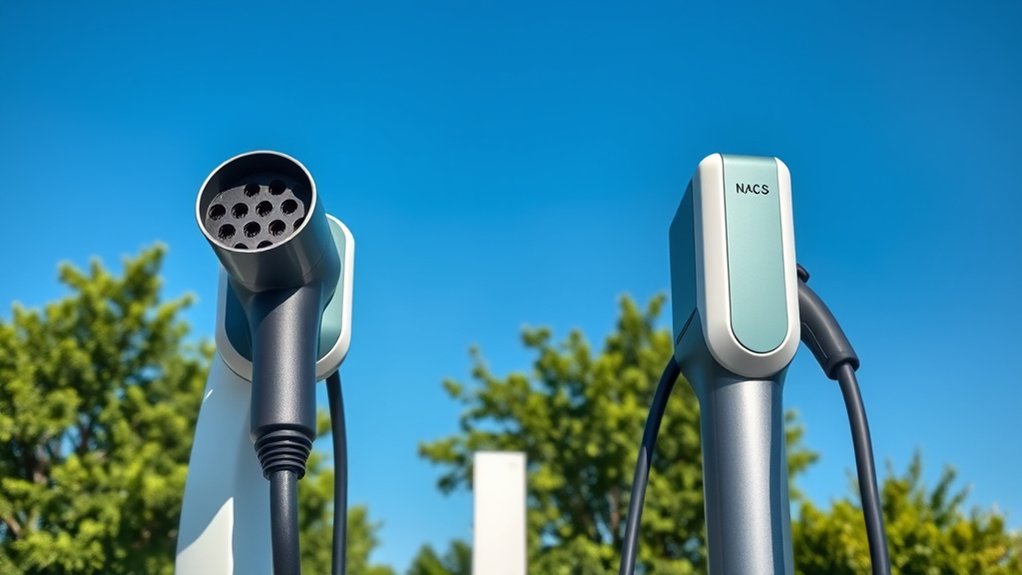
The biggest design difference is size. NACS uses a compact connector that handles both AC charging and DC fast charging through the same general plug shape. That makes it easier to lift, align, and connect, especially when you are charging in rain, snow, or tight parking spaces.
CCS, often called CCS1 in North America, builds on the J1772 AC charging shape and adds two larger DC pins below it for fast charging. This setup works, but the connector is larger and heavier. For some drivers, especially those with limited grip strength, the bulkier connector can feel awkward.
Connector Size Comparison
The NACS connector is usually easier to handle with one hand. Tesla describes its design as lightweight, compact, and efficient, with no moving parts. That simplicity is one reason many drivers prefer the physical charging experience.
The CCS connector is more cumbersome because it combines the AC J1772 section with additional DC fast-charging pins. The tradeoff is that CCS became widely deployed across many non-Tesla EVs before the North American market started shifting toward NACS/J3400.
Pin Configuration Differences
NACS combines AC and DC charging functions into a compact connector layout. CCS uses the J1772-style top section for AC charging and the two lower pins for DC fast charging. For you as a driver, the main difference is not the pin count itself. It is how easy the connector is to use and whether your car can access the charging network you want.
In daily use, NACS tends to feel simpler. CCS remains practical because many EVs, charging stations, and route-planning tools still support it.
Comparing Charging Speeds: NACS vs. CCS
Charging speed is where many comparisons become misleading. A connector does not decide charging speed by itself. Your actual charging rate depends on the charger output, vehicle charging curve, battery voltage, battery temperature, and state of charge.
The U.S. Department of Energy notes that DC fast-charging equipment can provide up to 500 kW, but charging power varies by vehicle and battery state of charge. Many EVs cannot hold their peak charging rate for long, even when plugged into a high-power charger.
A connector alone does not make an EV charge faster. The charger, vehicle, battery temperature, and battery state of charge all decide the real-world speed.
In practice, Tesla Superchargers are often praised for consistent setup, payment, routing, and charger availability. CCS chargers can be very fast too, especially newer 150 kW, 250 kW, and 350 kW units, but the experience can vary more by charging network, site maintenance, payment system, and cable layout.
If fast road-trip charging matters to you, compare the charging stops on your real routes. A nearby reliable 150 kW charger can be more useful than a theoretical 350 kW charger that is far away, blocked, broken, or incompatible with your vehicle.
User Experience: Convenience Factors for NACS vs. CCS
NACS usually wins on physical convenience. The connector is smaller, lighter, and easier to plug in. Tesla’s Supercharger experience also reduces friction for many drivers because the vehicle, route planner, charger, and payment system are closely integrated.
For non-Tesla EVs, the experience depends on the automaker. Tesla says select Superchargers are open to non-Tesla vehicles that are NACS-equipped or have a NACS DC adapter. Newer non-Tesla vehicles have started coming with NACS charge ports, and those vehicles do not need an adapter at compatible sites.
CCS convenience depends more heavily on the charging network. Some CCS networks offer strong apps, reliable hardware, and simple payment. Others can be more frustrating, especially if the charger has a broken screen, a payment issue, a short cable, or poor uptime.
Pro Tip: Before a road trip, check your vehicle’s navigation system and at least one independent charging map. Filter by connector type, charger power, live availability, payment method, and recent driver reviews.
Charging Network Availability: Where to Charge?
Network availability is one of the strongest reasons NACS/J3400 has gained momentum. Tesla currently reports 36,500+ Supercharger stalls for Teslas, 25,000+ stalls for NACS, and 2,400+ stalls for other EVs on its NACS page. Tesla also reports 99.95% Supercharger uptime, although that is Tesla’s own reported figure.
CCS coverage is still important because many public fast-charging networks, including Electrify America, ChargePoint, EVgo, and many utility-backed networks, have deployed CCS plugs. The Department of Energy’s Alternative Fuels Data Center also provides a station locator that can help you find current public chargers by connector type and location.
For local driving, the best charging standard is the one that has reliable stations near your home, work, errands, and common routes. For long-distance driving, the best standard is the one with dependable fast chargers along highways where you actually travel.
Compatibility Challenges: Adapters and Interoperability
Adapters make the NACS and CCS transition easier, but they also create confusion. A CCS-equipped vehicle may be able to use certain NACS Superchargers with an approved DC adapter. A Tesla may be able to use some CCS fast chargers with the correct Tesla-compatible adapter. However, support varies by vehicle, charger, network, software, and automaker agreement.
Warning: Do not use random third-party DC fast-charging adapters. Tesla says Supercharging for CCS1-equipped vehicles requires a NACS DC adapter provided by Tesla or your vehicle manufacturer, and third-party adapters are prohibited for safety reasons.
Adapter Types Explained
There are two broad adapter situations:
- CCS vehicle to NACS Supercharger: Some CCS-equipped EVs can use compatible Tesla Superchargers with an automaker-approved NACS DC adapter.
- Tesla/NACS vehicle to CCS charger: Some Tesla or NACS-equipped vehicles can use CCS fast chargers with the correct approved adapter, depending on vehicle support.
Adapters are not all the same. AC adapters and DC fast-charging adapters do different jobs. Never assume that an adapter that physically fits is safe or supported for high-power DC charging.
Interoperability Issues Faced
Interoperability means the vehicle, charger, connector, software, payment system, and network all work together. This is where the NACS transition can still feel messy. Some vehicles have adapter access now. Others need a software update, an approved adapter, or automaker activation. Some Supercharger sites are Tesla-only, some support all EVs through Magic Dock, and some support NACS-equipped or adapter-equipped vehicles by manufacturer.
CCS also has interoperability challenges. A charger can be rated for high output but still fail because of a payment issue, network error, damaged connector, cable reach problem, or vehicle communication fault. A 2022 Greater Bay Area study of public CCS DC fast-charging connectors found that 72.5% of tested connectors were functional at the time of evaluation, which shows why reliability and maintenance matter as much as plug type.
NACS vs. CCS Adoption Rates: Who’s Winning?
In North America, NACS/J3400 has the stronger momentum for new passenger EVs. Tesla says all large automakers have adopted NACS, with manufacturers and charge point operators transitioning to NACS. Its support page also lists brands such as Ford, Rivian, General Motors, Volvo, Polestar, Nissan, Lucid, Mercedes-Benz, Hyundai, Genesis, Kia, Honda, Acura, JLR, Audi, Porsche, Toyota, Volkswagen, Subaru, BMW, and Stellantis in its Supercharging access information.
That does not mean CCS disappears overnight. Many CCS-equipped EVs will stay on the road for a long time. Charging networks will need to serve those drivers, and many new charging sites may include more than one connector type during the transition.
For EV buyers, the practical question is not only “who is winning?” It is “what will work best for me over the next five to ten years?” If you are buying new, NACS/J3400 access is a strong advantage. If you already own CCS, focus on approved adapters, reliable local CCS sites, and your automaker’s Supercharger access timeline.
Future Trends: What’s Next for NACS and CCS?
The future is likely mixed, not instant replacement. NACS/J3400 is becoming the dominant direction for new North American EVs, but CCS will remain part of the charging landscape because so many current vehicles use it.
Expect more chargers with NACS cables, more vehicles with built-in NACS ports, and more automaker-approved adapters for existing CCS vehicles. Also expect better route planning, better Plug and Charge support, and clearer charger-access filtering in vehicle apps.
For drivers, the biggest improvements will come from reliability, payment simplicity, cable reach, station layout, and charger maintenance. A better plug helps, but a working charger in the right location helps more.
Which Charging Standard Is Best for Your Situation?
Choose NACS/J3400 if you are buying a new EV in North America, want easier Supercharger access, value a smaller connector, and take road trips where Tesla’s network has strong coverage.
Stick with CCS confidently if you already own a CCS-equipped EV, your local CCS network is reliable, and your road trips are well covered by CCS fast chargers.
Be careful with adapters if you own a CCS vehicle and want Supercharger access. Confirm that your automaker supports access, your vehicle software is ready, your adapter is approved, and the specific Supercharger site works with your vehicle.
Check local coverage first if you rent, live in an apartment, drive rural routes, or depend on public charging. Local reliability matters more than national headlines.
Frequently Asked Questions
How do NACS and CCS affect battery life?
NACS and CCS do not directly decide battery life. Battery wear is affected more by heat, high charging power, frequent DC fast charging, battery chemistry, state of charge, and how the vehicle manages temperature. Use your EV’s charging recommendations and avoid sitting at very high charge levels longer than needed.
What are the costs associated with each charging standard?
Costs vary by charging network, location, membership plan, time of day, vehicle efficiency, and local electricity rates. NACS does not automatically mean cheaper charging, and CCS does not automatically mean more expensive charging. Always check the charger app or your vehicle screen before starting a session.
Are there regional preferences for NACS or CCS?
Yes. NACS/J3400 is becoming the preferred direction for new EVs in North America, while CCS remains common across many existing non-Tesla EVs and public fast chargers. In Europe, CCS2 is the dominant standard, so this NACS vs. CCS1 comparison mainly applies to the U.S. and Canada.
How does weather impact charging efficiency for NACS and CCS?
Cold weather can slow charging because the battery may need heating before it can accept high power. Hot weather can also reduce charging speed if the battery or charger needs thermal protection. This affects both NACS and CCS vehicles, so preconditioning the battery before DC fast charging can help.
What maintenance is required for NACS and CCS chargers?
Public charger operators must maintain cables, connectors, screens, payment systems, cooling systems, software, network connections, and site safety. As a driver, inspect the connector for damage, avoid using damaged equipment, report broken chargers in the app, and never force a plug or adapter.
Can a CCS vehicle use a Tesla Supercharger?
Some CCS vehicles can use compatible Tesla Superchargers with an approved NACS DC adapter, but access depends on the automaker, vehicle software, adapter, and Supercharger site. Add your vehicle details in the Tesla app or check your automaker’s guidance before relying on a Supercharger stop.
Is NACS the same as J3400?
In current North American EV discussions, NACS is commonly used to refer to the SAE J3400 charging standard based on Tesla’s connector design. You may see both names used together as NACS/J3400.
Conclusion
For new EV shoppers in North America, NACS/J3400 is the more future-facing choice because many automakers are adopting it and Tesla’s Supercharger access continues to expand. For current EV owners, CCS still has real value because many vehicles and charging stations already use it.
The smartest choice is the one that fits your actual driving. Check your vehicle’s supported connector, approved adapters, local charger reliability, and road-trip routes. A compact plug is helpful, but the best charging standard is the one that gives you reliable power where you need it.
Sources
- Tesla NACS — supports Tesla-reported Supercharger stall counts, NACS adoption, connector design, and uptime claims.
- Tesla Support: Supercharging Other EVs — supports non-Tesla Supercharger access, NACS/J3400 terminology, and approved adapter safety guidance.
- U.S. Department of Energy Alternative Fuels Data Center: Electric Vehicle Charging Stations — supports CCS/J3400 terminology, charging levels, DC fast-charging ranges, and station-locator guidance.
- Reliability of Open Public Electric Vehicle Direct Current Fast Chargers — supports the 72.5% functionality finding for a 2022 Greater Bay Area CCS DC fast-charging study.