Level 2 and Level 3 EV charging serve different needs. Level 2 charging is the practical choice for most homes, apartments, workplaces, and long parking sessions. Level 3 charging, more accurately called DC fast charging, is built for quick public stops, highway travel, fleets, and commercial charging sites where speed matters more than installation cost.
Quick Answer
Level 2 EV chargers use AC power and usually add enough range for daily driving during an overnight or workday charge. Level 3 chargers use high-power DC fast charging and can add major range in minutes, but they cost far more to install and are mainly used at public or commercial sites.
Key Takeaways
- Level 2 charging is best for home, work, hotels, apartments, and any place where the car can sit for several hours.
- Level 3 charging, also called DC fast charging, is best for road trips, public corridors, fleet depots, and high-turnover commercial locations.
- Level 2 equipment usually uses 208-240 volts AC, while DC fast chargers use much larger commercial electrical infrastructure.
- Connector compatibility now includes J1772, CCS, CHAdeMO, and SAE J3400/NACS, so always check your vehicle port and adapter support.
- Federal charger tax credits can help, but eligibility depends on location, use, date placed in service, and IRS rules.
Understanding the Basics of EV Charging Levels
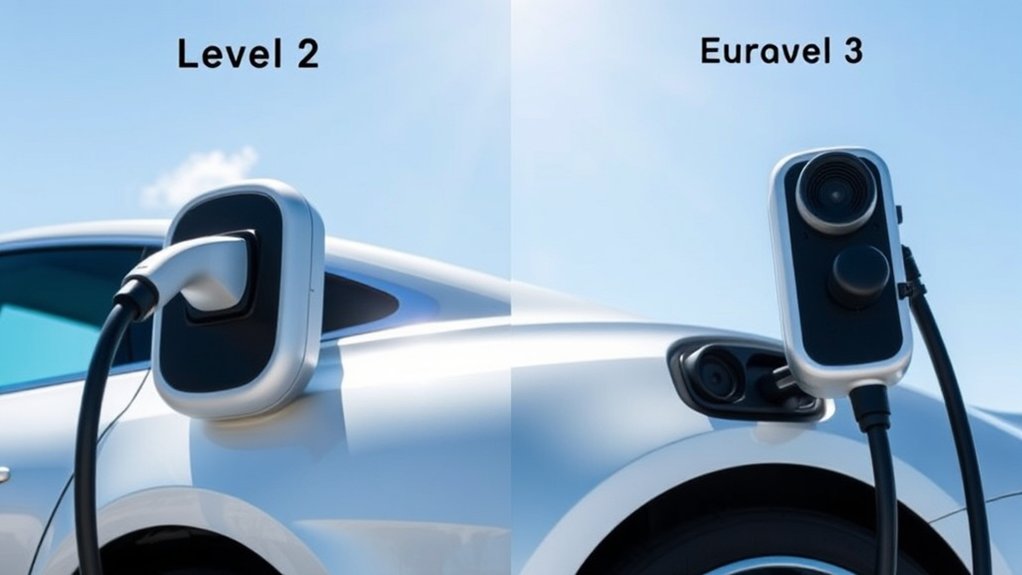
EV charging levels describe how quickly power moves into your vehicle battery. The higher the charging power, the faster your EV can add range, but the installation also becomes more complex.
The U.S. Department of Energy Alternative Fuels Data Center classifies common passenger EV charging as Level 1, AC Level 2, and DC fast charging. Many drivers still call DC fast charging “Level 3,” but the more precise current term is DC fast charging.
Level 2 chargers use alternating current (AC). Your EV’s onboard charger then converts that AC power into direct current (DC) for the battery. This is why Level 2 speed depends not only on the charger but also on your vehicle’s onboard charger limit.
Level 3 chargers, or DC fast chargers, convert AC power to DC inside the charging station and send DC power directly to the vehicle battery. This bypasses the slower onboard AC charger and allows much higher charging power.
Level 2 is about convenience during long parking sessions. DC fast charging is about speed during short stops.
Level 2 vs Level 3 Charging Comparison
| Feature | Level 2 Charging | Level 3 / DC Fast Charging |
| Power type | AC power | DC power delivered directly to the battery |
| Typical electrical service | 240 V residential or 208 V commercial AC service | Commercial high-power service, usually with three-phase input |
| Best use | Home, workplace, apartments, hotels, parking garages | Highways, fleet depots, public fast-charge hubs, busy retail sites |
| Charging speed | Often enough for a full overnight charge | Often charges compatible EVs to about 80% during a short stop |
| Main drawback | Too slow for quick highway stops | High equipment, utility, installation, and maintenance costs |
What Are the Key Power Requirements for Each Charging Level?
Power requirements are the biggest practical difference between Level 2 and Level 3 charging. A Level 2 installation often fits into a residential or light-commercial electrical plan. A DC fast charger usually requires utility coordination, major site work, and much higher available power.
Level 2 Voltage and Circuit Needs
Level 2 charging uses AC electrical service. In homes, that usually means 240 volts. In many commercial buildings, it may be 208 volts. According to the DOE, Level 2 equipment can range from 2.9 kW to 19.2 kW, and many residential units are set up around 30 amps and 7.2 kW.
That does not mean every EV will charge at the charger’s maximum rating. The vehicle’s onboard charger sets the actual AC charging limit. For example, plugging an EV with an 11 kW onboard charger into a 19.2 kW Level 2 station will not force the car to accept 19.2 kW.
Pro Tip: Before buying a Level 2 charger, check your EV’s maximum AC charging rate. Paying for more amperage than your vehicle can accept may not shorten your charge time.
Level 3 DC Fast Charging Power Needs
DC fast chargers are much more demanding. Instead of sending AC power to the vehicle’s onboard charger, the station converts power to DC and sends it directly to the battery. The DOE notes that DC fast charging is typically supplied by three-phase AC input and can reach installed power outputs up to 500 kW.
That level of power is why DC fast chargers are rarely a home project. They may require transformer upgrades, switchgear, utility service upgrades, concrete work, cable management, networking, payment hardware, and ongoing service contracts.
Warning: EV charger installation is electrical work. Use a licensed electrician, follow local code, and get required permits. DC fast charging installations should be planned with the utility and qualified commercial electrical professionals.
Electrical Capacity Needs
For Level 2, the key question is whether your panel has enough spare capacity for the charger size you want. Homes with electric heat, large air-conditioning loads, electric water heaters, or older panels may need a load calculation before installation.
For DC fast charging, the key question is whether the site has enough available utility power. A busy fast-charge site may also face demand charges, which are utility fees based on peak power draw. These charges can make operating costs much higher than the cost of energy alone.
What Are the Physical Specifications of Level 2 and Level 3 Chargers?
Level 2 chargers are usually compact wall-mounted or pedestal units. They fit garages, parking stalls, carports, apartment lots, and commercial parking spaces. Many units include a cable holster, network features, and a weather-rated housing for outdoor use.
DC fast chargers are larger because they contain high-power electronics, cooling systems, heavier cables, contactors, payment or network hardware, and safety systems. A DC fast charging site may also need bollards, signs, lighting, ADA-accessible layout planning, and enough room for vehicles to enter, charge, and exit safely.
Charger Size Comparison
A Level 2 charger is usually small enough to mount near a parking space. The larger installation concerns are cable reach, weather exposure, breaker capacity, trenching distance, and whether the unit needs Wi-Fi, cellular, or hardwired networking.
A DC fast charger needs more space. The charger cabinet, power modules, cables, protective equipment, and utility gear may take up multiple parking spaces or a dedicated equipment pad. Site design matters because fast-charging cables are heavier and may not easily reach every vehicle’s charge port if the charger is poorly placed.
Plug Type Differences
Connector compatibility is changing quickly in North America. Level 2 charging has historically used the SAE J1772 connector for most non-Tesla EVs, while Tesla vehicles used the Tesla/NACS connector with adapters for J1772 stations.
For DC fast charging, common connectors include CCS, CHAdeMO, and SAE J3400/NACS. CCS has been common on many non-Tesla battery-electric vehicles. CHAdeMO is now mostly a legacy connector in North America. SAE J3400, based on Tesla’s North American Charging System connector, is increasingly important because it can support both AC and DC charging.
Note: Always check your exact EV model, model year, charging port, and adapter support. Two vehicles from the same brand can have different fast-charging connector options.
How Quickly Can You Charge Your EV?
Charging speed depends on the charger power, the vehicle’s maximum charging rate, battery size, battery temperature, and current state of charge. A charger can only deliver what the car is able to accept at that moment.
Level 2 charging is usually measured in hours. For many drivers, that is not a problem because the vehicle is parked overnight or during the workday. The DOE estimates Level 2 charging at about 25 miles of range per hour, though real-world results vary by vehicle efficiency and charger amperage.
DC fast charging is designed for short stops. The DOE describes DC fast charging as adding about 100 to 200+ miles of range in 30 minutes, depending on the EV and charger. Some compatible EVs can charge from about 10% to 80% in 15 to 45 minutes, but that is not guaranteed for every vehicle or every charger.
Charging also slows near the top of the battery. This is called the charging curve. Many EVs charge fastest at a lower state of charge and slow down as they approach 80% or more. That is why road-trip drivers often stop around 80% instead of waiting for a full 100% charge.
What Will It Cost to Install Level 2 and Level 3 Chargers?
Installation cost depends on equipment price, electrical capacity, distance from the panel, trenching, permits, labor rates, networking, weather protection, and whether the site needs utility upgrades.
Level 2 installation is usually the lower-cost option. A simple home installation near an adequate electrical panel may be straightforward. Costs rise if the electrician needs to upgrade the panel, add a long conduit run, install a subpanel, trench outdoors, or bring the setup up to current code.
DC fast charging installation is much more expensive because the site may need commercial electrical design, utility service upgrades, transformers, switchgear, concrete pads, networked payment systems, cooling, and ongoing service agreements. Higher-power stations generally cost more than lower-power stations, and multi-port sites cost more than single-port sites.
For homeowners, Level 2 is usually the realistic upgrade. For businesses, the better choice depends on dwell time. A hotel, office, or apartment property usually benefits from Level 2. A highway stop, delivery fleet, rideshare hub, or busy convenience store may justify DC fast charging if utilization is high enough.
What Are the Expected Maintenance and Operating Costs?
Level 2 chargers usually have lower maintenance needs because the equipment is simpler. Common costs include electricity, occasional cable or connector replacement, network fees for smart chargers, software subscriptions, and repairs after weather damage or misuse.
DC fast chargers have higher operating costs. They include more complex electronics, heavier cables, cooling systems, payment terminals, network connections, preventive maintenance, and more expensive repair calls. High-power sites may also face utility demand charges, which can make the monthly bill higher even if the station is not used constantly.
For public charging operators, utilization is critical. A fast charger that sits unused can be expensive to own. A Level 2 charger can make more sense where drivers naturally park for hours, while DC fast charging makes more sense where drivers are willing to pay for speed.
What Charging Connectors Are Compatible With Each Level?
Connector compatibility is one of the most important details when choosing where and how to charge. The charger level tells you the speed class, but the connector tells you whether your vehicle can physically use the station.
| Connector | Common use | What to know |
| J1772 | Level 1 and Level 2 AC charging | Common on many non-Tesla EVs and plug-in hybrids in North America. |
| CCS | DC fast charging | Common on many non-Tesla battery-electric vehicles sold in recent years. |
| CHAdeMO | Legacy DC fast charging | Still found at some stations but less common on newer North American EVs. |
| SAE J3400 / NACS | Level 2 AC and DC fast charging | Used by Tesla and being adopted by more North American EVs. |
If you own a plug-in hybrid, check whether it supports DC fast charging at all. Many plug-in hybrids only support Level 1 and Level 2 AC charging because their smaller batteries do not need fast charging.
Choosing the Right Charger for Your Needs
The right charger depends on how long the vehicle stays parked and how quickly the driver needs to leave again.
Best Choice for Homeowners
For most homeowners, Level 2 charging is the best balance of speed, cost, and convenience. You plug in at night, wake up with enough range for daily driving, and avoid relying on public charging for routine use.
Choose a charger size that fits your electrical panel and your EV’s onboard charging limit. A smart charger can also help schedule off-peak charging if your utility offers time-of-use rates.
Best Choice for Apartments and Workplaces
Level 2 usually works best for apartments, condos, offices, universities, hospitals, hotels, and parking garages. Vehicles sit for long periods, so extreme speed is not required. Site owners can often install several Level 2 ports for the cost and electrical load of fewer fast chargers.
Networked Level 2 chargers can help property owners manage access, billing, reporting, and energy use. Load sharing can also reduce the need for expensive electrical upgrades.
Best Choice for Road Trips and Commercial Sites
DC fast charging makes sense where drivers need to get back on the road quickly. Good examples include highway corridors, convenience stores, fleet depots, rideshare charging hubs, and busy retail centers.
For a business, the question is not only “How fast is the charger?” It is also “Will enough drivers use it to justify the cost?” A fast charger with low utilization can be expensive to operate.
What Financial Incentives Are Available for Charging Station Installations?
EV charger incentives can come from federal tax credits, state programs, local governments, utilities, and air-quality agencies. These programs change often, so verify current rules before buying equipment or signing an installation contract.
The IRS Alternative Fuel Vehicle Refueling Property Credit can apply to qualified EV charging equipment installed in an eligible location. For personal-use property placed in service at a main home from January 1, 2023, to June 30, 2026, the IRS states that the credit equals 30% of the cost, up to a maximum credit of $1,000 per item.
Eligibility is not automatic. The IRS requires the property to be installed in an eligible census tract, and business property has separate rules. Businesses and tax-exempt organizations may have different credit percentages and caps, especially if prevailing wage and apprenticeship requirements apply.
Note: Tax incentives are not guaranteed. Confirm your location, placed-in-service date, equipment eligibility, and documentation with the IRS guidance or a qualified tax professional.
Frequently Asked Questions
What is the difference between Level 2 and Level 3 charging?
Level 2 charging uses AC power and is best for several-hour parking sessions at home, work, hotels, or apartments. Level 3 charging, usually called DC fast charging, sends DC power directly to the battery and is best for short public stops, highway travel, and commercial charging sites.
Can I install a Level 3 charger at home?
For almost all homeowners, no. DC fast chargers need high-power commercial electrical infrastructure, utility coordination, large equipment, and expensive installation. A properly sized Level 2 charger is the realistic home option for most EV drivers.
Is Level 3 charging bad for an EV battery?
Occasional DC fast charging is normal for compatible EVs, especially on road trips. For daily charging, Level 2 is usually gentler, cheaper, and more convenient. Follow your vehicle maker’s battery-care guidance, especially in extreme heat or cold.
What stops someone from unplugging your electric car?
Many EVs lock the connector while charging, especially on DC fast chargers. Some stations also use session controls, app authentication, and cable-locking features. Still, charging etiquette matters: do not unplug another vehicle unless the owner has clearly allowed it.
Is there a Level 4 EV charger?
For normal passenger EV charging, the common categories are Level 1, Level 2, and DC fast charging. Heavy-duty charging systems, including megawatt-class charging, are being developed for trucks and buses, but they are not usually called “Level 4” passenger EV chargers.
Are Tesla chargers Level 2 or Level 3?
Tesla home chargers and many Tesla Destination Chargers are Level 2 AC chargers. Tesla Superchargers are DC fast chargers. The same J3400/NACS-style connector can support different charging levels, so the station type matters more than the plug shape alone.
Conclusion
Level 2 and Level 3 charging are not competitors for the same job. Level 2 is the everyday charging solution for most EV owners because it is practical, slower, and usually much less expensive to install. Level 3, or DC fast charging, is the speed solution for road trips, public corridors, commercial sites, and fleets.
If you are charging at home or at work, start with Level 2. If you are planning a public site where drivers need to leave quickly, evaluate DC fast charging carefully, including power availability, utility costs, connectors, maintenance, and expected usage. The right choice is the one that matches how long the car will be parked and how quickly the driver needs range.
Sources
- U.S. Department of Energy Alternative Fuels Data Center — Electric Vehicle Charging Stations — charging levels, power ranges, connectors, and DC fast charging overview.
- Internal Revenue Service — Alternative Fuel Vehicle Refueling Property Credit — federal EV charging tax credit rules, dates, location limits, and credit amounts.
- SAE International — SAE J3400 North American Charging System — J3400/NACS connector standard reference.
- U.S. Department of Energy AFDC — Laws and Incentives — state, local, utility, and federal incentive search resource.