
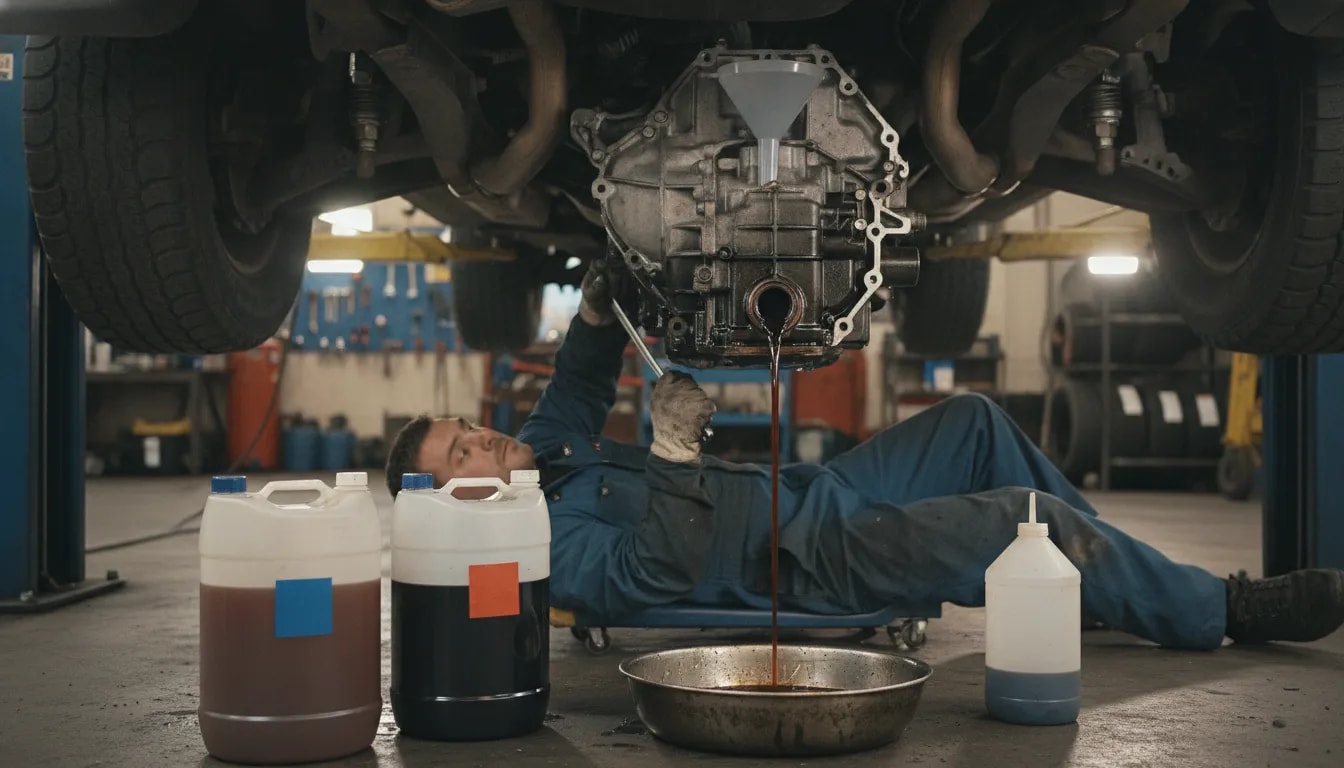
Keeping a diesel automatic gearbox healthy comes down to three priorities: use the correct transmission fluid, renew it with an appropriate service procedure, and avoid unnecessary heat and shock loads. An incremental drain and fill can gradually refresh automatic transmission fluid without a pressurized flushing process.
That approach is especially relevant to diesel SUVs, pickups, and commercial vehicles used for towing, heavy loads, or frequent stop-start driving. However, it is preventive maintenance, not a guaranteed cure for shuddering or a promise of 300,000 miles without repairs.
This guide applies to conventional torque-converter automatic transmissions. Always confirm the requirements for your exact gearbox before choosing fluid, setting a service interval, or carrying out any work.
Key Takeaways
- Incremental drain-and-fill services gradually dilute old ATF without replacing the entire fill at once.
- The exact gearbox specification determines fluid choice, not whether the engine runs on diesel.
- Three fluid changes renew different proportions depending on how much each drain removes.
- Gentle cold driving and complete stops before direction changes reduce unnecessary transmission stress.
Table of Contents
- What Is an Incremental Transmission Drain and Fill?
- Before Servicing: Confirm the Fluid and Assess the Symptoms
- Why Diesel Use Can Put Transmission Fluid Under Stress
- How to Plan an Incremental Drain-and-Fill Service
- How Much Fluid Do Three Drain-and-Fill Cycles Replace?
- How Often Should a Diesel Automatic Get a Fluid Change?
- Driving Habits That Reduce Unnecessary Gearbox Stress
- Common Diesel Transmission Maintenance Mistakes
- A Practical Maintenance Plan
What Is an Incremental Transmission Drain and Fill?
An incremental drain and fill means draining the accessible transmission fluid, replacing it with the specified fresh ATF, driving to circulate and mix the fluid, then repeating the process when appropriate.
A single drain does not normally empty the entire transmission. Fluid remains in areas such as the torque converter and cooler lines. Repeated changes progressively dilute that remaining old fluid.
The method has two important limits:
- It does not replace all the old fluid in one service. The proportion renewed depends on how much each drain removes.
- It does not repair damaged components. Fresh fluid may improve fluid-related shift problems, but it cannot reverse existing clutch-pack wear.
Drain and fill versus a machine flush
A drain and fill removes fluid through the gearbox’s normal service access. A machine fluid exchange uses equipment to replace fluid through the system. A pressurized flush introduces a different process and can raise concerns about disturbing accumulated deposits in a neglected transmission.
Do not assume that every machine exchange is a high-pressure flush, or that one service method suits every gearbox. Ask the workshop exactly what it proposes and whether that procedure matches the manufacturer’s instructions for your transmission.
For an incremental service, the aim is gradual fluid renewal rather than attempting to force the entire old fill out at once.
Before Servicing: Confirm the Fluid and Assess the Symptoms
The most important preparation is not buying a large quantity of ATF. It is identifying the exact transmission and its service requirements.
Choose ATF by specification, not by engine fuel type
Automatic transmission fluid is more than a lubricant. Its friction characteristics must suit the transmission’s clutch packs and hydraulic controls. An unsuitable formulation can contribute to poor engagement, shudder, and accelerated wear.
There is no single ATF suitable for every diesel automatic. Select fluid by the gearbox’s required specification, not simply because a bottle says it is suitable for diesel vehicles or multiple vehicle brands.
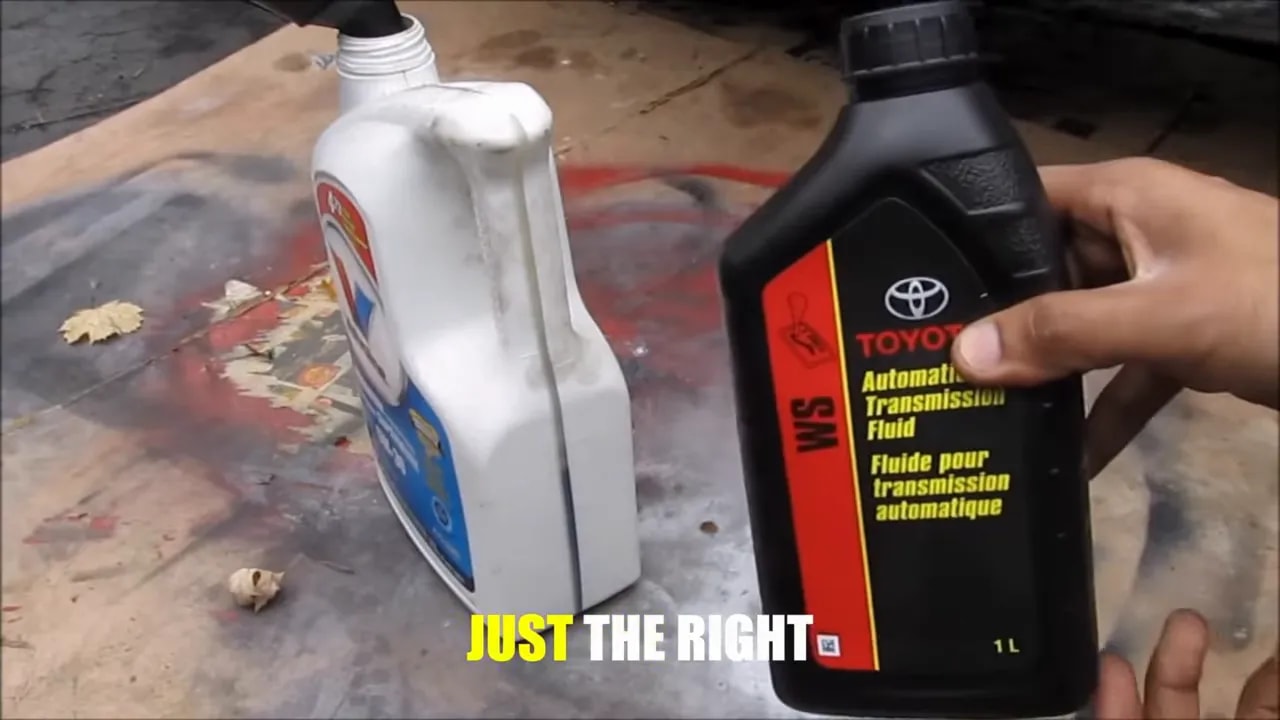
- Toyota WS: Use it where the exact Toyota transmission specifies WS. Do not assume every Toyota diesel automatic has the same requirement.
- Aisin transmissions: Confirm the application-specific requirement. The transmission manufacturer’s name alone is not enough to select fluid.
- Allison transmissions: Confirm the required approval for the exact model and application. TES 295 is one specification to check where applicable, not a universal requirement.
Useful starting points include Toyota’s owner’s manual resources and Allison’s approved-fluid information. Use documentation relevant to your vehicle’s model year and market.
Do not diagnose every shudder as old fluid
Symptoms worth investigating include:
- Delayed engagement when selecting Drive, particularly from cold.
- A shudder during a shift or when accelerating under load.
- Hesitation when pulling away.
- Shift quality that has gradually deteriorated.
Degraded fluid can contribute to these problems because ATF supports lubrication, hydraulic operation, and clutch cooling. But the symptoms alone do not prove that a fluid change will fix the gearbox.
If the transmission is slipping, failing to engage, or getting progressively worse, arrange an assessment rather than treating repeated fluid changes as a repair strategy. A neglected but functioning gearbox and a mechanically failing gearbox need different decisions.
Why Diesel Use Can Put Transmission Fluid Under Stress
Diesel engines commonly deliver substantial torque at relatively low engine speeds. The transmission must manage that twisting force when the vehicle pulls away, accelerates, or moves a heavy load.
In a conventional automatic, the torque converter transfers power through fluid during operation before any applicable lock-up function takes over. Working hard at low road speeds can generate significant heat.
The demanding situations highlighted here are:
- Towing: Moving a trailer increases the load the drivetrain must handle.
- Heavy cargo: Frequent loaded operation adds sustained demand.
- Stop-start traffic: Repeated pulling away creates repeated converter work.
- Hilly routes: Long climbs and repeated shifting can add heat.
Heat and extended use can degrade the fluid’s performance. Friction modifiers become depleted, wear material accumulates, and the fluid becomes less effective at supporting the transmission’s operating requirements.
The practical lesson is to account for how the vehicle is used, not just its odometer reading. Diesel power alone does not establish that a gearbox will fail sooner than a petrol equivalent.
How to Plan an Incremental Drain-and-Fill Service
The sequence below explains the maintenance approach. It is not a replacement for the workshop procedure for your gearbox, particularly its filling and fluid-level requirements.
1. Establish the correct procedure before draining
Confirm the required ATF, the drain-and-refill quantity, and the method for checking the final fluid level. Do not confuse total transmission capacity with the smaller quantity removed during a normal drain.
If you cannot confidently carry out the specified procedure, have a suitably equipped workshop perform it. The concept is simple, but the vehicle-specific details still matter.
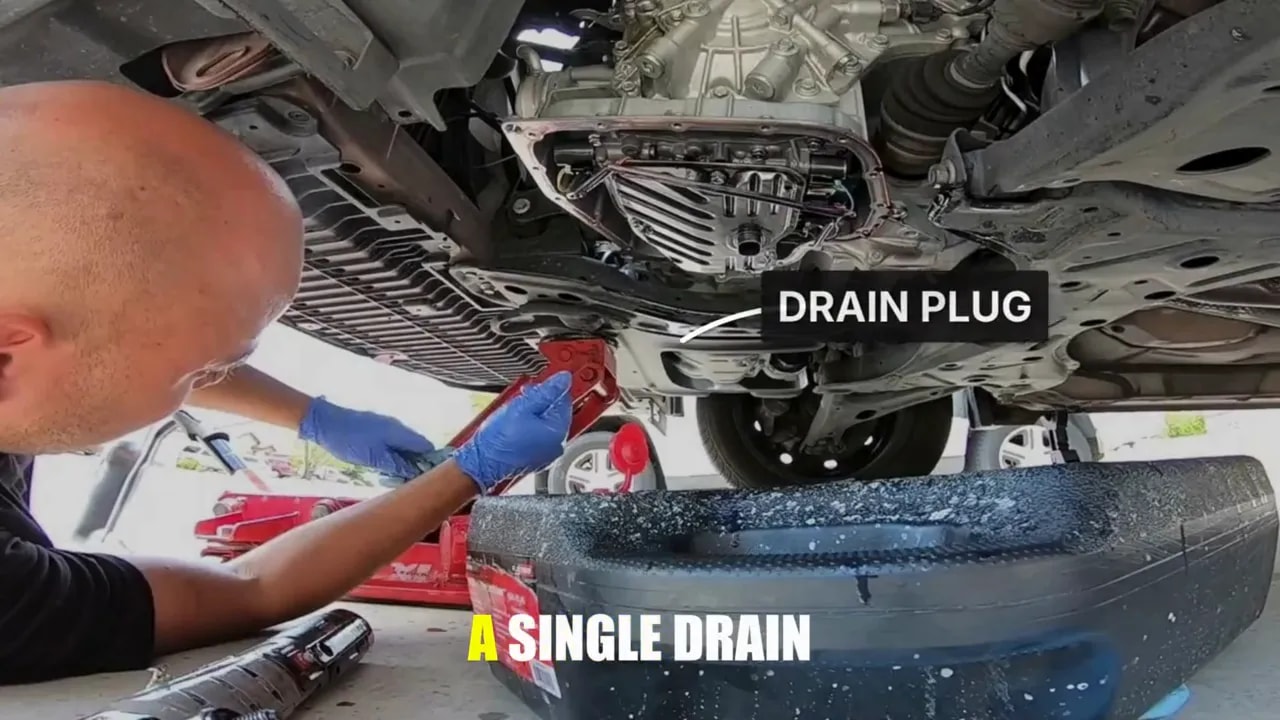
2. Drain the accessible fluid
A normal drain may remove roughly 30% to 40% of total fluid volume, although the actual proportion depends on the transmission and service procedure. The remainder stays within the system.
3. Refill with the specified ATF
Follow the manufacturer’s filling and level-setting instructions. Using the correct fluid is only one part of the job; the final level must also be correct.
4. Drive gently to circulate the fluid
The incremental approach described here uses approximately 100 to 150 km, or 60 to 90 miles, between changes to allow fresh and remaining old fluid to mix during normal operation.
After each service, keep acceleration and stops smooth, especially over the first 50 to 100 km, or 30 to 60 miles. Avoid immediately testing the transmission with hard acceleration or heavy pulling.
These distances describe a gradual maintenance approach, not a universal manufacturer requirement. A model-specific procedure takes priority.
5. Repeat only as appropriate
A further drain removes a mixture of fresh and old fluid. Another refill reduces the old-fluid proportion again. Record the date, mileage, fluid used, and any change in shift quality after each cycle.
If symptoms persist or worsen, reassess the problem rather than continuing indefinitely.
How Much Fluid Do Three Drain-and-Fill Cycles Replace?
Three changes do not necessarily renew 85% to 90% of the fluid. That percentage depends on the fraction removed during each drain.
Assuming thorough mixing and the same drain fraction each time, the old-fluid proportion remaining is calculated by multiplying the retained fraction by itself for each cycle.
For example, if each drain removes 40%, it leaves 60%. After three cycles, the old-fluid proportion is 0.6 × 0.6 × 0.6 = 21.6%, so approximately 78.4% of the final mixture is fresh fluid.
| Total fluid removed per drain | Fresh-fluid proportion after one cycle | After two cycles | After three cycles |
|---|---|---|---|
| 30% | 30% | 51% | 65.7% |
| 40% | 40% | 64% | 78.4% |
| 50% | 50% | 75% | 87.5% |
This also explains why repeated services use more fresh ATF than the quantity ultimately retained: later drains remove some fluid added during earlier cycles.
What a reported Land Cruiser result illustrates
One reported example involved a Land Cruiser with approximately 180,000 km, or 112,000 miles, that had never received a transmission-fluid change. It showed shudder under load and delayed cold engagement into Drive.
After three incremental changes using Toyota WS over three weeks, the owner reported that the shudder disappeared and the cold engagement delay became minimal.
That is an encouraging example of a possible fluid-related improvement, not controlled evidence or a guarantee for other transmissions.
How Often Should a Diesel Automatic Get a Fluid Change?
Start with the manufacturer’s maintenance schedule, including any severe-use provisions. Towing, heavy loads, congested driving, and hilly operation should be considered when discussing an interval with a workshop.
A conservative maintenance approach for heavily worked diesel vehicles may use these intervals as discussion points:
| Use pattern | Drain-and-fill interval to discuss |
|---|---|
| Regular towing or heavy loads | About 30,000 km, or 18,500 miles |
| Especially demanding operation | About 15,000 km, or 9,000 miles |
These are not universal factory intervals. Do not apply them automatically to every transmission.
Likewise, do not interpret “lifetime fill” as proof that ATF cannot deteriorate. Check what the manufacturer requires for the exact application. It is also inaccurate to assume that the phrase always means only the warranty period.
Driving Habits That Reduce Unnecessary Gearbox Stress
Use gentle throttle while cold
After a cold start, drive gently for roughly the first 5 to 10 minutes. Use smooth throttle inputs and avoid kickdowns or hard acceleration from low speed while the drivetrain warms.
Winter conditions can extend warm-up time, so treat the clock as a guide rather than proof that the ATF has reached its operating temperature.
Stop completely before changing direction
Do not select Drive while rolling backward or Reverse while rolling forward. Bring the vehicle to a complete stop, pause briefly, then select the next direction.
This avoids asking the transmission’s clutch elements to absorb an unnecessary direction-change load, particularly in a heavy SUV or commercial vehicle.
Reduce repeated gear hunting
On a long climb or in conditions that cause repeated shifting between adjacent ratios, use the automatic transmission’s manual-selection function where appropriate and permitted by the owner’s manual.
The objective is a suitable, stable gear, not holding one ratio regardless of speed or load. Reducing unnecessary shifts can help limit avoidable heat generation.
Follow the specified adaptation procedure
Keep driving smooth after a fluid service. If the transmission requires an adaptation reset or relearn, follow its documented procedure.
Do not disconnect the battery as a universal gearbox-reset method. A five-minute disconnect is not an established procedure for every transmission, and routine fluid renewal does not automatically require an adaptive-memory reset.
Common Diesel Transmission Maintenance Mistakes
- Buying ATF by a broad label: Verify the exact required specification rather than relying on “multi-vehicle” wording.
- Expecting a complete change from one drain: Account for fluid retained elsewhere in the system.
- Assuming three cycles achieve a fixed percentage: Calculate renewal from the actual drain fraction.
- Using a fluid change as a diagnosis: Shudder and delayed engagement do not identify the cause by themselves.
- Accepting an unspecified flush: Ask what equipment and procedure the workshop will use.
- Ignoring demanding use: Discuss towing and load patterns when setting the service schedule.
- Expecting guaranteed mileage: Good maintenance supports longevity but cannot promise a repair-free lifespan.
A Practical Maintenance Plan
Identify your transmission, confirm its ATF specification, and check the applicable maintenance instructions. If a drain and fill is appropriate, perform it correctly and consider further gradual changes based on the gearbox’s condition and service guidance.
Combine that fluid care with gentle cold driving, complete stops before reversing direction, and sensible gear selection under load. The goal is to maintain a healthy transmission early, not wait for fresh fluid to rescue one that is already failing.