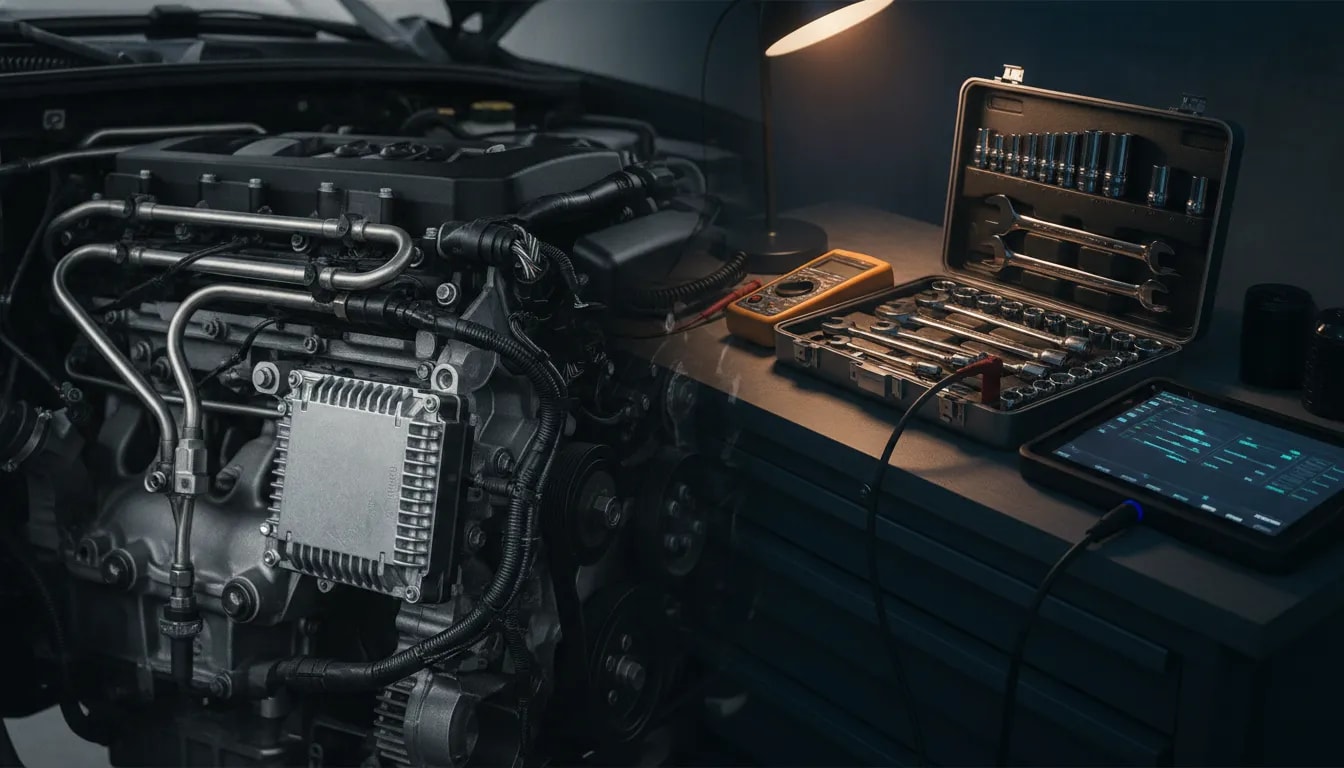
Modern diesel cars are harder to repair at home because many jobs now require both mechanical work and software access. Replacing a component may be only half the repair: the engine control unit, or ECU, may also need coding, a reset, or a guided relearn procedure.
High-pressure fuel injection, diesel particulate filters, and AdBlue emissions systems have changed what a capable home mechanic can realistically do. A socket set and workshop manual still matter, but they no longer cover every part of the job.
DIY diesel maintenance is not finished. The important distinction is between routine mechanical work and repairs that involve high pressures, ECU-controlled emissions systems, or vehicle-specific programming.
Key Takeaways
- Many modern diesel repairs require coding or adaptation after the physical component has been replaced.
- A basic OBD2 reader does not provide every vehicle-specific diagnostic or service function.
- DPF and AdBlue faults require diagnosis before regeneration attempts, resets, or replacement parts.
- Routine mechanical maintenance remains practical, while advanced diesel repairs demand suitable tools and expertise.
Table of Contents
- What Can You Still Repair on a Modern Diesel?
- Why a Basic OBD2 Reader Is No Longer Enough
- AdBlue Faults Can Become a No-Start Problem
- DPF Problems Require More Than Hard Driving
- Common Rail Injectors Need Precision and Sometimes Coding
- One Diesel Fault Can Affect Several Systems
- What Modern Diesel Repairs Can Cost
- A Practical Checklist Before Starting a Diesel Repair
- Are Older Diesel Cars Easier to Work On?
- The Real Change Is Repair Access, Not the End of DIY
What Can You Still Repair on a Modern Diesel?
Many familiar maintenance tasks remain within reach of a suitably equipped owner. The difficult jobs are increasingly those that require the car to recognize a replacement part or actively command a system through a diagnostic tool.
| Type of work | DIY outlook | Main consideration |
|---|---|---|
| Oil and filter changes | Often practical at home | Follow the vehicle-specific servicing procedure. |
| Brake pads and suspension components | Many mechanical tasks remain possible | Confirm the tools, safety precautions, and any electronic procedures before starting. |
| Common rail injector replacement | More demanding than physical installation alone | High-pressure safety, injector coding, and possible relearning. |
| DPF forced regeneration | Not a basic maintenance task | Compatible diagnostic functions, live monitoring, and significant exhaust heat. |
| AdBlue or SCR fault repair | Highly dependent on the fault and vehicle | Diagnosis, component access, countdown resets, and adaptations. |
| ECU replacement | Usually a programming-dependent repair | Vehicle identification, immobilizer pairing, and calibration data. |
The useful question is not simply whether you can remove and install the part. It is whether you can diagnose the fault, complete the installation, and perform every required electronic procedure afterward.
Why a Basic OBD2 Reader Is No Longer Enough
A low-cost OBD2 code reader can be a useful starting point. It typically reads standardized emissions-related fault codes, but that is different from having full diagnostic access to a modern diesel.
Reading a code does not necessarily give you access to manufacturer-specific data, component tests, coding functions, or service routines. Depending on the vehicle and tool, these may include:
- Entering replacement injector calibration codes.
- Running an injector pilot quantity relearn.
- Reading DPF soot estimates, differential pressure, and exhaust temperatures.
- Commanding a service regeneration.
- Resetting an SCR warning countdown after a completed repair.
- Performing adaptations or programming a replacement control unit.
The EPA’s overview of onboard diagnostics provides useful background on OBD’s emissions-monitoring role. For repair planning, however, the essential distinction is between standardized code access and vehicle-specific service functions.
Check function coverage, not just brand coverage
A scanner advertised as compatible with your manufacturer may still lack the exact function your engine needs. Compatibility should be checked against the model, year, engine, and intended procedure.
Before buying a tool, confirm:
- System access: Can it communicate with the relevant engine and emissions controls?
- Live data: Does it display the readings needed to diagnose the problem?
- Service functions: Does it support the specific coding, reset, or relearn?
- Access costs: Are subscriptions or manufacturer software access required?
Tools with diesel service functions can cost roughly $200 to more than $1,000, but price alone does not establish compatibility. Manufacturer-level software may also involve subscription charges.
AdBlue Faults Can Become a No-Start Problem
AdBlue, also called diesel exhaust fluid or DEF, is used in selective catalytic reduction, or SCR. This system doses a urea solution into the exhaust to reduce nitrogen oxides, commonly abbreviated as NOx.
SCR is common on newer diesel cars, particularly many models introduced around and after 2015, although equipment varies by vehicle and market. It adds more than a fluid tank. The system can include:
- A pump and dosing injector.
- A fluid heater.
- Level and temperature sensors.
- NOx sensors.
- Electronic controls linked to the engine management system.
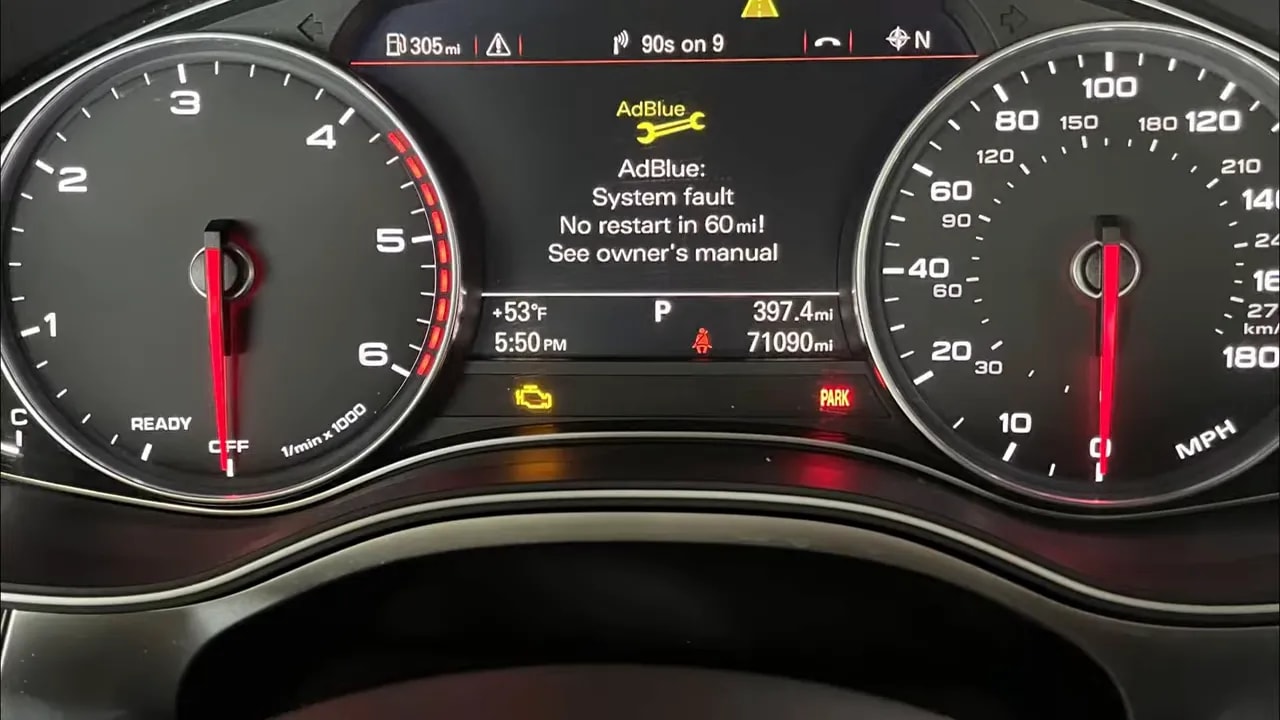
Possible faults include a failed pump, sensor problems, crystallized fluid, or contamination. Some vehicles respond with a distance or restart countdown, reduced engine performance, or an eventual refusal to restart.
Why topping up does not fix every AdBlue warning
A low-fluid warning and a system malfunction are different problems. Adding fluid cannot repair a defective pump, heater, or NOx sensor.
Even after the faulty component is replaced, the repair may require clearing fault codes, resetting the countdown, or performing an SCR adaptation. Those functions need a compatible diagnostic tool.
Component packaging can also make a relatively small fault expensive. On some Peugeot and Citroën applications, the pump or control module is integrated into the AdBlue tank assembly, and the prescribed repair may involve replacing the whole tank.
Cold weather adds another dependency
AdBlue freezes at approximately minus 11°C. The system uses heating hardware to manage cold conditions, which means heater faults are another diagnostic consideration. Freezing temperature alone should not be treated as proof that a component has failed.
Pump failures can occur at higher mileages, including around 80,000 to 120,000 miles on some applications. That range is not a universal service interval or a prediction for every diesel.
DPF Problems Require More Than Hard Driving
A diesel particulate filter, or DPF, traps soot in the exhaust. Regeneration removes accumulated soot by exposing it to sufficiently high temperatures.
Modern diesel cars commonly rely on DPF systems, and repeated short trips or stop-and-go use can make successful regeneration more difficult. If the required operating conditions are not reached often enough, soot can accumulate.
That does not mean every DPF warning calls for a forced regeneration. It means the filter’s condition and the reason regeneration is not completing need to be established first.
Normal regeneration versus forced regeneration
Suitable sustained driving can help a functioning system complete normal regeneration. A forced or service regeneration is different: a diagnostic tool commands the ECU to carry out a controlled procedure.
Simply revving the engine or driving more aggressively is not the same operation. Once loading is too high, or a relevant fault is active, the ECU may refuse regeneration.
A service regeneration can involve:
- Automatically increased engine speed.
- Exhaust temperatures above 600°C.
- Monitoring of soot loading, differential pressure, and exhaust temperatures.
- A procedure lasting roughly 20 to 40 minutes, depending on the application.
This is a high-temperature service procedure, not a casual driveway shortcut. It requires an appropriate, well-ventilated setting, fire precautions, and adherence to the manufacturer’s and diagnostic tool’s instructions, including interruption rules.
Why a scanner may refuse to regenerate the DPF
Having the correct menu option does not guarantee that regeneration is permitted. The ECU may block it because of active faults, excessive soot loading, or unsuitable temperatures.
At that point, repeatedly requesting regeneration is not a substitute for diagnosis. The underlying fault may need repair, or the filter may require a different intervention.
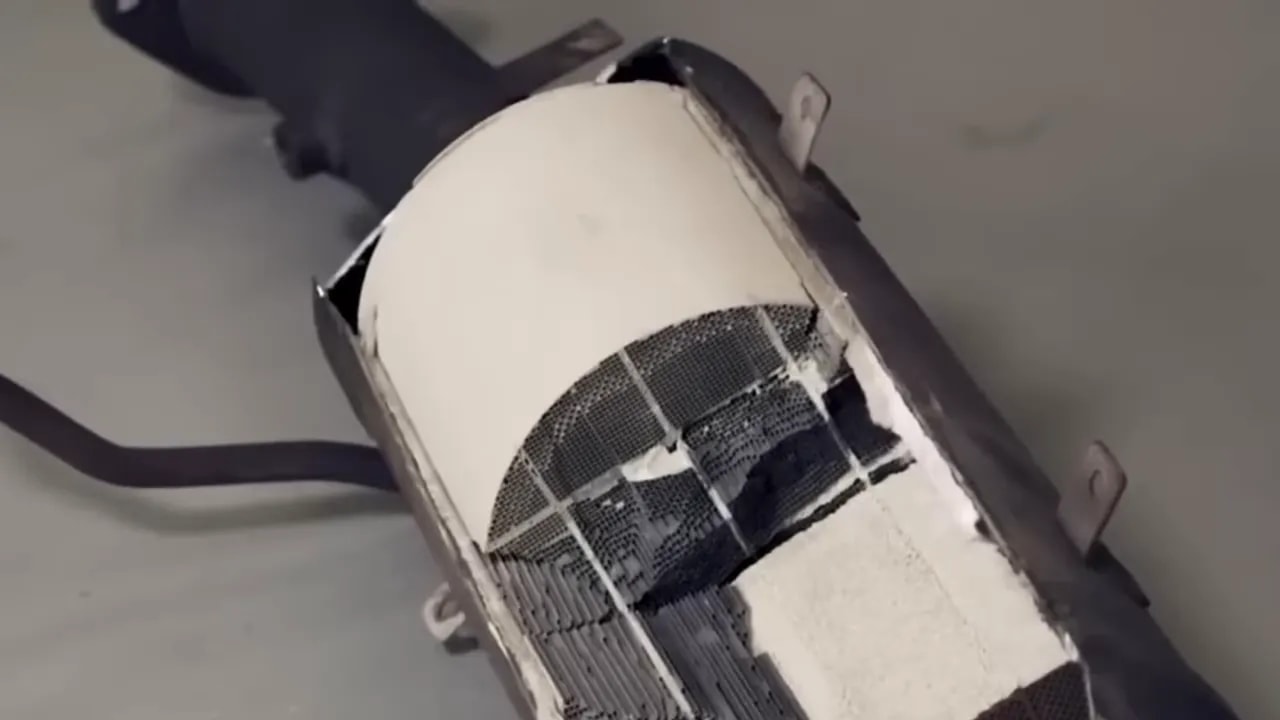
For further background on filter operation and driving-related problems, the RAC’s DPF guide is a useful reference. Always use the instructions for your particular vehicle rather than assuming one driving routine applies to every diesel.
Common Rail Injectors Need Precision and Sometimes Coding
Older diesel injection systems were often mechanical or used simpler electronic controls. Injector work could still be difficult, but the repair was more likely to center on removal, testing, replacement, and bleeding.
Modern common rail injection adds two major barriers: extreme fuel pressure and precise electronic calibration.
The pressure changes the safety requirements
Some modern common rail systems operate above 2,000 bar, with newer systems exceeding 2,500 bar. At 2,500 bar, pressure is approximately 36,000 psi.
Injector internals use micron-scale tolerances. The ECU may command several separate injection events during one combustion cycle, delivered within milliseconds and timed with very fine precision.
Those characteristics help explain why modern fuel-system work cannot be approached like a basic low-pressure mechanical repair. Correct equipment, procedures, and high-pressure safety knowledge are essential.
What injector coding actually does
Many common rail injectors carry an individual calibration identifier. Depending on the manufacturer, it may be called an IMA code, trim code, or characterization code.
The code gives the ECU information about that injector’s measured characteristics, including its flow and response. Where coding is required, the replacement injector’s code must be entered using a diagnostic tool that supports the vehicle.
If the old calibration remains in use, the engine may meter fuel incorrectly. Possible results include rough running, smoke, reduced fuel economy, or starting difficulties. Some piezoelectric injector systems also have tightly controlled electrical calibration requirements.
Injector coding is vehicle-specific. Do not assume that every injector follows the same procedure, or that physically fitting the correct part completes the repair.
Coding and relearning are separate steps
Some engines also require a pilot quantity relearn after injector replacement. This recalibrates the small preliminary injection used before the main fuel delivery.
The routine may involve a prescribed sequence of engine-speed changes and returns to idle, guided by the scan tool. Entering the injector code and completing this relearn are distinct operations, and both may be necessary.
One Diesel Fault Can Affect Several Systems
Modern diesel diagnosis is complicated by the connections between fuel injection, emissions control, and air management. The DPF, SCR system, EGR valve, turbocharger, and intercooler do not operate in isolation.
For example:
- A failing EGR system can contribute to increased soot production.
- A NOx sensor fault can, on some vehicles, interfere with regeneration permissions.
- An SCR fault can cause engine derating even when the engine remains mechanically capable of running.
This is why replacing the component named in a warning can miss the real cause. A DPF problem may involve another system preventing regeneration, rather than the filter alone.
The same principle applies after a repair. Some replacement components need a registration or adaptation procedure before the control system recognizes the change correctly.
Why a replacement ECU may not start the car
An ECU is not necessarily a plug-and-play replacement. It may need programming to the vehicle identification number, pairing with the immobilizer, and entry of injector calibration data.
Without the required programming, many electronically controlled diesels can remain in a no-start condition. Matching the physical unit is therefore only part of establishing whether an ECU replacement will work.
What Modern Diesel Repairs Can Cost
Software access and integrated components can reduce the savings from doing a repair yourself. The following are broad budgeting examples, not current quotations:
| Item or repair | Illustrative cost range | Important limitation |
|---|---|---|
| Diagnostic tool with diesel service functions | About $200 to more than $1,000 | Verify exact function coverage and ongoing access costs. |
| DPF replacement | About $1,000 to $3,000 or more | The vehicle and required repair determine the bill. |
| AdBlue-related software reset | Around £75 in some cases | A reset alone cannot fix a hardware failure. |
| Major SCR pump or catalyst repair | More than £2,000 in some cases | Integrated assemblies can increase replacement costs. |
The dollar and pound figures represent different market examples and should not be treated as currency equivalents. Obtain a vehicle-specific quote before deciding whether purchasing tools makes financial sense.
A Practical Checklist Before Starting a Diesel Repair
Planning the entire repair before dismantling anything helps avoid a car that is mechanically reassembled but still cannot run.
- Identify the exact vehicle and engine. Diagnostic procedures and tool coverage vary by application.
- Establish the fault before ordering parts. Consider linked systems rather than treating a warning as a complete diagnosis.
- Read the full repair procedure. Look for coding, relearning, adaptation, and programming requirements.
- Confirm diagnostic access. Check the specific function, not merely the scanner’s supported brands.
- Assess the working conditions. High-pressure fuel work and high-temperature regeneration need more than ordinary hand tools.
- Compare the complete cost. Include parts, tools, subscriptions, and any professional programming needed afterward.
A sensible division of labor is to retain routine maintenance and appropriate mechanical work while using a qualified diesel specialist for tasks beyond your equipment, access, or experience.
Are Older Diesel Cars Easier to Work On?
Some diesels from the late 1990s and early 2000s appeal to home mechanics because they predate the full combination of modern emissions hardware. Fewer interdependent systems can make diagnosis and repair more directly mechanical.
However, age is not a reliable dividing line. Some older vehicles already use common rail injection and substantial electronic control. Check the actual engine and equipment rather than assuming an early-2000s diesel needs no computer-based diagnosis.
Older diesels are not automatically better cars overall. Their appeal here is narrower: some give an owner more scope to understand faults through inspection, measurement, and conventional tools.
The Real Change Is Repair Access, Not the End of DIY
Common rail injection and electronically controlled emissions systems bring meaningful benefits, including cleaner operation, quieter combustion, and improved efficiency. Their sophistication also makes repairs more dependent on software.
Manufacturer-controlled diagnostic access, subscription fees, and uneven aftermarket tool coverage are central right-to-repair concerns. Physical access to a component is of limited value if an owner cannot complete the electronic part of its replacement.
Modern diesel DIY is still possible, but it requires more careful boundaries. Keep the jobs your skills and equipment genuinely cover, and confirm the diagnostic requirements before beginning anything involving injection, emissions control, or ECU replacement.