
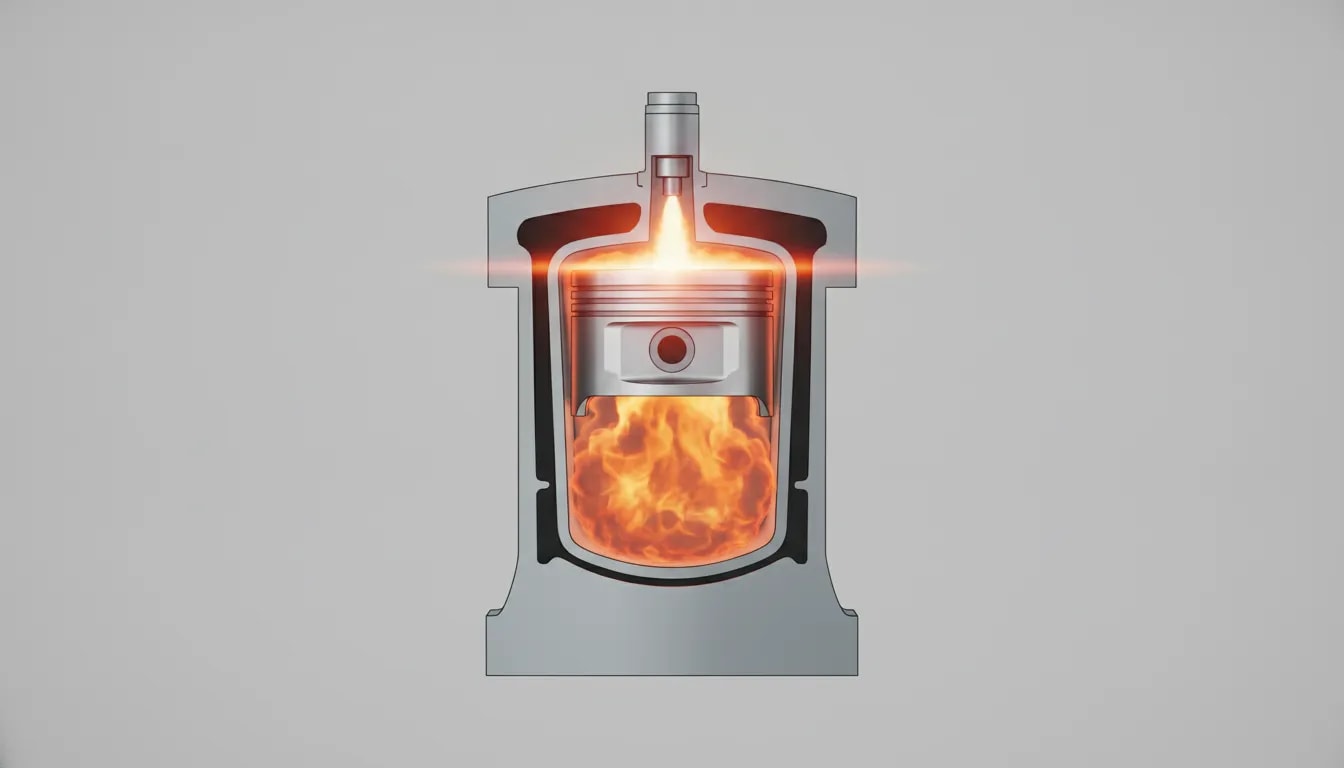
Diesel engines do not need spark plugs because they ignite fuel using the heat produced by compressing air. The piston squeezes the air inside the cylinder until its temperature is high enough for injected diesel fuel to burn without an electrical spark. This process is called compression ignition.
That explains the missing spark plugs, but it also explains much of a diesel engine’s character: its strong construction, low-speed pulling power, distinctive clatter, and need for extra heat during cold starts.
Key Takeaways
- Diesel engines ignite injected fuel using air heated by compression, so they do not need spark plugs.
- Glow plugs provide extra heat for cold starting rather than producing an ignition spark.
- Fuel injection timing remains essential even though diesel engines have no spark timing.
- Compression ignition helps explain diesel construction, low-speed torque, combustion noise, and fuel efficiency.
Table of Contents
- How Does a Diesel Engine Ignite Fuel Without a Spark?
- If Diesels Have No Spark Plugs, Why Do They Have Glow Plugs?
- Diesel vs. Gasoline: What Changes When Ignition Changes?
- Why Diesel Engines Need Stronger Components
- Why Diesels Produce Strong Torque at Low RPM
- Why Diesel Engines Make a Clattering Sound
- Why Diesel Engines Can Be More Fuel Efficient
- Common Misconceptions About Diesel Ignition
- The Bottom Line
How Does a Diesel Engine Ignite Fuel Without a Spark?
A conventional gasoline, or petrol, engine uses a spark plug to start combustion in an air-and-fuel mixture. A diesel takes a different approach: it compresses air first, then injects fuel into that hot air.
The important distinction is what is inside the cylinder during compression. In normal diesel operation, the fuel is introduced near the end of the compression stroke rather than being compressed as a premixed charge.
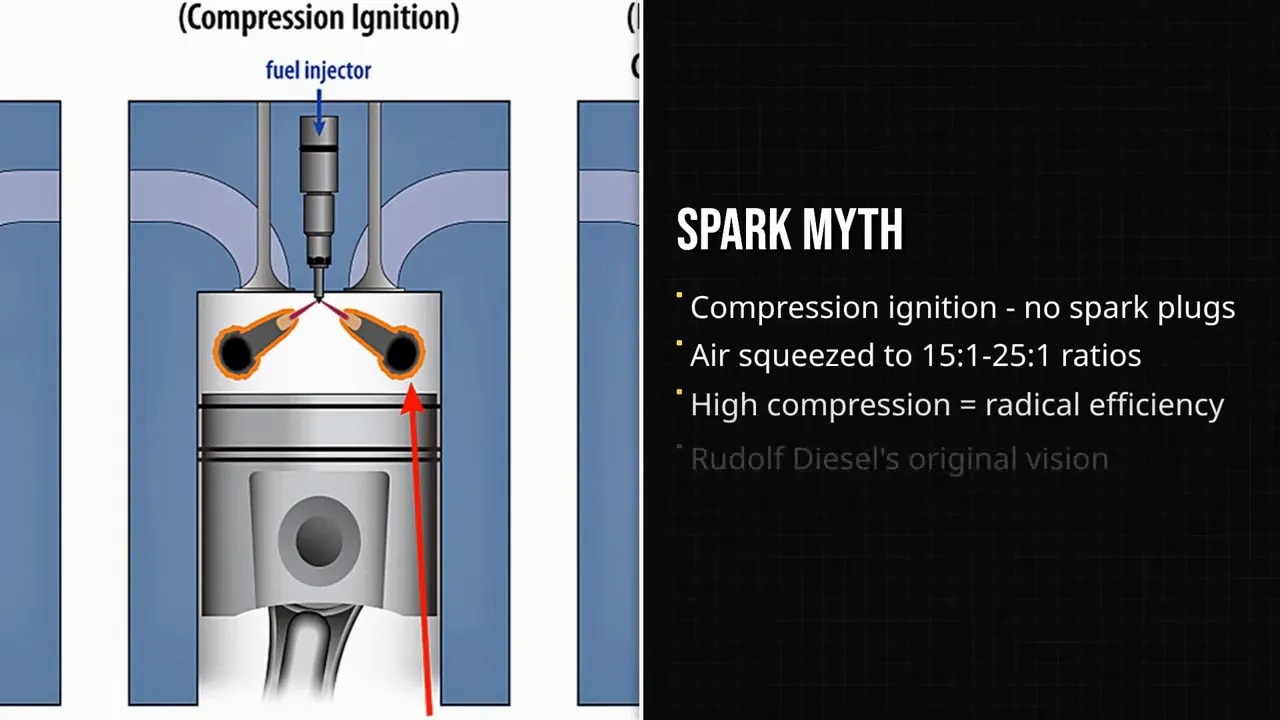
The combustion sequence, step by step
- Air enters the cylinder. The piston moves downward during the intake stroke, drawing in air.
- The piston compresses the air. As the piston rises with the valves closed, the trapped air occupies a much smaller space.
- Compression raises the temperature. The piston does work on the air, increasing its pressure and temperature.
- The injector delivers fuel. Near the top of the stroke, diesel fuel is sprayed into the hot compressed air.
- The fuel ignites and produces useful work. Combustion raises cylinder pressure, pushing the piston downward and turning the crankshaft.
- Exhaust gases leave the cylinder. The exhaust stroke clears the cylinder for the next cycle.
The injector therefore plays a central role in controlling combustion. A diesel may have no spark timing, but injection timing still matters: the fuel must arrive at the appropriate point in the piston’s movement.
Why squeezing air makes it hot
Rapid compression adds energy to the trapped air. Because the compression stroke happens quickly, there is limited time for that energy to escape as heat through the cylinder walls.
An idealized version of this process is called adiabatic compression, meaning compression without heat transfer. A real engine does lose some heat, but the basic explanation remains the same: reducing the air’s volume raises its temperature enough to support ignition.
Under suitable operating conditions, compressed air in a diesel cylinder can exceed approximately 800°C, with compression pressure around 1,200 psi. These are illustrative conditions, not fixed values for every engine or every start.
What a diesel compression ratio means
The compression ratio compares the cylinder’s volume when the piston is at its lowest position with the remaining volume when it is at its highest position.
For example, an 18:1 compression ratio means the maximum cylinder volume is eighteen times the minimum volume. It does not mean the pressure simply increases eighteenfold.
Diesel designs commonly use ratios in the region of 15:1 to 25:1. Many conventional gasoline engines use lower ratios, around 8:1 to 12:1, although those ranges are not universal limits. The higher compression in a diesel helps create the heat required for self-ignition.
If Diesels Have No Spark Plugs, Why Do They Have Glow Plugs?
A glow plug is an electric heater, not a spark-producing ignition device. It supplies additional heat to help a cold diesel establish combustion.
When the engine and incoming air are very cold, compression alone may not produce sufficiently favorable conditions for reliable starting. Glow plugs help overcome that temperature shortfall.

| Component | Main function | Role in combustion |
|---|---|---|
| Spark plug | Produces an electrical spark | Initiates combustion in a conventional gasoline engine |
| Glow plug | Produces heat electrically | Helps a diesel achieve suitable conditions for cold starting |
| Diesel injector | Delivers a controlled spray of fuel | Introduces fuel into air heated by compression |
Glow plugs do not turn a diesel into a spark-ignition engine. The underlying process remains compression ignition, with electrical heating providing assistance when needed.
What this means on a cold morning
- Allow the prescribed preheat sequence to finish. The required procedure depends on the engine and conditions.
- Do not assume one waiting time applies to every diesel. Extreme-cold equipment and ordinary road vehicles can have very different requirements.
- Remember that preheating draws electrical power. Cold starting involves both heating and cranking, not simply fuel delivery.
Cold starts also involve an emissions trade-off. Getting the engine running reliably does not mean it immediately operates under its normal warm conditions. Initial combustion and emissions behavior can differ from operation at temperature.
Diesel vs. Gasoline: What Changes When Ignition Changes?
The absence of spark plugs is not an isolated design choice. Compression ignition affects the engine’s fuel system, mechanical structure, and operating behavior.
| Feature | Diesel engine | Conventional gasoline engine |
|---|---|---|
| Ignition source | Heat from compressed air | Electrical spark |
| Fuel introduction | Fuel injected into hot compressed air | An air-and-fuel charge is prepared before spark ignition |
| Compression ratio | Generally higher | Generally lower |
| Cold-start assistance | Additional heating may be needed | Spark initiates combustion |
| Typical heavy-duty behavior | Strong torque at relatively low engine speed | Often reaches peak torque at a higher engine speed |
These are broad comparisons, not rules that describe every engine. A particular model’s compression ratio, torque curve, and efficiency depend on its design and application.
Why Diesel Engines Need Stronger Components
The cylinder pressure associated with diesel operation places substantial loads on the engine’s structure. Blocks, pistons, connecting components, and crankshafts must withstand repeated compression and combustion forces.
That is why diesel engines often use thicker castings, reinforced internal structures, and robust moving parts. Their additional mass serves a mechanical purpose rather than simply making them look heavy-duty.
Wear-resistant cylinder surfaces and durable component materials also support repeated high-load operation. This construction helps explain why diesels are widely used for sustained work, although it does not guarantee a particular service life.
Do not confuse cylinder pressure with injection pressure
Fuel-system pressure and cylinder pressure describe different things. Mixing them up makes diesel specifications unnecessarily confusing.
- Compression pressure is the pressure of the air being squeezed inside the cylinder before combustion.
- Combustion pressure is the pressure inside the cylinder as the fuel burns.
- Injection pressure is the pressure used to deliver fuel through the injector.
Modern common-rail systems can operate at fuel pressures around 20,000 to 30,000 psi. Those figures refer to the fuel system, not to the air pressure created by the piston’s compression stroke.
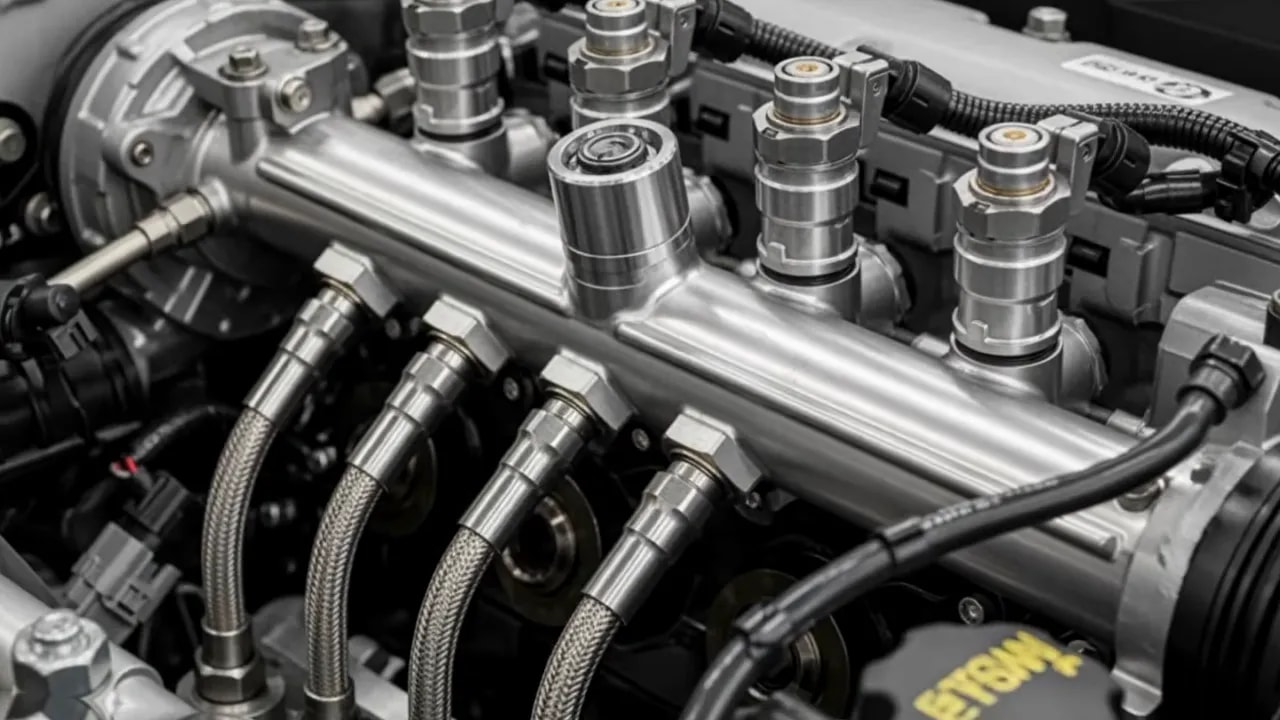
High injection pressure helps produce a fine fuel spray. The engine still relies on hot compressed air to ignite that spray.
Why Diesels Produce Strong Torque at Low RPM
Many heavy-duty diesel engines deliver substantial torque without needing to spin especially fast. That makes them well suited to moving loaded trailers, powering construction machinery, and hauling freight.
A useful concept here is mean effective pressure, or MEP. It represents the average effective pressure that would produce the engine’s useful work over a cycle. It is a way to connect cylinder work with torque, rather than a measurement of the highest pressure reached during combustion.
Strong effective pressure acting on the pistons allows a diesel to produce considerable turning force at relatively low engine speed. A broad torque plateau makes that force available across a useful operating range.
For example, versions of Ford’s 6.7-liter Power Stroke are rated above 1,000 lb-ft of torque at low engine speeds. That illustrates the diesel’s heavy-duty character, but exact ratings depend on the version.
The practical benefit is not that a diesel never needs to downshift. It is that substantial pulling force can be available without constantly demanding high RPM.
Why Diesel Engines Make a Clattering Sound
The characteristic diesel knock or clatter is closely connected to how quickly cylinder pressure rises during combustion.
When injected fuel begins burning in the hot air, pressure can increase sharply over a short interval. That rapid change excites the engine’s structure and contributes to its distinctive sound.
Engineers describe the rate of pressure change as dP/dt. Two combustion events can reach similar pressures yet sound different if one reaches that pressure more abruptly.
How pilot injection reduces the harshness
Modern injection systems can divide fuel delivery into several events rather than supplying the entire quantity in one burst.
- Pilot injection: A small early dose begins combustion before the main fuel delivery, helping soften the subsequent pressure rise.
- Main injection: The principal fuel delivery supplies most of the cycle’s power.
- Post-injection: Some operating strategies add fuel after the main event.
Common-rail control makes these multiple injections possible. Pilot injection can reduce the abruptness of combustion, which helps explain why modern diesels can sound more refined than older designs without losing their recognizable diesel character.
Why Diesel Engines Can Be More Fuel Efficient
Thermal efficiency describes how much of the fuel’s energy becomes useful mechanical work. Diesel engines can convert a larger proportion of that energy into work than many conventional gasoline engines.
High compression and the diesel combustion process contribute to that advantage. Illustrative efficiency figures can reach approximately 44% for a modern diesel, compared with around 31% for a conventional gasoline design. These are not universal ceilings or promises for every engine.
In practical terms, better efficiency can mean less fuel consumed for the same task, longer range, and fewer refueling stops. Those benefits matter especially in applications that accumulate substantial distance or operating hours, including highway hauling and marine work.
However, efficiency is not the same as guaranteed savings. A useful comparison must consider the actual vehicle, load, operating conditions, and fuel price rather than assuming every diesel will outperform every gasoline alternative.
Common Misconceptions About Diesel Ignition
- “A glow plug is just a diesel spark plug.” It supplies heat rather than producing a timed spark.
- “Diesel compresses a fuel-and-air mixture until it burns.” In normal operation, air is compressed first and fuel is injected afterward.
- “No spark plugs means ignition needs no control.” Injection timing and fuel delivery still require careful control.
- “A 25:1 ratio means 25 times the pressure.” Compression ratio compares volumes; pressure also depends on the thermodynamic process.
- “High fuel-rail pressure is cylinder pressure.” The injection system and combustion chamber have separate pressure conditions.
- “Every diesel has identical starting and performance characteristics.” Preheating requirements, torque ratings, and efficiency vary by design.
The Bottom Line
Diesel engines have no spark plugs because compression supplies the heat needed for ignition. Fuel enters the cylinder only after the air has been compressed and heated.
Glow plugs assist that process during cold starts, while precise injection controls combustion. The same operating principle helps explain the diesel’s stronger construction, low-RPM torque, characteristic sound, and efficiency in demanding work.