
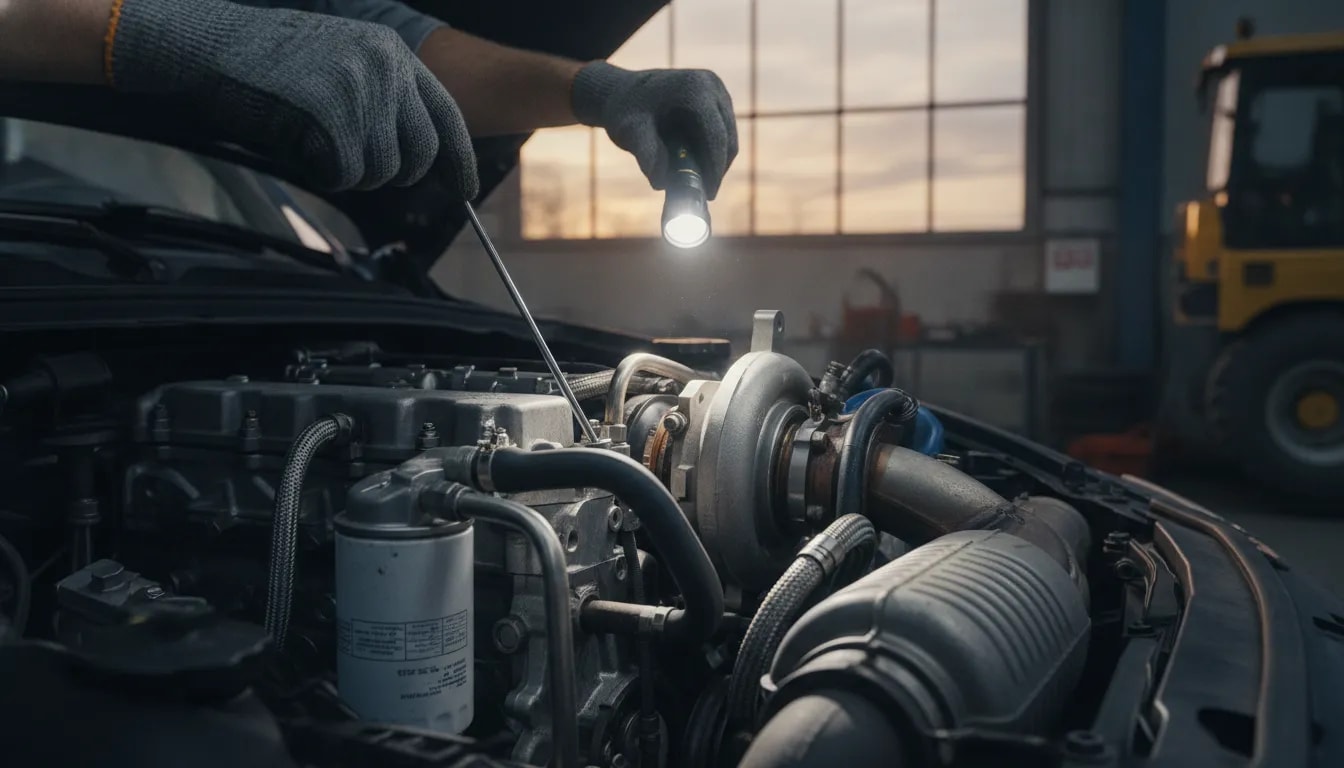
Reaching 100,000 miles does not mean a diesel engine is about to fail. It is a useful point to reassess its condition, service history, and maintenance needs. Wear, oil contamination, injector deposits, and exhaust-filter ash can become more important as mileage accumulates.
The practical goal is not to replace every expensive component at once. It is to identify developing problems, catch up on overdue service, and adjust maintenance before one worn system damages another. That applies whether you drive a diesel car, pickup, van, or 4×4.
A well-maintained diesel can continue toward 300,000 miles or more, but mileage alone cannot predict its remaining life. Treat 100,000 miles as a maintenance checkpoint, not a mechanical expiration date.
Key Takeaways
- Use 100,000 miles as a comprehensive maintenance checkpoint, not an automatic engine-failure deadline.
- Review oil and fuel-filter intervals as contamination and component wear become more important.
- DPF regeneration removes soot, while accumulated ash may require professional cleaning.
- Inspect injectors, turbo, cooling, transmission, and front-end components before approving major repairs.
Table of Contents
- Your Diesel’s 100,000-Mile Service Checklist
- What Actually Changes in a High-Mileage Diesel?
- Reassess Oil Changes Before Other Problems Multiply
- Fuel System Health: Inspect Injectors and Improve Filtration
- Loss of Power: Check the Turbo and DPF Separately
- Do Not Neglect Cooling, Transmission, and Front-End Wear
- How Much Should You Budget?
- Common Mistakes After 100,000 Miles
- A Practical Plan for the Next 100,000 Miles
Your Diesel’s 100,000-Mile Service Checklist
Start with a comprehensive inspection and a review of previous service records. Use the following checklist to discuss the work with a diesel specialist, then match fluid specifications, procedures, and intervals to your particular vehicle.
| System | What to request | Purpose |
|---|---|---|
| Engine lubrication | Oil and filter service, plus a review of the current interval | Address contamination and protect lubricated engine and turbo components |
| Fuel and air filtration | Fuel filter replacement and air filter inspection or replacement | Keep filtration maintenance current |
| Injectors | Injector health assessment and professional testing when appropriate | Identify deposits, wear, and fuel-delivery problems |
| Turbocharger | Inspect for wear, leaks, and changes in boost performance | Investigate declining efficiency before replacing the turbo |
| Diesel particulate filter, if fitted | DPF inspection and assessment of cleaning needs | Distinguish soot loading from accumulated ash |
| Cooling system | Review coolant service; inspect hoses, thermostat, and water pump | Reduce the risk of overheating |
| Automatic transmission | Review fluid-service history and determine the correct service | Address overdue maintenance |
| Manual clutch and flywheel | Assess the dual-mass flywheel when clutch work is required | Avoid paying for overlapping labor twice |
| Front end | Inspect ball joints, tie rod ends, and wheel bearings | Identify worn steering and suspension components |
| Whole vehicle | Thorough leak inspection and comprehensive diagnostic scan | Establish a baseline for future maintenance |
Separate routine service from condition-dependent repairs. Filters and overdue fluids are one category. Injector replacement, turbo rebuilding, DPF cleaning, and suspension repairs should follow inspection findings rather than the odometer alone.
What Actually Changes in a High-Mileage Diesel?
The most important changes are cumulative. Piston rings and cylinder surfaces wear, injector components age, turbo bearings accumulate operating time, and some exhaust-filter residue remains even after regeneration.
These processes do not suddenly begin at exactly 100,000 miles. The milestone is valuable because several systems deserve a closer look by this stage, especially when service history is incomplete or performance has changed.
It also helps to distinguish engine longevity from whole-vehicle reliability. An engine may remain fundamentally sound while its injectors, turbocharger, emissions equipment, transmission, or front-end components need substantial work.
Reassess Oil Changes Before Other Problems Multiply
Why blowby matters
Blowby occurs when combustion gases pass the piston rings and enter the crankcase. As rings, ring grooves, and cylinder walls wear, more combustion byproducts can reach the oil.
That increases the importance of controlling contamination, including soot, acids, moisture, and fuel dilution. Oil that is carrying more contamination may need attention sooner than it did earlier in the engine’s life.
Fuel-system problems can add to this burden. An injector fault that allows diesel fuel into the oil is not simply a running-quality problem. It also affects the lubricant protecting the engine.
Should you shorten the oil-change interval?
Review the interval rather than assuming it remains suitable indefinitely. Conservative examples to discuss with your mechanic include:
- Reducing a 7,500-mile interval to approximately 5,000 to 6,000 miles.
- Reducing a 5,000-mile interval to approximately 4,000 miles where condition and use justify it.
These are planning examples, not universal requirements for every diesel above 100,000 miles. Base the decision on the vehicle’s service guidance, operating conditions, and evidence of contamination or wear.
Use quality diesel engine oil that meets the vehicle’s required specification, along with the correct filter. More frequent changes do not compensate for using unsuitable oil or leaving a fuel-dilution problem unresolved.
Fuel System Health: Inspect Injectors and Improve Filtration
Recognize injector warning signs
Carbon deposits on injector tips can interfere with fuel spray. Internal wear can affect fuel delivery, while deteriorating seals can contribute to fuel contamination of the engine oil.
Symptoms worth investigating include:
- Rough idle.
- Black smoke during acceleration.
- Higher fuel consumption.
- Reduced power.
- A diesel-fuel smell in the engine oil.
- A check-engine light with misfire-related codes.
These symptoms are clues, not proof that every injector needs replacement. Professional testing around the 100,000 to 120,000-mile checkpoint can help establish whether cleaning is appropriate or whether wear requires replacement. Do not wait for that mileage window if symptoms appear earlier.
Shorter fuel-filter intervals may be worth considering
Fuel filtration deserves renewed attention as part of a high-mileage maintenance plan. Conservative interval examples include reducing a 20,000-mile schedule to 15,000 miles, or a 15,000-mile schedule to 10,000 miles.
As with oil changes, confirm what is appropriate for the specific fuel system. Choose reputable, high-turnover fuel stations and keep filter replacement records rather than relying on memory.
Where injector cleaners fit
Diesel injector cleaners such as Liqui Moly, Hot Shot’s Secret, and Stanadyne are examples of products used for deposit-control maintenance. Treatment costs may be approximately $15 to $25.
A mileage-based routine of roughly every 3,000 to 5,000 miles, or a tank-based routine every three to four fills, can serve as a discussion point. Follow the chosen product’s directions and confirm compatibility with the vehicle.
An additive is not a substitute for testing a worn or leaking injector. Do not keep treating persistent rough running or fuel-contaminated oil without addressing the underlying cause.
Loss of Power: Check the Turbo and DPF Separately
Reduced power and increased fuel consumption appear in several diesel fault patterns. Avoid assuming the most expensive component is responsible before the system has been assessed.
Turbocharger wear and maintenance
Changes that deserve inspection include increasing turbo lag, greater oil consumption, a different turbo sound, and declining boost pressure. These can be associated with turbo wear and reduced efficiency, but inspection should guide the repair decision.
Clean oil and consistent servicing remain central to turbo longevity. Also follow the vehicle’s cooldown guidance after hard or sustained driving rather than treating every shutdown identically.
A maintained turbo may remain in service for 200,000 to 300,000 miles. That is a possible lifespan, not a promise. Do not dismiss a new noise or a noticeable performance change simply because the vehicle still runs.
DPF regeneration does not remove ash
A diesel particulate filter traps exhaust particles. Regeneration burns off soot, but it does not eliminate the noncombustible ash that accumulates over time. Oil additives contribute to that residue.
This distinction explains why a DPF can need professional attention even when regeneration still occurs. For supporting background, the EPA’s explanation of diesel particulate filters describes filter operation and maintenance considerations.
Signs that justify a DPF assessment include:
- More frequent regeneration cycles.
- Reduced power.
- Higher fuel consumption.
- DPF warnings or differential-pressure-related fault codes.
The 100,000 to 150,000-mile range is a useful period to review ash accumulation and possible cleaning needs. It is not an automatic cleaning deadline for every vehicle, and this advice only applies to diesels equipped with a DPF.
Professional cleaning can be substantially less expensive than replacement when the filter is suitable for cleaning. Ask the specialist to assess its condition and choose an appropriate process rather than assuming another regeneration will solve an ash problem.
Do Not Neglect Cooling, Transmission, and Front-End Wear
Cooling system: prevent overheating rather than repair its aftermath
A 100,000-mile review should include coolant condition and service history, hose condition, thermostat operation, and water-pump inspection. Replace overdue coolant and address deteriorated parts before they cause a breakdown.
Not every component requires replacement solely because of mileage. The purpose of the inspection is to identify what is overdue, leaking, worn, or operating incorrectly. Overheating damage can cost far more than the cooling-system service that might have prevented it.
Automatic transmission: review overdue fluid service
If the transmission has never received a fluid service, make its history and condition a priority at the inspection. Determine the correct fluid and service procedure for that transmission.
Do not interpret a “lifetime fluid” label as a reason to ignore transmission maintenance indefinitely. A conservative preventive approach may consider service around 60,000 to 80,000 miles, but that range should not replace model-specific guidance.
At 100,000 miles, the useful question is whether service is overdue and what procedure is appropriate, not whether every automatic transmission needs the same treatment.
Manual transmission: coordinate clutch and flywheel work
For a manual diesel fitted with a dual-mass flywheel, clutch replacement is an important opportunity to assess the flywheel. Much of the access labor overlaps, so replacing a worn flywheel during the clutch job can avoid another major labor bill.
Discuss the flywheel’s condition and replacement requirements before approving the clutch repair. Saving on a necessary part can become expensive if the assembly must be dismantled again soon afterward.
Front-end components need their own inspection
Many diesel vehicles carry substantial front-end weight. Include ball joints, tie rod ends, and wheel bearings in the inspection rather than focusing exclusively on the engine.
Wear in these components is a separate maintenance issue. A healthy engine does not mean the rest of a high-mileage vehicle is ready for another long service period without attention.
How Much Should You Budget?
A comprehensive 100,000-mile service may fall around $800 to $1,500, before major condition-dependent repairs. The following figures are broad budgeting estimates, not vehicle-specific quotes. Parts, labor, access difficulty, and the work included can change the total substantially.
| Service or repair | Approximate cost |
|---|---|
| Professional injector testing | $150 to $300 |
| Injector cleaning, set | $300 to $500 |
| Injector replacement, per injector | $300 to $500 |
| Four-cylinder injector replacement job | $1,200 to $2,500 |
| Turbocharger rebuild | $800 to $1,500 |
| Turbocharger replacement | $1,500 to $3,000 |
| Professional DPF cleaning | $400 to $800 |
| DPF replacement | $1,500 to $3,500 |
| Automatic transmission fluid service | $200 to $400 |
| Major transmission failure repair | $3,000 to $8,000 |
| Coolant service | $100 to $200 |
| Hose inspection and replacement allowance | $50 to $150 |
| Thermostat replacement | $50 to $100 |
| Water-pump replacement, if needed | $200 to $400 |
| Clutch and dual-mass flywheel replacement | $1,200 to $2,000 |
| Worn front-end component repairs | $500 to $1,500 |
| Engine rebuild | $5,000 to $15,000 |
Do not add every row together as a mandatory service bill. Testing may show that an injector needs cleaning rather than replacement, or that a turbo remains serviceable. Request an itemized estimate that separates maintenance, diagnostic work, and confirmed repairs.
Common Mistakes After 100,000 Miles
- Assuming diesel durability eliminates maintenance needs. A long-lived engine still depends on lubrication, cooling, and healthy supporting systems.
- Keeping an interval without reviewing engine condition. Increased contamination may justify more frequent service.
- Using additives to postpone diagnosis. Persistent injector symptoms need investigation.
- Confusing DPF soot with ash. Regeneration does not remove both.
- Replacing expensive parts without testing. Similar symptoms can involve different systems.
- Ignoring the transmission and front end. Diesel reliability extends beyond the engine itself.
- Expecting preventive spending to guarantee a repair-free future. Maintenance reduces avoidable risk; it cannot erase existing wear.
A Practical Plan for the Next 100,000 Miles
- Establish a baseline. Review records, inspect the vehicle, check for leaks, and complete a diagnostic scan.
- Catch up on overdue maintenance. Prioritize required filters and fluids before considering optional treatments.
- Investigate changes promptly. Rough idle, smoke, increasing oil consumption, lower boost, and frequent regeneration should not become accepted as normal.
- Set condition-appropriate intervals. Review oil and fuel-filter schedules with the mechanic rather than changing them by guesswork.
- Plan confirmed repairs. Coordinate overlapping jobs, such as clutch and flywheel work, and maintain a realistic repair budget.
The central change after 100,000 miles is a more preventive approach: inspect sooner, respond to symptoms, and maintain the whole vehicle. That is more useful than either assuming a diesel will last forever or treating six-digit mileage as a reason to replace it.