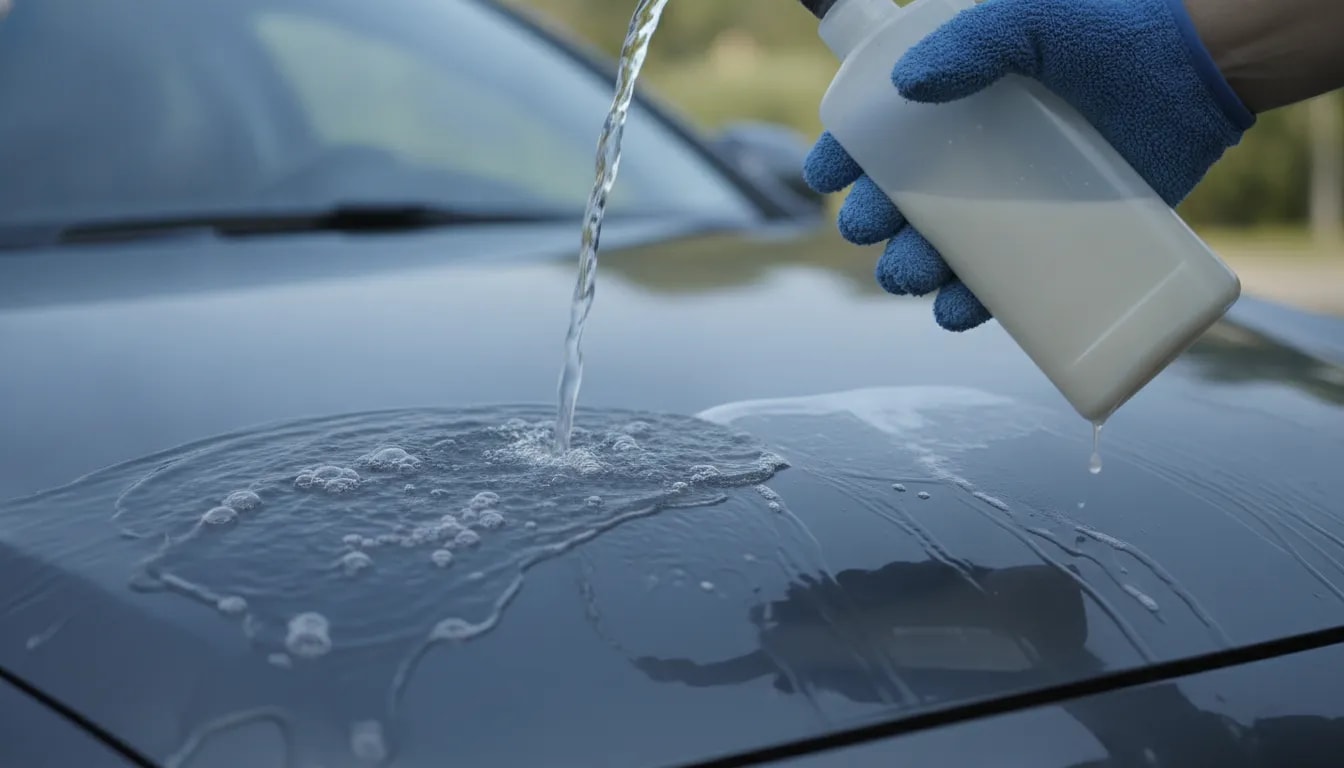
Dish soap can clean a car, but it is not a good choice for routine washing. Its grease-cutting formula can work against the wax or sealant you want to preserve. A dedicated car shampoo is designed to clean exterior surfaces while providing lubrication during washing and rinsing away cleanly.
That does not mean one accidental wash will automatically ruin your paint. The important distinction is between removing dirt, weakening surface protection, and damaging the paint itself. Those are different things, and treating them as the same problem makes this debate unnecessarily confusing.
Key Takeaways
- Dish soap cleans effectively but is not the best choice for routine car washing.
- Grease-cutting cleaners can work against the wax or sealant you want to preserve.
- Car shampoo prioritizes lubrication, protection compatibility, and clean rinsing alongside dirt removal.
- Limited emergency use should be followed by thorough rinsing and appropriate restoration of protection.
Table of Contents
- Already Washed Your Car With Dish Soap? What to Do Next
- Dish Soap vs. Car Shampoo: What Actually Matters?
- Why Dish Soap Cleans Well but Can Be a Poor Fit for Paint Care
- Does Dish Soap Damage Car Paint or Just Remove Wax?
- Other Concerns: Rubber, Trim, Salt, and Residue
- Are There Any Situations Where Dish Soap Is Acceptable?
- How to Choose a Better Soap for Regular Car Washing
- The Bottom Line
Already Washed Your Car With Dish Soap? What to Do Next
If you have just used dish soap, focus on removing any remaining detergent and restoring protection rather than assuming the finish is destroyed.
- Rinse thoroughly. Remove the cleaning solution from the paint, trim, glass, and other exterior surfaces.
- Do not leave the surface to dry with soap on it. Remaining detergent can leave a film or streaks.
- Inspect the clean finish. Look for residue, spotting, reduced gloss, or visible wash marks.
- Reapply wax or sealant where appropriate. This is especially relevant if dish soap was used specifically to remove old protection.
- Switch to car shampoo for future washes. An occasional mistake is different from making a household degreaser your regular wash product.
If your car has a ceramic coating or paint protection film, use its care instructions when choosing a cleaner. Do not assume that every type of protection responds to dish soap in the same way.
Dish Soap vs. Car Shampoo: What Actually Matters?
Both products can make suds and loosen dirt. The difference is what they are formulated to accomplish alongside cleaning.
| Consideration | Dish soap | Dedicated maintenance car shampoo |
|---|---|---|
| Primary purpose | Remove grease and food-related oils from dishes | Clean vehicle exterior surfaces |
| Wax and sealant preservation | Grease-cutting action can work against existing protection | Choose a formula intended to preserve existing protection |
| Lubrication during contact washing | Not formulated specifically for a wash mitt moving across automotive paint | Designed to provide a slick washing solution |
| pH | Varies by formulation; may be neutral to mildly alkaline | pH-neutral options are intended for maintenance washing |
| Rinsing | Residue is a concern if not thoroughly removed | Designed to rinse clean when used as directed |
| Best role in car care | A limited fallback, not the default wash product | Regular exterior washing |
A stronger degreaser is not automatically a better car wash. The objective is to remove contamination without unnecessarily disturbing protection or increasing friction against the finish.
Is car shampoo expensive per wash?
A useful comparison is the cost per wash, not simply the price of the bottle. As an illustrative estimate, a $10 to $20 bottle that provides 20 to 30 washes costs approximately $0.33 to $1 per wash.
Actual cost depends on the bottle size and recommended dilution. Even so, dedicated shampoo need not represent a large ongoing expense.
Why Dish Soap Cleans Well but Can Be a Poor Fit for Paint Care
Surfactants lift oily dirt
Dish soap contains surfactants, ingredients that help water interact with oily contamination so it can be carried away during rinsing. That is why it works well on greasy dishes. For a general explanation of their function, see Britannica’s guide to surfactants.
The difficulty is selectivity. A cleaner cannot simply recognize that road grime is unwanted while a wax layer should remain untouched. Aggressive grease removal can also affect some of the products applied to protect the finish.
This explains why a car can look clean immediately after a dish-soap wash without that result proving the cleaner was suitable for maintaining its protection.
pH is relevant, but it is not a complete safety test
Dish soap may fall around pH 7 to 9, depending on the product. A pH-neutral maintenance shampoo is around pH 7.
However, pH alone does not establish whether a cleaner preserves wax, rinses well, or provides suitable lubrication. Avoid choosing dish soap solely because a particular formula is described as mild or neutral. Its intended use and overall formulation still matter.
Foam does not tell you how safely a mitt moves
Car shampoo is designed to provide a slick solution between the washing tool and the surface. That lubrication helps reduce friction as dirt is removed.
A thick layer of suds is not proof of equivalent lubrication. Dirt trapped between a mitt and the clear coat can contribute to fine scratches and swirl marks, regardless of how foamy the wash looks.
Does Dish Soap Damage Car Paint or Just Remove Wax?
The main reason to avoid routine dish-soap washing is its potential effect on protective products, not a certainty that it immediately attacks the paint.
Wax and sealant sit on top of the finish as additional protection. Their performance can include water repellency and a barrier against environmental contamination. Repeated use of an unsuitable cleaner can undermine the protection you are trying to maintain.
Keep three different concerns separate:
- Protection loss: Wax or sealant performance may decline even when the car still looks glossy.
- Mechanical marks: Friction and grit during contact washing can create fine scratches.
- Residue and spotting: Cleaner left on the surface can spoil the finish’s appearance, especially if it dries.
These concerns do not establish that every dish-soap wash causes permanent damage. Nor does a clean-looking car establish that its protective layer is unchanged.
What if the car has no wax?
There may be no added wax layer to weaken, but that does not make dish soap the ideal cleaner. Lubrication, rinsing, and compatibility with the vehicle’s other exterior materials still matter.
Likewise, the absence of wax does not mean there is literally nothing protecting the color underneath. The clear coat and an applied wax or sealant are distinct layers. Removing an added protective product is not the same as removing the clear coat.
What about ceramic coatings and paint protection film?
Wax, sealant, ceramic coatings, and paint protection film should not be treated as interchangeable materials. A cleaner’s ability to affect wax does not prove it will remove a coating or strip film.
For a protected vehicle, select a maintenance shampoo compatible with that protection and follow the relevant care directions.
Other Concerns: Rubber, Trim, Salt, and Residue
Rubber and plastic deserve attention too
A car wash reaches more than painted panels. It also contacts wiper blades, door seals, tire sidewalls, and exterior trim.
Repeated exposure to cleaners not intended for automotive maintenance raises compatibility concerns for those materials. If you notice streaking wipers, cracking seals, or faded trim, inspect them rather than assuming that clean paint means the entire wash process is suitable.
Those symptoms alone do not prove dish soap caused the problem. They are reasons to review your maintenance products and the condition of the affected parts.
Does the salt in dish soap cause rust?
Some dish soaps contain sodium chloride as a formulation thickener. Its presence is worth distinguishing from the road salt that accumulates on a vehicle in winter.
An ingredient list alone does not demonstrate that a diluted, thoroughly rinsed wash creates the same exposure as road-salt buildup. Avoid using that comparison as proof that a single wash causes corrosion. The practical recommendation remains to use an automotive cleaner and rinse thoroughly.
Will car shampoo prevent all water spots?
No shampoo should be treated as a guarantee against spotting. A clean-rinsing formula helps avoid detergent residue, but rinsing and drying remain important.
Do not allow either dish soap or car shampoo to dry on the finish. Persistent spotting deserves attention because some spots can become more difficult to remove and may affect the clear coat.
Are There Any Situations Where Dish Soap Is Acceptable?
Before a full detail or paint correction
If you intend to remove old wax or sealant and apply fresh protection, preserving that existing layer is no longer the goal. In that limited context, dish soap can serve as a pre-cleaning option.
However, do not assume it has completely removed every protective product. A pre-clean is not confirmation that the surface is fully prepared for the next treatment. Follow the preparation requirements for the detailing products you plan to use, and restore protection afterward.
Emergency spot cleaning
Bird droppings and tree sap should not be left on paint indefinitely. Droppings can damage the finish, while sap becomes harder to remove as it hardens.
If no suitable automotive cleaner is available, a small amount of diluted dish soap may be a reasonable temporary fallback for the affected area. Keep the use limited, rinse it away thoroughly, and restore wax or sealant as appropriate.
Do not turn an emergency exception into a weekly washing habit. If the contamination remains, avoid escalating to forceful scrubbing.
How to Choose a Better Soap for Regular Car Washing
For routine maintenance, look for a dedicated car shampoo with the following characteristics:
- Maintenance-wash suitability: Intended for regular cleaning rather than deliberately stripping protection.
- pH-neutral formulation: A straightforward choice for ordinary maintenance washing.
- Lubrication: Designed to help the washing tool move smoothly across the finish.
- Clean rinsing: Formulated to wash away without leaving an unwanted detergent film.
- Protection compatibility: Appropriate for the wax, sealant, coating, or film on your vehicle.
- Clear dilution directions: Use the stated amount rather than assuming more soap gives a better result.
The most common mistake is judging a wash product only by how much dirt it removes. A suitable car shampoo also supports the parts of washing that are less visible: preserving protection, managing friction, and avoiding residue.
The Bottom Line
Dish soap is capable of cleaning a car, but cleaning ability alone does not make it suitable for regular paint care. Choose a dedicated maintenance shampoo for ordinary washes, especially when you want to preserve wax or sealant.
If you have already used dish soap, rinse thoroughly, check the finish, and renew protection where needed. There is no reason to assume instant paint failure, but there is also little reason to keep using a kitchen cleaner when a purpose-made alternative is inexpensive per wash.