
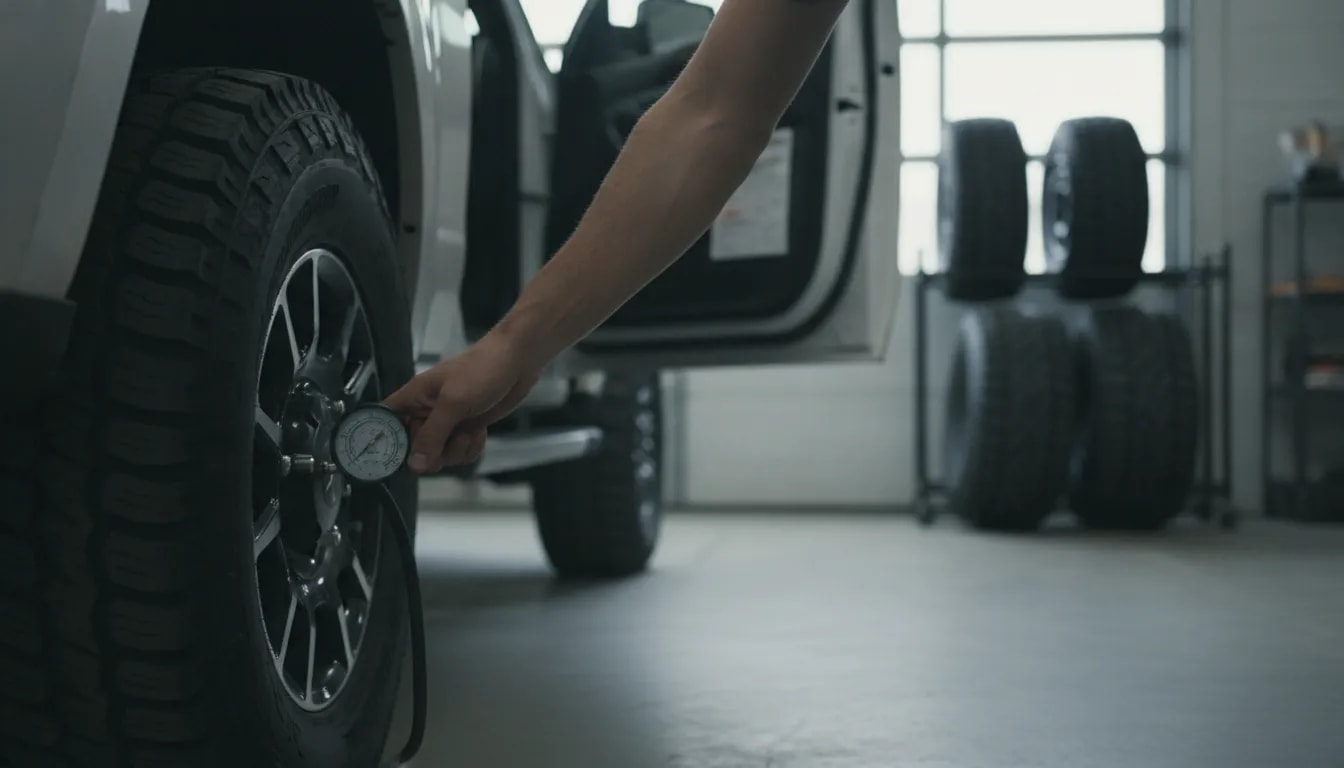
The correct tire pressure for a diesel vehicle is the manufacturer’s recommended cold PSI for your vehicle, tires, and loading conditions. Start with the tire-information label in the driver’s door opening and check the owner’s manual for any separate towing or fully loaded recommendations.
There is no single PSI that suits every diesel car, SUV, or pickup. The common mistake is treating one number as universal, whether it comes from another owner, the tire sidewall, or a general towing rule.
Proper tire pressure management means knowing which recommendation applies, measuring before the tires warm up, and reviewing the setting when your load or tire setup changes.
Key Takeaways
- Use your vehicle’s recommended cold pressure, not a universal diesel PSI or the tire sidewall maximum.
- Check manufacturer instructions before changing pressure for towing, cargo, or a full passenger load.
- Measure pressure monthly while cold, even when the TPMS warning light is off.
- Investigate alignment, suspension, and rotation history before blaming uneven tread wear entirely on pressure.
Table of Contents
- Which Tire Pressure Number Should You Use?
- How to Set Diesel Tire Pressure Correctly
- Towing and Heavy Loads: When Does Pressure Need to Change?
- What Uneven Tire Wear Can Tell You
- Temperature Changes and TPMS: Why Manual Checks Still Matter
- Will Higher Tire Pressure Improve Diesel Fuel Economy?
- Modified Diesel Trucks Need a Separate Pressure Review
- The Tire-Pressure Mistakes to Avoid
- Bottom Line
Which Tire Pressure Number Should You Use?
Three different numbers can cause confusion: the vehicle’s recommended pressure, a loaded-use recommendation, and the pressure marking on the tire itself. They serve different purposes.
| Pressure information | Where to find it | How to use it |
|---|---|---|
| Recommended cold tire pressure | Vehicle tire-information placard and owner’s manual | Use the specified front and rear settings for the applicable operating conditions. |
| Loaded or towing pressure, if specified | Owner’s manual or a load-specific pressure label | Use it when the manufacturer’s stated loading conditions apply. |
| Maximum pressure or load-related pressure marking | Tire sidewall | Read it as tire-rating information, not as an everyday inflation target. |
The door label is vehicle-specific
The manufacturer’s recommendation accounts for the vehicle’s weight distribution, suspension, handling, and intended tire equipment. It balances tire life, ride quality, fuel economy, and safety.
A diesel engine can add weight compared with a gasoline equivalent, but the recommendation for the diesel model already accounts for its original configuration. Do not add extra PSI simply because the vehicle runs on diesel.
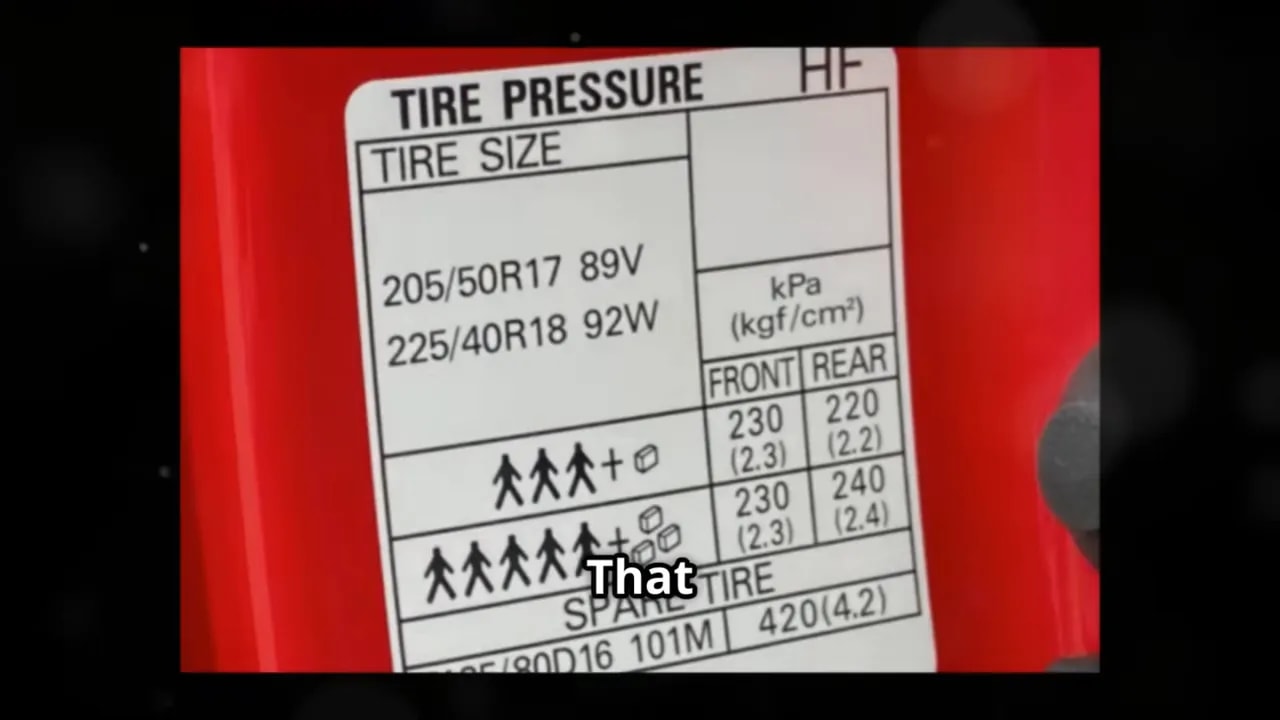
Read the whole label, not just the first number. Front and rear pressures may differ, and some vehicles provide separate settings for different passenger or cargo loads.
Do not assume every placard describes a lightly loaded vehicle, either. Labels and manufacturer instructions vary. If yours lists only one setting, check the manual before deciding that towing requires an increase above it.
The tire sidewall is not your normal pressure recommendation
The sidewall describes the tire’s capabilities. Its pressure and load markings do not tell you the ideal setting for your particular vehicle on an ordinary commute.
Inflating to the sidewall maximum just because the number is higher can produce an unnecessarily harsh ride and contribute to uneven wear. Conversely, some heavily loaded applications may require a high cold pressure. The correct decision comes from the vehicle instructions and appropriate tire-load guidance, not a rule that maximum pressure is always desirable or always unnecessary.
For additional guidance on finding and using the recommended pressure, see NHTSA’s tire-safety information.
How to Set Diesel Tire Pressure Correctly
Use this routine for everyday maintenance and before a loaded trip.
- Find the applicable recommendation. Note the front and rear cold pressures, plus any separate instructions for towing or heavy loads.
- Check before driving. First thing in the morning, before the vehicle has been driven, is a practical time to measure cold tire pressure.
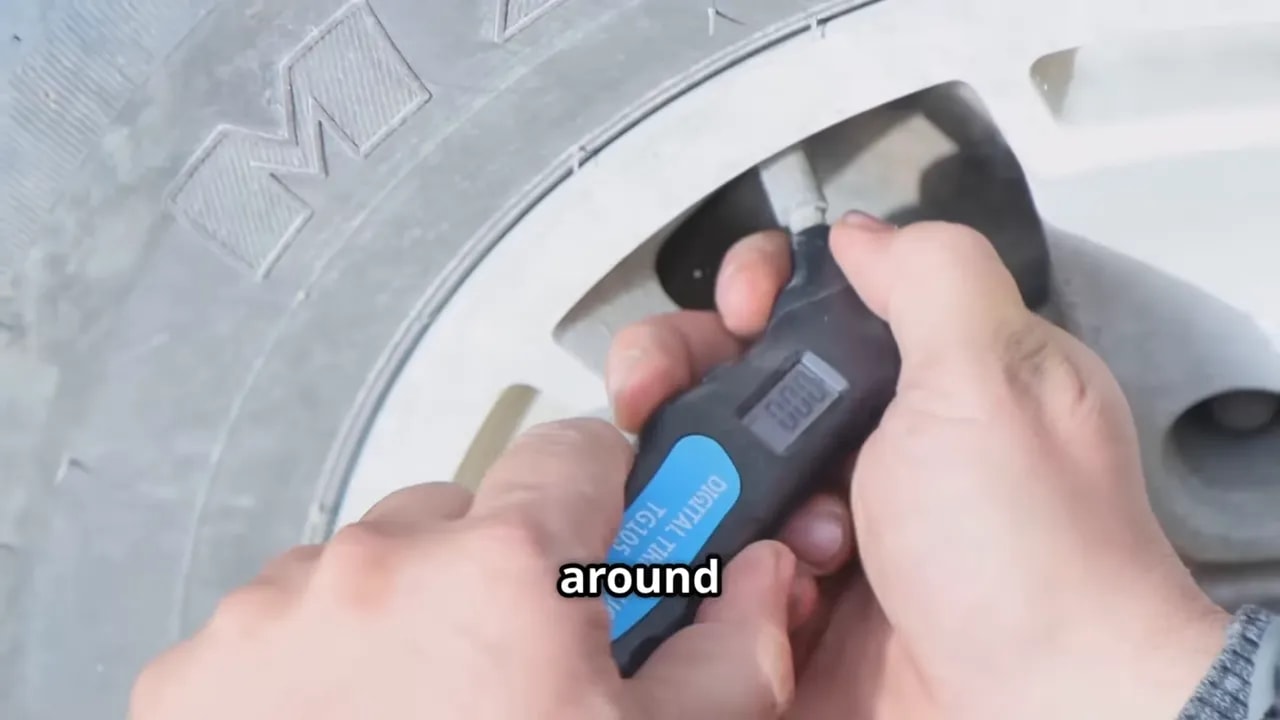
- Use a reliable gauge. A quality digital gauge is convenient to keep in the vehicle. Gauge accuracy matters more than relying on an unfamiliar service-station reading.
- Measure each tire. Compare each reading with the recommendation for that axle rather than assuming all tires need the same PSI.
- Adjust and verify. Add or release air as needed, then measure again to confirm the cold setting.
- Inspect the tread. Look for uneven wear while checking pressure so developing problems are not overlooked.
Why cold readings matter
Tire pressure rises as the tires heat up during driving. A warm reading can therefore look adequate even when the cold pressure is too low.
Do not release air from warm tires merely to bring them down to the specified cold PSI. Recheck when they are cold before making a routine adjustment against the cold recommendation.
How often should you check?
Check tire pressure at least once a month, and review it before towing or carrying a substantial load. Check more frequently during major seasonal temperature changes.
Tires can gradually lose air, roughly 1 PSI per month. A setting that was correct several months ago may no longer be correct, even without an obvious puncture.
Towing and Heavy Loads: When Does Pressure Need to Change?
More load requires adequate tire load capacity at the appropriate inflation pressure. If the pressure is insufficient for the load, the sidewalls flex excessively, heat builds up, and wear accelerates.
That does not mean every loaded diesel needs an arbitrary increase above its placard setting. Use the manufacturer’s loaded-use instructions when provided. The existing recommendation may already cover the intended load, or the vehicle may specify a different setting.
A practical loaded-trip checklist
- Check the manual for towing, cargo, or full-passenger-load tire-pressure instructions.
- Read front and rear recommendations separately.
- Set the applicable pressures while the tires are cold, before the trip.
- Make sure the load remains within the vehicle’s and tires’ rated capacities.
- After unloading, return to the normal-use setting if the manufacturer specifies a lower one.
Adding 3 to 5 PSI is sometimes suggested as a shortcut, but it is not a universal towing prescription. Nor should you go slightly above a specified loaded pressure without supporting guidance. If the manual does not resolve the question, consult a qualified tire specialist rather than guessing.
Example: a diesel SUV with separate loaded settings
Suppose an SUV specifies 35 PSI for normal use and 38 or 40 PSI for a particular fully loaded condition. Use 35 PSI for routine driving, the applicable higher setting for the loaded trip, and 35 PSI again after unloading and checking the tires cold.
Those numbers illustrate the process. They are not recommendations for every diesel SUV.
Example: a pickup with different rear pressure requirements
Suppose a pickup’s instructions specify 35 PSI front and rear for normal use, but 35 PSI front and 45 PSI rear for a stated heavy-load condition. In that case, the rear setting changes while the front setting stays the same.
This is why increasing all four tires by the same amount can be the wrong approach. Use your pickup’s actual instructions, not these illustrative figures.
What Uneven Tire Wear Can Tell You
Tread wear provides useful clues, but it cannot diagnose tire pressure by itself. Alignment, suspension condition, rotation history, loading, and driving style also affect wear.
| Wear pattern | Possible explanation | What to check |
|---|---|---|
| Both outer shoulders wear faster than the center | Underinflation may contribute, but cornering habits and mechanical issues can also matter. | Cold pressure, loading, alignment, suspension, and driving style. |
| The center wears faster than the shoulders | Excessive inflation for the operating load may contribute. | Actual cold pressure against the applicable recommendation. |
| Uneven wear despite correct pressure | Alignment, suspension, or missed rotations may be involved. | Mechanical condition and tire-rotation schedule. |
| Wear is relatively even across the tread | A desirable result, but not proof that every maintenance setting is correct. | Continue pressure checks and scheduled tire maintenance. |
Do not try to fix alignment with air pressure
Correct inflation cannot compensate for misalignment. Potholes, curb impacts, and rough off-road use can make an alignment inspection worthwhile, especially if the vehicle starts pulling or the tread wears unevenly.
Consider an annual alignment check, and have symptoms investigated promptly rather than waiting for the next scheduled visit.
Keep tire rotations on schedule
A rotation interval of around 5,000 to 7,000 miles is a useful general reference, but follow the schedule and rotation requirements for your vehicle and tires. Rotation helps distribute wear; it does not repair an inflation or alignment problem.
Temperature Changes and TPMS: Why Manual Checks Still Matter
Cold weather lowers tire pressure
A useful approximation is a loss of about 1 PSI for every 10°F drop in temperature. A 30°F temperature drop could therefore reduce pressure by roughly 3 PSI, even without a leak.
The response is to measure and restore the recommended cold pressure. Seasonal changes do not create a separate universal “winter PSI” for diesel vehicles.
A dark TPMS light does not mean pressure is ideal
The tire pressure monitoring system warns about significant underinflation. It is not a substitute for routine gauge checks.
A warning threshold around 25% below the recommended pressure means that a tire with a 35 PSI recommendation may not trigger a warning until it is around 26 or 27 PSI. Exact behavior varies by system, but the maintenance lesson remains the same: pressure can be below the target before the warning appears.
Use TPMS as a warning system, not as permission to skip monthly checks.
Will Higher Tire Pressure Improve Diesel Fuel Economy?
Underinflated tires increase rolling resistance, making the engine work harder. Restoring significantly underinflated tires to the correct pressure can provide a modest fuel-economy improvement, potentially around 2% to 3%, depending on the starting condition.
That is a reason to maintain proper inflation, not a reason to overinflate. Any small additional economy benefit from exceeding the recommendation can come with tradeoffs in ride quality, traction, and tread wear.
For better diesel MPG, focus on correct tire pressure alongside smooth driving, proper engine maintenance, and removing unnecessary weight. Chasing extra PSI is not a substitute for those habits.
Modified Diesel Trucks Need a Separate Pressure Review
The original recommendation may need reassessment if the vehicle’s tires or loading characteristics have changed significantly.
Seek qualified guidance if you have:
- Changed tire or wheel sizes.
- Fitted tires with a different load range.
- Added substantial permanent accessory weight.
- Lifted the truck or otherwise changed its original setup.
A tire specialist can help determine the appropriate pressure for the modified equipment and intended load. Reading the new tire’s maximum pressure alone does not answer that question.
The Tire-Pressure Mistakes to Avoid
- Copying another diesel owner’s PSI: Their vehicle, tires, and load may differ from yours.
- Adding pressure just for the diesel engine: Its original weight is already part of the vehicle-specific recommendation.
- Automatically exceeding the placard when towing: First establish what loading conditions the manufacturer’s setting covers.
- Using the sidewall maximum as a daily target: Tire-rating information is not the same as a vehicle recommendation.
- Adjusting against a warm reading: The specified pressure is a cold setting.
- Blaming all uneven wear on inflation: Alignment, suspension, rotation, and driving habits also matter.
- Waiting for a warning light: Routine checks catch smaller pressure losses earlier.
Bottom Line
The best diesel tire-pressure strategy is vehicle-specific and consistent: use the applicable manufacturer recommendation, check monthly while cold, review the instructions before loaded trips, and investigate uneven wear promptly.
The right PSI is not necessarily the highest number available. It is the supported setting for your vehicle, tire equipment, and operating load.