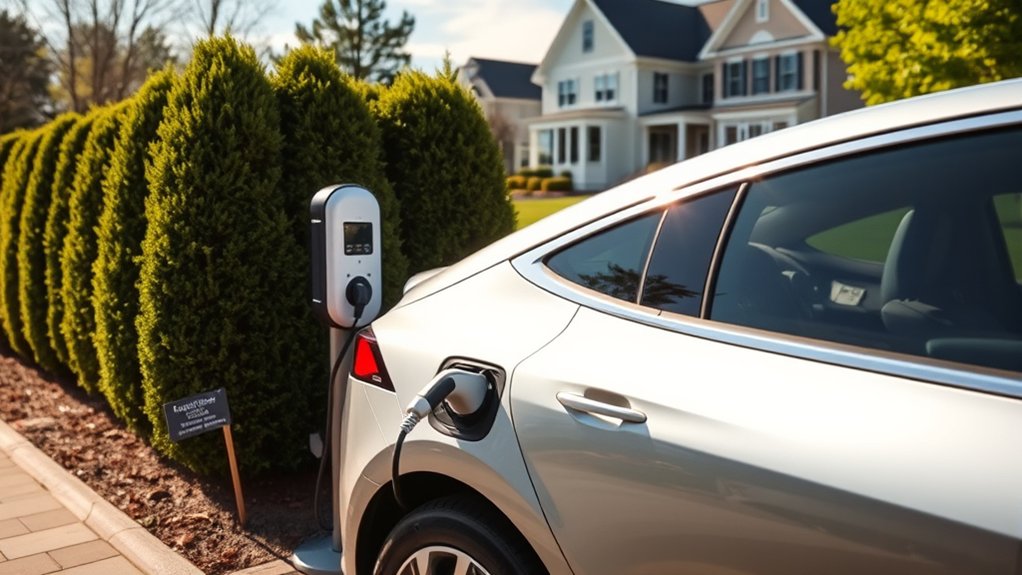
Navigating EV charging rules in HOAs starts with four questions: where the charger will go, who controls the parking space, what your state law allows, and who pays for installation, electricity, insurance, maintenance, and repairs. In many right-to-charge states, an HOA can require an application, permits, licensed electrical work, and reasonable design standards, but it generally cannot use those rules to block reasonable EV charging access.
Quick Answer
HOA EV charging rules usually require owner approval before installation, but right-to-charge laws in states such as Oregon, California, and Colorado limit unreasonable restrictions. You will usually pay for the charger, permits, electrical work, electricity, maintenance, damage, insurance, and removal or transfer duties when you sell.
Key Takeaways
- Check your state law first because HOA EV charger rights are not the same nationwide.
- Your parking-space type matters. Rules differ for deeded spaces, assigned spaces, limited common elements, and general common areas.
- Most HOA installations are Level 1 or Level 2. DC fast charging is usually a public or commercial setup, not a normal residential HOA project.
- Expect to submit a site plan, charger specs, electrician proposal, permit information, insurance proof if required, and an electricity billing plan.
- Never install an EV charger without required permits, code compliance, and qualified electrical work.
At a Glance
| Time Required | Often 2 to 8 weeks for HOA review, electrical bids, permits, and scheduling. Some states use a 60-day review rule when a complete application is submitted. |
| Difficulty | Moderate. Simple Level 1 charging can be easy if an approved outlet already exists. Level 2 may require panel review, wiring, permits, and HOA coordination. |
| Tools Needed | HOA application, parking-space documentation, charger spec sheet, electrician proposal, permit plan, load calculation, proof of insurance if required, and electricity billing method. |
| Cost | Varies widely. You may pay for equipment, electrical labor, permits, trenching or conduit, panel upgrades, electricity, maintenance, repairs, insurance, and future removal. |
Note: This article is general information, not legal advice. HOA rules, condo documents, state statutes, permits, and electrical codes vary by location. Review your governing documents and speak with a qualified attorney or licensed electrician when needed.
Understanding EV Charging Stations in HOAs
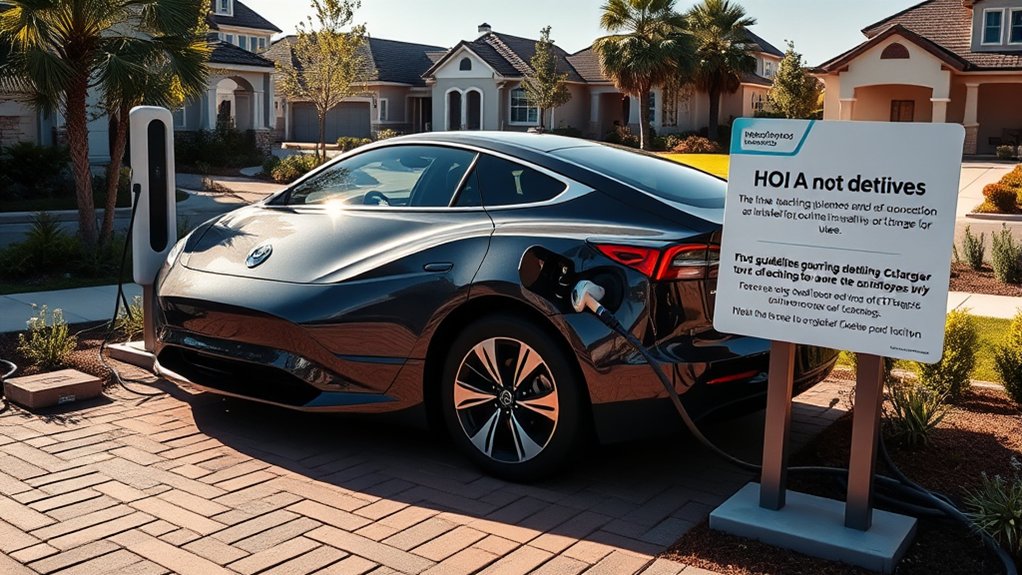
When you live in a homeowners association, condo association, or other common-interest community, EV charging is not only a vehicle issue. It is also a parking, electrical, insurance, architectural, and property-rights issue.
Your HOA may ask you to submit an application before you install a charging station. That application may include the charger model, electrical plan, installation location, permit status, proof of licensed electrical work, and how electricity will be measured or paid for.
At the same time, many states have right-to-charge laws. These laws often stop an HOA from enforcing a rule that effectively bans or unreasonably restricts EV charging in a space you own, use exclusively, or are assigned to use.
For example, Oregon Revised Statutes 94.762 says a homeowners association may not prohibit a compliant EV charging station in a planned community and must approve a completed application within 60 days unless a delay is based on a reasonable request for more information. Oregon has a similar condominium rule in ORS 100.627.
California also protects EV charging access in common-interest developments. California Civil Code 4745 makes rules void and unenforceable when they effectively prohibit or unreasonably restrict a covered charging station. It also says an application is deemed approved if it is not denied in writing within 60 days, unless the delay comes from a reasonable request for more information.
Essential Legal Guidelines for Installing EV Charging Stations
The most important legal point is that HOA EV charging rules are state-specific. Do not assume your neighbor’s approval process, a blog post from another state, or a charging-network FAQ controls your situation.
Right-to-Charge Laws Are State-Specific
Right-to-charge laws usually balance two interests: your access to EV charging and the association’s duty to protect common property, parking access, electrical capacity, safety, and insurance coverage.
- Oregon: Covered owners may apply to install a personal, noncommercial EV charging station in a qualifying space. The owner is responsible for installation and use costs, electricity costs, certain damage costs, disclosure to future buyers, and removal or transfer duties unless a different outcome is negotiated.
- California: Restrictions that effectively prohibit or unreasonably restrict covered EV charging stations are void and unenforceable. The owner generally pays installation and electricity costs and may need to provide liability coverage documentation.
- Colorado: Colorado Revised Statutes 38-33.3-106.8 prevents associations from prohibiting covered Level 1 or Level 2 systems in certain spaces, while still allowing bona fide safety requirements, registration requirements, and reasonable aesthetic provisions.
What Your HOA Can Reasonably Require
Even in right-to-charge states, an HOA may often require reasonable conditions. These can include architectural standards, licensed contractor work, permits, safety-code compliance, insurance proof, electricity reimbursement, equipment certification, and repair responsibility.
An HOA usually cannot turn those conditions into a hidden ban. A restriction is risky when it greatly increases cost, reduces charger performance, causes unreasonable delay, or treats EV charging differently from similar owner improvements without a safety or property reason.
Warning: Do not rely on an extension cord across a sidewalk, hallway, common garage aisle, or shared parking area unless local rules and your HOA expressly allow it. Loose cords can create trip hazards, fire risks, weather exposure, and code violations.
Parking Space Type Matters Before You Apply
Your approval path depends heavily on the legal status of your parking space. Before buying equipment, confirm which category applies to you.
| Parking Situation | Why It Matters |
| Private garage or space inside your unit | Often the easiest case, but electrical permits, safety rules, and insurance requirements may still apply. |
| Deeded or assigned parking space | Many right-to-charge laws protect these spaces, but the HOA can still require a complete application and safe installation. |
| Exclusive-use or limited common element space | You may have strong use rights, but the HOA may control the structure, conduit path, walls, ceiling, or shared electrical system. |
| General common-area parking | This is usually more complex because the charger may affect access, cost allocation, insurance, and fairness for other residents. |
Step-by-Step Guide to HOA Approval for EV Charging
A strong application reduces delays. It also makes it harder for the HOA to claim your request is incomplete.
- Read your governing documents. Check the CC&Rs, declaration, bylaws, architectural rules, parking map, and electrical-use rules.
- Confirm your parking rights. Identify whether the space is deeded, assigned, exclusive-use common area, limited common element, or shared common area.
- Check state and local law. Look for right-to-charge laws, building permits, electrical permits, fire-code rules, and local inspection requirements.
- Get an electrician’s proposal. Ask for the charger location, circuit size, panel capacity review, load calculation, conduit route, equipment model, and permit plan.
- Choose the charging level. Level 1 may work for low-mileage overnight charging. Level 2 is faster but usually needs dedicated electrical work.
- Prepare the HOA packet. Include drawings, charger specs, electrician license details, permits, proof of insurance if required, payment method for electricity, and a plan to repair or restore affected property.
- Submit the application in writing. Keep proof of delivery and ask the HOA to confirm the date it received a complete application.
- Respond quickly to information requests. If the HOA asks for reasonable missing information, provide it in writing.
- Wait for written approval before installation. Do not start work until you have the required HOA approval and permits.
- Keep final records. Save the permit, inspection approval, electrician invoice, charger manual, warranty, insurance documents, and resale disclosure information.
Pro Tip: Ask the electrician to mark the conduit path, charger location, disconnect location if required, circuit rating, and panel impact on one simple drawing. HOA boards respond faster when they can see the exact property impact.
Homeowner Financial Responsibilities for EV Charging Stations
In most owner-requested HOA EV charging projects, you should expect to pay the direct costs. The HOA is usually not required to fund your personal charger unless the board is creating shared community charging as an amenity.
| Responsibility | What It Usually Includes | Why It Matters |
| Installation costs | Charger, wiring, conduit, breaker, panel work, permits, labor, trenching, wall repair, and inspection fees. | These costs can rise quickly if the electrical panel is far from the parking space. |
| Electricity costs | Dedicated meter, submeter, network billing, utility reimbursement, or another HOA-approved payment method. | The HOA will want to avoid shifting your charging cost to other residents. |
| Maintenance and repairs | Charger servicing, damaged conduit, cable replacement, wall repair, and restoration after removal. | Many statutes and HOA agreements place these duties on the owner and later owners. |
| Insurance | Liability coverage, certificate of insurance, or naming the association as an additional insured when allowed by law. | Insurance terms vary by state and by whether the charger affects common property. |
| Sale or transfer | Disclosure to buyers, transfer of charger rights, buyer acceptance, or removal and restoration. | A charger can be personal property, so resale documents should explain who owns it and who maintains it. |
Choosing the Right EV Charging Setup
Most HOA residents compare Level 1 and Level 2 charging. The right choice depends on your daily miles, overnight parking time, electrical capacity, and budget.
- Level 1 charging: Uses a 120-volt AC plug. The U.S. Department of Energy’s Alternative Fuels Data Center says Level 1 charging provides about 5 miles of range per hour and can add about 40 miles in 8 hours for a mid-size EV.
- Level 2 charging: Uses 240 volts in typical residential settings or 208 volts in many commercial settings. It is much faster and can often charge a typical EV battery overnight.
- DC fast charging: Usually a public, fleet, or commercial installation. It needs major electrical infrastructure and is rarely the right fit for one homeowner’s HOA parking space.
If you drive only a short commute and park overnight, Level 1 may be enough. If you drive more miles, share a vehicle, or need faster recovery after trips, Level 2 is usually more practical.
Addressing Safety and Compliance Concerns
EV charging safety should be handled before the HOA vote, not after approval. A complete proposal should show that the charger will be safely installed, inspected, maintained, and billed.
- Use listed equipment. Choose charging equipment that meets recognized safety certifications and is appropriate for the location.
- Hire qualified electrical help. Many covered installations require a licensed electrician or electrical contractor. Oregon, for example, requires installation by a person licensed to act at least as a journeyman electrician for covered stations.
- Check electrical capacity. The electrician should review the panel, circuit capacity, load calculation, conduit route, and any need for service upgrades.
- Pull required permits. Local building or electrical permits may be required even when the HOA approves the project.
- Plan for inspection. Final inspection protects you, the HOA, future buyers, and neighboring residents.
- Protect common property. Your plan should explain how walls, ceilings, pavement, landscaping, or shared electrical rooms will be restored if disturbed.
Common Misconceptions About EV Charging Rules
EV charging rules in HOAs are often misunderstood. These mistakes cause unnecessary conflict and delay.
Misunderstanding HOA Restrictions
Many homeowners assume the HOA can simply ban EV charging. In right-to-charge states, that may not be true. The association may still require a formal application, reasonable design rules, safety compliance, insurance documents, and reimbursement for electricity, but it may not be allowed to use those rules as an unreasonable barrier.
The opposite mistake is also common. Some owners assume the HOA must approve any charger in any location. That is also wrong. Shared parking areas, common electrical systems, limited common elements, and building safety rules can create valid limits.
Assumptions About Installation Costs
Many homeowners think the HOA will pay for the charger because it benefits the community. That is rarely true for a charger requested for one owner’s personal use. You should expect to pay for equipment, installation, permits, electrical work, electricity, maintenance, damage, insurance if required, and future removal or transfer duties.
However, an HOA board can choose to create a shared charging program. In that case, costs may be paid through reserves, special assessments, grants, utility programs, charging fees, or a third-party charging provider.
How Right-to-Charge Policies Address Common Misconceptions
Right-to-charge policies are designed to keep HOAs from blocking EV adoption through blanket bans, slow-walking, or unreasonable conditions. They do not remove every HOA rule. Instead, they create a fair approval path.
- They limit blanket bans. A governing document that fully blocks covered EV charging may be void or unenforceable in some states.
- They protect reasonable access. Owners may have the right to install a charger in a qualifying space when they meet legal and safety requirements.
- They preserve safety rules. HOAs can usually require code compliance, permits, qualified installation, and protection of common property.
- They clarify cost responsibility. Many laws make the requesting owner responsible for installation, electricity, maintenance, damage, and disclosure duties.
What to Do If Your HOA Denies or Delays Your EV Charger Request
If your HOA denies the application or does not respond, stay organized and keep everything in writing.
- Ask for the reason in writing. A denial should identify the specific rule, safety issue, missing document, or property concern.
- Compare the denial with state law. Look for a right-to-charge law, a 60-day response rule, or limits on unreasonable restrictions.
- Fix true application gaps. If you forgot an electrician drawing, insurance document, permit detail, or charger spec sheet, submit it promptly.
- Request an internal appeal. Many HOA documents allow board review, architectural committee review, or dispute resolution.
- Document delay dates. Keep the submission date, response dates, and all requests for additional information.
- Get legal help when needed. If the HOA appears to ignore state law, speak with an attorney familiar with HOA or condominium law in your state.
Why EV Charging Stations Benefit Communities
EV charging can help communities stay useful to residents as more drivers switch to electric vehicles. For HOAs, the biggest benefits are convenience, resident satisfaction, marketability, and long-term planning.
- Convenience for residents: Home charging lets EV owners recharge while parked overnight instead of relying only on public stations.
- Better market appeal: EV-ready parking can make a community more attractive to buyers and renters who already own or plan to buy an EV.
- Lower conflict: A written charging policy reduces case-by-case disputes and gives owners a predictable process.
- Smarter infrastructure planning: A community policy can address metering, electrical capacity, charger placement, future expansion, and shared-use rules before demand grows.
Successful EV Charging Examples in HOAs
A successful HOA EV charging program usually starts with a written policy, not with a one-off exception. The strongest policies explain who may apply, where chargers can go, what documents are required, who pays, how electricity is billed, and what happens when the owner sells.
For example, an HOA with assigned parking might approve owner-funded Level 2 chargers only after the owner submits a licensed electrician’s plan, proof of permits, a charger spec sheet, a metering plan, and an agreement to maintain and remove the equipment if required. A larger condo community may instead choose shared charging stations with app-based billing and clear parking-time limits.
Both models can work. The key is matching the charging setup to the building’s electrical capacity, parking layout, and fairness concerns.
Future Trends in EV Charging for Multifamily Units
EV charging in multifamily communities is moving toward earlier planning, smarter load management, and more shared infrastructure. HOAs that wait until many residents ask for chargers at once may face higher costs and more conflict.
Expect more communities to consider EV-ready conduit, shared Level 2 stations, smart outlets, load-managed panels, billing software, and policies that reserve electrical capacity fairly. Some communities will support individual chargers in assigned spaces, while others will choose shared chargers in visitor or common parking areas.
Charging-network rules also continue to change. For public fast charging, companies such as Electrify America direct drivers to check the app or charger screen for real-time pricing, power levels, and idle fees. That same idea applies inside HOAs: clear pricing and use rules prevent confusion.
Frequently Asked Questions
Do I need HOA approval to install an EV charger?
Usually, yes. Even in right-to-charge states, the HOA can often require an application before you install a charger. Approval may depend on your parking rights, charger location, electrical plan, permits, insurance requirements, and whether the proposed setup affects common property.
Can my HOA deny an EV charger?
An HOA may deny or delay a charger request for valid reasons, such as an incomplete application, unsafe electrical work, lack of permits, or a location that improperly affects common property. In right-to-charge states, it generally cannot deny a compliant request only because the board dislikes EV chargers.
What is the 80/20 rule for charging?
For EV batteries, the “80/20 rule” usually means keeping daily charging roughly between 20% and 80% when practical. This is not an HOA law. It is a battery-care habit, and your vehicle manual should control your charging target. For HOA approval, the more important issue is whether you need Level 1 or Level 2 charging for your daily driving.
Does Electrify America allow you to charge to 100%?
In many cases, an EV can be charged beyond 80% at public DC fast chargers, but the practical limit depends on the vehicle, station rules, charger availability, and the battery’s charging curve. Charging often slows near full. Electrify America tells drivers to check the app or charger screen for real-time pricing, power levels, and idle fees.
How do I charge an EV in a condo?
Start by checking your condo declaration, parking-space assignment, and state right-to-charge law. Then get a licensed electrician’s proposal, choose Level 1 or Level 2 charging, prepare an HOA application, explain how electricity will be paid, and wait for approval and permits before installation.
Who pays for an HOA EV charger?
For a charger used by one owner, that owner usually pays for the charger, installation, electricity, permits, maintenance, repairs, insurance if required, and removal or transfer duties. If the HOA installs shared chargers for the community, the board may use a different funding model.
Can an HOA require insurance for an EV charger?
Often, yes, when allowed by state law and the charger affects common property or liability risk. The exact requirement varies by state. Some laws discuss liability coverage, certificates of insurance, or naming the association as an additional insured.
Conclusion
EV charging rules in HOAs are manageable when you treat the project as both an electrical installation and a property-approval request. Review your governing documents, confirm your parking rights, check your state’s right-to-charge law, get a qualified electrical plan, and submit a complete written application. A careful approach protects your charging access while giving the HOA the safety, cost, and property details it needs to approve the work fairly.
Sources
- Oregon Revised Statutes 94.762 – HOA EV charging rules for Oregon planned communities.
- Oregon Revised Statutes 100.627 – EV charging rules for Oregon condominiums.
- California Civil Code 4745 – California common-interest development EV charging protections.
- Colorado Revised Statutes 38-33.3-106.8 – Colorado restrictions on EV charging systems and EV parking.
- U.S. Department of Energy Alternative Fuels Data Center – EV charging levels, speeds, and equipment basics.
- Electrify America Pricing and Plans – Public charging pricing, power-level, and idle-fee guidance.