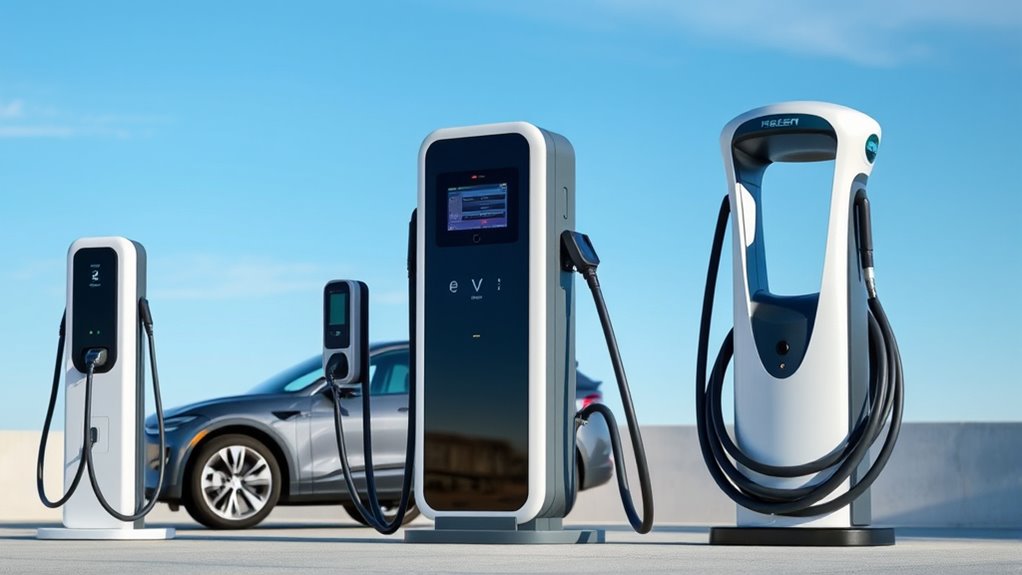
EV charging levels tell you how quickly a charger can add power to your electric vehicle and where that charger usually fits into daily life. Level 1 is slow but simple, Level 2 is the best match for most home charging, and Level 3, more commonly called DC fast charging, is built for road trips and quick public stops.
Quick Answer
Level 1 charging uses a regular 120-volt outlet and adds only a few miles per hour. Level 2 uses 208- to 240-volt AC power and is best for daily home or workplace charging. Level 3, or DC fast charging, can add major range quickly but is mainly for public travel stops.
Key Takeaways
- Level 1 is easiest to access but usually adds only about 2 to 5 miles of range per hour.
- Level 2 is the best everyday choice for many EV owners because it can usually refill a vehicle overnight.
- DC fast charging is the fastest option, but speed depends on the charger, your vehicle, battery temperature, and state of charge.
- Connector compatibility matters. North America now includes J1772, CCS1, CHAdeMO, and the growing SAE J3400/NACS connector.
At a Glance
| Best Everyday Choice | Level 2 for most drivers with home, work, or apartment charging access |
| Fastest Option | Level 3/DC fast charging for road trips and quick public stops |
| Tools Needed | EV charging cable or EVSE, compatible connector, charging app or payment method for many public stations |
| Main Cost Factor | Home electricity rate, Level 2 installation cost, public station pricing, idle fees, and membership discounts |
Understanding the Basics of EV Charging Levels
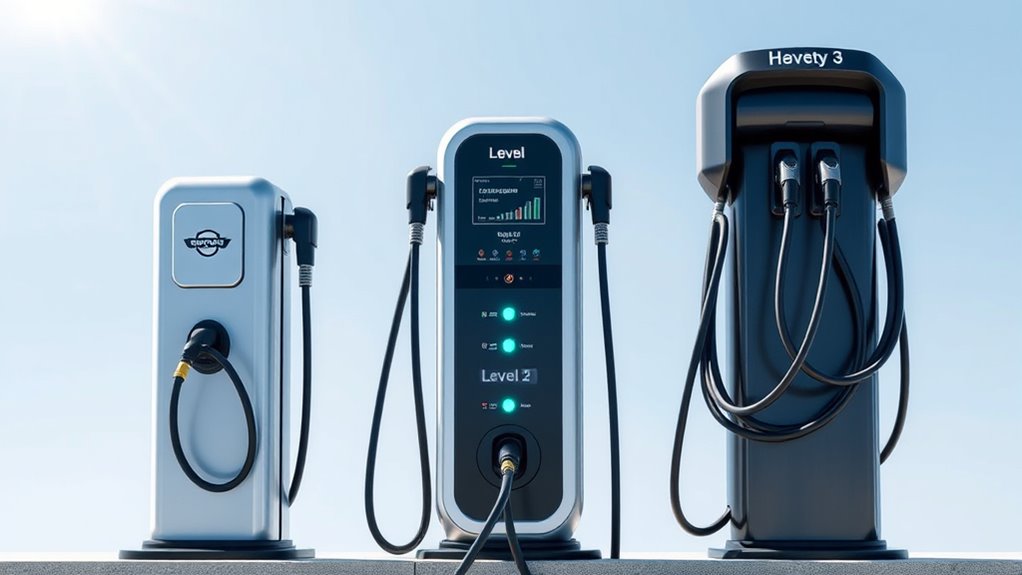
EV charging equipment is classified by how much power it can deliver and whether it sends alternating current (AC) or direct current (DC) to your vehicle. Your actual charging speed depends on the charger, your vehicle’s onboard charger or DC fast-charge limit, battery size, battery temperature, and how full the battery already is.
| Charging Level | Power Type | Typical Speed | Best Use |
|---|---|---|---|
| Level 1 | 120V AC | About 2 to 5 miles per hour | Low daily mileage, overnight top-offs, backup charging |
| Level 2 | 208V or 240V AC | Often around 10 to 30 miles per hour | Home, workplace, apartment, and public daily charging |
| Level 3/DC Fast Charging | DC power | About 100 to 200+ miles in 30 minutes on many compatible EVs | Road trips, highway corridors, quick public charging stops |
The U.S. Department of Energy’s Alternative Fuels Data Center describes Level 1 as 120V AC, Level 2 as 208V or 240V AC, and DC fast charging as high-power charging that can reach up to 500 kW at some stations. Those are equipment capabilities, not a promise that every EV can accept the full amount.
What Is Level 1 Charging and Who Should Use It?
Level 1 charging uses a regular 120-volt household outlet. It is the slowest EV charging level, but it can work well if you drive short distances, park for long periods, or need a simple backup charging option.
Many EVs include a portable Level 1 cordset, although some newer models may sell it separately. Level 1 usually adds only a few miles of range per hour, so a nearly empty battery can take more than a full day to recharge. For a driver who uses 20 to 40 miles of range each day and can plug in overnight, that may still be enough.
Warning: Do not treat EV charging like a phone charger. Use a properly grounded outlet, avoid extension cords unless your vehicle maker specifically allows one, and stop using any outlet, plug, or cord that feels hot, smells burnt, or looks damaged.
| Voltage | 120V AC |
| Range Added | Usually about 2 to 5 miles per hour |
| Best For | Short commutes, plug-in hybrids, backup charging, and overnight top-offs |
| Not Ideal For | Large-battery EVs, high daily mileage, or quick turnaround charging |
Enhancing Your EV Experience With Level 2 Charging
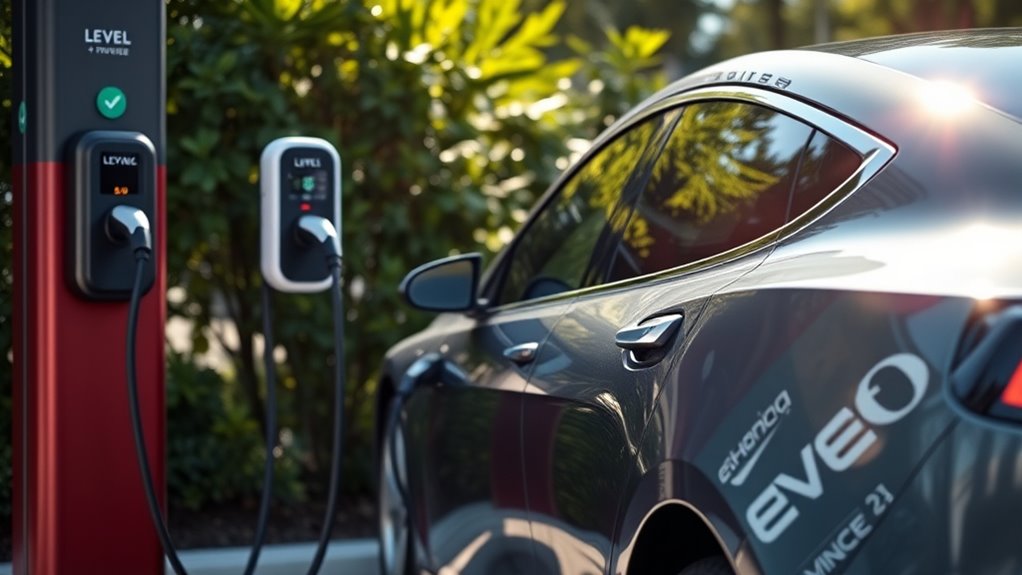
Level 2 charging is the sweet spot for many EV owners. It uses 240-volt power in many homes or 208-volt power in many commercial settings. Compared with Level 1, it adds range much faster and can often recharge an EV overnight.
You will find Level 2 chargers at homes, workplaces, hotels, apartment communities, parking garages, retail centers, and public destinations. If you install one at home, have a qualified electrician confirm that your electrical panel, wiring, breaker, and outlet or hardwired EVSE match the charger and local code requirements.
Pro Tip: For home cost, use this simple formula: battery energy added in kWh × your electricity rate. For example, adding 40 kWh at $0.18/kWh costs about $7.20 before taxes, fees, or time-of-use discounts.
Level 2 is especially helpful if you want to leave each morning with a comfortable charge level, precondition the cabin while plugged in, or avoid relying on public DC fast charging for routine driving.
The Advantages of Level 3 Charging for Quick Power-Ups
Level 3 charging is usually called DC fast charging. Unlike Level 1 and Level 2 AC charging, DC fast charging sends direct current to the battery through off-board charging equipment. This makes it much faster, but it also requires compatible hardware, a compatible vehicle, and a public high-power station.
DC fast charging is best for road trips, highway corridors, and days when you need a quick range boost. Many compatible EVs can add about 100 to 200+ miles in around 30 minutes under good conditions, but the result depends on the vehicle’s maximum DC charging rate, the station’s power, the battery temperature, and how full the battery is.
Note: DC fast charging is usually quickest from a low or mid battery state of charge. Charging often slows as the battery approaches 80%, and the final stretch to 100% can take much longer.
Because DC fast charging is more expensive to build and operate, it is usually found at public charging sites rather than private homes. It is also not supported by every plug-in vehicle. Always check your vehicle’s manual, charge-port type, and maximum DC charging rate before planning a trip around fast chargers.
EV Charging Times: Level 1, Level 2, and Level 3
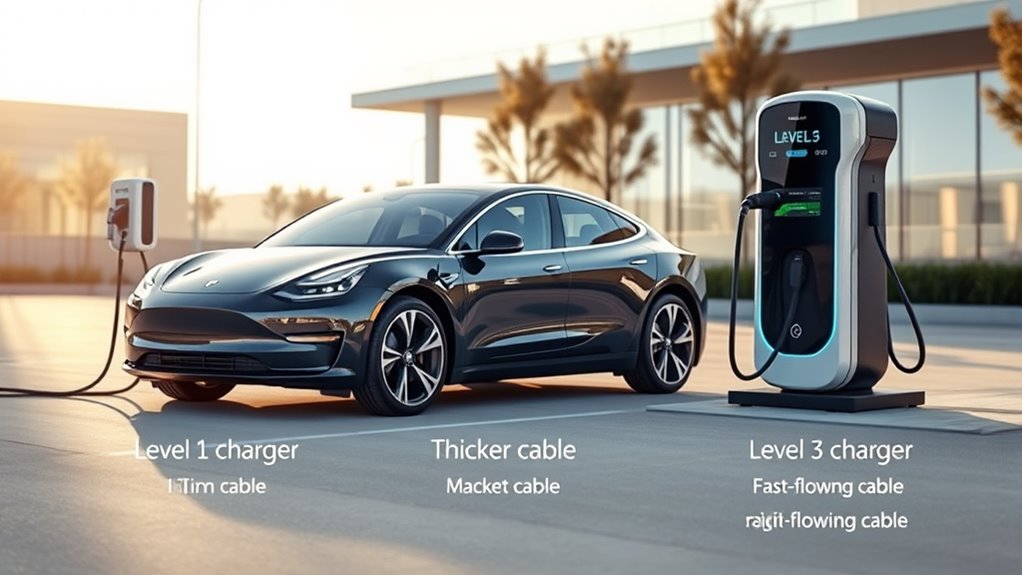
Charging time is not based on the charger alone. It also depends on battery size, starting percentage, target percentage, weather, battery temperature, and the vehicle’s charging limits.
- Level 1: Adds about 2 to 5 miles of range per hour. A full charge can take more than 20 hours on many EVs.
- Level 2: Often adds about 10 to 30 miles of range per hour. Many EVs can recharge overnight.
- DC fast charging: Can add major range in 20 to 60 minutes, especially when charging to around 80% instead of 100%.
The fastest charger is not always the best charger. For daily driving, Level 2 is usually cheaper, easier on your schedule, and more convenient than repeated public fast charging.
Can You Use Different Level EV Chargers Interchangeably?
You can often use different charging levels with the same EV, but not every connector fits every vehicle. The charging level, plug shape, adapter support, and your vehicle’s onboard hardware all matter.
| Connector | Common Use | What to Know |
|---|---|---|
| J1772 | Level 1 and Level 2 AC charging | Common on many non-Tesla EVs and plug-in hybrids in North America. |
| CCS1 | DC fast charging plus AC support through the upper J1772-style portion | Still common on many recent North American EVs. |
| CHAdeMO | Older DC fast charging standard | Found on some older EVs, but less common on new North American models. |
| SAE J3400/NACS | AC charging and DC fast charging | Based on Tesla’s connector and being adopted by many automakers in North America. |
The Joint Office of Energy and Transportation explains that SAE J3400 is based on the North American Charging Standard and that it can support AC Level 1, AC Level 2, and DC fast charging. During the transition, many drivers will still need to pay attention to adapters, station access, and vehicle software support.
How Much Do Home vs. Public Charging Costs?
Home charging is often cheaper than public charging, but the exact cost depends on your utility rate, time-of-use plan, battery size, and how much energy you add. The U.S. Energy Information Administration reported a national residential average of 18.04 cents per kWh year-to-date through April 2026, but your local rate may be higher or lower.
Home Charging Expenses
For Level 1 or Level 2 charging at home, the fuel cost is mainly electricity. If your EV needs 35 kWh to refill and your rate is $0.18 per kWh, the charging energy costs about $6.30. If your utility offers cheaper overnight rates, scheduled charging can lower that cost.
Level 2 installation can add upfront cost because you may need a dedicated circuit, panel work, permits, outdoor-rated equipment, or a hardwired charger. The Department of Energy’s home charging guidance recommends safety-certified equipment and a qualified electrical contractor.
Public Charging Rates
Public charging prices vary widely. Some stations bill per kWh, some bill per minute where required or allowed, and some add session fees, idle fees, parking fees, or higher on-peak pricing. Membership plans may reduce the rate, while roaming between networks may change payment steps.
Before you plug in, check the station screen or app for the price, connector type, charging power, and any idle fee. A fast charger that looks expensive per minute may still be worth it on a road trip, but it is usually not the cheapest way to handle daily driving.
Cost Comparison Factors
- Battery size: A larger battery costs more to refill from empty.
- Efficiency: A more efficient EV uses fewer kWh per mile.
- Electricity rate: Home rates, time-of-use plans, and state averages vary.
- Charging losses: Some energy is lost as heat during charging.
- Public fees: Network fees, idle fees, and parking fees can change the final cost.
How Charging Levels Affect Your Battery Life
Modern EV batteries are managed by software and thermal systems, so occasional DC fast charging is normal for compatible vehicles. Still, charging habits can affect battery health over time.
Charging Frequency Impact
Level 1 and Level 2 charging are usually gentler daily choices because they deliver power more slowly. DC fast charging can create more heat and is best saved for travel, quick turnarounds, or times when you truly need it.
Follow your vehicle’s recommended daily charge limit. For example, Tesla’s battery guidance says vehicles with an 80% daily recommendation should keep the limit at 80% for daily use and only increase to 100% when needed, such as before a long trip. Other EVs may give different guidance, especially if they use different battery chemistry.
Optimal Charging Practices
- Use Level 2 charging for most daily driving when available.
- Use DC fast charging when speed matters, especially on road trips.
- Avoid letting the battery sit near 0% or 100% for long periods unless your owner’s manual says otherwise.
- Precondition the battery before fast charging if your vehicle supports it.
- Do not chase 100% at a fast charger unless you need that range to reach the next stop.
Future Trends in EV Charging Technology
EV charging is changing quickly. The biggest near-term change in North America is connector standardization around SAE J3400/NACS, while CCS1 remains important during the transition. This should make charging easier over time, but drivers will still need to check station access and adapter support during the rollout.
Other trends include smarter home chargers, better public reliability, higher-power fast chargers, vehicle-to-grid programs, and wireless charging pilots. These upgrades may make charging more convenient, but the basics will stay the same: choose Level 1 for simple slow charging, Level 2 for everyday charging, and DC fast charging for quick public range.
Frequently Asked Questions
What is Level 1, Level 2, and Level 3 charging?
Level 1 uses a 120-volt household outlet and is slow. Level 2 uses 208- or 240-volt AC power and is much faster for daily charging. Level 3, better known as DC fast charging, uses high-power DC equipment to add range quickly at public stations.
How do I tell if an EV charger is Level 2 or Level 3?
Check the connector, station label, and listed power. Level 2 stations usually use AC power and often show power in the single-digit to low double-digit kW range. DC fast chargers usually use CCS1, CHAdeMO, or J3400/NACS connectors and often list much higher kW output.
Is Level 2 or Level 3 charging faster?
Level 3/DC fast charging is faster, but only if your vehicle supports that connector and can accept the station’s power. Level 2 is slower, but it is usually better for home charging, daily use, and overnight refills.
Is it cheaper to charge an EV on Level 1 or Level 2?
If both use the same home electricity rate, the energy cost is similar, though Level 2 may be more efficient and much faster. The main difference is equipment cost: Level 1 usually needs no installation, while Level 2 may require a charger, dedicated circuit, permits, and electrician labor.
Can every EV use a DC fast charger?
No. Your EV must support DC fast charging and match the connector or approved adapter. Many battery-electric vehicles support it, but some plug-in hybrids and older EVs do not. Always check your owner’s manual and charging-port type.
Conclusion
EV charging levels are easier to understand when you match them to real use. Level 1 is slow but simple, Level 2 is the everyday charging choice for many drivers, and Level 3/DC fast charging is the road-trip tool that gets you moving quickly. For the best experience, check your connector, know your vehicle’s charging limits, compare costs before plugging in, and use certified equipment installed safely.
Sources
- U.S. Department of Energy, Alternative Fuels Data Center: Electric Vehicle Charging Stations — charging levels, speeds, connector types, and DC fast charging basics
- U.S. Department of Energy, Alternative Fuels Data Center: Charging Electric Vehicles at Home — home charging, installation, safety-certified equipment, and electricity cost guidance
- Joint Office of Energy and Transportation: SAE J3400 Charging Connector — J3400/NACS standardization and connector compatibility
- U.S. Energy Information Administration: Average Price of Electricity to Ultimate Customers — current U.S. electricity price context
- Tesla Support: Supercharging — fast charging speed, pricing variation, and charging slowdown near full
- Tesla Support: Range Tips — battery health and daily charge-limit guidance