
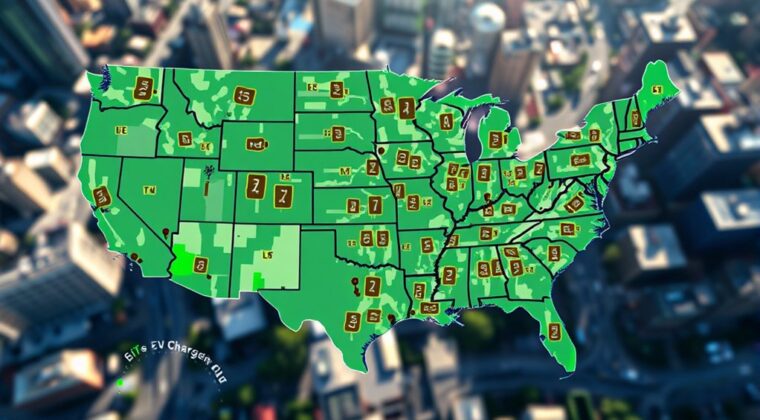
EV charging station density varies widely across the U.S. Vermont tops the list with 215.9 public charging ports per 100,000 residents, easing range anxiety for owners. Massachusetts and California follow, but states like Louisiana and Alabama lag considerably, with only 18.5 and 2.0 ports, respectively. This disparity affects EV adoption and highlights the need for infrastructure improvement. Understanding these dynamics can provide insights into the future of EV charging availability and its impact on ownership experience.
Why Charging Density Matters for EV Owners
When you consider owning an electric vehicle (EV), charging density greatly impacts your experience. High charging density states, like Vermont and Massachusetts, boast 215.9 and 133 public charging ports per 100,000 residents, respectively. This accessibility notably reduces range anxiety for EV owners, making your shift to electric driving seamless.
In contrast, states with low densities, such as Louisiana and Alabama, offer only 18.5 and 2.0 ports per 100,000 residents, complicating your ability to find reliable charging options.
The national average of about 72.5 ports shows the disparity in charging infrastructure across the U.S. States like California, with 64,673 total ports, demonstrate a strong commitment to EV adoption through robust infrastructure investment.
Ultimately, higher charging density fosters a supportive environment for EV owners, empowering you to embrace electric mobility without fear of running out of power.
Top 10 States for EV Charging Density
High charging density directly influences the experience for EV owners, making it essential to identify which states offer the best infrastructure. Vermont tops the list with an impressive 215.9 public EV charging ports per 100,000 residents, ensuring accessibility for electric vehicle users. Massachusetts follows closely, benefiting from its own high density and commitment to sustainable transportation.
California, despite having the most total charging ports at 64,673, ranks third with 89 ports per 100,000 residents. Maryland, showcasing a robust commitment to EV infrastructure, comes in fourth with 59 ports per 100,000 residents.
Significantly, the national weighted average sits at around 72.5 ports per 100,000 residents, emphasizing substantial disparities among states. Understanding these rankings helps you identify the top states that prioritize charging density, ultimately enhancing your EV experience and fostering a more liberated, eco-friendly lifestyle.
The 10 States With the Fewest Charging Ports
The ten states with the fewest EV charging ports highlight significant challenges for electric vehicle owners. Limited public access to charging infrastructure can hinder adoption and convenience for EV users. Below is a summary of states with low charging port density:
| State | Charging Ports per 100,000 Residents | EVs on the Road |
|---|---|---|
| Louisiana | 18.5 | 13,000 |
| Alabama | 2.0 | 10,000 |
| Florida | 1.6 | 500,000 |
| Mississippi | 5.0 | 4,900 |
| North Dakota | 0.2 | 1,300 |
| Kentucky | 2.5 | 30,000 |
| Idaho | 1.8 | 25,000 |
| Arkansas | 1.5 | 15,000 |
These statistics reveal a critical need for improved access to charging stations to support the growing number of electric vehicles in these states.
Key Factors Driving EV Charging Infrastructure Growth
As you explore the growth of EV charging infrastructure, you’ll notice several key factors at play.
Government incentives and policies greatly boost adoption rates, while technological advancements in charging speed enhance user convenience.
Public awareness campaigns further drive adoption, creating a feedback loop that supports ongoing infrastructure expansion.
Government Incentives and Policies
While various factors contribute to the growth of EV charging infrastructure, government incentives and policies play a crucial role in shaping consumer behavior and investment decisions.
States like California, Massachusetts, and Maryland lead with over 10 government incentives, including rebates and tax credits aimed at boosting EV adoption. With 46 states and Washington D.C. offering financial incentives, purchasing electric vehicles becomes more accessible.
California, for instance, accounts for about 35% of the nation’s EVs, thanks to its robust policies. Additionally, programs like NEVI funding aim to enhance EV infrastructure, although only 2% of these funds had been utilized as of January 2026.
Such significant incentives, including HOV lane exemptions, further incentivize EV adoption and charging port expansion.
Technological Advancements in Charging
Rapid advancements in charging technology are transforming the landscape of EV infrastructure, driving significant growth in availability and efficiency. With a 34.6% increase in public charging ports from 2024 to 2025, the U.S. is addressing heightened demand as the EV market expands. Major networks like Tesla are expanding their DC Fast Chargers to alleviate range anxiety for users. By 2035, we’ll need 42.2 million chargers to support an expected 78.5 million EVs, underscoring the urgency to invest in charging infrastructure.
| Charging Technology | Impact | Future Trends |
|---|---|---|
| DC Fast Chargers | Reduces wait times | Increased adoption rates |
| Level 2 Chargers | Widespread access | Home charging solutions |
| Wireless Charging | Convenience | Enhanced user experience |
Public Awareness and Adoption
Public awareness of electric vehicles (EVs) is a critical driver in the growth of charging infrastructure across the U.S.
With over 4.5 million EVs registered in 2025, a 26.7% increase in just one year, the demand for accessible charging networks is clear. States like California and Vermont exemplify this, boasting 64,673 and 215.9 public ports, respectively, making it easier for you to adopt EVs.
Government incentives for EVs, such as rebates and tax credits, further bolster adoption, particularly in states with over 10 incentives.
However, disparities exist; Maryland’s 59 ports per 100,000 residents contrasts sharply with Louisiana’s 18.5, illustrating how uneven infrastructure can hinder local adoption and perpetuate range anxiety.
Regional Insights: Geography and EV Charging Access
When you consider EV charging access, urban areas typically provide better infrastructure due to higher population densities.
For instance, Vermont’s high density of charging ports contrasts sharply with Louisiana’s low availability, highlighting how geography directly impacts access.
Understanding these regional differences helps identify gaps and opportunities for expanding EV infrastructure effectively.
Urban vs. Rural Access
While urban areas generally offer greater access to EV charging stations, the stark contrast with rural regions reveals significant disparities in infrastructure.
For instance, Vermont leads with 215.9 public charging ports per 100,000 residents, a figure bolstered by its urbanized areas. In contrast, Louisiana struggles with just 18.5 ports per 100,000, reflecting the challenges faced by rural areas.
The District of Columbia showcases extensive charging accessibility despite its small size, highlighting urban efficiency.
On the West Coast, states like California, Oregon, and Washington exemplify the correlation between urban development and higher EV registration, enhancing overall electric vehicle adoption.
These disparities emphasize the need for strategic infrastructure investments in rural locales to promote equitable access to charging stations.
Population Density Impact
Given the significant variations in population density across the U.S., the impact on EV charging station access becomes evident.
States like Vermont, with 215.9 ports per 100,000 residents, excel due to lower population, enhancing per capita density. Conversely, Louisiana struggles with only 18.5 ports per 100,000 residents, highlighting challenges in larger populations meeting EV infrastructure demands.
California balances a high total of 64,673 charging ports with a solid per capita density of 89, showcasing how vast states can effectively develop their charging network.
The District of Columbia exemplifies urban settings with dense networks that facilitate EV adoption.
Regional disparities persist, as West Coast states lead in access, while many Sun Belt states lag in per capita density despite substantial infrastructure.
How Charging Density Affects EV Adoption
As charging density increases in a state, it directly influences electric vehicle (EV) adoption rates among residents. States like Vermont, boasting 215.9 chargers per 100,000 residents, showcase how accessible infrastructure encourages potential buyers to opt for EVs.
In California, with 64,673 total ports, the state leads in EV registrations, accounting for 12.04% of all registered EVs, illustrating a clear correlation between charging availability and adoption rates.
Conversely, Louisiana’s low density of 18.5 ports per 100,000 residents reflects its struggle with EV adoption. The national average of approximately 72.5 ports per 100,000 residents serves as a critical benchmark; states below this threshold face challenges in increasing electric vehicle registrations.
Regions with robust charging networks, such as the West Coast, enjoy higher adoption rates, evidenced by Colorado and Oregon’s 9.47% and 5.33% EV presence on the roads, respectively.
Charging density undeniably shapes consumer choices and the future of EV adoption.
What’s Ahead for EV Charging?
With the surge in electric vehicle (EV) adoption, the future of EV charging infrastructure is at a significant juncture. The U.S. will need around 42.2 million chargers by 2035 to support an estimated 78.5 million EVs, emphasizing the urgent need for infrastructure expansion.
Currently, only 2% of the NEVI program funding has been utilized, highlighting a substantial gap in the investment and deployment of charging stations. As of April 2026, the nation boasts 79,554 EV charging stations, with a 26% increase in chargers since early 2025.
However, range anxiety and accessibility remain barriers to adoption, making the growth of DC Fast Chargers essential. Major networks like Tesla, EVgo, and Electrify America are critical for expanding charging infrastructure, yet uneven distribution across states complicates progress.
The Department of Energy‘s role in addressing these challenges will be key to meeting the growing demand for EV Chargers and ensuring a seamless shift to electric mobility.
Frequently Asked Questions
Which State Has the Most Electric Vehicle Charging Stations?
California has the most electric vehicle charging stations, showcasing significant EV infrastructure growth. Its diverse urban-rural distribution and incentives for installation enhance charging station accessibility, impacting adoption rates and shaping future trends in electric mobility.
What Is the 80% Rule for EV?
Imagine a world where charging your electric vehicle feels as easy as plugging in your phone. The 80% rule emphasizes home charging, integrating EV infrastructure, policy incentives, and renewable energy to enhance charging accessibility and ease range anxiety.
What State Has the Least Amount of EV Chargers?
Louisiana has the least amount of EV chargers, with significant geographic disparities in electric vehicle infrastructure. This limited charging station accessibility creates rural charging challenges, hindering urban EV adoption and reflecting state policy impacts on infrastructure development.
Who Has the Largest EV Charging Network in the US?
California has the largest EV charging network in the U.S., addressing EV infrastructure challenges through urban charging solutions and government incentives. However, rural accessibility issues and consumer adoption barriers remain, impacting future technology trends.
Conclusion
As the electric vehicle landscape evolves, the density of charging stations will play a pivotal role in shaping adoption rates across the U.S. Like roots nourishing a tree, robust infrastructure supports growth in EV ownership. States leading in charging density not only attract more EV drivers but also enhance their green credentials. To embrace a sustainable future, it’s essential to prioritize the expansion of charging networks—after all, the road ahead is electric, and the journey has just begun.