
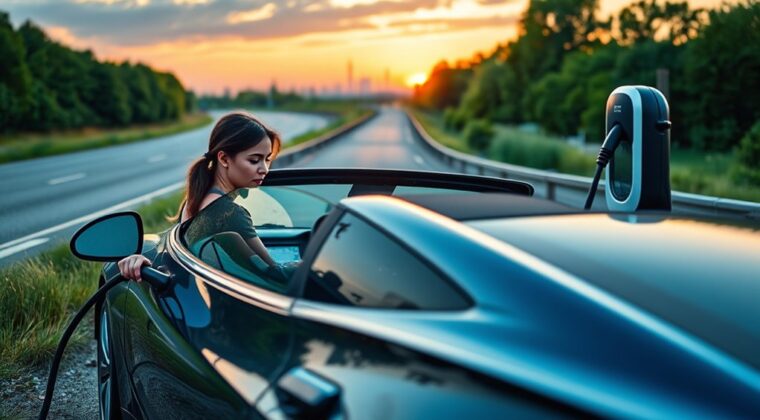
Range anxiety is the worry that your electric vehicle will run out of battery before you reach your destination or a working charger. It is common for new EV drivers, but it usually fades once you understand your real driving range, charging options, and backup plan. Modern EVs often cover normal daily driving with room to spare, and good route planning makes longer trips far less stressful.
Quick Answer
EV range anxiety is the fear of running out of battery before reaching a charger. You reduce it by knowing your real-world range, keeping a 10% to 20% battery buffer, charging at home when possible, and using your EV’s navigation or a charger app before longer trips.
Key Takeaways
- Most range anxiety comes from uncertainty, not from the EV’s actual daily range.
- EPA-estimated range is useful for comparison, but weather, speed, hills, tires, and cargo can change real-world range.
- For road trips, plan charging stops before you leave and aim to arrive at chargers with at least 10% to 20% battery remaining.
- Level 2 home or workplace charging is the biggest confidence booster for everyday EV driving.
At a Glance
| Time Required | 5 to 10 minutes for daily range planning; 15 to 30 minutes for a longer road trip route |
| Difficulty | Easy once you know your EV’s range estimate, charging speed, and nearby chargers |
| Tools Needed | Your EV’s navigation, a charger locator app, a tire-pressure gauge, and your charging cable or home charger |
| Cost | Planning is free; charging cost depends on your home electricity rate, public charging network, and charger speed |
What Is Range Anxiety and Why Does It Matter?
Range anxiety matters because it can make a practical EV feel harder to use than it really is. The worry often starts with questions like: “Will I make it home?” “Will the charger work?” or “What happens if the weather cuts my range?”
Those are fair questions. Early EVs had shorter ranges, and public charging was less common. Today, the picture is different. The U.S. Department of Energy’s Alternative Fuels Data Center lists tens of thousands of public EV charging locations, and the national charging network keeps expanding through federal and private investment.
As of July 8, 2026, the Alternative Fuels Data Center listed 81,155 public EV station locations and 252,884 public EV charging ports in the United States.
Range anxiety does not mean EVs are impractical. It means you need a new habit: checking battery percentage and charger access the way gas drivers check the fuel gauge and nearby stations. Once that habit becomes normal, most daily driving feels routine.
Understanding Electric Vehicle Ranges: What’s Realistic?
EV range is usually listed as an EPA-estimated number. That number helps you compare vehicles, but it is not a promise that every trip will match the sticker. Speed, temperature, hills, wind, tires, battery temperature, and cabin heating or cooling can all change your real range.
Many current EVs offer enough range for normal commuting, errands, school runs, and weekend driving. The 2017 National Household Travel Survey reported average daily person miles of travel at about 39 miles, which shows why even modest EV range can cover many daily routines.
| EV Example | EPA-Estimated Range Example | Why It Helps Reduce Range Anxiety |
|---|---|---|
| 2026 Nissan LEAF S+ | Up to 303 miles | Shows how compact EVs now offer far more range than early short-range models. |
| Tesla Model 3 Rear-Wheel Drive | Up to 363 miles | Long range and fast-route planning make highway trips easier. |
| Chevrolet Equinox EV FWD | Up to 319 miles | A mainstream electric SUV can cover most family driving without daily public charging. |
| Volkswagen ID.4 Pro | Up to 291 miles | A practical range target for drivers who want an electric crossover. |
Note: Do not compare EVs by range alone. A shorter-range EV with easy home charging may feel less stressful than a longer-range EV that you can only charge at public stations.
Key Factors Affecting Your EV’s Driving Range
Your EV’s dashboard range estimate changes because the car is constantly calculating how much energy you are using. These factors have the biggest effect:
- Speed: Highway driving uses more energy than lower-speed city driving because air resistance rises quickly at higher speeds.
- Cold weather: Cold batteries are less efficient, and cabin heat can use extra energy, especially in EVs without a heat pump.
- Hot weather: Air conditioning and battery cooling can reduce efficiency during extreme heat.
- Terrain: Hills, mountains, rough roads, wind, and rain can lower range.
- Driving style: Hard acceleration, late braking, and frequent high-speed passing use more battery.
- Tires: Low tire pressure and non-efficient tires add rolling resistance.
- Vehicle load: Extra passengers, cargo boxes, roof racks, trailers, and heavy tools increase energy use.
- Battery health: Range can decline slowly as the battery ages, though EV battery warranties often cover major capacity loss for a set time or mileage.
Warning: Do not plan a long trip that depends on arriving at a charger with 0% to 5% battery. Build in a 10% to 20% buffer, especially in cold weather, mountains, heavy traffic, or unfamiliar areas.
Tips to Reduce Your Range Anxiety as an EV Driver
The best way to reduce EV range anxiety is to turn the unknown into a simple routine. Use this step-by-step approach before daily driving and longer trips.
- Learn your real range. Track your battery percentage and miles for one normal week. Your own route is more useful than a general estimate.
- Start each day with a plan. If you charge at home, set a daily charge limit that fits your owner’s manual and driving needs.
- Know your nearby chargers. Save a few reliable chargers near home, work, school, and common destinations.
- Use your EV’s built-in route planner. Many EV navigation systems can estimate arrival battery and suggest charging stops.
- Check charger details before a road trip. Look at plug type, charger speed, network access, recent user reports, and whether multiple chargers are available.
- Precondition when plugged in. Heating or cooling the cabin before you unplug can save battery on the road.
- Drive smoothly. Moderate speed, gentle acceleration, and regenerative braking help stretch range.
- Keep a backup charger in mind. On longer trips, choose a second nearby charger in case your first stop is busy or offline.
Pro Tip: On road trips, it is often faster to charge from about 20% to 80% than to wait for a full 100% charge. Charging usually slows as the battery gets closer to full.
How Charging Stations Help Ease Your Worries
Charging stations reduce range anxiety because they give you more options. The key is knowing which charging level fits the situation.
| Charging Type | Best Use | What to Expect |
|---|---|---|
| Level 1 | Low-mileage drivers, overnight top-ups, emergency backup | The Alternative Fuels Data Center estimates about 5 miles of range per hour of charging. |
| Level 2 | Home, workplace, hotels, apartments, shopping centers | Often adds about 25 miles of range per hour, making it the most useful everyday charging option. |
| DC Fast Charging | Road trips and quick public charging stops | Charging speed varies, but many EVs can add roughly 100 to 200+ miles in about 30 minutes under good conditions. |
Use trusted tools before you leave. The AFDC Station Locator, your vehicle’s built-in navigation, A Better Routeplanner, and PlugShare can help you find chargers and plan stops.
Public charging is also being expanded through the National Electric Vehicle Infrastructure program. The Federal Highway Administration describes NEVI as a $5 billion program for EV charging infrastructure across fiscal years 2022 through 2026.
What to Do If Your Estimated Range Drops Fast
If your range estimate falls faster than expected, stay calm and reduce energy use before the battery gets too low.
- Slow down safely. Reducing highway speed can make a noticeable difference.
- Use Eco mode. It can soften acceleration and reduce climate-control demand.
- Adjust climate settings. Use seat heaters if available, lower fan speed, and avoid excessive defrost once the windshield is clear.
- Remove unnecessary drag. Roof boxes, open windows at highway speed, and heavy cargo can reduce efficiency.
- Navigate to a charger early. Do not wait until the battery is critically low if a reliable charger is nearby.
- Call roadside assistance if needed. Many insurers, automakers, and EV networks offer towing or charging support.
Note: Your EV’s range display is an estimate, not a fixed number. It can change quickly after a route change, temperature shift, climb, or stretch of fast highway driving.
Essential Tools to Alleviate EV Range Anxiety for Fleet Managers
Fleet managers face a different version of range anxiety. The risk is not just one driver feeling nervous; it is downtime, missed routes, charger bottlenecks, and vehicles returning with too little battery for the next shift.
An Electric Vehicle Suitability Assessment can help you match the right EV to the right route. Instead of replacing every gas vehicle with the same EV, compare route length, payload, idle time, driver schedule, charging window, climate, and depot access.
| Fleet Tool | How It Reduces Range Anxiety |
|---|---|
| Telematics | Tracks route length, energy use, idle time, driver behavior, and charging patterns. |
| Depot charging plan | Ensures vehicles are charged in the right order before their next route. |
| Charging redundancy | Reduces the risk that one failed charger disrupts the whole fleet. |
| Driver training | Teaches smoother driving, proper preconditioning, route planning, and charger reporting. |
| State-of-charge policy | Sets minimum return and departure battery levels so vehicles are ready for the next job. |
For fleets, the best range-anxiety fix is predictability. When routes, charging windows, and backup chargers are planned ahead, EVs can replace internal combustion vehicles with fewer surprises.
Frequently Asked Questions
How do I get over EV range anxiety?
Start by learning your real daily range, not just the EPA number. Charge at home or work when possible, save reliable nearby chargers, and plan longer routes before you leave. After a few weeks of routine driving, most EV owners become more confident because they know how much battery their normal trips actually use.
What is range anxiety related to electric vehicles?
EV range anxiety is the fear that your battery will run out before you reach your destination or a charger. It is related to driving range, charging speed, charger availability, weather, route planning, and how familiar you are with your vehicle’s energy use.
How much battery buffer should I keep?
For everyday driving, keep enough battery to handle a detour, traffic, or an unexpected errand. For road trips, try to arrive at charging stops with at least 10% to 20% battery remaining. Use a larger buffer in cold weather, mountains, rural areas, or places with limited chargers.
Is Level 1 charging enough for an EV?
Level 1 charging can work if you drive short distances and can plug in for many hours. It is slow, so Level 2 charging is better for most full-time EV drivers. If your daily driving is light, Level 1 may still cover your routine with occasional public charging for longer trips.
What is the most stolen EV?
The “most stolen EV” can change by region, model year, and data source, so it is not a useful range-anxiety question. EVs are generally not the top theft targets compared with many gas vehicles, but you should still lock the car, use built-in tracking features, park in well-lit areas, and keep key fobs secure.
How do I protect myself from EMF in my electric car?
For normal EV use, follow the vehicle manufacturer’s safety instructions rather than buying aftermarket EMF shielding products. Do not modify wiring, battery components, seats, airbags, or charging hardware. If you have an implanted medical device, ask your doctor and device manufacturer about any vehicle or charger precautions.
Does DC fast charging hurt the battery?
Modern EVs are designed to use DC fast charging, especially on road trips. Still, battery heat, very high state of charge, and frequent fast charging can affect long-term battery health. For everyday use, follow your owner’s manual and use Level 2 charging when it fits your routine.
Conclusion
EV range anxiety is manageable when you stop guessing and start planning. Learn your real-world range, keep a sensible battery buffer, use home or workplace charging when possible, and plan longer trips with reliable charging stops. Once you understand how your EV responds to weather, speed, and route conditions, driving electric becomes much less stressful and far more predictable.
Sources
- U.S. Department of Energy Alternative Fuels Data Center: Electric Vehicle Charging Stations — charging levels, charging speed ranges, and home/public charging basics
- U.S. Department of Energy Alternative Fuels Data Center: Alternative Fueling Station Counts by State — current U.S. public EV station and charging port counts
- Federal Highway Administration: NEVI Program Guidance — federal EV charging infrastructure program details
- National Household Travel Survey: 2017 Summary of Travel Trends — U.S. daily travel context
- Volkswagen ID.4 Official Page — ID.4 EPA-estimated range and battery warranty information
- Tesla Model 3 Official Page — Model 3 range and charging specifications