Choosing between a smart EV charger and a dumb EV charger comes down to how much control you want over home charging. A dumb charger is the simpler choice: plug in, charge, and skip the app. A smart charger costs more, but it can help with scheduling, energy tracking, load management, solar integration, and some utility programs. The best option depends on your vehicle, electrical panel, utility rates, budget, and whether you want your charger to stay useful as your EV needs grow.
Quick Answer
Choose a dumb EV charger if you only need reliable overnight charging for one vehicle and your electricity rate stays the same all day. Choose a smart EV charger if you want app control, off-peak scheduling, energy-use reports, solar charging, multiple-EV load sharing, or access to utility programs.
Key Takeaways
- A dumb EV charger is usually cheaper, simpler, and less dependent on Wi-Fi, apps, or software updates.
- A smart EV charger adds scheduling, remote control, energy tracking, load management, and possible utility-program support.
- Smart features do not automatically make charging faster. Charging speed depends on the charger output, circuit size, and your EV’s onboard AC charging limit.
- For safety, buy a certified charger and have a licensed electrician confirm your panel, wiring, breaker, outlet, and installation method.
- Check local utility rebates and rate plans before buying because some programs require a connected or ENERGY STAR certified charger.
What Is a Dumb EV Charger?
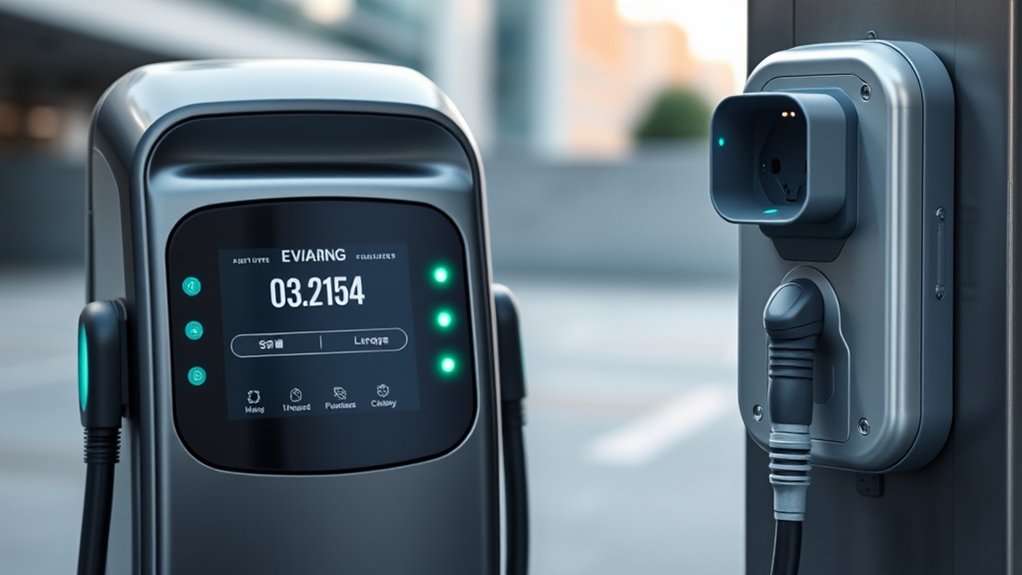
A dumb EV charger is a basic electric vehicle supply equipment unit, often called an EVSE, that sends power to your vehicle without internet features. You plug in the cable, the car and charger complete their safety handshake, and charging begins. There is no app, cloud account, usage dashboard, Wi-Fi setup, or remote start button.
This makes a dumb Level 2 charger appealing if your charging routine is simple. For example, you drive during the day, park at home at night, plug in before bed, and unplug in the morning. If your utility rate does not change by time of day, you may not need smart scheduling to save money.
Dumb chargers are also less dependent on software. If your Wi-Fi goes down, your app stops working, or a charging network has an outage, a basic non-networked charger can still do its main job as long as the electrical circuit and vehicle are working correctly.
Note: The wall unit is often called a charger, but with AC Level 1 and Level 2 home charging, the vehicle’s onboard charger converts AC power to DC power for the battery. The wall unit supplies and controls power safely.
Smart EV Chargers: Key Features and Benefits
A smart EV charger is a connected charger that usually works through Wi-Fi, Bluetooth, cellular service, Ethernet, or a linked app. It can still charge your car like a basic charger, but it also gives you more control over when and how charging happens.
Common smart charger features include:
- Remote monitoring: Check charging status from your phone.
- Scheduling: Set charging to start during cheaper off-peak hours if your utility offers time-of-use rates.
- Energy tracking: View how many kilowatt-hours your EV uses at home.
- Load management: Reduce output when your home, garage, or shared property has limited electrical capacity.
- Multiple-EV support: Share available power between two or more vehicles.
- Solar or home battery integration: Some models can prioritize excess solar power or coordinate with a home energy system.
- Access control: Lock the charger, restrict users, or track charging by driver in a shared location.
- Software updates: Receive feature and security updates from the manufacturer.
ENERGY STAR notes that some connected EV charger models allow remote power monitoring and control of the charging state, and some may help households or property managers participate in utility savings programs.
Pro Tip: Before paying extra for smart features, check your utility’s EV rate plan. A smart charger has the most value when it can actually shift charging to cheaper hours or qualify for a local incentive.
Smart vs Dumb EV Chargers: Key Differences
The biggest difference is control. A dumb charger focuses on reliable plug-and-charge operation. A smart charger adds data, automation, and communication.
| Feature | Dumb EV Charger | Smart EV Charger |
|---|---|---|
| Basic charging | Yes | Yes |
| App control | No | Usually yes |
| Off-peak scheduling | Usually handled by the car, if available | Usually built into the charger app |
| Energy reports | No | Yes, on many models |
| Load sharing | Limited or none | Available on some models |
| Wi-Fi dependence | None for normal operation | Needed for app features |
| Best fit | Simple home charging for one EV | Variable rates, multiple EVs, solar, shared charging, or energy tracking |
If you only need to refill one EV overnight, a dumb charger may be enough. If you want to control charging around electricity prices, panel limits, solar production, or multiple drivers, a smart charger is usually the better long-term choice.
Understanding the Costs of Smart vs Dumb EV Chargers
Dumb chargers usually cost less because they have fewer electronics, no cloud service, and fewer software features. Smart chargers often cost more because they include communication hardware, apps, data reporting, load-control features, and sometimes a connected service platform.
Do not compare hardware price alone. The installed cost can change more than the charger price itself. Your total cost may depend on:
- Distance from the electrical panel to the parking spot
- Whether you need a new 240-volt circuit
- Whether your panel has enough capacity
- Whether the charger is hardwired or plug-in
- Permit and inspection requirements in your area
- Outdoor rating, pedestal mounting, trenching, or conduit needs
- Whether a utility rebate requires a specific charger model
Check local programs before buying. The U.S. Department of Energy’s Alternative Fuels Data Center tracks utility incentives, and ENERGY STAR has a rebate finder for certified products. For federal tax questions, review the IRS Alternative Fuel Vehicle Refueling Property Credit because eligibility depends on placed-in-service date, location, and other rules.
Note: Some rebates require a networked, ENERGY STAR certified, or utility-approved charger. Buying a charger first and checking incentives later can cost you a rebate.
Charging Speed: What Smart Features Do and Do Not Change
A smart charger does not automatically charge faster than a dumb charger. Charging speed depends mainly on the charger’s output, the circuit size, and your vehicle’s maximum AC charging rate.
For home charging, most shoppers compare Level 1 and Level 2 charging. ENERGY STAR explains that Level 1 charging uses a standard 120-volt outlet and commonly adds about 2 to 5 miles of range per hour. Level 2 charging uses 240 volts and commonly adds about 10 to 20 miles of range per hour, with higher-output circuits able to charge faster.
That means a 48-amp Level 2 charger can be faster than a 32-amp Level 2 charger if your EV can accept that power and your electrical system supports it. But if two chargers have the same output, the smart one is not faster simply because it has an app.
When to Choose a Dumb EV Charger
A dumb EV charger makes sense when your setup is simple and predictable. It is the no-frills option for drivers who care most about reliability and lower upfront cost.
Predictable Charging Needs
Choose a dumb charger if you usually charge at the same time, drive a similar distance each day, and do not need detailed energy reports. Many EVs already let you set basic charging schedules from the vehicle’s own screen or app, so a second smart app may be unnecessary.
A dumb charger can be especially practical if you have one EV, one dedicated parking spot, and a utility plan with flat electricity pricing.
Budget Constraints
If your budget is tight, a dumb charger can leave more money for the installation itself. That matters because a safe 240-volt setup may require new wiring, a breaker, conduit, a weather-rated enclosure, or panel work.
You should not save money by buying an uncertified charger or skipping proper electrical work. The safer budget choice is a basic certified charger installed correctly.
The Value of Smart EV Chargers
A smart EV charger becomes more valuable when electricity prices, vehicle needs, or household loads change. The extra features can help you avoid charging at the wrong time or overloading a limited electrical system.
Smart chargers are most useful when you need one or more of these features:
- Time-of-use scheduling: Charge when electricity is cheaper, if your utility offers lower off-peak rates.
- Load management: Reduce charging output when your home is using heavy loads such as HVAC, an oven, a dryer, or another EV charger.
- Solar charging: Some chargers can coordinate with solar production so more of your EV energy comes from your roof instead of the grid.
- Shared charging: Apartments, condos, small businesses, and two-EV homes can track usage by driver.
- Energy records: Reports can help you separate vehicle charging from the rest of your home electric bill.
- Utility programs: Some utilities offer incentives for chargers that can communicate charging data or respond to demand-response events.
If you expect to add a second EV, install solar, move to a time-of-use rate plan, or share charging with another driver, a smart charger may be easier to justify.
Safety Features of EV Chargers: What to Look For
EV charging equipment handles continuous high electrical load, often for several hours. Safety should matter more than app features, cable color, or the lowest online price.
Look for these safety and installation basics:
- Safety certification: Choose equipment tested by a nationally recognized testing laboratory, such as UL or ETL listing. ENERGY STAR also notes that its certified chargers are safety-tested.
- Correct circuit size: The breaker, wire, outlet, and charger settings must match the charger’s continuous load.
- Licensed installation: Have a licensed electrician evaluate the panel, wiring, grounding, breaker, and installation location.
- Weather rating: Outdoor chargers should be rated for outdoor use and mounted according to the manufacturer’s instructions.
- Hardwired or heavy-duty outlet: Plug-in chargers need the correct receptacle and a high-quality installation. Hardwired units can be a cleaner choice for higher amperage or outdoor installs.
- Cable management: Keep the cord off the ground when possible to reduce tripping, abrasion, and connector damage.
- Access control: In shared or outdoor locations, smart access controls can help prevent unauthorized use.
Warning: Do not install a 240-volt EV charger on an undersized circuit or worn outlet. EV charging is a long-duration load, so weak wiring, loose receptacles, and incorrect breaker sizing can overheat. Use a licensed electrician and follow local code.
Compatibility: Connectors and Your Vehicle
Before choosing a charger, confirm three things: the connector your vehicle uses, the maximum AC charging rate your vehicle can accept, and the charger output your electrical system can support.
Many non-Tesla EVs in North America have used the J1772 connector for AC Level 1 and Level 2 charging. Tesla vehicles and many newer North American models use or are moving toward the NACS-style connector. Adapters may work in some cases, but the cleanest choice is a charger that matches your current vehicle and your likely next vehicle.
Also check your owner’s manual for the maximum AC charging rate. If your EV can only accept 7.2 kW on AC, installing a much larger Level 2 charger will not make that vehicle charge beyond its onboard limit. It may still help future vehicles, but it will not change the current vehicle’s ceiling.
How to Future-Proof Your EV Charging
Future-proofing is less about buying the fanciest charger and more about making smart installation choices. A well-planned circuit, safe wiring path, and compatible charger can serve you longer than an app feature you rarely use.
To future-proof your EV charging setup, consider:
- Panel capacity: Ask an electrician whether your panel can support the charger output you want.
- Higher-output wiring: If practical, wiring for a higher-capacity circuit may help later, even if you set the charger to a lower output now.
- Load management: Smart load sharing can avoid expensive panel upgrades in some homes or shared buildings.
- Connector strategy: Choose J1772, NACS, or a charger with replaceable cable options based on your vehicle plans.
- Outdoor durability: Weather rating, cable flexibility, and mounting location matter for long service life.
- Software support: If you buy smart, choose a brand with a clear update history and no required subscription for basic charging.
The best home EV charging setup is the one that safely matches your panel, your vehicle, your driving routine, and your utility rate plan.
Selecting the Right Charger for Your Electric Vehicle
Use your daily driving pattern first, not the marketing label on the charger. A simple charger can be excellent in the right home. A smart charger can be worth the upgrade when it solves a real problem.
Charging Needs Assessment
Start with your daily mileage. If you drive a short distance and plug in every night, almost any properly installed Level 2 charger may keep up. If you drive long distances, have a large battery, or need quick turnarounds between trips, charger output becomes more important.
Next, check your parking situation. A garage install near the panel is usually easier than a detached driveway, outdoor pedestal, apartment lot, or shared parking space.
Budget Considerations
Your real budget should include the charger, permit, wiring, breaker, labor, mounting hardware, and any panel work. A cheaper charger can become expensive if it needs a complicated install, and a pricier smart charger can become more affordable if it qualifies for a local utility rebate.
| Choose This | Best Situation | Watch Out For |
|---|---|---|
| Dumb Level 2 charger | One EV, flat electricity rate, simple overnight charging | No built-in energy reports or remote controls |
| Smart Level 2 charger | Time-of-use rates, utility programs, solar, multiple EVs, or usage tracking | Wi-Fi, app quality, privacy settings, and possible subscription limits |
| Higher-output hardwired charger | Long-range EV, future EV plans, or faster home charging needs | Panel capacity, code requirements, and vehicle AC charging limit |
Future-Proofing Your Investment
If you plan to keep your home charging setup for years, think about your next vehicle, not just your current one. A smart charger with load management can help if your household may add another EV. A properly sized circuit can reduce future rework. A charger with the right connector or adapter path can make daily charging easier as vehicle ports continue to shift.
Questions to Ask Before You Buy
Before choosing between smart and dumb EV chargers, answer these questions:
- Do I have time-of-use electricity rates? If yes, smart scheduling may save money.
- Does my EV already handle scheduling well? If yes, a dumb charger may be enough.
- Will I add a second EV? If yes, consider smart load sharing.
- Do I need energy reports for reimbursement or budgeting? If yes, choose smart.
- Is my Wi-Fi reliable where the charger will be mounted? If no, make sure smart features are not required for basic charging.
- Does my utility require a certain model for rebates? If yes, choose from the approved list.
- Will the charger be outdoors or shared? If yes, prioritize weather rating, access control, and durability.
Frequently Asked Questions
Can dumb chargers be upgraded to smart chargers later?
Usually, you replace the charger rather than upgrade the same unit. Some setups can add a smart circuit monitor or smart panel feature, but a basic dumb charger normally will not gain full app control, reporting, or utility-program support without being replaced.
Do smart chargers charge faster than dumb chargers?
Not by default. A smart charger only charges faster if it has a higher power output and your vehicle and electrical circuit can use that output. Smart features mainly help with timing, monitoring, load control, and energy management.
Are smart chargers compatible with all electric vehicles?
Many smart Level 2 chargers work with a wide range of EVs, but connector type matters. Check whether your vehicle uses J1772, NACS, or an adapter, and confirm the charger’s output does not exceed what your circuit and vehicle can support.
What happens during a power outage with a smart charger?
Most smart chargers stop when the home loses power and resume only when power returns, depending on the charger settings and vehicle settings. A normal smart charger does not power your home during an outage unless it is part of a compatible bidirectional charging system.
Do smart chargers require a monthly subscription fee?
Many home smart chargers do not require a subscription for basic use, but some advanced features may depend on the manufacturer’s app, cloud service, or network plan. Check this before buying, especially if you need reports, access control, or shared-property billing.
Is a dumb charger safer than a smart charger?
Safety depends more on certification, correct installation, circuit sizing, and product quality than on whether the charger is smart or dumb. A certified smart charger installed correctly is safer than an uncertified dumb charger installed poorly.
Can I use a smart charger without Wi-Fi?
Most smart chargers can still provide basic charging without Wi-Fi, but app control, energy reports, updates, and utility-program features may stop working. Confirm offline behavior with the manufacturer before installing the charger in a weak-signal area.
Conclusion
A dumb EV charger is the right choice when you want simple, reliable charging at the lowest practical cost. It works well for one EV, predictable overnight charging, and flat electricity rates. A smart EV charger is the better choice when you want scheduling, energy reports, remote control, load management, utility-program access, solar integration, or a setup that can adapt to more vehicles later.
Before you buy either one, check your vehicle’s connector, your EV’s maximum AC charging rate, your panel capacity, local permit rules, and available rebates. The best smart vs dumb EV charger decision is not about which label sounds better. It is about which charger safely fits your home, your driving routine, and your long-term charging needs.
Sources
- ENERGY STAR: Electric Vehicle Chargers — charging levels, certified charger guidance, standby energy, connected charger features, and safety testing.
- U.S. Department of Energy AFDC: Electricity — EV and charging infrastructure background.
- U.S. Department of Energy AFDC: Utility Incentives — utility incentives for alternative fuel vehicles and related infrastructure.
- U.S. Department of Energy AFDC: Alternative Fueling Station Locator — public charging station location resource.
- IRS: Alternative Fuel Vehicle Refueling Property Credit — federal tax-credit eligibility, placed-in-service dates, and qualifying location rules.