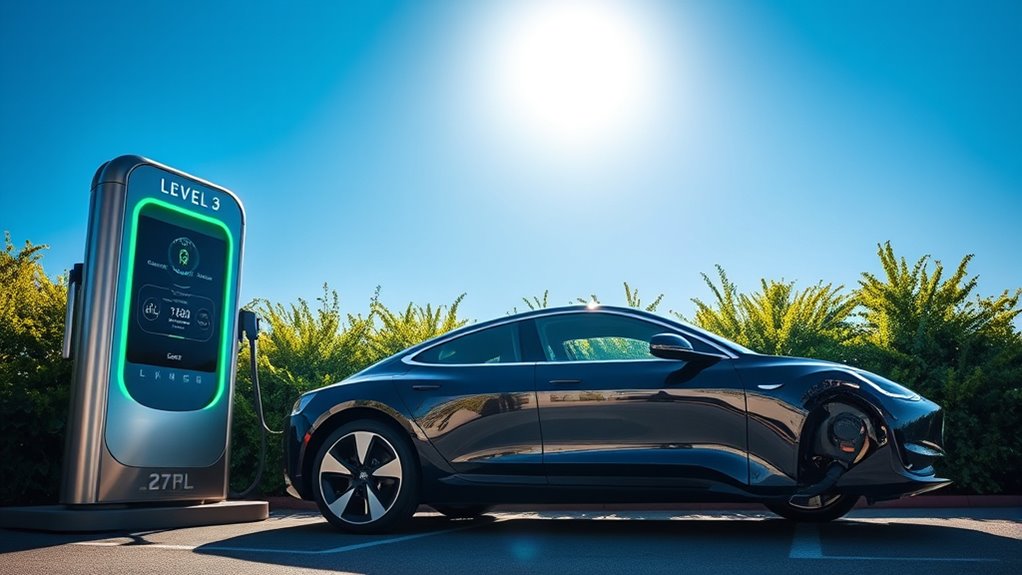
Level 3 charging, more accurately called DC fast charging, is the fastest common way to recharge an electric vehicle on the road. It is built for highway stops, road trips, ride-share use, and urgent top-ups, not routine overnight charging at home. The right charging speed depends on your EV, the charger, the connector, battery temperature, and how full the battery already is.
Quick Answer
Level 3 charging sends high-power DC electricity straight to your EV battery, usually adding about 100 to 200+ miles of range in roughly 30 minutes when the car and charger support it. It is best for travel, not daily home charging, because it needs commercial-grade power and can add more battery stress than slower charging.
Key Takeaways
- Level 3 charging is DC fast charging, the high-speed public charging used most often on road trips.
- A powerful charger does not guarantee maximum speed. Your EV’s battery, connector, temperature, and charge level set the real limit.
- Charging is usually fastest at a lower state of charge and slows as the battery approaches 80% or more.
- Common North American DC fast-charge connectors include CCS, CHAdeMO, and SAE J3400, which is based on Tesla’s NACS connector.
- Use DC fast charging when you need speed, but rely on Level 1 or Level 2 charging for most routine daily charging when possible.
What Is Level 3 Charging and Its Role in EV Travel?
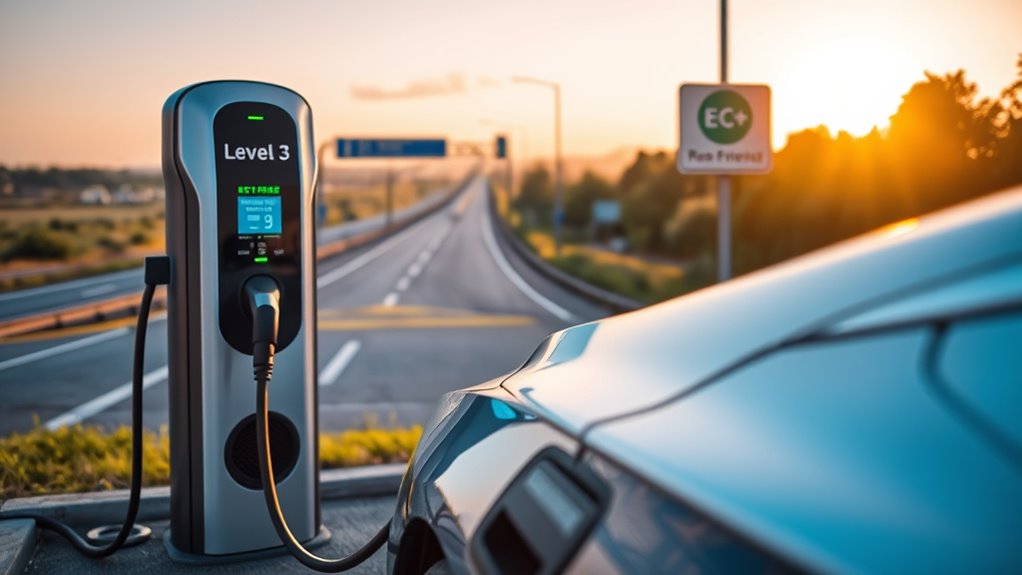
Level 3 charging is the common consumer name for DC fast charging. Unlike Level 1 and Level 2 charging, which send AC power to the vehicle’s onboard charger, DC fast charging converts AC power to DC inside the charging station and sends that DC power directly to the battery.
That is why a DC fast charger can add range much faster than a home outlet or most Level 2 stations. The U.S. Department of Energy estimates DC fast charging can add roughly 100 to 200+ miles of range in about 30 minutes, though the real number depends on your EV and conditions.
A 350 kW charger only helps if your EV can accept that much power. The vehicle, not just the station, controls the final charging speed.
You will usually find Level 3 chargers at highway plazas, travel centers, shopping centers, urban charging hubs, and some fleet locations. They are ideal when you need to keep moving, but they are not the best everyday charging option for most drivers.
Note: “Level 3” is widely used by drivers and charging networks, but “DC fast charging” is the clearer technical term because modern standards often classify AC and DC charging separately.
Factors That Affect Level 3 Charging Speed
Level 3 charging speed is not fixed. Two EVs plugged into the same charger can charge at very different speeds. The biggest factors are battery state of charge, battery temperature, battery size, the EV’s maximum DC fast-charge rate, and the charger’s available power.
Battery Size and Vehicle Limits
Battery size matters, but it does not tell the whole story. A larger battery may accept more power, but only if the EV’s battery management system allows it. Some smaller EVs may be limited to 50 to 100 kW, while many newer long-range EVs can accept 150 to 250 kW or more under the right conditions.
Your EV’s manual or charging screen is the best place to check its maximum DC fast-charge rate. If your car can accept 125 kW, plugging into a 350 kW station will not make it charge at 350 kW.
Battery Temperature and Weather
Temperature can make a major difference. A cold battery may charge slowly until it warms up. A very hot battery may also reduce charging speed to protect itself. Many EVs can precondition the battery when you navigate to a fast charger, warming or cooling the pack before you arrive.
Pro Tip: On a road trip, use your EV’s built-in navigation to route to the fast charger. Many EVs only precondition the battery automatically when the charger is set as a navigation destination.
Charger Power Output
Public DC fast chargers commonly range from about 50 kW to 350 kW, while some newer and commercial systems can go higher. The Department of Energy notes that installed DC fast-charging equipment can reach up to 500 kW, but many passenger EVs on the road cannot accept that full rate.
Several details affect the final speed you see on the screen:
- State of charge: Charging is usually fastest when the battery is low and slows as it fills.
- Battery temperature: Cold or overheated batteries may charge more slowly.
- Vehicle limit: Your EV has a maximum DC charging rate set by its design and software.
- Charger rating: A 50 kW station is much slower than a 150 kW or 350 kW station when the vehicle can use the extra power.
- Power sharing: Some sites split available power between stalls when several vehicles are charging.
- Connector and adapter: The wrong connector, a limited adapter, or a non-compatible station can reduce speed or prevent charging.
Why Level 3 Charging Slows Near 80%
Fast charging is not a straight line. Most EVs charge quickly at lower battery levels, then reduce power as the battery fills. This is called the charging curve. The slowdown protects the battery from excess heat, voltage stress, and accelerated wear.
For road trips, the fastest plan is often to charge from about 10% to 80%, then continue driving. Charging from 80% to 100% can take much longer than expected because the car must taper the charging rate. Charge to 100% only when you need the extra range to reach the next stop or your destination.
Warning: Do not force repeated 100% DC fast charges unless your trip requires it or your vehicle manual recommends it for your battery type. Follow your EV’s owner manual for daily charge limits and long-trip guidance.
How Does Level 3 Charging Compare to Other Charging Levels?
Level 3 charging is much faster than Level 1 or Level 2, but each charging level has a different role. Slower charging is usually better for daily use, while DC fast charging is best when time matters.
| Charging Type | Typical Use | Typical Speed |
| Level 1 AC | Standard 120 V outlet, backup or low-mileage daily charging | About 5 miles of range per hour |
| Level 2 AC | Home, workplace, hotel, apartment, and destination charging | Often around 25 miles of range per hour, depending on power output |
| Level 3 / DC Fast Charging | Road trips, urgent top-ups, fleet use, and high-traffic public charging | About 100 to 200+ miles in 30 minutes when conditions allow |
Level 2 charging remains the best fit for most daily driving because it can refill many EVs overnight at home or while parked at work. Level 3 charging is the better choice when you are traveling beyond your normal range or need to get back on the road quickly.
Where Can You Find Level 3 Charging Stations?
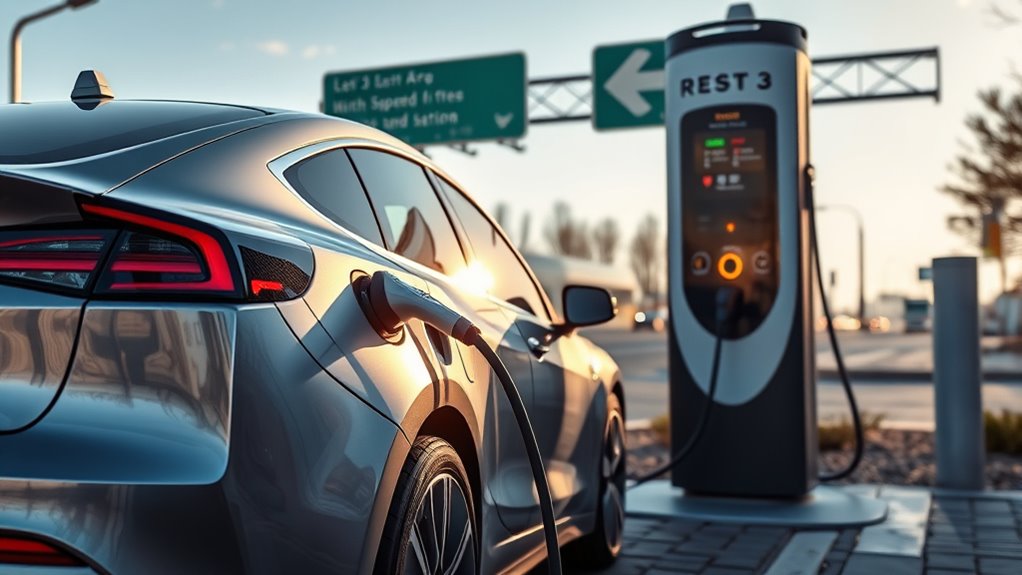
You can find Level 3 charging stations in places built around short stops and high traffic. Common locations include:
- Highway rest areas and travel plazas
- Gas stations and convenience stores
- Shopping centers and grocery stores
- Airports and parking garages
- Urban fast-charging hubs
- Fleet depots and ride-share charging sites
Use your EV’s built-in navigation, the charging network’s app, or the Alternative Fuels Data Center station locator to filter by connector type, power level, network, availability, and location. Live status is useful because a charger may be occupied, offline, blocked, or power-limited.
Federal highway charging standards are also shaping new U.S. corridor sites. Under the National Electric Vehicle Infrastructure standards, qualifying corridor DC fast-charging stations must include at least four network-connected DCFC ports and support up to 150 kW per port when requested by the EV.
Note: Always choose a backup charger on long trips, especially in rural areas or cold weather. Public fast chargers can be busy, temporarily down, or limited by maintenance and power-sharing conditions.
Common Connector Types for Level 3 Charging Stations
Connector compatibility is one of the most important parts of Level 3 charging. The most common DC fast-charging connectors in North America are CCS, CHAdeMO, and SAE J3400, which is based on Tesla’s North American Charging Standard connector.
CCS, also called the Combined Charging System, has been common on many non-Tesla EVs in North America. It combines AC charging pins with two larger DC pins for fast charging.
CHAdeMO is an older DC fast-charge connector used mainly by some Japanese EVs, especially older Nissan Leaf models and some plug-in hybrids. It is still present at some stations, but support in North America is becoming less common on new EVs.
SAE J3400, based on Tesla’s NACS connector, is becoming a major North American connector standard. The Joint Office of Energy and Transportation explains that standardizing J3400 allows manufacturers and charging suppliers to use and deploy the connector across North America.
Adapters can help during the transition, but they do not make every charger work with every EV. Some adapters are limited by vehicle software, charger network access, current limits, or automaker approval. Before relying on an adapter for a trip, confirm that your vehicle, adapter, and charging network all support the session.
Understanding the Costs of Level 3 Charging
Level 3 charging costs more than home charging in most cases because the equipment, power delivery, utility demand, maintenance, networking, and site costs are much higher. Public pricing can vary by network, location, time of day, membership plan, charger speed, and local rules.
Installation Expenses Overview
Installing a DC fast-charging site is a commercial infrastructure project. It may require high-voltage electrical service, utility upgrades, transformers, switchgear, trenching, permits, payment systems, networking, signage, lighting, parking work, and ongoing maintenance.
That is why Level 3 charging is usually found at public and commercial sites rather than homes. A normal residential electrical panel is not designed for the power demand of a DC fast charger.
Warning: Level 3 charging equipment is not a DIY home project. Any DC fast-charging installation should be designed, permitted, installed, and maintained by qualified professionals working with the utility and local code officials.
Pricing Models Explained
Public DC fast charging may be billed in several ways:
- Per kWh: You pay for the energy delivered to the vehicle.
- Per minute: You pay for the time connected or actively charging, often where energy-based billing rules differ.
- Session fee: Some networks or sites add a flat fee to start a charging session.
- Membership pricing: A monthly plan may lower the per-kWh or per-minute rate.
- Idle or congestion fees: Some sites charge extra if you stay plugged in after charging is complete or continue occupying a busy fast charger past a set charge level.
To estimate the cost before you plug in, check the app or screen for the price, idle-fee rules, and any parking charges. For road trips, compare the cost of charging to the value of your time. A faster charger may cost more but save enough time to be worth it.
Is Level 3 Charging Safe for My EV?
Level 3 charging is safe when your EV, connector, adapter, and charging station are compatible and used correctly. Modern EVs use a battery management system to control charging power, monitor temperature, and reduce speed when needed.
That said, frequent high-power charging can add more battery stress than slower Level 1 or Level 2 charging, especially in extreme heat, extreme cold, or at very high states of charge. This does not mean you should avoid DC fast charging. It means you should use it for the job it does best: fast travel charging.
- Use Level 2 charging for most routine daily charging when available.
- Use DC fast charging for road trips, busy days, and urgent top-ups.
- Precondition the battery before fast charging when your EV supports it.
- Stop around 80% on busy road-trip stops unless you need more range.
- Follow your automaker’s battery-care guidance for daily and long-trip charging.
How to Use a Level 3 Charger
Using a DC fast charger is simple once you know the steps, but the exact process varies by network and vehicle.
- Check compatibility: Confirm the station has the right connector for your EV or an approved adapter.
- Navigate to the charger: Use the car’s navigation if battery preconditioning is available.
- Park correctly: Line up the charge port with the cable without stretching or twisting it.
- Start the session: Use Plug & Charge, a network app, credit card, RFID card, or the charger screen, depending on the station.
- Watch the charge curve: Expect fast charging at first, then a slowdown as the battery fills.
- Move when finished: Unplug and move the vehicle so the next driver can charge.
Pro Tip: On a busy fast charger, charging from 20% to 80% and leaving is often faster for everyone than waiting for the last 20%.
Level 3 Charging Etiquette
Good charging etiquette keeps public stations useful for everyone. Because Level 3 chargers are built for quick turnover, avoid using them like parking spaces.
- Do not park in a charging stall unless you are actively charging.
- Move the vehicle soon after the session ends.
- Avoid charging to 100% at a busy station unless you need it to reach the next stop.
- Do not unplug another vehicle unless the driver has clearly allowed it.
- Report broken chargers in the app so the network can repair them.
- Keep the cable off the ground when you are finished if the station design allows it.
Frequently Asked Questions
How fast is Level 3 charging?
Level 3 charging can add about 100 to 200+ miles of range in around 30 minutes when the EV, charger, connector, battery temperature, and battery state of charge all support fast charging. Some sessions are slower, especially above 80% charge or in cold weather.
What is the key feature of a Level 3 DC charger?
The key feature is that it sends DC power directly to the EV battery instead of sending AC power through the vehicle’s onboard charger. This allows much higher charging power and much shorter stops compared with Level 1 or Level 2 charging.
How does Level 3 charging work?
The charging station converts grid AC power into DC power and communicates with the EV’s battery management system. The vehicle then requests the amount of power it can safely accept, and the charger adjusts output during the session.
How long does it take a Level 3 DC fast charger to reach 80%?
Many modern EVs can charge from about 10% to 80% in roughly 15 to 55 minutes, but the exact time depends on battery size, charging curve, temperature, charger power, and the EV’s maximum DC fast-charge rate.
Can I install a Level 3 charger at home?
For nearly all homes, no. Level 3 chargers need commercial-grade electrical service, specialized equipment, utility coordination, and professional installation. Most EV owners use Level 1 or Level 2 charging at home and save DC fast charging for travel.
Does every EV support Level 3 charging?
No. Most modern battery-electric vehicles support some form of DC fast charging, but some plug-in hybrids and older EVs do not. Even among EVs that support it, maximum charging speed and connector type vary by model.
Conclusion
Level 3 charging makes electric road trips far easier because it can add a large amount of range during a short stop. It works best when you arrive with a warm battery, a lower state of charge, the right connector, and a charger your EV can actually use at high power.
For daily driving, Level 1 or Level 2 charging is usually cheaper, gentler, and more convenient. For long trips, urgent top-ups, and busy driving days, DC fast charging is the tool that keeps you moving. Plan your stops, check connector compatibility, watch for the 80% slowdown, and move your vehicle when charging is complete.
Sources
- U.S. Department of Energy Alternative Fuels Data Center: Electric Vehicle Charging Stations — charging levels, DC fast-charging range estimates, power output, and connector overview.
- Joint Office of Energy and Transportation: SAE J3400 Charging Connector — J3400/NACS standardization and connector transition details.
- Federal Register: National Electric Vehicle Infrastructure Standards and Requirements — NEVI port, power, connector, payment, and availability requirements.
- Reliability of Open Public Electric Vehicle Direct Current Fast Chargers — public DC fast-charger reliability findings and the need to check charger status.
- Degradation-Aware Fast-Charging of Li-Ion Batteries Using Joint Electrical and Thermal Model Predictive Control — battery-health and thermal-management context for high-power fast charging.