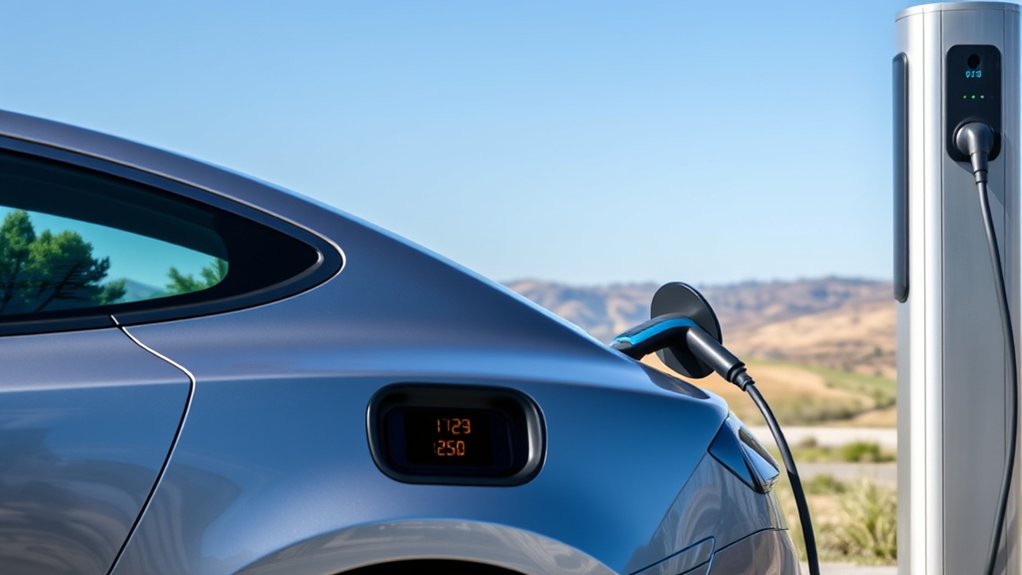
Charging an electric vehicle can take less than half an hour, overnight, or more than a day. The real time depends on your charger level, battery size, starting charge, target charge, temperature, and the maximum charging rate your EV can accept. For most daily driving, you usually do not need a full charge. You only need enough range for tomorrow.
Quick Answer
A full EV charge can take 20+ hours on Level 1, about 4 to 12 hours on many Level 2 home chargers, or roughly 20 to 45 minutes to reach about 80% on many DC fast chargers. The fastest estimate comes from dividing the energy you need by the charger’s usable power.
Key Takeaways
- Level 1 is slow but useful for short daily driving or emergency charging.
- Level 2 is the best home-charging choice for most EV owners because it can usually refill the battery overnight.
- DC fast charging is best for road trips, but charging usually slows after about 80%.
- Battery size, state of charge, weather, charger output, and your EV’s own charge limit all change the final time.
- To estimate charging time, calculate how many kWh you need to add, then divide by the charger’s usable kW.
At a Glance
| Time Required | About 1 minute to estimate; about 20 minutes to 2+ days to charge, depending on charger level and battery size. |
| Difficulty | Easy. You need only your battery size, current charge, target charge, and charger power. |
| Tools Needed | Vehicle app or dashboard, charger kW rating, battery capacity in kWh, and your electricity rate if you want a cost estimate. |
| Cost | Charging cost equals kWh added × your electricity price. Public DC fast charging often costs more than home charging. |
Understanding EV Charging Levels and Their Impact
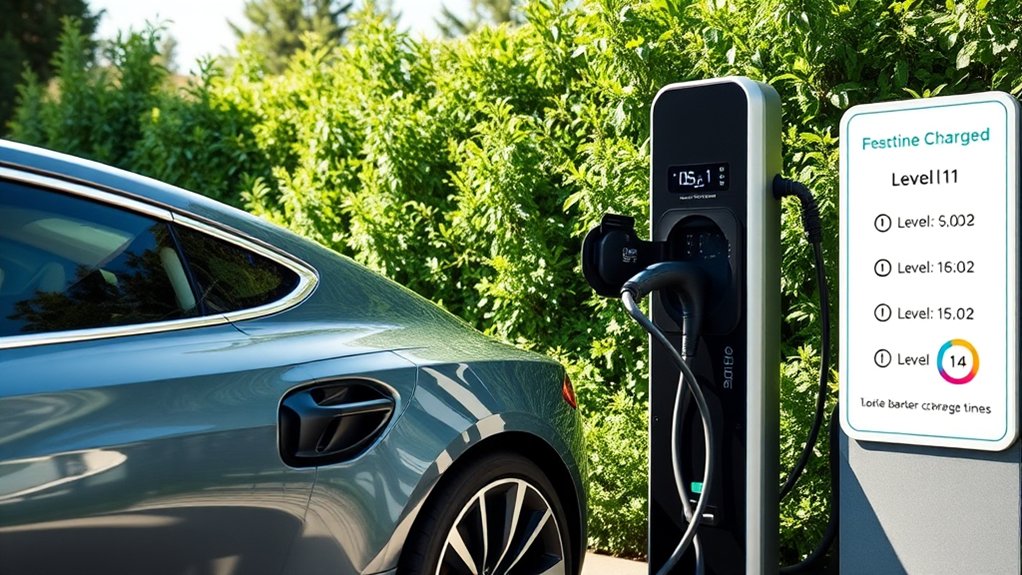
EV charging speed starts with the type of equipment you use. The U.S. Department of Energy’s Alternative Fuels Data Center groups common EV charging into AC Level 1, AC Level 2, and DC fast charging.
Level 1 charging uses a standard 120-volt household outlet. It is simple and usually requires no special hardware beyond the cordset that came with the vehicle, but it is slow. It works best when you drive short distances each day and can leave the car plugged in for many hours.
Level 2 charging uses 240 volts in many homes or 208 volts in many commercial settings. This is the common home upgrade because it can add much more range overnight than Level 1. Many public chargers at workplaces, hotels, parking garages, and shopping areas are also Level 2.
DC fast charging, often called Level 3 charging, bypasses the vehicle’s onboard AC charger and sends DC power directly to the battery. It is the fastest option and is mainly used at public stations along highways and busy travel routes.
Note: The charger’s advertised power is not always the power your EV receives. Your vehicle’s maximum charge rate, battery temperature, battery state of charge, and station condition can all limit charging speed.
Comparing Charging Times: Level 1, Level 2, and DC Fast Charging
Charging times vary, but the table below gives realistic planning ranges for most drivers.
| Charging Type | Typical Power | Range Added | Best Use |
| Level 1 | About 1.4 to 1.9 kW | About 5 miles per hour | Short commutes, backup charging, overnight top-ups |
| Level 2 | About 2.9 to 19.2 kW | Often around 25 miles per hour, depending on the car and charger | Home charging, workplace charging, overnight charging |
| DC Fast Charging | Up to 500 kW at some stations | About 100 to 200+ miles in 30 minutes on many EVs | Road trips and quick stops away from home |
A full charge is not always the best target. At home, charging to your daily limit is usually enough. On road trips, charging from about 10% to 80% is often faster than waiting for 100%, because many EVs slow charging as the battery fills.
For trip planning, the useful question is not “How long to 100%?” It is “How long until I have enough range for the next stop?”
Key Factors Affecting EV Charging Duration
Two EVs plugged into the same charger may finish at different times. That is normal. Charging time is affected by the charger, the vehicle, the battery, and the conditions around the car.
Charger Type Selection
The charger level sets the upper limit. A 120-volt Level 1 outlet is slow. A 240-volt Level 2 charger is much faster for home use. A DC fast charger is fastest, but only if your EV supports DC fast charging and the station connector fits your car.
Connector type also matters. In the United States, many EVs use CCS for DC fast charging, some older vehicles use CHAdeMO, and many newer vehicles are moving toward the J3400 connector, also known from Tesla’s North American Charging Standard design. Always check your vehicle manual or charging app before you depend on a specific station.
Battery Capacity Size
Battery capacity is measured in kilowatt-hours, or kWh. A small battery needs fewer kWh to fill than a large battery. That means a compact EV with a small battery may recharge much faster than a large truck or SUV when both use the same charger.
Think of the battery like a fuel tank. A bigger tank can hold more energy, so it usually takes longer to fill from empty. But it may also give you more driving range once charged.
State of Charge and the Charging Curve
State of charge, or SoC, is the battery percentage shown on your dashboard. Charging is usually fastest in the middle of the battery range and slower near full. This is why many trip planners suggest DC fast charging to about 80% instead of 100%.
The last 20% can take longer because the battery management system reduces power to protect the battery. That slowdown is called tapering. It is most noticeable on DC fast chargers.
Vehicle Maximum Charge Rate
Your EV has its own charging limit. If your car can accept only 7.2 kW on AC charging, plugging into an 11.5 kW Level 2 charger will not make the car charge at 11.5 kW. The vehicle will take only what it can safely use.
The same rule applies to DC fast charging. A 350 kW station does not guarantee 350 kW into your battery. Many EVs peak below that, and most hold peak speed only for part of the session.
Ambient Temperature Influence
Temperature affects battery performance. Cold weather can reduce EV range and make the battery less ready to accept high charging power. Hot weather can also affect efficiency because the vehicle may need to cool the battery and cabin.
For cold weather, the practical fix is simple: preheat the cabin while the car is still plugged in when your vehicle allows it. Some EVs also precondition the battery before a DC fast-charging stop when you navigate to the charger through the car’s built-in route planner.
Battery Size and Charging Duration
Battery size is one of the biggest reasons EV charging times vary. A 40 kWh battery and a 100 kWh battery will not take the same time to fill on the same charger.
For example, adding 30 kWh on a Level 2 charger is very different from adding 80 kWh. Even if both vehicles use the same charger, the larger energy amount takes longer.
Daily Top-Up vs. Full Charge
Most EV owners do not fully drain the battery before plugging in. They add back the miles they used that day. If your commute uses 12 kWh and your Level 2 charger gives the car about 7 kW, that daily top-up may take around 2 hours after charging losses.
A full charge from a very low battery takes much longer. That is why charging at home overnight is convenient: the car can refill while parked.
Optimal Charging Methods
Use Level 1 if your daily driving is light and you can plug in for long periods. Use Level 2 if your EV is your main vehicle, your commute is longer, or your battery is large. Use DC fast charging when you need a quick stop during a long trip.
Pro Tip: For road trips, it is often faster to make shorter DC fast-charging stops from a low state of charge to about 70% or 80% than to wait for one long charge to 100%.
How to Estimate Your EV Charging Time
You can estimate your EV charging time with a simple formula:
Charging time = kWh needed ÷ usable charging power
First, calculate how much energy you need to add:
kWh needed = battery capacity × (target charge % – current charge %) ÷ 100
Then divide that number by the charger power your vehicle can actually use.
Charging Time Example
Say your EV has a 75 kWh battery. It is at 20%, and you want to charge to 80%.
- Battery amount to add: 75 kWh × 60% = 45 kWh
- Usable Level 2 power: 7.2 kW
- Basic estimate: 45 ÷ 7.2 = 6.25 hours
- Real-world estimate with charging losses: about 6.7 to 7.4 hours
Charging losses vary by vehicle, charger, temperature, and battery condition. FuelEconomy.gov notes that battery charging efficiency can vary, so it is smart to add a small buffer when planning.
Charging Cost Example
Charging cost is also easy to estimate:
Charging cost = kWh added × electricity price per kWh
If you add 45 kWh and your home electricity rate is $0.16 per kWh, the energy cost is about $7.20 before taxes, fees, or charging losses. Public DC fast charging may cost more, so check the charging app before you plug in.
Tips for Maximizing Charging Efficiency
Small habits can make EV charging easier and more predictable.
- Charge at home when possible. Home Level 2 charging is usually the most convenient option for daily use.
- Use scheduled charging. Many EVs and smart chargers let you charge during lower-cost utility hours.
- Preheat while plugged in. In cold weather, warm the cabin before unplugging so the battery keeps more energy for driving.
- Avoid unnecessary 100% charges. Follow your vehicle manual for daily charge limits. Many EVs are happiest below 100% for routine use.
- Use DC fast charging for trips, not every ordinary stop. It saves time on the road, but home or Level 2 charging is gentler and often cheaper for daily charging.
- Check the station before arriving. Make sure the connector, speed, price, and stall availability match your vehicle.
Warning: Do not rely on damaged cords, loose outlets, or non-certified charging equipment. For Level 2 home charging, use safety-certified equipment and a qualified electrician when a new circuit, panel check, or permit is needed.
Level 1, Level 2, or DC Fast Charging: Which Should You Use?
The best charging method depends on how you drive.
Choose Level 1 If
- You drive only a few miles per day.
- You can plug in for long periods.
- You rent or cannot install Level 2 charging yet.
- You need a backup option.
Choose Level 2 If
- Your EV is your main vehicle.
- You want easy overnight charging.
- You have a longer commute.
- Your battery is too large for Level 1 to refill comfortably.
Choose DC Fast Charging If
- You are on a road trip.
- You need a quick charge away from home.
- Your EV supports DC fast charging.
- The charger has the right connector or a supported adapter.
Frequently Asked Questions
Can I charge my EV to 100% every night?
For many EVs, daily charging to 100% is not needed unless you are preparing for a long drive. Many automakers recommend a lower daily limit, often around 80% or 90%, but the right setting depends on your battery chemistry and owner’s manual. Some LFP-battery EVs may recommend regular 100% charges for calibration, so follow your vehicle’s guidance.
Is charging an EV cheaper than buying gas?
Charging at home is often cheaper per mile than buying gasoline, but it depends on your electricity rate, your EV’s efficiency, local gas prices, and whether you use public fast charging. To compare, multiply your EV’s kWh per 100 miles by your electricity price, then compare that cost with your gas vehicle’s cost per 100 miles.
What happens if you do not drive an electric car for 6 months?
An EV can sit for a long time, but you should store it the way the manufacturer recommends. Many EVs should be left with a moderate battery charge, parked in a reasonable temperature range, and checked or plugged in periodically. Do not store the car near 0% charge. Check the owner’s manual for the exact long-term storage setting.
What drains an EV battery the most?
High speed, hard acceleration, cabin heat, air conditioning, cold weather, low tire pressure, roof racks, heavy cargo, steep hills, and towing can all reduce EV range. In winter, cabin heating and battery temperature can have a major effect. Smooth driving and preheating while plugged in can help.
Why does charging slow down after 80%?
Charging slows near the top of the battery because the battery management system reduces power to protect the cells. This is normal. On road trips, stopping around 80% and moving to the next charger is often faster than waiting for 100%.
Can I install a Level 2 charger myself?
Use a qualified electrician unless you already have the correct outlet, circuit capacity, permits, and equipment for your charger. Level 2 charging is a continuous electrical load, so the circuit, wiring, breaker, outlet, and charger must match code and the vehicle’s requirements.
Conclusion
EV charging time depends on how much energy you need and how fast your car can accept power. Level 1 is slow but simple, Level 2 is the best daily home option for most drivers, and DC fast charging is the quickest choice for road trips. For the most useful estimate, ignore the idea of a full charge and calculate the kWh you actually need for your next drive. Once you know your battery size, target charge, and charger power, you can plan each stop with much less guesswork.
Sources
- U.S. Department of Energy Alternative Fuels Data Center: Electric Vehicle Charging Stations — charging levels, power ranges, connector types, and charging-time factors.
- U.S. Department of Energy Alternative Fuels Data Center: Charging Electric Vehicles at Home — home Level 1 and Level 2 charging, installation safety, electricity cost examples, and code considerations.
- FuelEconomy.gov: All-Electric Vehicles — EV recharge time, fast charging to 80%, battery life context, and charging efficiency notes.
- FuelEconomy.gov: Fuel Economy in Cold Weather — cold-weather effects on EV range, battery performance, and preheating tips.
- U.S. Department of Energy Alternative Fuels Data Center: Electric Vehicle Benefits and Considerations — battery life, fuel-cost context, and charging infrastructure availability.