
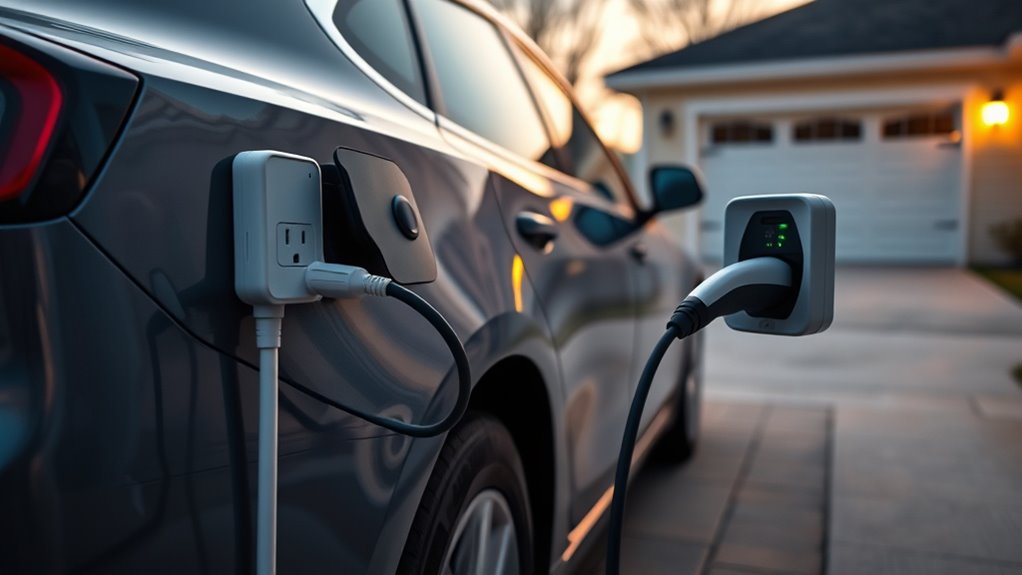
You can charge your EV from a standard 120-volt wall outlet using Level 1 charging. This is the slowest home charging method, but it works well for many low-mileage drivers who can plug in every night. Use the portable charging cord made for your vehicle, connect it to a sound outlet on a dedicated circuit, and check the plug and outlet for heat during long sessions. If you need faster daily recovery, compare Level 2 charging before your routine starts feeling limited.
Quick Answer
Yes, you can charge an EV from a standard 120V wall outlet with Level 1 charging. Expect roughly 3 to 5 miles of range per hour, depending on the vehicle and charging losses. Use a dedicated, good-condition outlet, avoid extension cords, and upgrade to Level 2 if your daily mileage is too high.
Key Takeaways
- Level 1 charging uses a standard 120V outlet and is best for short daily driving or plug-in hybrids.
- A typical Level 1 session adds about 3 to 5 miles of range per hour, so overnight charging may recover 30 to 50 miles.
- Use a dedicated circuit, a sound outlet, and the vehicle-approved charging cord. Do not rely on extension cords.
- Level 2 charging makes more sense for long commutes, multiple EVs, large batteries, or unpredictable schedules.
At a Glance
| Time Required | 5 minutes to plug in; several hours to multiple days to charge, depending on battery size and starting charge |
| Difficulty | Easy, if the outlet and circuit are suitable |
| Tools Needed | Vehicle-approved portable charging cord, standard 120V outlet, and access to the vehicle charge port |
| Cost | Usually no equipment cost if your EV includes a cord; electricity cost depends on your local kWh rate and vehicle efficiency |
How Wall Outlet Charging Works
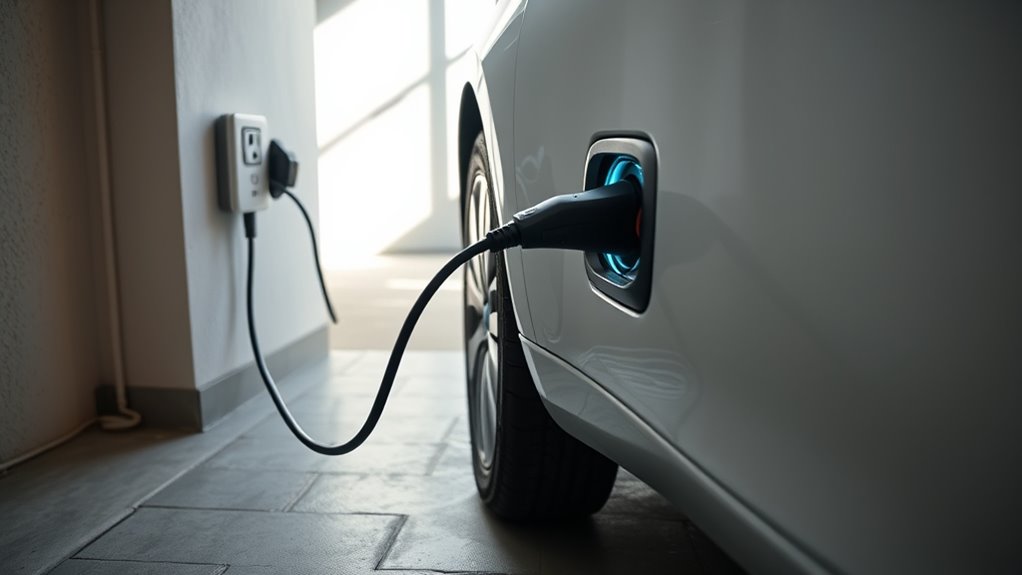
Charging your EV from a standard 120-volt wall outlet uses AC Level 1 charging. The portable charging cord takes power from the outlet, and your vehicle’s onboard charger converts that AC power into DC power for the battery.
This method is simple because it usually does not require a wall-mounted charger or a 240V circuit. Many EVs come with a portable Level 1 cordset, though some newer vehicles or trims may sell the cord separately. Always use the charging cord approved for your vehicle and check the cord label for its rated voltage and amperage.
Level 1 charging is slow. A common estimate is about 3 to 5 miles of driving range per hour. That means an 8- to 10-hour overnight session may add roughly 30 to 50 miles of range, depending on your EV’s efficiency, temperature, battery state of charge, and the charge current allowed by the vehicle.
Note: “Miles added per hour” is only an estimate. A more efficient EV gains more miles from the same electricity than a large truck or SUV.
What You Need for Level 1 Charging
For Level 1 charging, you need a standard 120V outlet, a vehicle-approved portable charging cord, and an electrical circuit that can safely support continuous EV charging. The U.S. Department of Energy’s Alternative Fuels Data Center notes that many EV owners can meet daily driving needs with Level 1 charging when a suitable outlet on a dedicated branch circuit is available near the parking space.
| Requirement | Why it matters |
|---|---|
| Standard 120V outlet | Provides basic Level 1 charging without a 240V installation |
| Outlet in good condition | Reduces the risk of heat, arcing, loose contact, or nuisance trips |
| Dedicated circuit | Helps prevent overload from sharing the circuit with tools, freezers, heaters, or other loads |
| Vehicle-approved charging cord | Matches the vehicle’s charging system and built-in safety controls |
| No extension cord | Limits voltage drop, overheating, and connection failure during long charging sessions |
If your outlet is old, loose, discolored, warm, or on a circuit that already powers other heavy loads, have a licensed electrician inspect it before regular EV charging. EV charging is treated as a continuous load, so the circuit needs to be safe for hours of steady current, not just a quick appliance cycle.
How to Charge Your EV From a Wall Outlet
Charging from a wall outlet is simple, but you should still follow a safe routine every time.
- Park close enough to the outlet so the portable charging cord reaches without stretching or using an extension cord.
- Inspect the outlet and cord for cracks, looseness, scorch marks, bent prongs, or moisture.
- Plug the cord into the wall outlet first if your EVSE manual instructs that sequence.
- Connect the vehicle-side plug to the EV charge port until it clicks or locks in place.
- Check the indicator lights on the cord and vehicle display to confirm charging has started.
- Check for heat after 15 to 30 minutes during the first few sessions. The plug may feel slightly warm, but it should not feel hot.
- Unplug when finished by following the vehicle manual, then store the cord where it will stay dry and undamaged.
Warning: Stop charging if the outlet, plug, or cord feels hot, smells burnt, trips the breaker repeatedly, or shows discoloration. Do not keep “testing” the same outlet. Have the circuit inspected.
How Fast Is Level 1 Charging?
Level 1 charging usually adds about 3 to 5 miles of range per hour. The Department of Energy’s AFDC lists Level 1 at approximately 5 miles of range per hour and notes that charging time depends on battery size, state of charge, the vehicle’s onboard charger, equipment power, and electrical service.
That makes Level 1 practical for light daily driving, but slow for a nearly empty large battery. A plug-in hybrid may refill overnight because it has a smaller battery. A long-range battery-electric vehicle may need more than one night if it starts at a low state of charge.
Charging Speed Basics
The simplest way to estimate charging time is:
Charging time = battery energy needed ÷ charging power, plus extra time for charging losses.
For example, if you need to add 20 kWh and your Level 1 setup delivers about 1.4 kW before losses, the session may take around 14 to 16 hours. If you only need to add 8 kWh after a short commute, overnight charging is much more realistic.
Daily Range Added
You can estimate daily range by multiplying your charging hours by 3 to 5 miles per hour. If you plug in for 10 hours, you may add about 30 to 50 miles. If you drive 20 miles a day, that may be enough. If you drive 60 miles a day, Level 1 may fall behind unless you also charge at work or use public charging.
| Plug-in time | Typical range added | Best fit |
|---|---|---|
| 4 hours | About 12 to 20 miles | Errands, plug-in hybrids, short top-ups |
| 8 hours | About 24 to 40 miles | Short daily commute |
| 12 hours | About 36 to 60 miles | Low-mileage drivers with long overnight parking |
When It’s Enough
Level 1 is enough when your daily mileage stays below what you can recover overnight. It is often a good fit for drivers who cover 0 to 25 miles a day, people with plug-in hybrids, and households that can leave the vehicle parked for long periods.
| Use case | Level 1 fit |
|---|---|
| Light commuting | Often enough overnight |
| 25 to 40 miles daily | Possible, but timing gets tighter |
| 40+ miles daily | Often too slow without backup charging |
| Multiple EVs | Usually better with Level 2 planning |
How to Estimate Charging Time and Cost
To estimate charging time, first find how much energy you need to add. If your EV used 12 kWh during the day, divide 12 by the charging power. A Level 1 cord may deliver roughly 1.4 to 1.9 kW depending on the cord, outlet, and vehicle settings. After charging losses, that 12 kWh refill may take most of the night.
To estimate cost, multiply the energy added by your electricity rate:
Charging cost = kWh added × your electricity price per kWh.
If you add 12 kWh and pay $0.16 per kWh, the session costs about $1.92 before taxes, fees, or special rate adjustments. Your actual cost depends on your local utility rate, time-of-use plan, and vehicle efficiency. AFDC recommends using electricity cost and vehicle efficiency in kWh per 100 miles to estimate EV cost per mile.
Pro Tip: Check your EV’s charging screen or app after a normal week. If the battery percentage slowly drops even though you plug in nightly, Level 1 is not keeping up with your real driving.
When Level 1 Charging Is Enough
Level 1 charging is enough when your daily driving is modest, your parking time is long, and your outlet is reliable. It works best when you can plug in most nights and do not need to recover a large amount of range quickly.
- Short commutes: If you drive 0 to 25 miles a day, overnight Level 1 charging may replace what you used.
- Predictable schedules: If the car sits at home for 8 to 12 hours, slow charging is less of a problem.
- Plug-in hybrids: Smaller batteries often finish charging sooner than full battery-electric vehicles.
- Backup charging access: Public, workplace, or occasional DC fast charging can cover unusual long-distance days.
You do not need to install Level 2 charging just because you own an EV. The better question is whether Level 1 restores enough range before your next drive. If the answer is yes, a wall outlet can be a practical starting point.
Safety Tips for Home EV Charging
Even though Level 1 charging is simple, it still places a steady load on your home wiring for hours. The AFDC notes that EV charging is considered a continuous load under the National Electrical Code, and local permits or code requirements may apply for charging equipment.
- Use a dedicated circuit when possible. Avoid sharing the circuit with refrigerators, freezers, heaters, power tools, or other high-draw appliances.
- Inspect the outlet before charging. Do not use an outlet that is loose, cracked, scorched, wet, or discolored.
- Avoid extension cords. Use the EVSE exactly as the manufacturer instructs. Most portable charging cords are designed to plug directly into the outlet.
- Keep connections dry and protected. Outdoor charging can be safe when the equipment is outdoor-rated and installed or used according to instructions.
- Check for heat. A slightly warm plug can be normal, but a hot plug or outlet is a warning sign.
- Ask an electrician if unsure. This is especially important in older homes, detached garages, carports, or outlets with unknown wiring.
Warning: Do not use a damaged outlet, a loose receptacle, a two-prong adapter, a power strip, or a household extension cord for routine EV charging.
Troubleshooting Common Level 1 Charging Problems
If your EV does not charge from a wall outlet, start with the simple checks before assuming the car has a major problem.
| Problem | Likely cause | What to do |
|---|---|---|
| No charging lights | Outlet has no power, cord fault, or vehicle timer is active | Check breaker, GFCI outlet, cord indicator, and vehicle schedule settings |
| Breaker trips | Shared circuit, weak breaker, wiring issue, or excessive load | Stop charging and have the circuit checked before using it again |
| Outlet gets hot | Loose receptacle, worn contacts, damaged wiring, or overload | Unplug and call an electrician |
| Charging is slower than expected | Low current setting, cold weather, charging losses, or inefficient vehicle | Check the vehicle’s charge-current setting and compare kWh added, not just miles shown |
| Cord fault light appears | Ground fault, moisture, damaged cord, or outlet issue | Follow the EVSE manual and do not bypass the fault |
If the same outlet fails more than once, do not keep resetting the breaker or GFCI. Repeated trips are a warning that the setup needs inspection.
When Level 2 Charging Makes Sense
Level 2 charging makes sense when your daily driving regularly outpaces Level 1 recovery. Level 2 uses 240V power in most home installations and commonly adds around 20 to 30 miles of range per hour, with AFDC listing approximately 25 miles per hour as a typical estimate.
Level 2 does cost more upfront because it may require a wall-mounted charger, a dedicated 240V circuit, permits, and professional installation. But it can make EV ownership easier if you have a long commute, a large battery, multiple EVs, or little time between trips.
Faster Daily Recharging
With Level 1, you may recover enough range for tomorrow only if the car sits plugged in for a long time. With Level 2, you can often recover a normal commute in a few hours and refill a typical EV overnight.
- You add range much faster than with a standard outlet.
- You have more flexibility after an unexpected long drive.
- You reduce the chance of waking up with less charge than planned.
High-Mileage Driving Needs
If you regularly drive more than 40 miles a day, Level 1 may not keep up. It can still work as a backup, but relying on it as your only charger may require more public charging stops.
Level 2 is also the better long-term setup for households with two EVs, vehicles with large batteries, or drivers who cannot plug in every night. Before installation, ask a licensed electrician to confirm panel capacity, circuit requirements, permitting rules, and whether a load-management option is needed.
| Charging type | Typical power source | Typical range added | Best for |
|---|---|---|---|
| Level 1 | 120V outlet | About 3 to 5 miles per hour | Short commutes, plug-in hybrids, backup charging |
| Level 2 | 240V home circuit or commercial 208V service | Often around 20 to 30 miles per hour | Long commutes, large batteries, multiple EVs |
How to Cut Charging Costs
To cut charging costs, focus on when you charge and how much energy you actually need. Some utilities offer time-of-use rates, EV charging plans, rebates, or other incentives. If your utility has lower overnight rates, schedule charging during those hours through your vehicle, charger, or utility program.
- Use off-peak charging if available. Lower overnight rates can reduce charging cost, but savings vary by utility and plan.
- Charge for your next day, not always to 100%. Follow your vehicle manual for daily charging limits and battery-care settings.
- Track kWh, not just percentage. Your electricity bill is based on energy used, so kWh added gives a better cost estimate.
- Compare home and public rates. Public fast charging is convenient, but it often costs more than home charging.
- Check incentives before installing Level 2. Local, state, or utility programs may help offset equipment or installation cost.
If you only drive a few miles each day, Level 1 charging may be the lowest-cost setup because you avoid buying and installing a Level 2 station. If you drive more, Level 2 may still be worth it because it saves time and makes off-peak scheduling easier.
Frequently Asked Questions
Can you charge an EV from a standard wall socket?
Yes. In North America, a standard 120V wall outlet can provide Level 1 charging when used with the correct portable charging cord. It is slow, but it can work well for short daily driving, plug-in hybrids, and overnight charging.
Can I charge an EV with a regular outlet?
Yes, if your EV supports Level 1 charging and you use the charging cord approved for the vehicle. The outlet should be grounded, in good condition, and preferably on a dedicated circuit. Do not use a loose, damaged, or overheated outlet.
Can you charge an EV from a normal power outlet?
Yes. A normal 120V outlet can charge an EV through Level 1 charging, but it adds range slowly. Expect about 3 to 5 miles of range per hour in many real-world situations, with the exact result depending on the vehicle and conditions.
How long does it take to charge an EV on a standard outlet?
A small top-up may take a few hours, while a large battery that is nearly empty can take more than a full day. Instead of relying on one fixed number, estimate the energy you need to add, divide by Level 1 charging power, and allow extra time for charging losses.
Is it safe to charge an EV from an outdoor outlet?
It can be safe if the outlet, cover, and charging equipment are rated for outdoor use and installed correctly. Keep connections protected, follow the EVSE manual, and have an electrician inspect the outlet if it is old, loose, or exposed to weather.
Do I need Level 2 charging at home?
You need Level 2 charging if Level 1 cannot recover your normal daily driving before the next trip. It is especially useful for long commutes, large batteries, multiple EVs, and households that want faster, more flexible overnight charging.
Conclusion
You can charge an EV from a standard wall outlet, and for many low-mileage drivers, Level 1 charging is enough. The key is matching the slow charging speed to your real driving. If you can recover your daily miles overnight, use a safe dedicated outlet, and avoid extension cords, a 120V outlet can be a practical home charging solution. If your mileage grows, your schedule gets tighter, or your battery stays lower each week, Level 2 charging is the smarter upgrade.
Sources
- U.S. Department of Energy Alternative Fuels Data Center: Electric Vehicle Charging Stations — backs Level 1, Level 2, charging speed, connector, and equipment details.
- U.S. Department of Energy Alternative Fuels Data Center: Charging Electric Vehicles at Home — backs home charging setup, dedicated branch circuit guidance, code considerations, and cost calculation concepts.
- ENERGY STAR Certified Electric Vehicle Supply Equipment — helps readers identify safety-certified EV charging equipment.
- FuelEconomy.gov — helps compare EV efficiency, energy use, and estimated operating costs by vehicle model.