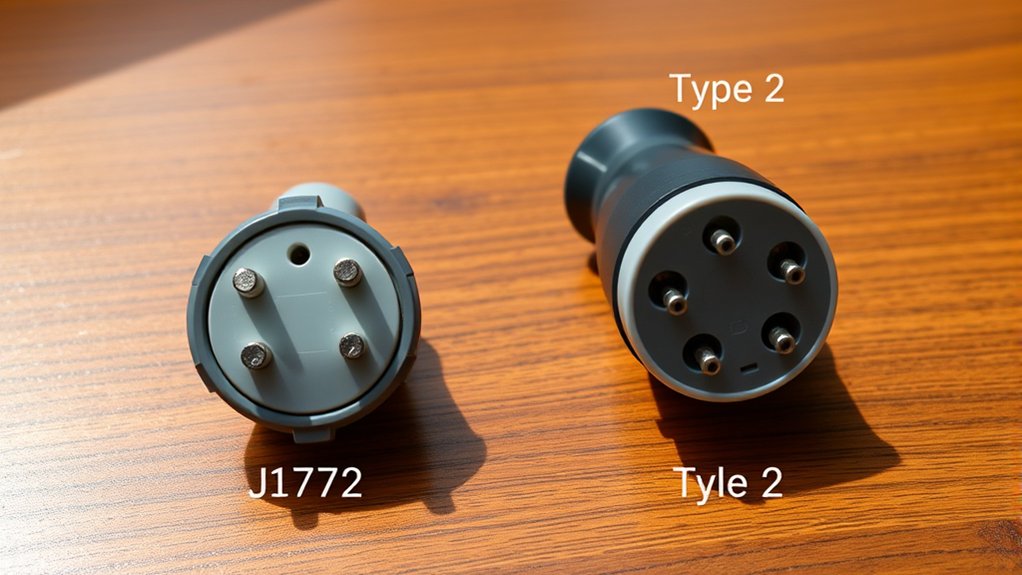
The J1772 and Type 2 connectors both let electric vehicles charge on AC power, but they serve different regions and electrical systems. J1772, also called Type 1, is common in North America and Japan. Type 2, often called Mennekes, is common across Europe and supports single-phase and three-phase AC charging.
Last updated: September 8, 2026. Technical references were checked against current SAE, IEC, U.S. Department of Energy, and European Union charging-standard sources.
Quick Answer
J1772, also called Type 1, is the common North American and Japanese AC connector. It has five contact positions, uses single-phase AC, and Level 2 equipment can reach 19.2 kW. Type 2, or Mennekes, is the main European AC connector. It has seven contact positions and supports single-phase or three-phase AC; 11 kW and 22 kW are common three-phase charging levels. Neither connector guarantees that speed. The charging station, electrical supply, cable, and your EV’s onboard AC charger determine the power the car actually receives.
Key Takeaways
- J1772 is mainly used for AC charging in North America and Japan.
- Type 2 is the main AC connector in Europe and supports single-phase and three-phase AC charging.
- Type 2 can charge faster on three-phase power, but only if the EV, cable, electrical supply, and charging station support the required power.
- J1772 is not the same as CCS1, and Type 2 is not the same as CCS Combo 2.
- Adapters can help with some AC charging situations, but they do not convert an AC connector into a DC fast-charging connector.
J1772 vs Type 2: Main Differences at a Glance
| Feature | J1772 / Type 1 | Type 2 / Mennekes |
| Main region | North America and Japan | Europe and many other markets outside North America |
| Pin layout | 5 contact positions | 7 contact positions |
| AC phase support | Single-phase AC | Single-phase and three-phase AC |
| Common AC power range | Level 1 and Level 2 AC, with Level 2 equipment ranging up to 19.2 kW | Commonly about 7.4 kW single-phase or 11–22 kW three-phase; connector-standard ratings can be higher |
| DC fast charging relationship | CCS1 adds two DC pins below the J1772 shape | CCS Combo 2 adds DC pins below the Type 2 shape |
| Best fit | U.S., Canadian, Japanese, and many legacy North American non-Tesla EV charging setups | European EVs, European public AC chargers, and three-phase home or workplace charging |
What Is the J1772 Connector and Where Is It Used?
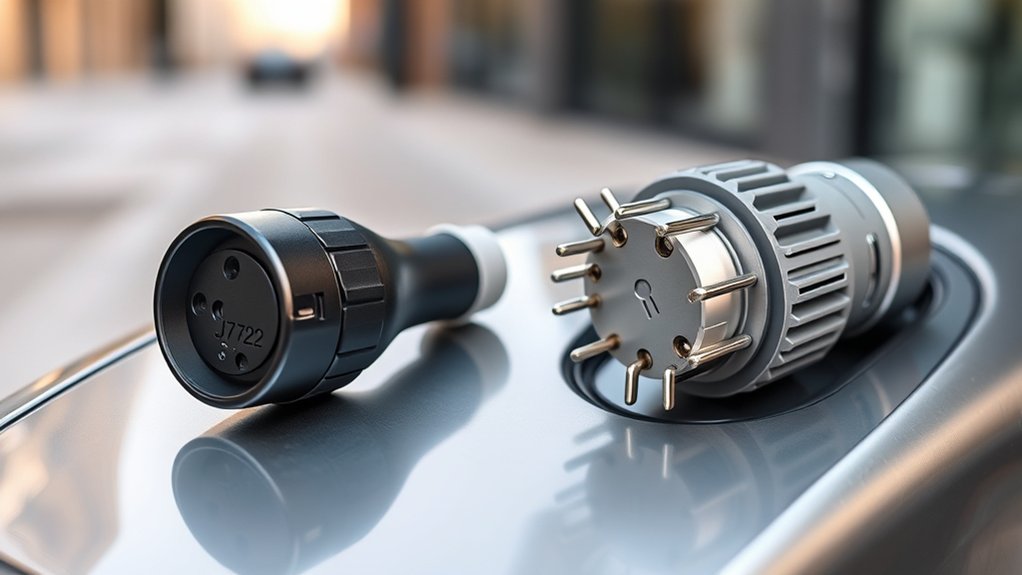
The J1772 connector, also known as Type 1, is a common AC charging connector in North America and Japan. It is used for Level 1 charging from a 120-volt outlet and Level 2 charging from 208-volt or 240-volt service. The U.S. Department of Energy’s Alternative Fuels Data Center lists Level 2 charging equipment at roughly 2.9 kW to 19.2 kW, depending on the charger and electrical service.
J1772 has five main contact positions: two AC power contacts, a protective earth contact, a control pilot, and a proximity pilot. These pilot contacts help the charging station and vehicle confirm that the plug is connected and communicate the available current before charging begins.
For many years, most non-Tesla EVs sold in North America used J1772 for AC charging. Tesla vehicles in North America historically used Tesla’s own connector but could use J1772 Level 2 equipment with an adapter. The transition toward SAE J3400/NACS is now underway on non-Tesla vehicles too. For example, the 2025 Hyundai IONIQ 5 has a native NACS port. J1772 remains important because a large installed base of J1772-equipped vehicles and Level 2 charging equipment is still in use.
Note: A connector’s maximum rating is not always the speed your EV will get. The vehicle’s onboard AC charger, the charging station, the circuit size, the cable, and temperature conditions all affect the final charging rate.
What Is the Type 2 Connector and Why Is It Common in Europe?
The Type 2 connector, often called the Mennekes connector, is the main AC charging connector used across Europe. It has seven contact positions and supports both single-phase and three-phase AC charging. That extra phase support is the biggest practical difference between Type 2 and J1772.
Under the current consolidated version of Regulation (EU) 2023/1804, publicly accessible AC recharging points for light-duty vehicles installed or renovated from January 8, 2026 use Type 2 for Mode 3 interoperability. A limited exception applies to certain normal-power points at or below 3.7 kW whose primary purpose is Mode 2 charging. The same rules identify Combo 2, also called CCS2, for applicable DC interoperability.
In everyday passenger-EV use, Type 2 charging is often about 7.4 kW on single-phase AC or 11 kW to 22 kW on three-phase AC. However, 22 kW is not an absolute limit of the connector standard. IEC 62196-2:2025 covers AC accessories rated up to 63 amps three-phase or 70 amps single-phase at nominal operating voltages up to 480 volts AC. The EV, charging station, cable, and electrical supply can all impose a lower practical limit.
Type 2 also supports locking at the vehicle or station side. This helps prevent accidental disconnection and can help secure a removable cable at untethered public charging stations.
How Do Charging Speeds Differ: J1772 vs Type 2?
J1772 Level 2 equipment can reach 19.2 kW at 240 volts and 80 amps. That is the upper end of the Level 2 range, not the normal home experience. Many home installations operate at lower power because of the EVSE rating, circuit capacity, and the vehicle’s onboard charger.
Type 2 can often charge faster in Europe because it can use three-phase AC. A common 400-volt, 32-amp three-phase setup is about 22 kW. Type 2 hardware can have higher electrical ratings, but that does not mean every Type 2 station or EV will charge above 22 kW.
The important limit is what your EV can accept. If the vehicle’s onboard AC charger is limited to 7.4 kW, plugging it into a 22 kW Type 2 station will not make it charge at 22 kW. The car will take only the AC power its onboard charger and the rest of the charging system allow.
The fastest connector is not always the fastest charge. The slowest link, usually the EV’s onboard AC charger or the circuit feeding the charger, sets the real charging speed.
J1772, Type 2, CCS1, and CCS2: Do Not Mix These Up
J1772 and Type 2 are mainly AC charging connector families. DC fast charging uses related but larger connector systems.
- J1772: AC charging connector used mainly in North America and Japan.
- CCS1: Adds two large DC pins below the J1772-style upper section for DC fast charging.
- Type 2: AC charging connector used mainly in Europe.
- CCS Combo 2: Adds two large DC pins below the Type 2-style upper section for DC fast charging.
This distinction matters when buying adapters. A small J1772-to-Type 2 AC adapter does not give you access to CCS DC fast charging. AC and DC charging use different power paths and different equipment.
Which EVs Are Compatible With J1772 and Type 2?
Compatibility depends mostly on where the EV was sold and which charging inlet the manufacturer installed for that market.
Common J1772-Compatible EVs
Many non-Tesla EVs sold in North America use J1772 for AC charging. Common examples include the Chevrolet Bolt EV, Nissan Leaf, Ford Mustang Mach-E with CCS1/J1772 equipment, Hyundai Kona Electric, Kia Niro EV, and many plug-in hybrids.
These vehicles may use CCS1 for DC fast charging, but the upper AC portion of the charge port still accepts J1772 for Level 1 and Level 2 charging.
Common Type 2-Compatible EVs
Most modern EVs sold in Europe use Type 2 for AC charging. Examples include European-market Volkswagen ID models, BMW i models, Audi e-tron and Q8 e-tron models, Mercedes-Benz EQ models, Renault Zoe, Peugeot e-208, and many European-market Tesla vehicles.
For DC fast charging in Europe, many of these vehicles use CCS Combo 2. A CCS2 vehicle inlet can therefore accept a compatible Type 2 plug through its upper AC section, while the additional lower contacts are used for CCS2 DC charging.
Tesla, NACS, and J3400 in North America
North America is changing because the Tesla-developed connector has been standardized as SAE J3400, commonly called NACS. The transition is no longer limited to future announcements: some current non-Tesla EVs now ship with native NACS/J3400-style charging inlets, while many existing J1772 and CCS1 vehicles use adapters to reach newer infrastructure.
This does not make J1772 irrelevant overnight. J1772 Level 2 chargers remain widespread, and many EVs will continue using them for years. If you are buying a home charger today, choose the connector that fits your current EV and consider whether your next EV may use J3400.
J1772 vs Type 2 Technical Specifications
Pin Configuration and Design
J1772 has five contact positions and is designed for single-phase AC charging. It uses a rounded plug shape with a latch-style handle on many charging cables.
Type 2 has seven contact positions. Its extra power contacts allow it to support three-phase AC charging. The plug is round with a flattened top, which helps with orientation when plugging in.
Voltage and Current Ratings
J1772 Level 2 charging commonly uses 208-volt or 240-volt service. U.S. Level 2 equipment can reach 80 amps and 19.2 kW, although many residential installations operate below that level.
Type 2 commonly uses 230-volt single-phase AC or 400-volt three-phase AC in Europe. Common passenger-EV three-phase charging levels include 11 kW and 22 kW. IEC 62196-2:2025 covers compatible AC accessories with ratings up to 63 amps three-phase or 70 amps single-phase at nominal voltages up to 480 volts AC, so connector rating and common EV charging power should not be treated as the same number.
What AC Power Can Each Connector Support?
For J1772, U.S. Level 2 equipment ranges up to 19.2 kW. With Type 2, 22 kW is a common three-phase benchmark for passenger-EV charging, but Type 2 connector-standard ratings can be higher. In both systems, the vehicle’s onboard charger, EVSE, cable, circuit, and electrical supply can reduce the actual charging power.
Pro Tip: Before paying extra for a high-output home charger, check your EV’s onboard AC charging limit. Extra station capacity will not make the car charge faster once the onboard charger becomes the limiting factor.
Can You Use an Adapter Between J1772 and Type 2?
Yes, adapters can work for some AC charging situations, especially when using an imported EV or traveling with a vehicle that has a different AC inlet than the local charging station. However, the adapter must match the direction of use, the connector type, the cable rating, and the charging mode.
A J1772-to-Type 2 adapter can help a Type 2 vehicle use some J1772 AC stations. A Type 2-to-J1772 adapter can help a J1772 vehicle use some Type 2 AC stations. These adapters do not create three-phase charging if the car or electrical supply does not support it.
Warning: Do not use damaged, uncertified, or underrated EV charging adapters. Never modify a plug, bypass a pilot signal, or use an adapter for DC fast charging unless it is specifically approved for that vehicle and charging network.
What Safety Features Are Found in J1772 and Type 2 Connectors?
Both J1772 and Type 2 use pilot signaling to help the vehicle and charging equipment communicate before power flows. This helps confirm that the connector is inserted and that the vehicle can accept the available current.
Both systems also depend on protective earth grounding, overcurrent protection, and equipment that is built to the correct electrical safety standards. Quality EVSE equipment will stop or reduce charging if it detects a fault or unsafe condition.
Type 2 has a practical safety and convenience advantage in many European public charging setups because the vehicle or station can lock the connector or cable during charging. J1772 handles often have a latch, and some vehicles can lock the inlet, but locking behavior varies by vehicle and equipment. For routine disconnect steps, see how to unplug an EV charger safely.
How Public Charging Feels Different With J1772 and Type 2
In North America, many public Level 2 stations have a tethered cable with a J1772 plug already attached. You park, plug in, start the session, and return the cable to the holster when finished.
In Europe, many public AC stations are untethered. The station may provide a Type 2 socket, and you bring your own Type 2 cable. This is one reason Type 2 locking matters: the station and vehicle can secure the cable during the session.
DC fast charging is different. Fast chargers usually have a tethered CCS1, CCS2, CHAdeMO, or J3400/NACS cable because DC charging cables are larger and more specialized.
Will J1772 and Type 2 Coexist in the Future?
Yes. J1772 and Type 2 will continue to coexist because they serve different regions and large installed bases. Type 2 remains central to European AC charging interoperability, while J1772 remains common on North American Level 2 infrastructure and existing EVs.
The bigger shift is in North America, where SAE J3400/NACS is changing new-vehicle and charging-infrastructure plans. That shift affects future charger buying decisions, but it does not erase the usefulness of J1772 adapters, public Level 2 stations, or existing J1772-equipped EVs.
In Europe, Type 2 and CCS Combo 2 remain the practical standard combination: Type 2 for AC charging and CCS2 for DC fast charging.
How to Select Between J1772 and Type 2 for Your EV
Choose based on your vehicle inlet, your region, and your charging habits. A simple compatibility check is to work through five variables in order: vehicle inlet, AC phase support, onboard-charger limit, station or circuit output, and whether the session is AC or DC. If any one of those does not match, a connector with a higher theoretical rating will not solve the problem.
- If you live in North America and your EV has J1772 or CCS1: choose a J1772 Level 2 home charger unless you have a clear reason to buy a J3400/NACS unit with an approved adapter.
- If you live in Europe: choose Type 2 for AC charging. If you need fast public charging, look for CCS Combo 2 compatibility.
- If you own a Tesla or J3400/NACS EV in North America: a J3400/NACS home charger may make sense, but compatible J1772 equipment can still work with the correct adapter.
- If you own an imported EV: confirm the inlet type, phase support, onboard charger limit, and local electrical supply before buying a charger or adapter.
- If you use mostly public charging: check connector and power filters before driving to a station. This guide to using PlugShare to find compatible EV chargers explains a practical way to filter charging stops.
For most drivers, the best connector is not the one with the highest theoretical rating. It is the one that matches the vehicle, local infrastructure, electrical service, and charging mode you actually use.
Frequently Asked Questions
Is J1772 a Type 2 connector?
No. J1772 is also called Type 1 and is mainly used in North America and Japan. Type 2 is a different connector used mainly in Europe. The two are not physically interchangeable without the correct adapter or cable arrangement.
What are the two main AC EV plug types?
Two widely encountered AC EV connector types are J1772, also called Type 1, and Type 2, also called Mennekes. J1772 is common in North America and Japan, while Type 2 is the main AC connector across Europe.
Is Type 2 faster than J1772?
Type 2 can be faster when it uses three-phase AC power. A 22 kW three-phase Type 2 station is common in some European markets, while U.S. J1772 Level 2 equipment ranges up to 19.2 kW. Actual speed still depends on the EV’s onboard charger, station output, cable, and electrical supply.
Does Type 2 always charge at 22 kW?
No. Type 2 describes the connector interface, not a guaranteed charging speed. A Type 2 session may run at a lower single-phase or three-phase power level, and the vehicle’s onboard charger can limit the rate even when the station can provide more.
Is Type 2 the same as CCS2?
No. Type 2 is the AC connector interface. CCS2, also called Combo 2, combines the Type 2-based upper section with two large DC contacts below it so the vehicle can use DC fast charging.
Can a CCS2 car use a Type 2 AC charger?
Yes, when the vehicle supports compatible Type 2 AC charging. A CCS2 inlet uses the Type 2-based upper section for AC charging, while the two additional lower contacts are used for DC fast charging.
Can I use a J1772-to-Type 2 adapter?
Yes, in some AC charging situations. The adapter must be rated for the current, match the direction you need, and be approved for EV charging use. It will not convert AC charging into DC fast charging, and it will not make a single-phase EV accept three-phase charging.
Conclusion
J1772 and Type 2 are not competing versions of the same plug. They are regional AC charging standards built around different electrical systems. J1772 is the familiar Level 1 and Level 2 AC connector for many North American EVs, while Type 2 is the European AC standard and can take advantage of three-phase charging.
If you are choosing a charger, start with your vehicle inlet. Then check AC phase support, your EV’s onboard charging limit, your home or workplace electrical service, and whether the charging session is AC or DC. Those factors matter more than the connector’s theoretical maximum rating.
Sources
- U.S. Department of Energy Alternative Fuels Data Center: Electric Vehicle Charging Stations — backs Level 1, Level 2, J1772, charging-speed factors, CCS, and J3400 context.
- Consolidated Regulation (EU) 2023/1804, version applicable from January 8, 2026 — backs current Type 2 AC and Combo 2 DC interoperability requirements and exceptions.
- SAE International J1772_202401 — current J1772 conductive charge coupler reference.
- SAE International J3400_202409 — backs the North American Charging System/NACS standard.
- IEC 62196-2:2025 — backs current AC connector accessory voltage and current ratings, including Type 2 configurations.
- SAE International J3068_202409 — backs three-phase-capable AC charging context.
- Hyundai USA: 2025 IONIQ 5 NACS Charging Information — verifies a current non-Tesla North American EV with a native NACS port.