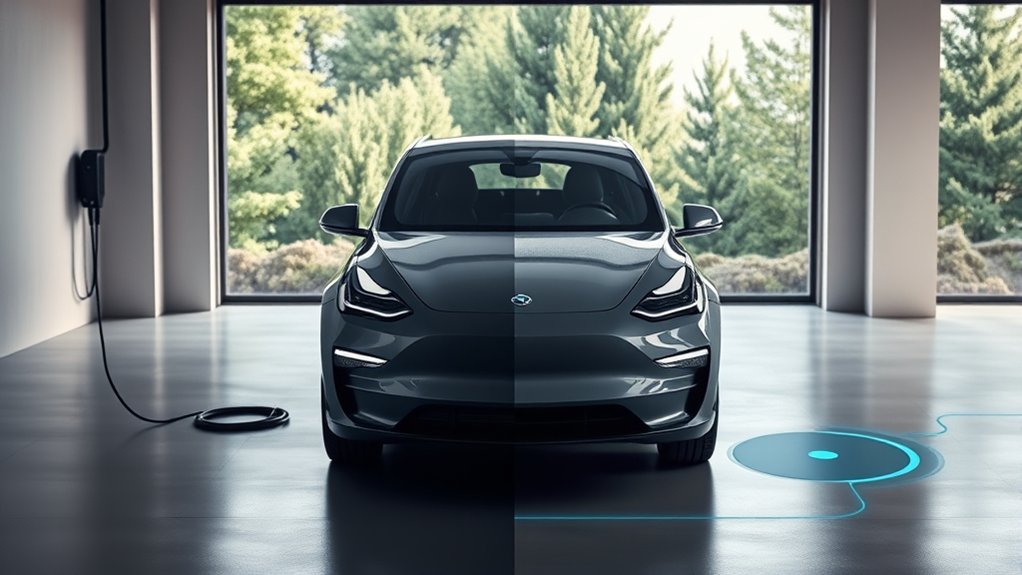
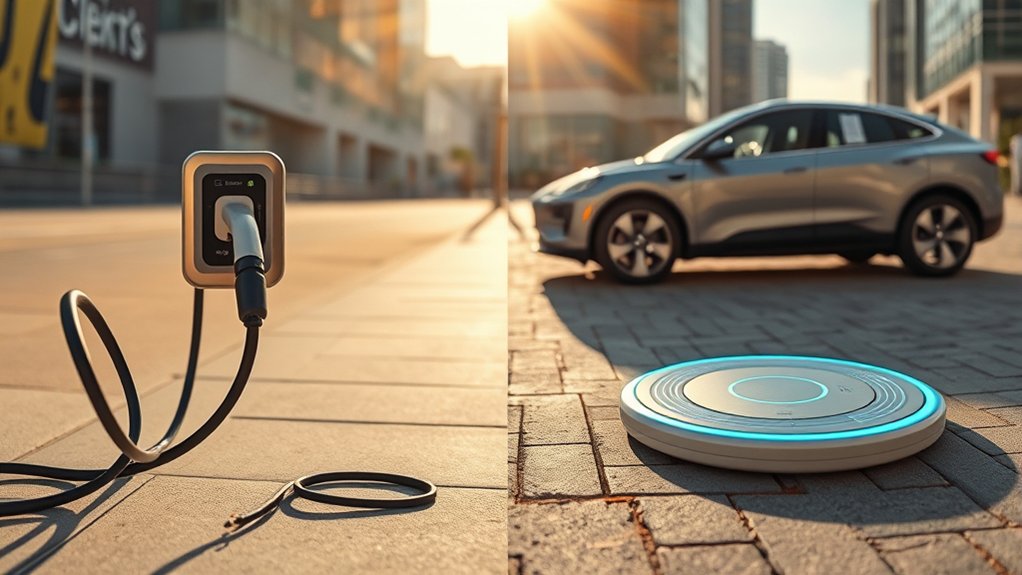
Wired EV charging is still the best all-around choice for most drivers because it is widely supported, offers the highest available charging power, and is usually simpler and less expensive to install. Wireless EV charging is more convenient because charging can start automatically after you park, but vehicle compatibility, pad installation, and limited availability remain important drawbacks. Modern wireless systems can be highly efficient when properly aligned, so the choice is no longer as simple as “wired is efficient, wireless is wasteful.”
Key Takeaways
- Wired charging wins on availability and maximum speed. AC Level 2 charging is common at homes and public sites, while DC fast charging can deliver far more power than today’s mainstream passenger-vehicle wireless systems.
- Wireless charging wins on convenience. A compatible vehicle can begin charging after it is positioned over a charging pad, with no cable to handle.
- Efficiency depends on the system. Properly designed wireless charging can approach wired AC charging efficiency, but misalignment, air gap, and power-conversion losses matter.
- Wireless compatibility is not universal. The vehicle needs compatible receiver hardware; a standard plug-in EV cannot use a wireless pad simply by parking over it.
- Cost is site-specific. Wired Level 2 equipment is widely available, while wireless charging may require both vehicle-side hardware and a dedicated floor or ground assembly.
Wired vs. Wireless: Key Differences in EV Charging
| Factor | Wired EV Charging | Wireless EV Charging |
|---|---|---|
| Connection | Physical cable and connector | Magnetic coupling between a ground pad and vehicle receiver |
| Convenience | Driver usually plugs in and unplugs | Can start automatically after correct parking and authorization |
| Typical home use | Level 1 or Level 2 | Comparable to Level 2 on compatible systems |
| Maximum mainstream power | Much higher because DC fast charging is widely available | SAE J2954 currently defines light-duty stationary wireless charging levels up to 11 kVA |
| Efficiency | Generally high; varies by charger and vehicle | Can be close to wired AC charging when well aligned, but coupling and alignment affect losses |
| Compatibility | Broad, provided the connector and vehicle are compatible | Requires wireless-charging hardware in the vehicle plus a compatible ground assembly |
| Installation | Usually wall-, pedestal-, or cabinet-mounted EVSE plus electrical work | Requires electrical work plus a properly positioned floor or ground assembly |
| Best for | Most homes, road trips, workplaces, and public charging | Drivers or fleets that value automatic, hands-free charging and have compatible vehicles |
For most U.S. EV owners, wired charging remains the practical default. Wireless charging is becoming more credible, however, as standards mature and automakers begin integrating factory-supported systems.
How Does Wired EV Charging Work?
Wired EV charging transfers electricity through a cable connected to the vehicle. With AC Level 1 and Level 2 charging, the vehicle’s onboard charger converts AC electricity from the grid into DC electricity for the traction battery.
In the United States, AC Level 2 equipment can range from about 2.9 to 19.2 kW. The U.S. Department of Energy uses roughly 25 miles of added range per hour as a typical Level 2 example, although the real rate depends on the vehicle, charger output, battery state of charge, temperature, and driving efficiency.
DC fast charging works differently. The station converts AC to DC outside the vehicle and supplies DC power to the battery system. Public DC fast chargers can operate at power levels far above home Level 2 equipment, although the vehicle controls how much power it can actually accept.
Wired charging also benefits from mature connector and charging standards. SAE J1772 remains an important conductive-charging standard, while SAE J3400 covers the connector commonly known as NACS in North America.
What Makes Wireless EV Charging Convenient?
Wireless EV charging removes the need to handle a charging cable. A ground assembly creates an alternating magnetic field, and a receiver mounted on the vehicle captures that energy and converts it for battery charging.
The main benefit is automation. Once a compatible vehicle is positioned correctly over the pad and the charging session is authorized, charging can start with little or no driver interaction. This can be especially useful for garages, fleets, autonomous-vehicle concepts, and drivers with limited mobility.
Wireless EV charging trades some infrastructure simplicity and universal compatibility for a more automated, hands-free charging experience.
Alignment still matters. Modern systems use positioning guidance and control logic to keep the transmitter and receiver within an acceptable charging zone. A wireless pad is therefore not a universal charger for any EV parked above it.
Which Charging Method Is More Efficient?
There is no single efficiency percentage that applies to every wired or wireless EV charger. Results depend on where efficiency is measured, the vehicle, charger design, power level, temperature, and—especially for wireless systems—coil alignment and air gap.
Well-designed wireless systems can be much closer to wired AC charging than older rules of thumb suggest. Porsche states that its 11 kW wireless charging system can reach up to 90% efficiency. In research, Oak Ridge National Laboratory demonstrated 100 kW wireless power transfer to a passenger EV at 96% efficiency. That laboratory result shows the technology’s potential, but it should not be treated as the normal efficiency of every consumer wireless charger.
Wired charging avoids the magnetic coupling stage, so it does not have the same alignment-related losses. For a buyer comparing real products, the most useful approach is to compare manufacturer-rated or independently measured wall-to-battery efficiency under similar conditions rather than relying on a broad “wired versus wireless” percentage.
Which Method Charges an EV Faster?
Wired charging has the clear advantage in maximum charging speed today. U.S. AC Level 2 equipment spans a wide power range, and public DC fast chargers can deliver up to hundreds of kilowatts. The Department of Energy lists DC fast equipment with output up to 500 kW, although actual vehicle charging power is often lower.
For light-duty stationary wireless charging, the current SAE J2954 standard defines three charging levels up to 11 kVA. Porsche’s factory wireless system for the Cayenne Electric also supports up to 11 kW, which places it in the same general use case as home AC Level 2 charging rather than highway DC fast charging.
Higher-power wireless charging is being developed. Oak Ridge National Laboratory has demonstrated 100 kW wireless charging for a passenger EV, but research demonstrations are not the same as broadly available public infrastructure.
How Do Costs Compare Between Wired and Wireless EV Charging?
Wired charging is usually the easier option to price and install because Level 1, Level 2, and DC charging equipment are already widely sold and installed. The final cost can still vary sharply with charger power, electrical-panel capacity, cable runs, trenching, permits, labor, networking, and utility upgrades.
Wireless charging adds different hardware requirements. A compatible vehicle needs a receiver, and the parking space needs a matching ground or floor assembly positioned and installed correctly. Because consumer wireless charging is still less common and may be tied to a specific vehicle option, a universal price comparison is not reliable.
The original fixed cost figures and break-even calculations should not be used as general rules. For a real purchase decision, compare the total installed quote, expected electricity use, maintenance terms, vehicle compatibility, and any required factory preparation.
Safety, Weather, and Battery Health
Both charging methods can be safe when the equipment is certified, correctly installed, and used as directed. Outdoor wired EVSE is designed for outdoor conditions when properly rated. Wireless systems add controls for positioning, electromagnetic-field limits, foreign-object detection, and other safety functions covered by applicable standards and product certifications.
Weather affects the vehicle battery as well as the charging equipment. Cold batteries may accept power more slowly, while high temperatures can increase thermal stress. These effects are not unique to wired or wireless charging.
Charging speed also should not be confused with battery health. Faster charging is valuable on trips, but very high charging power creates more heat and can increase battery stress. Use the charging method and power level recommended by the vehicle manufacturer, especially for routine charging.
Compatibility and Availability
Wired charging has a major advantage because compatible public and home charging equipment is already widespread. Drivers still need the correct connector or an approved adapter, but conductive charging is built into modern plug-in vehicles.
Wireless charging requires dedicated receiver hardware. SAE J2954 helps establish interoperability, safety, electromagnetic compatibility, performance, and alignment requirements for light-duty stationary wireless charging, but a vehicle must be designed or equipped to use the system.
Factory integration is beginning to appear. Porsche lists wireless charging as an option for the 2026 Cayenne Electric, with charging up to 11 kW. This is an important step toward consumer availability, but it does not make wireless charging universal across EVs.
Future Trends in EV Charging Technologies: What to Expect
The biggest near-term change is not a replacement of wired charging, but a broader mix of charging methods. Conductive charging will continue to serve home, workplace, and high-power public charging, while wireless systems are likely to grow where automation and repeated parking patterns add clear value.
Standards are also becoming more mature. SAE J2954 covers stationary light-duty wireless charging up to 11 kVA, while higher-power and dynamic wireless charging remain active development areas. In October 2026, Honda announced plans for public-road demonstrations of in-motion wireless charging technology beginning in Japan’s 2027 fiscal year, including development work aimed at high-power charging for commercial vehicles.
| Trend | Current Direction | Likely Impact |
|---|---|---|
| Standardized Stationary Wireless Charging | SAE J2954 defines light-duty wireless charging and alignment requirements up to 11 kVA | Better interoperability and easier factory integration |
| Higher-Power Wireless Research | Laboratories have demonstrated wireless charging well above current consumer Level 2 power | Potential use in fleets and faster stationary charging |
| Dynamic Wireless Charging | Road-embedded systems are moving toward public-road demonstrations | Could support high-utilization commercial vehicles if cost and infrastructure challenges are solved |
Frequently Asked Questions
Can I Use Both Charging Methods Interchangeably?
Not automatically. A wireless-capable EV may also support normal plug-in charging, but wireless charging requires compatible receiver hardware in the vehicle and a matching ground assembly. A conventional plug-in EV cannot use a wireless pad unless it was designed or properly equipped for that system.
How Do Weather Conditions Affect Charging Efficiency?
Extreme temperatures can reduce charging performance because the battery-management system may limit power while the battery is too cold or too hot. Properly rated wired and wireless charging equipment can operate outdoors, but snow, debris, standing water, installation quality, and equipment specifications should always be considered.
What Is the Lifespan of Wired Vs Wireless Chargers?
There is no reliable universal rule that wired chargers always last longer than wireless chargers, or vice versa. Wired systems have cables and connectors that can wear or be damaged, while wireless systems use additional embedded power electronics and pad hardware. Product quality, environment, duty cycle, maintenance, and warranty matter more than the charging method alone.
Are There Safety Concerns With Wireless Charging?
Wireless EV charging must manage electromagnetic-field exposure, object detection, thermal conditions, alignment, and system faults. Standards such as SAE J2954 include safety and electromagnetic-compatibility requirements. Buyers should use certified, vehicle-compatible equipment installed according to the manufacturer’s instructions and local electrical rules.
How Do Charging Speeds Compare in Real-World Scenarios?
For overnight home charging, an 11 kW wireless system can serve a similar role to a strong Level 2 wired charger if the vehicle supports that power. For road trips, wired DC fast charging is much faster because public chargers can deliver hundreds of kilowatts, while current standardized light-duty stationary wireless charging tops out at 11 kVA.
Conclusion
For most EV drivers, wired charging remains the better overall choice because it is widely available, broadly compatible, and capable of much higher charging power. Wireless EV charging is most compelling when hands-free operation matters more than universal compatibility or maximum speed.
The efficiency gap is also smaller than many older comparisons suggest. Modern wireless systems can perform well when correctly aligned, but cost, vehicle hardware, installation, and infrastructure availability still make wired charging the safer default for most buyers in 2026.