
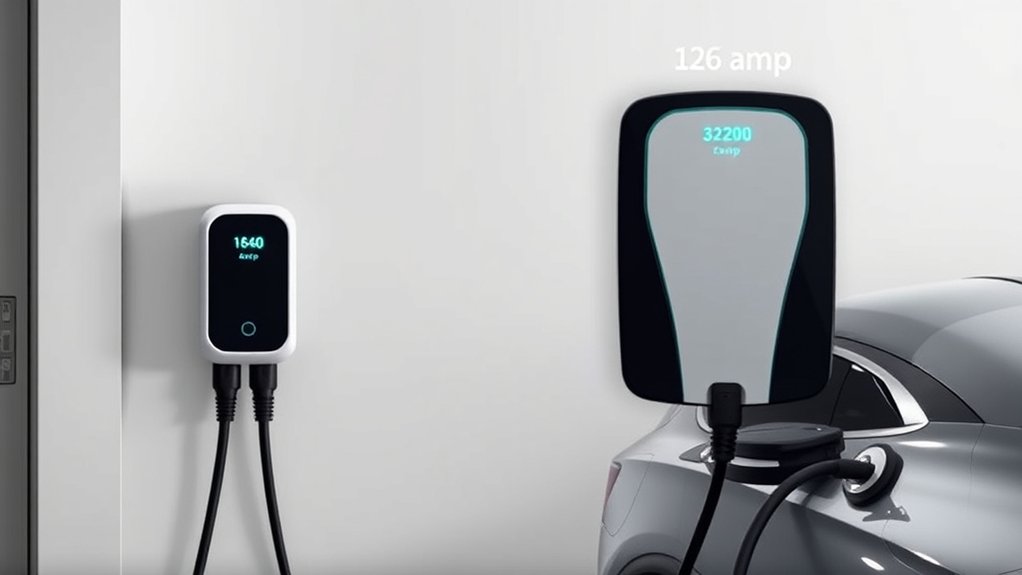
For a typical U.S. 240-volt home charging setup, a 16 Amp EV charger supplies about 3.8 kW, while a 32 Amp EV charger supplies about 7.7 kW. If your vehicle can accept the higher rate and your electrical system supports it, 32A can deliver roughly twice the charging power. A 16A setup can still be enough for plug-in hybrids, lower daily mileage, or long overnight charging windows.
| Feature | 16 Amp EV Charger | 32 Amp EV Charger |
|---|---|---|
| Approx. power at 240V | 3.8 kW | 7.7 kW |
| Typical branch-circuit size for continuous charging | 20A | 40A |
| Ideal time to supply 60 kWh | About 15.6 hours | About 7.8 hours |
| Approx. range added per hour | Often about 10–15 miles | Often about 20–30 miles |
| Best fit | Lower daily energy use, PHEVs, limited electrical capacity | Many BEVs, longer commutes, faster overnight recovery |
Important: Actual charging speed depends on voltage, the EVSE setting, the vehicle’s onboard charger, battery state of charge, temperature, and charging losses. The circuit and installation must also be sized for the continuous EV charging load under applicable electrical codes.
Understanding the 32 Amp EV Charger: Features and Advantages
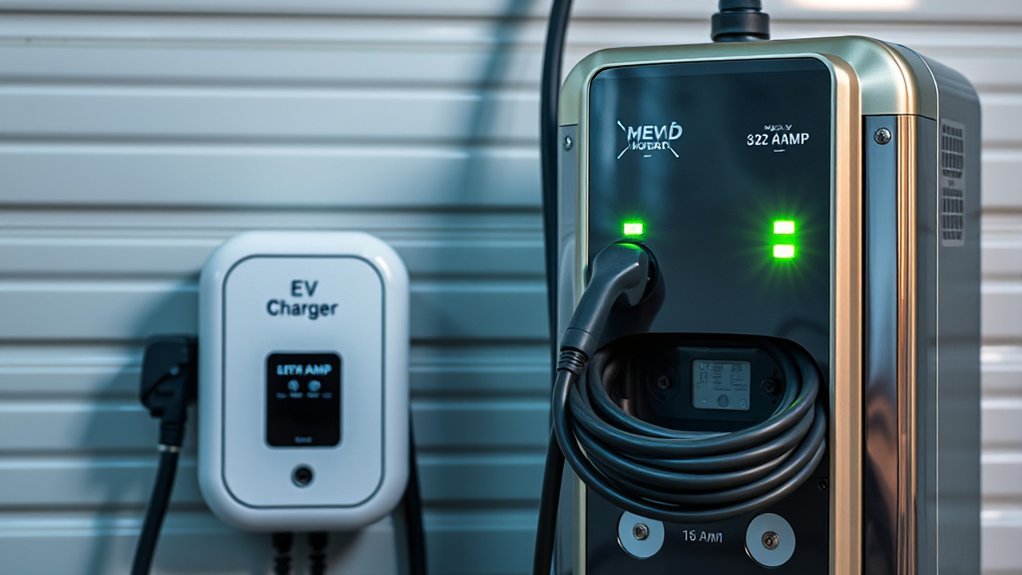
A 32 Amp EV charger on a 240V supply can provide about 7.7 kW of AC charging power. That is a common Level 2 home-charging rate and is fast enough to replenish a substantial amount of energy during an overnight charging window.
For example, supplying 60 kWh at a steady 7.68 kW would take about 7.8 hours in ideal conditions. Real charging can take longer because the vehicle may not draw the maximum rate continuously and some energy is lost during AC-to-DC conversion and battery charging.
A 32A EVSE is not simply connected to any 32A household circuit. EV charging is treated as a continuous load, so a 32A charging setting is commonly paired with a 40A branch circuit. The exact wiring, breaker, receptacle or hardwired method, and permitting requirements depend on the equipment instructions and local code.
For many battery-electric vehicles, 32A offers a useful balance of charging speed and electrical demand. It is especially attractive when you regularly use more energy than a 16A setup can comfortably replace during the time the car is parked.
What Is a 16 Amp EV Charger and How Does It Work?
A 16 Amp EV charger set for 240V operation provides about 3.8 kW. It uses the same basic Level 2 process as a higher-amperage EVSE: the charging equipment safely supplies AC power, while the vehicle’s onboard charger converts that AC power to DC for the traction battery.
At 3.84 kW, supplying 60 kWh would take about 15.6 hours in ideal conditions. Actual time can be longer, but most drivers do not charge from 0% to 100% every day. If you only need to replace a modest amount of daily driving energy, 16A can still restore that energy overnight.
A 16A charging load also needs a properly sized circuit. For continuous charging, a 16A setting is commonly used on a 20A branch circuit. Do not assume an existing outlet or circuit is suitable just because the charger can be set to 16A; the circuit, receptacle, wiring, and installation must be appropriate for EV charging.
This lower-power option can work well for plug-in hybrids, shorter commutes, second vehicles, or homes where available electrical capacity is limited.
Key Benefits of the 16 Amp Charger
- Lower electrical demand: A 16A setting draws half the current of a 32A setting, which can make it easier to fit within a home’s available electrical capacity.
- Enough for many overnight top-ups: Ten hours at 3.8 kW represents roughly 38 kWh of energy supplied before accounting for charging losses, which may be more than enough to replace a typical day’s driving for some owners.
- Good match for smaller batteries and PHEVs: Vehicles that cannot accept or do not need higher AC charging power may gain little practical benefit from a faster EVSE.
- Potentially simpler installation: If the home already has suitable electrical capacity, a lower-current circuit may require less infrastructure than a higher-current installation. An electrician should still verify the existing service and branch circuit.
How Do 16 Amp and 32 Amp Chargers Stack Up?
The main difference is charging power. At the same 240V supply voltage, doubling current from 16A to 32A roughly doubles the available power from 3.8 kW to 7.7 kW. Whether the car actually charges twice as fast depends on the vehicle’s onboard AC charging limit and other conditions.
- Charging speed: A 32A setup can replace energy about twice as quickly as a 16A setup when the vehicle can accept the full rate.
- Daily driving needs: A 16A charger may be sufficient when the car sits for many hours and daily energy use is modest. A 32A charger gives more recovery margin after longer trips.
- Electrical capacity: A 16A charging load typically needs a 20A circuit, while a 32A load typically needs a 40A circuit. The home’s service capacity may determine which setting is practical.
- Vehicle limit: The EV’s onboard charger sets an upper limit. A 32A EVSE cannot force a vehicle that accepts less current to charge faster.
- Future needs: A 32A installation gives more charging headroom than 16A, but it is not automatically “future-proof.” Future vehicles may support higher AC rates, and the home’s electrical capacity still matters.
Installation Costs: 16 Amp vs. 32 Amp Chargers
There is no reliable universal price difference between a 16A and 32A home EV charger installation. Equipment price, wire length, panel location, local labor rates, permits, receptacle versus hardwired installation, trenching, and electrical-service upgrades can change the total substantially.
A 32A installation may cost more when it requires a larger branch circuit, a longer run of heavier conductors, load management, or a panel or service upgrade. However, a home with sufficient capacity and a convenient installation path may be able to support 32A without major electrical work.
Before buying charging equipment, have a licensed electrician evaluate the electrical panel, available capacity, circuit route, and local code requirements. Comparing installation quotes is more useful than relying on a generic national price range.
Compatibility: Which EVs Work With 16 Amp and 32 Amp Chargers?
Most EVs can charge from AC equipment that advertises a higher maximum current than the vehicle itself can accept, because the car and EVSE communicate and the vehicle draws only up to its supported limit. Compatibility still depends on the charging connector or an approved adapter, the EVSE’s voltage and current capability, and the vehicle’s onboard charger.
Check these four items before choosing a charger:
- Vehicle AC charging limit: Find the maximum Level 2 AC rate in the owner’s manual or manufacturer’s specifications.
- Connector compatibility: Make sure the EVSE connector matches the vehicle inlet, or use an adapter specifically approved for the vehicle and charging equipment.
- Available electrical capacity: Confirm that the home can support the required continuous load.
- Charging window: Estimate how much energy you normally need to replace and how many hours the vehicle is parked.
If your vehicle can accept 32A or more, a 32A charger can take advantage of that capability. If the vehicle is limited to a lower AC rate, selecting a 32A EVSE will not increase charging speed beyond the vehicle’s limit.
Safety and Maintenance Tips for Your EV Charger
Home EV charging is routine when the equipment and electrical system are properly installed. Use listed or safety-certified charging equipment, follow the manufacturer’s instructions, and have the installation completed or reviewed by a qualified electrician as required by local rules.
Regular Inspection Guidelines
- Inspect the cable and connector: Look for cuts, crushed sections, exposed conductors, damaged pins, melted plastic, or unusual discoloration.
- Check the equipment mount: Make sure a wall-mounted EVSE remains secure and that the cable is not being sharply kinked or repeatedly driven over.
- Watch for abnormal heat or faults: Stop using the equipment and follow the manufacturer’s troubleshooting guidance if the plug, receptacle, connector, or EVSE becomes unusually hot or repeatedly reports a fault.
- Keep the area clear: Avoid trip hazards and keep charging equipment away from unnecessary impact or abrasion.
Follow the EVSE manufacturer’s maintenance and inspection instructions rather than assuming a fixed annual service interval applies to every charger.
Proper Cable Management
Store the charging cable so it does not create a tripping hazard, drag through standing water or dirt, or suffer repeated sharp bends. A wall-mounted holster or cable organizer can help keep the connector protected and the charging area tidy.
Do not use a damaged charging cable or connector. If you notice overheating, arcing marks, looseness, or physical damage, stop charging and have the equipment inspected before using it again.
Safe Charging Practices
- Use safety-certified equipment: Choose EV charging equipment evaluated by a recognized testing laboratory and suitable for the installation location.
- Match the EVSE to the circuit: The configured charging current must not exceed what the branch circuit and installation are designed to support.
- Use outdoor-rated equipment outdoors: Follow the product’s environmental and installation ratings.
- Avoid improvised adapters and extension cords: Use only connection methods and adapters approved for the vehicle and EVSE.
- Follow local electrical code: Permit, GFCI, receptacle, hardwiring, and disconnect requirements can vary by jurisdiction and by the specific equipment.
Safety note: Electrical work and load calculations should be handled by a qualified professional. Do not increase an EVSE’s amperage setting without confirming that the circuit and electrical service support it.
Making the Right Choice: Which Charger Is Best for You?
Choose the lowest charging rate that reliably replaces the energy you use before you need the car again, while staying within the vehicle’s AC charging limit and the home’s safe electrical capacity.
| Choose 16A when… | Choose 32A when… |
|---|---|
| You have modest daily mileage or a PHEV. | You regularly need faster overnight recovery. |
| Your car is parked for a long overnight window. | Your EV can accept 32A or more on AC. |
| Available electrical capacity is limited. | Your home can support a properly installed 40A branch circuit or equivalent approved setup. |
| You can comfortably replace your normal daily energy use at about 3.8 kW. | About 7.7 kW gives you useful extra charging margin. |
If both options fit your electrical system and budget, 32A is usually the more flexible choice for a battery-electric vehicle because it can replenish energy about twice as fast. A 16A charger remains a sensible option when your daily charging need is modest.
Frequently Asked Questions
Is Charging at 32A Bad?
No. Charging at 32A is a normal Level 2 charging rate when the EV, EVSE, circuit, and installation are designed for it. The vehicle controls how much current it accepts, so a properly configured 32A EVSE does not force excessive current into the battery.
How Many Amps Should My EV Charger Be?
Match the amperage to three things: your vehicle’s maximum AC charging rate, your home’s available electrical capacity, and the amount of energy you need to replace during your normal parking window. For many drivers, 16A is enough for overnight top-ups; 32A provides more flexibility and faster recovery.
How Long to Charge an EV at 32 Amps?
At 240V, 32A is about 7.7 kW. Dividing the energy you need by that power gives a rough ideal time: supplying 60 kWh takes about 7.8 hours before accounting for charging losses or changes in the vehicle’s charging rate. A routine partial recharge will take less time.
Should I Charge My Tesla at 16A or 32A?
Use 32A if your Tesla, charging equipment, and electrical circuit support it and you benefit from the faster rate. Tesla’s current Wall Connector guidance shows 32A output on a 40A breaker and 16A output on a 20A breaker. If 16A already replaces your daily driving energy overnight, there is no requirement to use 32A.
Does a 32A Charger Always Charge Twice as Fast as a 16A Charger?
No. It offers roughly twice the available power at the same voltage, but the vehicle may limit AC charging below 32A. Charging losses, battery temperature, state of charge, and power sharing can also affect the actual rate.
Can I Use a 32A Charger on a 30A Circuit?
Not at a 32A charging setting. The EVSE must be configured to a current that the branch circuit can safely support under applicable code and the manufacturer’s instructions. Do not change breaker size or charger settings without verifying the wiring and electrical load.
Sources and Further Reading
- U.S. Department of Energy Alternative Fuels Data Center: Charging Electric Vehicles at Home
- ChargePoint Home Flex Installation FAQ
- Tesla Wall Connector Support
Conclusion
For a typical 240V U.S. home setup, the practical difference between a 16 Amp and 32 Amp EV charger is about 3.8 kW versus 7.7 kW of available charging power. A 16A charger can be enough for lower daily energy use and long overnight charging windows, while 32A is usually the better fit for drivers who want faster recovery and whose vehicle and electrical system can support it.
The best choice is not simply the highest amperage. Confirm your EV’s AC charging limit, estimate how much energy you need each day, and have the home’s electrical capacity checked before installation.