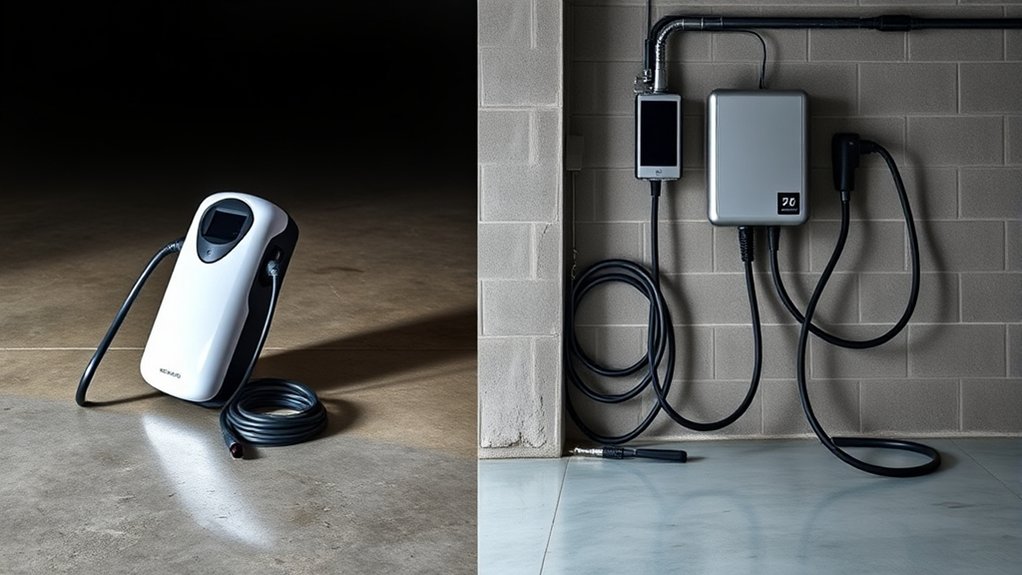
Choosing between a portable plug-in EV charger and a hardwired wall charger comes down to how you charge, where you live, and how long you plan to keep the setup. A portable charger is easier to move. A hardwired charger is usually cleaner, more durable, and better for higher-amperage home charging when your electrical panel can support it.
Quick Answer
Choose a portable EV charger if you rent, move often, or already have a safe 240V outlet. Choose a hardwired EV charger if you own the home, want a cleaner permanent setup, need higher amperage, or charge daily. Either option must be installed on a properly sized circuit and follow local electrical code.
Key Takeaways
- Portable chargers are best for renters, travel, temporary setups, and homes that already have a safe, code-compliant outlet.
- Hardwired chargers are usually better for daily home charging, outdoor mounting, cleaner cable management, and higher-output Level 2 charging.
- Many plug-in Level 2 chargers use a 50A receptacle and charge at up to 40A, while many hardwired home chargers can charge at 48A on a properly sized 60A circuit.
- Your vehicle’s onboard charger, battery size, electrical panel, breaker size, wiring, and local code all affect real charging speed.
- Use listed charging equipment and a licensed electrician for new 240V circuits, hardwired units, panel upgrades, or outdoor installations.
At a Glance
| Time Required | 15 to 30 minutes to compare options; several hours or more for a new circuit or hardwired installation. |
| Difficulty | Easy if using an existing approved outlet; advanced electrical work if adding a 240V circuit or hardwired charger. |
| Tools Needed | Charger manual, vehicle manual, circuit information, permit requirements, and a licensed electrician for new wiring or hardwired work. |
| Cost | Varies widely by charger, wiring distance, panel capacity, permits, labor, outdoor rating, and whether a panel upgrade or load-management device is needed. |
Choosing Between Portable and Hardwired EV Chargers: What You Need to Know
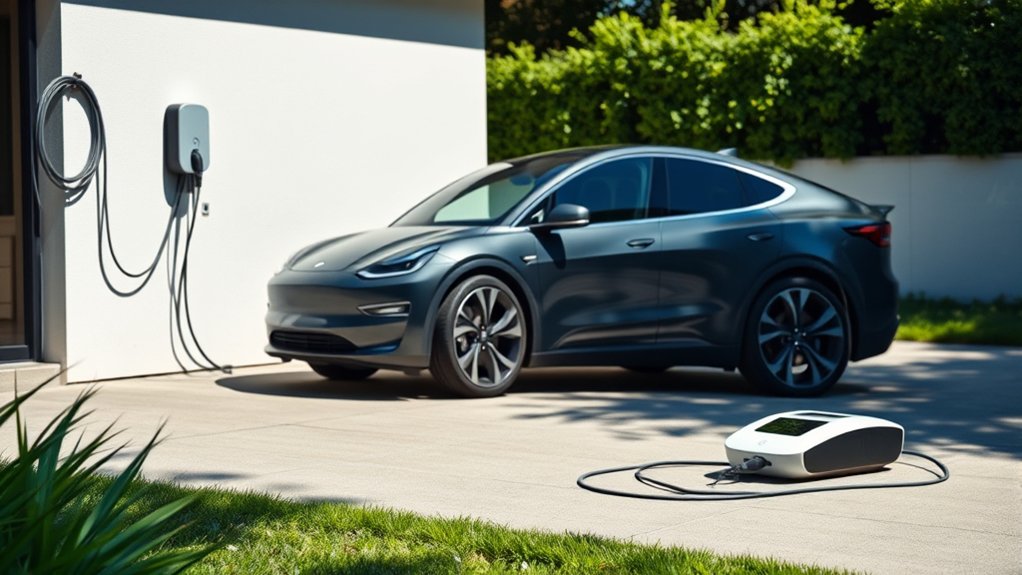
When deciding between portable and hardwired EV chargers, start with your living situation, parking setup, daily mileage, and available electrical capacity. A portable charger plugs into a compatible outlet, such as a standard 120V outlet for Level 1 charging or a 240V receptacle for faster Level 2 charging. A hardwired charger connects directly to a dedicated circuit and is fixed in place.
The U.S. Department of Energy’s Alternative Fuels Data Center explains that Level 1 charging uses a 120V AC plug and adds about 5 miles of range per hour, while Level 2 charging typically uses 240V service at home or 208V service in commercial locations and can add about 25 miles of range per hour, depending on the vehicle and charger.
For many home setups, a plug-in Level 2 charger on a 50A receptacle is set to a maximum of 40A continuous output. Many hardwired chargers can be configured for 48A on a properly sized 60A circuit, and some Level 2 systems can go higher when the charger, wiring, breaker, electrical service, and vehicle onboard charger all support it.
The best EV charger is not simply the fastest one. It is the charger your home can support safely, your vehicle can use efficiently, and your routine will actually benefit from every day.
Portable vs. Hardwired EV Chargers: Quick Comparison
| Factor | Portable Plug-In Charger | Hardwired Charger |
| Best For | Renters, travel, temporary setups, and homes with an existing approved outlet. | Homeowners, daily charging, outdoor installs, and higher-amperage Level 2 charging. |
| Portability | Easy to unplug and move if the next location has the correct outlet. | Fixed in place and not designed for relocation. |
| Typical Home Output | Often up to 40A on a 50A receptacle, if the circuit and charger allow it. | Often up to 48A on a 60A circuit, with higher options on some systems. |
| Safety Concern | Outlet quality, heat, GFCI requirements, plug wear, weather exposure, and cord strain. | Proper circuit sizing, breaker selection, installation quality, permits, and inspection. |
| Look | More visible plug and receptacle hardware. | Cleaner wall-mounted installation with fewer exposed connection points. |
Pros and Cons of Portable vs. Hardwired EV Chargers
Both charger types can work well when installed correctly. The right choice depends on whether you value mobility and lower setup friction or a permanent charging station with fewer plug-and-outlet wear points.
Flexibility and Portability
A portable EV charger gives you more flexibility because you can unplug it and take it with you. This is helpful if you rent, split time between two homes, plan to move soon, or want a backup cord for travel.
- Easy relocation: You can move the charger if another location has a compatible outlet.
- Good for renters: You may avoid permanent electrical changes if a safe outlet already exists and your lease allows use.
- Backup charging: A portable Level 1 cord can help in emergencies, even though it charges slowly.
- Lower commitment: You can start with portable charging before investing in a permanent station.
The tradeoff is that frequent plugging and unplugging can wear the receptacle, loosen connections, or increase heat if the outlet is not rated and installed for continuous EV charging use.
Installation Complexity and Cost
A hardwired EV charger is more permanent. It connects directly to your home’s electrical wiring on a dedicated circuit, so it usually requires a licensed electrician, permits, and inspection where your local authority requires them.
Hardwired units often cost more to install at first, but they can be worth it when you charge every day, park outdoors, want a cleaner setup, or need more amperage than a plug-in unit can safely provide. They also avoid the long-term wear that can happen at a heavily used receptacle.
Warning: Do not install a new 240V EV charging circuit, hardwire a charger, replace a breaker, or upgrade a panel unless you are qualified to do that work under local law. EV charging is a continuous high-load application, so poor installation can cause overheating, nuisance trips, shock hazards, fire risk, failed inspection, or insurance problems.
Installation Process: How to Install Your EV Charger
Before buying a portable or hardwired EV charger, review the charger manual, your vehicle’s maximum AC charging rate, your electrical panel capacity, and your local permit rules. If you are adding a new circuit, the safest route is to hire a licensed electrician who understands NFPA 70, the National Electrical Code, and your local amendments.
- Check your vehicle’s onboard charger: A 48A wall charger will not help if your vehicle can only accept 32A or 40A on AC power.
- Evaluate your electrical panel: Your electrician may need to perform a load calculation to confirm spare capacity.
- Choose plug-in or hardwired: Use plug-in if portability matters and a safe outlet is available. Use hardwired for a cleaner permanent setup or higher-output charging.
- Confirm circuit sizing: EV charging is a continuous load, so breaker, wire, and charger settings must match code and manufacturer instructions.
- Check GFCI and local rules: Plug-in installations often have specific GFCI requirements. Your local authority having jurisdiction has the final say.
- Use listed equipment: Choose a charger with recognized safety certification, weather rating for its location, and a cable length that reaches without strain.
- Schedule inspection if required: Many jurisdictions require a permit and inspection for a new 240V circuit or hardwired EV charger.
Pro Tip: Before choosing amperage, park your EV where it normally sits and measure the path from the wall to the charge port. A slightly slower charger with the right cable path is often better than a faster charger that leaves the cable stretched across a walkway.
Charging Speed: What to Expect From Different Chargers
Charging speed depends on charger output, circuit size, battery state of charge, battery temperature, vehicle efficiency, and the vehicle’s onboard AC charger. The wall charger supplies AC power, but the vehicle decides how much AC power it can accept.
Here is a practical way to compare common home charging setups:
- Level 1 portable charging: Uses a standard 120V outlet and is slow, often around 5 miles of range per hour under DOE assumptions.
- Level 2 plug-in charging: Commonly uses a 240V receptacle and may charge at 16A, 24A, 32A, or 40A depending on the charger and circuit.
- Level 2 hardwired charging: Often supports 40A or 48A at home, and some systems can support higher output if the electrical service and vehicle allow it.
- DC fast charging: This is mostly for public charging sites, road trips, and fleet locations. It is not the same as a home Level 2 charger.
The DOE notes that Level 2 charging equipment can range from 2.9 kW to 19.2 kW, so “portable versus hardwired” is not the only speed factor. The circuit, charger setting, and vehicle limit matter just as much.
Cost Comparison: Initial vs. Long-Term Expenses for EV Chargers
EV charger cost is more than the price of the box on the wall. The real cost includes the charger, permit, breaker, wire, conduit, labor, distance from the panel, outdoor protection, wall repairs, inspection, and possible panel or service upgrades.
Upfront Costs Analysis
A portable charger may be cheaper if you already have a safe, compatible outlet in the right location. But if you need a new 240V receptacle, the installation can cost as much as, or sometimes more than, a simple hardwired install.
A hardwired charger can cost more upfront because it usually requires professional installation. The price rises when the electrical panel is far from the parking spot, the garage is detached, trenching is needed, the panel has limited capacity, or local permits require extra work.
Long-Term Savings Potential
Both portable and hardwired home chargers can save money compared with relying only on public charging, especially if your utility offers off-peak electricity rates. Smart chargers and many EV apps let you schedule charging when electricity is cheaper.
Federal, state, local, and utility incentives may also reduce the total cost. The IRS Alternative Fuel Vehicle Refueling Property Credit can apply to qualified EV charging property, but the rules include eligible-location requirements. Check your address, tax situation, state programs, and utility rebate rules before assuming you qualify.
Note: A charger that qualifies for a rebate may need Wi-Fi, ENERGY STAR certification, utility enrollment, or professional installation. Read the rebate terms before you buy.
Safety Features of EV Chargers: Which Is Safer?
A hardwired charger is not automatically safe, and a plug-in charger is not automatically unsafe. The safer option is the one installed correctly with listed equipment, proper circuit sizing, correct breaker protection, sound wiring, weather-appropriate mounting, and inspection where required.
Hardwired chargers often have fewer connection points because they do not rely on a frequently used receptacle. That can reduce plug looseness and outlet wear over time. Plug-in chargers, however, can still be safe when the receptacle is high quality, properly installed, correctly protected, and not used beyond its rating.
- Use listed equipment: Look for recognized safety certification and consider ENERGY STAR certified EV chargers when smart-charging efficiency matters.
- Match charger settings to the circuit: Do not set the charger above what the breaker, wiring, and manufacturer instructions allow.
- Inspect receptacles: If a plug-in charger feels hot, smells burnt, trips breakers, or fits loosely, stop using it and call an electrician.
- Protect outdoor equipment: Use a charger and installation method rated for the location, weather, and mounting surface.
- Avoid extension cords: Most EV charger manufacturers prohibit extension cords because they add heat and failure points.
How Durable Are EV Chargers? What to Expect Long-Term
Hardwired EV chargers usually have the durability advantage because they stay fixed to the wall and do not depend on repeated plug-and-receptacle use. They are often the better choice for outdoor locations, daily charging, shared driveways, or garages where the charger will remain in place for years.
Portable chargers can still last a long time, but they face more handling, cord bending, plug wear, travel damage, and exposure to dirt or moisture. If you keep a portable charger in the trunk, protect the connector, avoid crushing the cable, and check the plug blades regularly.
For either style, inspect the cable, connector, wall unit, mounting hardware, and charging behavior every few months. If charging slows unexpectedly, the breaker trips repeatedly, or the connector gets hot, treat it as a warning sign rather than a minor annoyance.
Connector Compatibility: J1772, CCS1, NACS, and Adapters
Connector names can make EV charging confusing. In North America, many non-Tesla EVs use J1772 for Level 1 and Level 2 AC charging and CCS1 for DC fast charging. Tesla vehicles use the NACS connector, now standardized as SAE J3400. Many automakers are moving toward NACS/J3400, but the transition depends on brand, model year, and market.
For home charging, the connector on the cable must match your vehicle or work with an approved adapter. If you plan to keep your charger for many years, think about whether your current EV and your likely next EV will use J1772, NACS/J3400, or an adapter.
Note: Do not rely only on a generic online answer for vehicle connector type. Check your exact model year, trim, market, and owner’s manual, especially during the NACS/J3400 transition.
Flexibility vs. Permanence: Which Charger Suits Your Needs?
Choose a portable plug-in EV charger if you rent, expect to move, already have a properly installed outlet, need a travel-friendly charger, or drive low to moderate daily mileage. It gives you flexibility without locking the charger to one property.
Choose a hardwired EV charger if you own your home, charge daily, want faster Level 2 charging, park outdoors, want a cleaner look, or plan to keep the charger in the same place for years. It is also the better option when your local code, charger model, or desired amperage requires hardwiring.
For most long-term homeowners, a hardwired Level 2 charger is the stronger permanent solution. For renters and drivers who need mobility, a portable charger can be the smarter choice.
Final Decision Checklist
- Do you own or rent? Renters usually benefit from portable options unless the landlord approves a permanent install.
- How much do you drive daily? High-mileage drivers benefit more from faster Level 2 charging.
- Can your panel support it? Ask an electrician about panel capacity and load calculation before choosing amperage.
- Where do you park? Outdoor charging may favor hardwired, weather-rated equipment.
- Will you move soon? Portable charging may save money if the setup is temporary.
- Do you qualify for rebates? Check IRS, state, local, and utility rules before buying.
- What connector do you need? Confirm J1772, NACS/J3400, CCS1, and adapter needs for your exact vehicle.
Frequently Asked Questions
Should an EV charger be hardwired?
An EV charger should be hardwired if you want a permanent setup, higher amperage, fewer receptacle wear points, cleaner installation, or outdoor mounting. A plug-in charger can still be a good choice if you rent, move often, or already have a safe, code-compliant outlet.
What charger does the Chevrolet Equinox EV use?
Many North American Chevrolet Equinox EV model years use J1772 for Level 1 and Level 2 AC charging and CCS1 for DC fast charging. GM is also moving through the NACS/J3400 transition, so check your exact model year, market, and owner’s manual before buying a charger or adapter.
What stops someone from unplugging your electric car?
Many EVs lock the charging connector while the vehicle is locked or actively charging. You can also use charger settings, a cable lock, garage parking, driveway lighting, security cameras, or a charging location that keeps the cable away from public walkways.
What kind of charger does the Hyundai Kona Electric use?
In North America, many Hyundai Kona Electric model years use J1772 for Level 1 and Level 2 AC charging and CCS1 for DC fast charging. In other markets, connector types can differ. Hyundai and Kia are also transitioning some newer EVs to NACS/J3400, so verify your exact model year and market before choosing equipment.
Is a plug-in EV charger cheaper than a hardwired charger?
It can be cheaper if you already have the correct outlet in the right location. If you need a new 240V receptacle, permit, wiring, GFCI protection, or panel work, the cost may be similar to a hardwired installation. Always compare full installed cost, not just charger price.
Can I install an EV charger myself?
You can plug a portable charger into an existing approved outlet if the outlet, circuit, and charger instructions allow it. For a new 240V circuit, hardwired charger, panel upgrade, outdoor installation, or permit-required work, use a licensed electrician.
Conclusion
The best choice between portable and hardwired EV chargers depends on your home, driving habits, budget, and long-term plans. A portable charger gives you flexibility and can work well for renters or temporary setups. A hardwired charger is usually the better long-term choice for homeowners who want a cleaner, more durable, higher-output charging station.
Before you buy, check your vehicle’s AC charging limit, your electrical panel capacity, local permit rules, connector type, and rebate eligibility. If the setup needs new wiring, a new breaker, outdoor mounting, or a permanent connection, hire a licensed electrician and make sure the finished installation is code-compliant.
Sources
- U.S. Department of Energy Alternative Fuels Data Center: Electric Vehicle Charging Stations — backs Level 1, Level 2, DC fast charging, charging-speed ranges, and connector terminology.
- Internal Revenue Service: Alternative Fuel Vehicle Refueling Property Credit — backs federal EV charging property credit eligibility and location caveats.
- NFPA 70: National Electrical Code — backs electrical-code context for EV charger circuits and installation compliance.
- ENERGY STAR Certified Electric Vehicle Chargers — backs charger certification and efficient equipment selection.
- SAE J3400 North American Charging Standard — backs NACS/J3400 connector transition context.