
Scheduled charging and smart charging both help you control when your electric vehicle charges, but they are not the same thing. Scheduled charging follows a fixed time window you choose. Smart charging uses connected software, charger data, utility programs, or price signals to adjust charging more dynamically when conditions are better for your bill, battery needs, or the grid.
Quick Answer
Scheduled charging is best when your utility has simple off-peak hours and your routine is predictable. Smart charging is better when you want app control, utility program savings, demand-response features, or charging that can adjust automatically based on price, grid demand, and your departure time.
Key Takeaways
- Scheduled charging uses fixed start and stop times, so it works well with simple time-of-use electricity plans.
- Smart charging can add app control, remote monitoring, utility demand-response support, and automatic rate-aware adjustments when your charger, vehicle, and utility support those features.
- Neither method guarantees the same savings for every driver. Your results depend on your local rate plan, miles driven, EV efficiency, charger type, and plug-in habits.
- Avoid running both a vehicle schedule and a charger schedule unless you understand how they interact, because conflicting timers can stop charging unexpectedly.
Scheduled Charging: Definition and Function
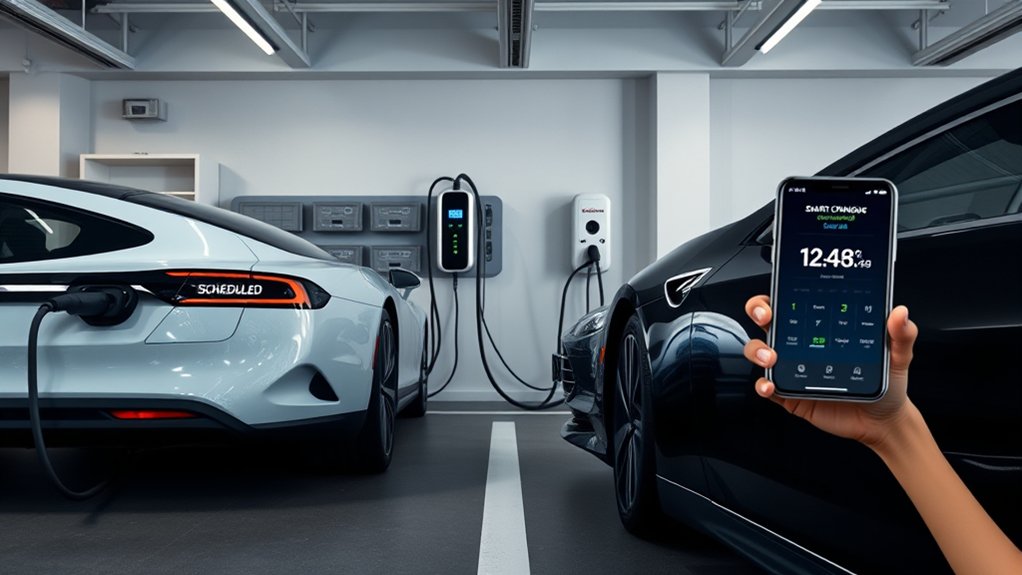
Scheduled charging means you tell your EV, charger, or charging app when to start and stop charging. For example, you may plug in at 7 p.m. but set charging to begin at midnight because your utility’s off-peak rate starts later.
This method is useful because many EV owners charge at home overnight, and the U.S. Department of Energy’s Alternative Fuels Data Center notes that actual residential charging cost depends on electricity price, equipment, time of day, and how long the charging station is used.
Scheduled charging works best when your utility rate is predictable. If your off-peak window is always 12 a.m. to 6 a.m., a simple schedule can move most of your charging into that cheaper window with little effort.
Pro Tip: Set the schedule in one place first, either in the car or in the charger app. If both have active timers, the charger may wait for the car while the car waits for the charger, leaving you with less range than expected.
Smart Charging: How It Optimizes Your Charging Time
Smart charging is a broader term. It usually means your charger, vehicle, utility, or charging network can exchange data and adjust charging based on more than a fixed clock time.
Some smart chargers only offer app-based scheduling and usage reports. More advanced connected chargers can support remote monitoring, remote control, demand response, price response, and utility savings programs. ENERGY STAR explains that some connected EV charger models can monitor and control charging remotely, and some can support demand-response features through open communication protocols.
What Smart Charging Can Adjust
Depending on your equipment and utility program, smart charging may adjust:
- when charging starts;
- how fast the vehicle charges;
- whether charging pauses during peak grid demand;
- whether charging resumes when electricity is cheaper;
- how charging fits your target departure time;
- how much energy is added before a set battery limit.
This does not mean every smart charger can automatically find the cheapest electricity on its own. Some chargers need your utility rate entered manually. Others need enrollment in a utility program. Some vehicles have stronger built-in charging controls than the wall charger itself.
Cost Optimization Strategies
To save money with either method, start with your rate plan. Look for peak, off-peak, super off-peak, demand charges, EV-only rates, and utility rebates. The best method depends on how your utility prices electricity.
A fixed schedule is often enough if your cheapest hours are the same every day. Smart charging becomes more useful if your rate changes by season, your utility offers demand-response rewards, or you want the charger to respond to price signals instead of relying on one fixed timer.
A 2025 study using EV telematics data found that smarter home charging schedules could reduce charging costs and emissions for many drivers, but the benefit depends on when the vehicle is plugged in, local electricity prices, and the owner’s driving needs.
Scheduled vs. Smart Charging: Key Differences
The biggest difference is control. Scheduled charging follows the time window you set. Smart charging can make more decisions for you, but only when your charger, car, app, and utility program support those features.
| Feature | Scheduled Charging | Smart Charging |
|---|---|---|
| Main control | Fixed start and stop times | Software-controlled timing, rate response, or utility signals |
| Best for | Simple off-peak rate plans | Variable rates, utility programs, solar, fleet charging, or demand response |
| User effort | Low after setup | Low to medium, depending on app setup and utility enrollment |
| Savings potential | Good when off-peak hours are predictable | Potentially higher when it can respond to rates, demand events, or renewable availability |
| Main drawback | Less flexible if rates or plans change | Needs compatible hardware, software, Wi-Fi, and sometimes utility participation |
Scheduling Flexibility
Scheduled charging gives you direct control. You pick the hours, plug in, and let the car or charger wait until the scheduled time. Most EV owners who have predictable commutes and a stable rate plan can get strong results with this basic setup.
Smart charging gives you more flexibility when your situation changes. For example, you may be able to override a schedule from your phone, delay charging during a utility peak event, or prioritize charging before an early departure.
Cost Efficiency
Cost efficiency depends less on the label and more on how well the method matches your rate plan. Scheduled charging can be very cost-effective if it reliably moves charging into lower-priced hours. Smart charging can improve on that when it can track changing rates or utility events.
Do not judge savings by one national dollar figure. A driver with a small battery, short commute, and flat-rate electricity may save little from scheduling. A driver with a long commute and a large peak-to-off-peak price gap may save much more.
Cost and Convenience Benefits of Scheduled Charging for EV Owners
Scheduled charging is simple, reliable, and easy to understand. Once you know your utility’s cheaper hours, you can set the vehicle or charger to start during that window.
The main benefits are:
- Predictable timing: You know exactly when the charging session should begin.
- Lower effort: You do not need to watch electricity prices every day.
- Good fit for overnight charging: Many EV owners can plug in after dinner and let the schedule handle the rest.
- Easy setup: Most modern EVs and many Level 2 chargers include basic timers.
Note: If you charge from a standard 120-volt outlet, scheduled charging may not leave enough time to recover your daily range. Level 2 charging is faster and is often a better fit for strict off-peak windows.
Smart Charging: Saving Money and Supporting the Grid
Smart charging can be especially helpful when many EVs are connected at the same time. Instead of every vehicle charging immediately after work, smart systems can spread charging across the night, reduce peak demand, and still aim to have vehicles ready by morning.
For the owner, the value is convenience plus better timing. For the grid, the value is load management. The International Energy Agency reports that home charging remains a major part of EV ownership where available, while public and private charging infrastructure continue to grow to support wider EV adoption.
Smart charging can also support cleaner charging when the program is designed to favor lower-emission hours or renewable energy availability. This depends on your region’s power mix and the data your charger or utility program can use.
Warning: Use safety-certified EV charging equipment and follow local electrical codes. If you install Level 2 charging, hire a qualified electrician and check permit requirements before installation.
Which Method Should You Choose?
Choose scheduled charging if your utility has a clear off-peak window, your commute is predictable, and you want a simple setup. This is the easiest option for many home EV owners.
Choose smart charging if your utility offers EV charging rewards, demand-response programs, seasonal rates, solar integration, or variable price signals. It is also useful if you want better app control and charging reports.
Use this quick decision guide:
- You have flat-rate electricity: Either method may work, but savings may be limited.
- You have fixed off-peak hours: Scheduled charging is usually enough.
- You have a utility smart-charging program: Smart charging may unlock rebates, bill credits, or better automation.
- You often leave at different times: Smart charging may be more convenient because it can adapt to departure settings.
- You use solar at home: Smart charging may help align charging with solar output if your charger or energy system supports it.
Troubleshooting Common Charging Schedule Problems
If your EV does not charge when expected, check these common causes before assuming the charger is broken:
- Two schedules are active: Disable either the vehicle timer or the charger timer and test again.
- The plug was not fully seated: Unplug and reconnect until the vehicle confirms the connection.
- The app lost connection: Check Wi-Fi, Bluetooth, cellular service, and charger status lights.
- The utility event paused charging: If you joined a demand-response program, the charger may delay charging during peak demand.
- The battery limit was reached: If your limit is set to 80%, the EV may stop before reaching 100%.
- The off-peak window is too short: Extend the charging window or use a higher-power Level 2 charger if your electrical system supports it.
User Feedback on Charging Methods: Preferences and Experiences
EV owners often prefer the method that feels predictable. Some drivers like scheduled charging because it is simple: plug in, walk away, and let the timer start overnight. Others prefer smart charging because they can check the session from an app, change the plan remotely, and receive energy-use reports.
The biggest frustration is usually compatibility. A vehicle app, charger app, and utility app may not always share the same settings. If your car says “ready by 7 a.m.” but your charger says “charge only after 1 a.m.,” the system may not behave the way you expect.
The best setup is the one you can trust. Test your schedule on a normal weeknight before relying on it before a long trip.
Which Charging Method Is More Cost-Effective?
For many drivers, scheduled charging is the most cost-effective starting point because it is simple and often built into the vehicle. If your utility has a fixed off-peak rate, a basic schedule may capture most of the savings available to you.
Smart charging can be more cost-effective when it has better data. That may include time-of-use rates, demand-response signals, solar production, battery target, and departure time. When those pieces work together, smart charging can reduce charging costs without forcing you to manually adjust the schedule every day.
The most accurate answer comes from your own bill. Compare your utility’s peak and off-peak price per kWh, estimate how many kWh your EV uses per month, and then calculate how much energy you can realistically shift into cheaper hours.
Frequently Asked Questions
Does smart charging really work?
Yes, smart charging can work well when your vehicle, charger, app, and utility program are compatible. It is most useful when it can respond to off-peak rates, demand-response events, or your target departure time. It is less useful if your electricity rate never changes or if your charger only offers a basic timer.
What is the 20/80 rule for charging?
The 20/80 rule is a common battery-care habit that means avoiding very low battery levels and charging to about 80% for normal daily use. It is not a universal law. Some EVs, especially models with different battery chemistries, may have different manufacturer guidance, so check your owner’s manual.
What are the drawbacks of smart EV charging?
Smart EV charging may require a more expensive charger, a stable Wi-Fi connection, an app account, compatible vehicle settings, and utility enrollment. Some programs may pause or delay charging during peak demand, so you should always set a clear departure time and know how to override the schedule.
Is it okay to use a 45W charger for a 25W phone?
For a modern USB-C phone, it is usually fine to use a higher-watt charger if the charger and cable are certified and the phone supports safe power negotiation. The phone should draw only the power it can accept. This is a phone-charging question, though, and it is separate from EV scheduled or smart charging.
Should I schedule charging in the car or in the charger app?
Start with one schedule only. If your car has strong departure-time controls, use the car. If your charger is tied to a utility program or special rate, use the charger app. Avoid using both until you test them together.
Can smart charging hurt my EV battery?
Smart charging should not hurt the battery when configured correctly. In many cases, it can help by limiting charge level, avoiding unnecessary 100% charges, and reducing charging during hot or high-demand periods. The bigger risk is poor setup, such as charging too late before a trip or ignoring your vehicle’s battery-care guidance.
Do I need a smart charger to use scheduled charging?
No. Many EVs have built-in scheduled charging, so you may be able to use a basic Level 1 or Level 2 charger and let the vehicle control the timing. A smart charger becomes more useful if you want app controls, energy reports, utility program support, or demand-response features.
Conclusion
Scheduled charging is the simpler choice when your routine and off-peak hours are predictable. Smart charging is the stronger choice when you want automation, app control, demand-response support, or rate-aware adjustments. The best method is not the one with the flashiest app. It is the one that reliably charges your EV before you leave while moving as much energy as possible into the lowest-cost, lowest-stress charging window available to you.
Sources
- U.S. Department of Energy Alternative Fuels Data Center: Charging Electric Vehicles at Home — supports home charging, Level 1/Level 2 charging, time-of-day cost factors, and utility incentives.
- ENERGY STAR: Electric Vehicle Chargers — supports smart charger features, safety certification, standby energy savings, and demand-response capability.
- International Energy Agency: Global EV Outlook 2025, Electric Vehicle Charging — supports current charging infrastructure context and the role of home charging.
- The Untapped Potential of Smart Charging — supports research-based discussion of cost and emissions reduction potential from smarter home charging schedules.
- Estimating the Benefits of Electric Vehicle Smart Charging at Non-Residential Locations — supports discussion of managed charging benefits for cost and peak-load reduction.