
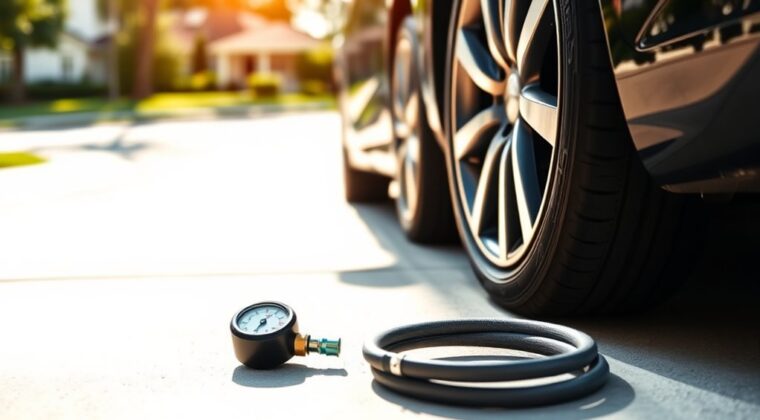
You should match each tire to your vehicle’s recommended PSI, not force all four to the same number. Check the driver’s door placard or owner’s manual for the correct cold tire pressure, since front and rear values can differ for handling, load, and weight balance. Use an accurate gauge, adjust in short bursts, and recheck monthly or before long trips. If you want, you can see how to read the placard and set pressure correctly.
Key Takeaways
- All four tires should match the vehicle’s recommended PSI, not necessarily each other’s maximum sidewall pressure.
- Check the door placard or owner’s manual for the correct front and rear tire PSI.
- Front and rear tires can require different PSI because vehicles distribute weight unevenly.
- Keep tire pressure close to the recommended target and avoid a spread greater than 3 PSI.
- Recheck pressure monthly, before trips, and after temperature changes or heavy loading.
Should All Four Tires Match?
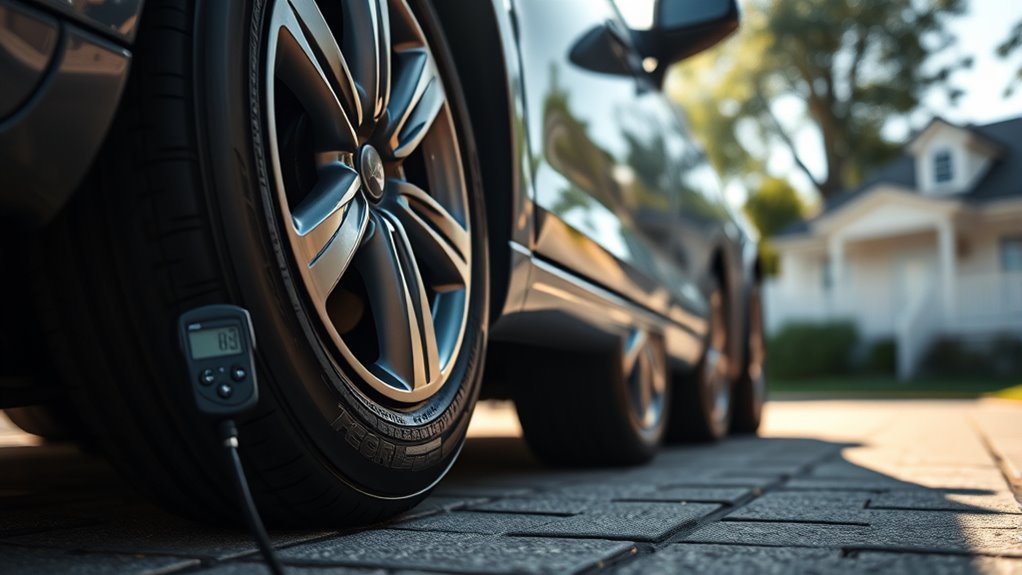
Yes—your tires should generally be set to the vehicle’s recommended PSI, which you’ll find on the door placard or in the owner’s manual.
You want all four tires close to the manufacturer’s recommended psi for balanced performance and safe driving conditions. In some vehicles, the front and rear pressures differ slightly because weight distribution changes load demands, especially on SUVs and trucks. A 1-2 psi variation is usually acceptable, but you should correct differences above 3 psi.
Equal tire pressure improves handling, steadies braking, and lowers the chance of blowouts. It also helps prevent uneven tire wear and avoids the sluggish response that underinflated tires create.
Equal tire pressure improves handling, braking, and tire life while reducing blowout risk and sluggish response.
Don’t confuse recommended tire pressure with maximum pressure stamped on the sidewall; maximum isn’t the target for normal use.
Check pressures regularly, adjust them when needed, and keep each tire within spec so you can drive with control, efficiency, and freedom.
How to Read the Tire Placard PSI?
To find the correct PSI, check the tire placard, usually mounted in the driver’s door jamb. This tire placard lists the manufacturer’s recommended pressure for your front tires and rear tires, along with the original tire size and load limits.
Read it as your baseline for tire pressure, not as a guess or a sidewall number.
- Confirm the cold tire pressure shown on the placard.
- Check your tires before driving, or after sitting at least three hours.
- Use the owner’s manual for load or condition adjustments.
Treat the listed psi as the operating target for your vehicle’s tire specifications.
Don’t use the maximum sidewall pressure as your goal; it’s the tire’s upper limit, not the recommended pressure. If you’re carrying heavy loads, the owner’s manual may call for added inflation.
Reading the placard correctly lets you set tire pressure with confidence, keep control, and move with freedom.
Why Front and Rear PSI Differ
Front and rear tire PSI often differ because your vehicle doesn’t carry weight evenly; in many front-heavy vehicles, the front tires need higher pressure to support the added load and maintain proper handling.
You should follow the vehicle placard or owner’s manual, because the listed front and rear PSI values reflect the manufacturer’s engineering for safety and control.
SUVs and trucks may need larger PSI gaps to match their load-carrying capabilities and suspension design.
If you ignore those differences, one axle can run underinflated, causing uneven wear and handling issues that reduce stability and traction.
Correct tire pressure also helps you preserve fuel efficiency, because properly supported tires roll with less resistance.
During tire rotation, keep track of each axle’s recommended PSI so you don’t blindly apply one number to all four tires.
Your freedom on the road starts with respecting the distinct demands of the front and rear.
How to Set Tire Pressure Correctly
Start with the owner’s manual or tire placard and set each tire to the listed PSI for its position and load, since front and rear values can differ. Use a tire gauge on cold tires before you drive; the recommended PSI for most new passenger vehicles is 30–35 PSI.
Check tire air pressure one tire at a time, and add air in short bursts so you don’t overshoot. Recheck after each adjustment until all tire pressures match spec. Tires lose air naturally, so your routine should stay disciplined and factual.
- Measure each tire separately with an accurate gauge.
- Inflate only to the owner’s manual target, not a guess.
- Correct any spread above 3 PSI to keep the car stable and properly inflated.
A 1–2 PSI difference is usually tolerable, but larger gaps can affect handling.
When to Recheck Tire Pressure?
Recheck tire pressure at least once a month, before long trips, and after major temperature swings, because PSI can change enough to affect handling and wear. You should check tire pressure when the tires’re cold, after three parked hours. Vehicles require different psi for every axle load; follow the manual, not guesswork. A Tire Pressure Monitoring System helps, but it doesn’t replace a gauge. Tires lose air over time, so inspect the valve stem and record readings.
| When | Action | Why |
|---|---|---|
| Monthly | Check tire pressure | Detect slow loss |
| Before trips | Recheck all tires | Improve safe guidance |
| Temperature shift | Measure again | PSI moves with heat |
| Load/towing | Adjust to spec | Match vehicles require |
| Routine service | Check spare | Avoid hidden risk |
Use a reliable gauge, then compare results with the manual. If readings drift, correct them immediately and keep your liberation through control.
Frequently Asked Questions
Should Tire Pressure Be the Same on All Four Tires?
No, you shouldn’t force all four tires to match exactly; you should follow your vehicle placard.
You’ll get tire pressure benefits from proper inflation techniques, seasonal tire adjustments, and pressure monitoring systems.
Watch for effects of underinflation, overinflation risks, tire wear patterns, and alignment effects.
Use emergency tire tips and tire maintenance practices, and check pressures often, since a 2 psi gap’s usually fine, but bigger differences need correction.
Will It Ruin Tires if You Inflate Them to 40 PSI Instead of 35 PSI When the Recommended PSI Is 35?
Yes, 40 psi can hurt your tires if you should run 35 psi; you’ll see performance impact, uneven wear, and possible handling issues.
Overinflation reduces tire longevity, can lower fuel efficiency, and raises safety concerns. You should check inflation accuracy, pressure monitoring, and temperature effects regularly, then follow manufacturer guidelines exactly.
If you keep them at 40 psi, you’re courting a harsher ride and faster tread-center wear.
Is It Safe to Drive With 80 PSI Tires at 65 PSI?
No, you shouldn’t drive with 80 psi tires and 65 psi tires. A 15 psi spread creates safety concerns, hurts handling stability, and can trigger uneven wear.
Since most passenger tires need just 30–35 psi, 80 psi is roughly double the norm.
Check tire pressure cold, follow manufacturer recommendations, and match load capacity.
Better pressure monitoring improves driving performance, fuel efficiency, and tire longevity while reducing blowout risk.
Does 2 PSI Make a Difference in Tire Pressure?
Yes, 2 psi can make a difference in Tire pressure.
You’ll usually notice subtle Safety implications in Handling stability, Fuel efficiency, and Driving comfort, especially when Temperature effects or Load capacity shift.
Over time, small gaps alter Wear patterns and can shorten Tire lifespan.
Keep pressures within 1–2 psi of spec, check them cold, and use regular Maintenance tips so you stay in control, with less waste and more freedom.
Conclusion
So, should all four tires have the same PSI? Not always. You should follow your vehicle’s tire placard, since front and rear pressures can differ for handling, load, and safety. Check pressure when tires are cold, use a reliable gauge, and adjust each tire to the specified PSI. Recheck regularly, especially with temperature changes. Think of tire pressure like a balancing act: each tire needs the right setting, not just the same one, to keep your ride stable and safe.