
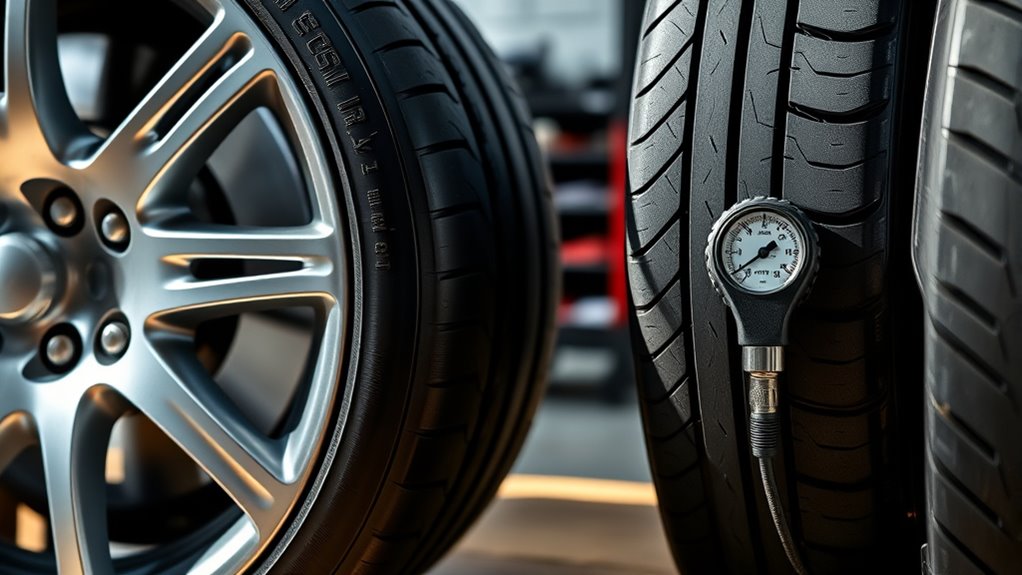
Built-in tire gauges give you real-time pressure feedback while you inflate, so you can stop at the target quickly and avoid overfilling. Separate tire gauges are better when you want higher precision, clearer readability, and a baseline check before adding air. They’re also usually more durable and easier to calibrate. If you want simple inflation control, choose built-in; if you want tighter measurement and better long-term reliability, choose separate, and the details get even more useful.
Key Takeaways
- Built-in tire gauges provide real-time pressure feedback during inflation and often include automatic shut-off to help prevent over-inflation.
- Separate tire gauges let you check pressure before inflation, giving a more accurate baseline reading.
- Separate gauges are typically more precise, often offering digital, analog, or pencil styles with tighter accuracy.
- Built-in gauges are convenient and fast, but separate gauges are usually more readable, durable, and better for repeated use.
- Separate gauges are easier to store and replace, while built-in gauges may require replacing the entire inflator if they fail.
Built-In vs Separate Tire Gauges
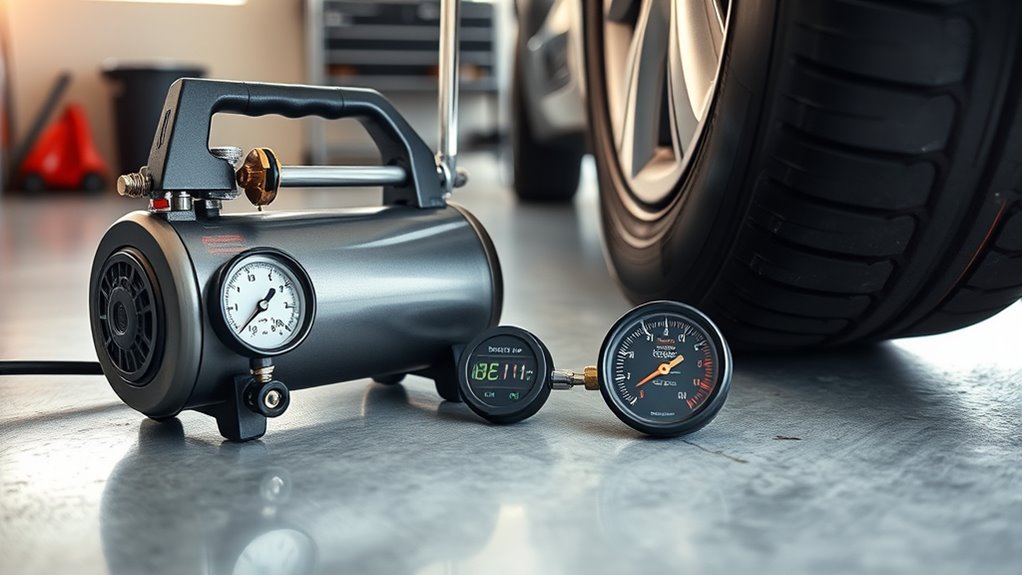
Built-in tire pressure gauges give you immediate feedback during inflation, which is convenient, but separate gauges are usually the better choice when accuracy matters. With built-in gauges on tire inflators, you can adjust pressure on the spot, yet you’re still tied to the tool’s accuracy levels and its operating conditions.
Separate tire pressure gauges let you perform pre-checks before inflation, so you can verify the baseline without dependence on the inflator. That freedom improves consistency across vehicles and use cases.
You’ll also find broader options in separate tire pressure gauges: analog, digital, and pencil styles, each suited to different accuracy levels and preferences.
Standalone models generally deliver tighter precision readings, sometimes down to 0.01 psi, which matters when you need exact pressure control. They also tend to offer better durability, since they’re built for repeated use in harsher environments.
If you want reliable measurement, choose the tool that prioritizes measurement, not convenience.
How Built-In Tire Gauges Work
When you use an inflator with an integrated gauge, it measures tire pressure in real time as air enters the tire, so you can monitor and adjust pressure without switching tools.
Built-in gauges in tire inflators use electronic sensors to convert pressure into an electrical signal, then show the result on a digital screen. That lets you verify inflation against the target pressure range, typically 0 to 150 psi for passenger vehicles and light trucks.
You can keep control of the process because the automatic shut-off function stops the compressor once your preset level is reached, reducing over-inflation risk.
Many units also use backlit displays, which make readings clear in low light and convenient for nighttime use.
With this setup, you stay in command of your tire maintenance, gain faster feedback, and avoid dependence on separate measuring steps.
Why Separate Gauges Are Easier to Read
Separate tire pressure gauges usually give you a larger, clearer display, so you can read pressure values quickly without straining to interpret a small dial or screen.
If you’re checking tires in dim conditions, many standalone digital gauges also use backlit displays, which improves visibility and reduces reading errors.
That combination of display size and illumination makes separate gauges easier to read than many built-in options.
Clearer Displays
A separate tire pressure gauge usually gives you a clearer reading because its display is larger, less cluttered, and easier to view at a glance. With separate gauges, you get clearer displays that support accurate checks without visual strain.
- Digital models can show pressure to 0.1 psi, improving precision.
- Analog gauges use wider dials and bold markings, boosting readability.
- Ergonomic design helps you angle the tool for clean viewing.
- Built-in gauges often compress data into smaller screens, reducing clarity.
When you choose separate gauges, you reduce interface noise and read the number faster. That matters when you want control, efficiency, and freedom from guesswork.
Their layout keeps the important data front and center, while built-in gauges can hide it in a tighter format.
Better Low-Light Visibility
In low light, a separate tire pressure gauge is usually easier to read because it gives you a larger, brighter display with stronger contrast than most built-in gauges. That means better low-light visibility when you’re checking pressure at night or in a dim garage.
| Type | Visibility | Use case |
|---|---|---|
| Digital models | Backlit displays | Fast night checks |
| Analog gauge | Glow-in-the-dark dials | No power needed |
| Built-in gauge | Smaller screens | Limited clarity |
You can position the gauge for a clean viewing angle, and that ergonomic control makes readings easier to read. A dedicated, reliable tool supports accurate tire pressure monitoring and reduces guesswork. When lighting drops, separate gauges give you the visual freedom built-in units often deny.
Accuracy, Durability, and Ease of Use
When you compare accuracy, separate tire pressure gauges usually have the edge, with digital models often reading to within ±0.1 psi, while built-in gauges commonly fall around ±1 psi. That precision matters when you want disciplined tire pressure control.
Separate gauges also improve durability through rugged housings and protective cases, so drops and shop abuse won’t cripple them as easily as built-in gauges integrated into inflators. Their ease of use is also stronger: you can check pressure instantly without powering a compressor.
Separate gauges offer rugged durability and quick, compressor-free checks, making tire pressure monitoring easier and more reliable.
- Accuracy: separate gauges reduce measurement error.
- Durability: cases and robust shells resist damage.
- Ease of use: quick checks save time.
- Readability and calibration: backlit displays help you see values, and you can recalibrate or replace separate gauges if they drift.
Built-in gauges can work, but if they fail, you may need to replace the whole unit.
Which Gauge Fits Your Driving Style?
Which gauge fits your driving style depends on how much precision you need and how often you check tire pressure.
If you want fast verification during routine maintenance, built-in gauges inside inflators or compressors can serve you well, especially when convenience matters more than exactness. For casual use, they free you from extra tools and keep your workflow simple.
But if you demand precise readings, separate tire pressure gauges give you stronger accuracy across vehicle type and pressure ranges, often from 0 to 200 PSI. Their digital counterparts can resolve 0.1 PSI, which matters when you tune pressures for performance or load.
You also gain better durability, since quality separate tire pressure gauges resist impact and stay reliable longer.
How to Pick the Right Tire Gauge
When you pick a tire gauge, match the gauge type to your need for precision and ease of use: digital models usually give tighter readings, while analog models are simpler and tougher.
You should verify that the measurement range fits your vehicle, with most cars needing 0–60 psi and larger vehicles often requiring up to 200 psi. Also, check that the display stays readable in your usual conditions.
For reliable performance, choose a compact gauge with durable construction. Then calibrate it regularly and replace it if wear starts to affect accuracy.
Gauge Type Matters
Gauge type matters because each design trades off accuracy, durability, readability, and convenience.
You should match the gauge type to your tire pressure needs and your vehicle’s demands for proper inflation.
- Digital gauges: You get high accuracy, often from 1 to 150 psi, and some read to 0.1 psi for performance use.
- Analog gauges: You gain rugged simplicity; Bourdon tube models don’t need batteries and handle abuse well.
- Stick gauges: You save money and space, but you accept lower accuracy for casual tire pressure checks.
- Built-in bleeder: You can fine-tune pressure quickly, then verify the reading without wasting time.
Choose the tool that lets you measure tire pressure clearly, act decisively, and stay in control.
Readability And Accuracy
Accuracy and readability should drive your choice because the right gauge only helps if you can trust the number and see it quickly.
If you use a built-in gauge, treat convenience as secondary; a separate gauge usually delivers tighter accuracy for a cleaner pressure reading. Digital models often give ±0.1 psi precision and backlit readability, which helps when you need exact control.
Analog gauges can be easier to scan and plenty adequate, but their accuracy can drift near ±1 psi. You should pick the display you can read without hesitation, then verify it stays calibrated against a known standard.
That testing keeps both built-in and separate tools honest, so you’re not guessing. When precision matters, choose digital; when simple visibility matters, analog can work well.
Range And Durability
To choose the right tire pressure gauge, match its measurement range to your use case: racing setups may only need 0 to 30 psi, while commercial vehicles may require coverage up to 0 to 160 psi.
A gauge with proper pressure ranges keeps you calibrated accurate and supports maintaining peak tire performance.
- Pick durable construction: brass and rubber handle impact better than cheap plastics.
- Choose digital if you need 0.1 psi resolution; analog can still work at ±1 psi.
- Use a built-in bleeder valve for fast, precise adjustments without removal.
- Favor a compact gauge if you store it in a trunk.
You deserve tools that resist wear, read true, and let you tune pressure freely.
Frequently Asked Questions
What Type of Tire Pressure Gauge Is Most Accurate?
Digital tire pressure gauges are usually the most accurate, giving you about ±0.1 psi digital accuracy.
You’ll get better pressure consistency than with analog precision, especially if you calibrate the gauge regularly and watch for temperature effects.
For tire maintenance, a quality standalone gauge beats most built-ins.
Your user preferences matter, but gauge longevity often favors trusted professional models that stay reliable and let you measure with confidence.
What Is the 4 PSI Rule on Tires?
The 4 PSI rule means you check tire pressure when your tires’re cold, since driving can raise pressure about 4 PSI; nature, ever generous, loves to mock precision.
You use it for tire pressure maintenance, ideal tire inflation, and tire pressure monitoring.
It supports seasonal tire adjustments, debunks tire pressure myths, and improves tire safety tips.
You should also note tire performance factors, gauge calibration importance, and underinflation risks.
Are Digital or Analog Tire Pressure Gauges Better?
Digital tire pressure gauges are usually better for you if you want precision, display clarity, and easy reading, especially in low light.
You’ll get digital advantages like finer resolution, but you should weigh battery life and price comparison.
Analog gauges still offer strong analog reliability, no batteries, and rugged simplicity.
Your best choice depends on user preference, ease of usage, and the measurement range you need for your tire checks.
What Is the 5 PSI Rule?
The 5 PSI rule says you should check tire pressure cold, before driving, because heat can raise it about 1 PSI per 10°F.
You’ll use this for tire maintenance tips, seasonal pressure adjustments, and tire inflation techniques.
It helps you avoid common gauge mistakes and tire pressure myths, while emphasizing the importance of accuracy, gauge calibration methods, and pressure monitoring systems.
Keep your tires within 5 PSI of spec for safety.
Conclusion
In the end, you’ll get the best results when you compare how your vehicle’s built-in gauge and a separate tire pressure gauge perform in real use. Built-in systems are convenient, but a quality handheld gauge usually gives you a clearer, more reliable reading. If you check pressures regularly, the right tool can feel like a thousand tiny wins for safety, efficiency, and tire life. Choose the gauge that matches your accuracy needs, driving habits, and maintenance routine.

