
Charging your electric vehicle affects your carbon footprint, but the impact is not the same everywhere. It depends on your local electricity mix, your EV’s efficiency, the charger’s losses, and the time you plug in. A cleaner grid, a more efficient vehicle, and smarter charging habits can lower emissions without changing how far you drive.
Quick Answer
EV charging usually has a much lower carbon footprint than driving a gasoline vehicle, but the exact number depends on your grid. Using EPA national-average electricity data and a 3.6 miles-per-kWh EV estimate, charging produces about 0.23 lb CO2e per mile, compared with about 0.87 lb CO2e per mile for the average gasoline passenger vehicle.
Key Takeaways
- EVs have zero tailpipe emissions, but the power used to charge them can still create upstream emissions.
- Your local grid matters more than the national average, so use EPA Power Profiler or your utility’s fuel-mix data to check your area.
- The cleanest charging time is not universal. Midday can be cleaner in solar-heavy areas, while some wind-heavy grids may be cleaner overnight.
- A more efficient EV, steady Level 2 home charging, and renewable electricity can reduce emissions per mile.
- Battery manufacturing adds upfront emissions, but EVs typically have lower lifetime greenhouse gas emissions than comparable gasoline vehicles.
The Basics of EV Charging Carbon Footprint
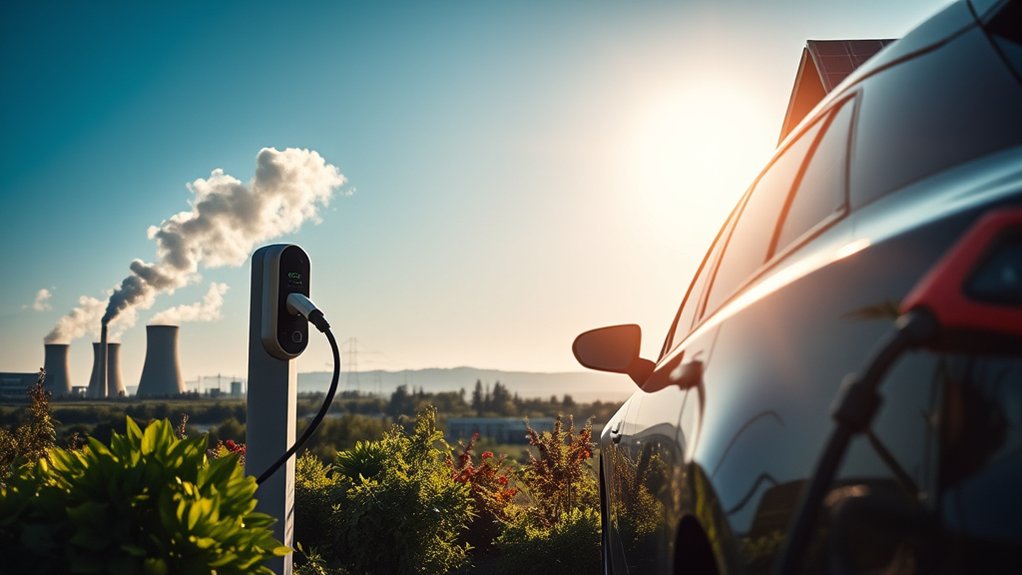
When you charge an electric vehicle (EV), the vehicle itself produces no tailpipe emissions. The carbon footprint comes from the electricity used to charge the battery, plus upstream emissions from producing and delivering that electricity. The U.S. Department of Energy Alternative Fuels Data Center explains that EVs have zero direct emissions, but electricity production can create emissions depending on the power source.
The simplest way to estimate charging emissions is:
EV charging emissions per mile = electricity emissions per kWh ÷ your EV’s miles per kWh.
For example, EPA’s national electricity factor for energy use is 823.1 lb CO2 per megawatt-hour, which equals about 0.823 lb CO2 per kWh. If an EV averages 3.6 miles per kWh, the charging footprint is about 0.23 lb CO2 per mile. EPA’s gasoline passenger vehicle estimate is about 0.87 lb CO2e per mile, so the average EV charging footprint is much lower than the average gasoline vehicle.
That does not mean every charging session has the same impact. A driver charging from a coal-heavy grid can have higher emissions than a driver charging from hydro, wind, solar, nuclear, or a cleaner regional mix. The difference is why local electricity data matters.
How Electricity Sources Impact EV Emissions
The cleaner the electricity, the lower your EV charging emissions. Wind, solar, hydro, and nuclear power have very low direct operating emissions, while coal and natural gas produce carbon dioxide when used to generate electricity. The real-world grid is usually a mix of these sources.
According to the U.S. Energy Information Administration, U.S. utility-scale electricity generation in 2023 was about 60% fossil fuels, 18.6% nuclear, and 21.4% renewables. That national mix is useful as a baseline, but it does not tell you what happens in your city, state, or utility territory.
Note: Do not assume the national grid average matches your charging footprint. EPA’s eGRID data and Power Profiler are better tools for checking regional electricity emissions.
Here is a practical way to compare the impact:
| Charging or driving source | What it means | Approximate emissions |
|---|---|---|
| Renewable-backed charging | Best when your electricity comes from verified solar, wind, hydro, or a green utility plan | Very low operating CO2 |
| U.S. average grid example | Uses EPA national-average electricity factor and 3.6 miles per kWh | About 0.23 lb CO2 per mile |
| Fossil-heavy regional grid | Emissions rise when coal or gas supplies a larger share of electricity | Can be much higher than the U.S. average |
| Average gasoline passenger vehicle | EPA comparison point for gasoline use | About 0.87 lb CO2e per mile |
A coal-heavy grid can shrink the EV advantage and may compare poorly against very efficient hybrids. Still, EPA states that EVs typically have a smaller carbon footprint than gasoline cars, even when charging electricity is included.
How Grid Mix Affects EV Charging Emissions
Your grid mix is the blend of energy sources used to make electricity in your area. It can include natural gas, coal, nuclear, hydro, wind, solar, biomass, and other sources. Because each region uses a different blend, two drivers with the same EV can have different charging footprints.
There are two grid concepts worth knowing:
- Average emissions: The average carbon intensity of electricity over a period of time. This is useful for estimating your yearly charging footprint.
- Marginal emissions: The emissions from the power plants that respond when electricity demand changes. This can matter when you decide what time to charge.
For most drivers, the practical move is simple: check your local electricity profile, then shift charging toward cleaner hours when your utility or charging app provides that information. If your utility offers a renewable electricity plan, community solar, or verified green power option, those can reduce the footprint of home charging.
Pro Tip: If your EV app or charger lets you schedule charging, set it to finish shortly before you leave. This can reduce idle battery conditioning time and lets you target cleaner or cheaper utility windows.
Why Does Charging Time Matter for Emissions?
Charging time matters because the grid changes throughout the day. In solar-heavy regions, midday and early afternoon may have cleaner electricity because solar production is high. In wind-heavy regions, overnight charging may be cleaner during windy periods. In other places, the cleanest time may shift by season, weather, and demand.
This is why “off-peak” and “low-carbon” are not always the same thing. Off-peak hours are usually cheaper because demand is lower, but the lowest-cost hour is not guaranteed to be the cleanest hour. Some utilities now provide time-of-use rates, demand-response programs, or cleaner-energy charging signals that make scheduling easier.
For home charging, a good priority order is:
- Use your utility’s cleanest charging window if it publishes one.
- Charge during solar-rich daytime hours if your local grid has strong solar generation and your schedule allows it.
- Use off-peak charging when your main goal is reducing grid strain and cost.
- Pair charging with home solar or a green utility plan when available.
How Efficient Is Your Electric Vehicle?
Your EV’s efficiency has a direct effect on charging emissions. A vehicle that travels 4 miles per kWh uses less electricity per mile than one that travels 2.5 miles per kWh. Less electricity per mile means fewer emissions per mile when the grid mix is the same.
EV efficiency changes with speed, temperature, tire pressure, terrain, cargo weight, and use of heating or air conditioning. Cold weather can increase energy use because the battery and cabin may need heat. Highway driving can also reduce efficiency because aerodynamic drag rises with speed.
Charging Efficiency Factors
Charging is not 100% efficient. Some energy is lost as heat, and some is used by the vehicle’s onboard electronics while charging. FuelEconomy.gov notes that battery charging efficiency can vary, but it is often in the 84% to 93% range.
Level 2 home charging is often a strong balance for efficiency, convenience, and battery health. Level 1 charging can be useful for low daily mileage, but it may spend more time running vehicle electronics. DC fast charging is helpful on road trips, but it can add heat and may be less efficient in some conditions.
Vehicle Energy Consumption
EVs are much more energy-efficient than gasoline vehicles. EPA states that EVs use about 87% to 91% of battery energy for propulsion and regenerative braking, while gasoline vehicles convert about 16% to 25% of gasoline energy into movement. FuelEconomy.gov also explains that EVs convert more than 77% of electrical energy from the grid to power at the wheels, compared with 12% to 30% for conventional gasoline vehicles.
That efficiency is the main reason EVs often produce lower emissions per mile even when the grid still uses fossil fuels. If your EV is efficient and your electricity is getting cleaner over time, your charging footprint can keep improving without replacing the vehicle.
What Are the Lifecycle Emissions of EVs?
Lifecycle emissions include more than charging. They cover raw material extraction, battery and vehicle manufacturing, electricity or fuel production, driving, maintenance, recycling, and disposal. The DOE AFDC describes this as cradle-to-grave emissions, which include both fuel-cycle and vehicle-cycle emissions.
EVs usually start with higher manufacturing emissions than comparable gasoline vehicles because battery production is energy-intensive. After purchase, the EV’s lower operating emissions gradually offset that upfront impact. The break-even point depends on battery size, electricity mix, driving efficiency, annual mileage, and the gasoline vehicle used for comparison.
The cleanest EV is not just the one with the biggest battery. It is the one that fits your range needs, uses electricity efficiently, and charges from the cleanest practical power source.
A larger battery can be useful if you need long range, tow, or drive in remote areas. But buying far more battery than you need can increase manufacturing emissions and vehicle weight. For many drivers, the best carbon choice is a right-sized EV with enough range for daily use and occasional trips.
Why Renewable Energy Matters for EV Owners
Renewable electricity can greatly reduce the carbon footprint of EV charging. If you charge from home solar during production hours, join a community solar program, or enroll in a verified renewable utility plan, you can lower the emissions tied to your charging.
That said, “renewable” claims should be specific. A rooftop solar system that charges your car directly during the day is different from buying renewable energy certificates or joining a green-pricing plan. All can support cleaner energy, but they do not work the same way for real-time charging emissions.
Lower Carbon Emissions
Charging with cleaner electricity reduces emissions per mile. In low-carbon regions, an EV’s operating footprint can be very small. In fossil-heavy regions, the footprint is higher, but EVs still benefit from efficient electric drivetrains and from future grid improvements.
The grid is also changing. More renewable generation, battery storage, and cleaner power plants can reduce EV emissions over the life of the vehicle. A gasoline vehicle’s per-gallon emissions do not improve in the same way unless you change the fuel or the vehicle.
Sustainable Charging Practices
Sustainable charging is about using less electricity per mile and choosing cleaner electricity when you can. You do not need a perfect setup to make progress.
- Charge at home when possible so you can schedule sessions and avoid unnecessary fast charging.
- Use renewable energy through rooftop solar, community solar, or a verified utility green-power program.
- Improve driving efficiency by keeping tires properly inflated and reducing unnecessary cargo weight.
- Precondition while plugged in when your EV supports it, especially in cold weather.
- Choose a right-sized EV instead of buying a much larger battery than your driving pattern requires.
Practical Steps to Reduce EV Charging Emissions
To reduce emissions from EV charging, start with the choices that give the biggest impact and are easiest to repeat.
- Check your local grid mix. Use EPA Power Profiler, eGRID, your utility’s fuel-mix disclosure, or a charging app with carbon-intensity data.
- Schedule charging for cleaner hours. Use solar-rich daytime hours, wind-rich overnight hours, or utility-recommended low-carbon windows when available.
- Use Level 2 charging for daily charging. It is usually faster and often more efficient than Level 1 for regular home use.
- Limit DC fast charging to when you need it. Fast charging is convenient for trips, but home or workplace charging is usually easier to schedule and manage.
- Pick renewable electricity options. Home solar, community solar, and verified green utility programs can lower your charging footprint.
- Drive efficiently. Smooth acceleration, moderate highway speed, proper tire pressure, and less extra weight all reduce kWh per mile.
- Choose the right battery size. A battery that fits your real driving needs can reduce unnecessary manufacturing emissions and weight.
Note: If you drive a plug-in hybrid, your emissions depend heavily on how often you charge and how much you drive in electric mode. A PHEV that rarely gets plugged in will behave more like a gasoline hybrid than an EV.
Frequently Asked Questions
Can charging in different locations affect my EV’s carbon footprint?
Yes. Charging in different locations can change your EV’s carbon footprint because each region uses a different electricity mix. A charger supplied by a cleaner grid, workplace solar, or a verified renewable plan will usually have lower emissions than one supplied by a fossil-heavy grid.
How does battery size influence charging emissions?
Battery size affects lifecycle emissions more than the emissions from one charging session. A larger battery usually requires more materials and manufacturing energy. It may also add vehicle weight, which can reduce efficiency. Choose enough range for your real driving needs, but avoid paying for far more battery than you will use.
Do fast chargers produce higher emissions than regular chargers?
The charger itself is not the main factor. The biggest factors are the electricity source, charging losses, battery temperature, and the time of day. DC fast charging can add heat and may be less efficient in some conditions, but a fast charger powered by clean electricity can still have a low carbon footprint.
Are there specific times when charging is cleaner?
Yes, but the cleanest time depends on your grid. Midday can be cleaner in solar-heavy areas. Overnight can be cleaner in some wind-heavy areas. In other regions, the cleanest window changes by season or demand. Check your utility, charging app, or regional grid data instead of assuming one rule fits everywhere.
How can I find my local grid’s energy mix?
Use EPA Power Profiler, EPA eGRID data, your electric utility’s fuel-mix disclosure, or your regional grid operator’s dashboard. Entering your ZIP code in EPA Power Profiler is one of the easiest ways to see your regional electricity emissions profile.
Does home solar make EV charging carbon-free?
Home solar can make charging much cleaner, especially when your EV charges while the panels are producing power. It is not completely carbon-free on a lifecycle basis because solar panels, batteries, inverters, and the EV itself require manufacturing, but it can greatly reduce operating emissions.
Is an EV still cleaner if my state uses coal or natural gas?
Usually, yes compared with the average gasoline vehicle, but the advantage is smaller on a fossil-heavy grid. Your result depends on your EV’s efficiency, local power plants, charging time, and the gasoline vehicle used for comparison. Use a ZIP-code-based calculator for the most accurate estimate.
Conclusion
EV charging is usually much cleaner than burning gasoline, but your carbon footprint depends on how the electricity is made and how efficiently your vehicle uses it. The best approach is practical: check your local grid mix, charge during cleaner hours when possible, use renewable electricity if you can, and choose an EV that fits your real range needs. Small charging choices can add up over thousands of miles.
Sources
- U.S. EPA: Electric Vehicle Myths — backs up EV vs gasoline climate comparison and EV efficiency figures.
- U.S. Department of Energy AFDC: Emissions from Electric Vehicles — explains direct, well-to-wheel, and cradle-to-grave emissions.
- U.S. EPA eGRID — source for regional electricity emissions and grid resource mix data.
- U.S. EPA Power Profiler — tool for checking local electricity emissions by region.
- FuelEconomy.gov: All-Electric Vehicles — backs up EV energy efficiency and charging-efficiency context.
- U.S. Energy Information Administration: U.S. Electricity Generation by Source — backs up U.S. electricity generation mix data.