
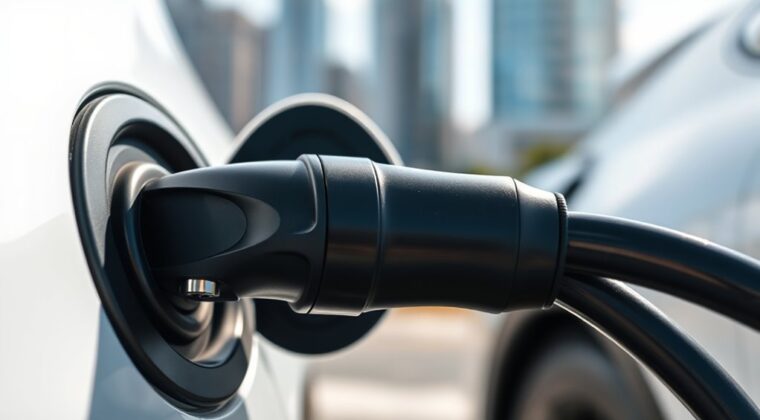
An EV charging cable is the cord assembly that connects your electric vehicle to charging equipment so power can move safely into the battery. The right cable depends on your vehicle inlet, the charging level, your region, the cable’s amperage rating, and whether you are using AC charging or DC fast charging.
Quick Answer
An EV charging cable connects your electric vehicle to an EV charger or charging station. For home charging, most drivers use Level 1 or Level 2 AC cables. For public fast charging, the cable is usually attached to the station and uses CCS, CHAdeMO, or J3400/NACS, depending on your vehicle.
Key Takeaways
- Level 1 uses a 120-volt outlet and is slow but simple for light daily driving.
- Level 2 uses 240-volt or 208-volt service and is the best fit for most home and workplace charging.
- DC fast charging uses station-attached cables and can add range much faster, but your vehicle controls the maximum speed it can accept.
- Connector type matters. In North America, common connectors include J1772, CCS1, and J3400/NACS. In Europe, Type 2 and CCS2 are common.
- Never use a damaged cable, hot connector, loose plug, or unapproved adapter.
At a Glance
| Time Required | 5 to 10 minutes to check your vehicle inlet, charger label, cable rating, and manual |
| Difficulty | Easy for compatibility checks; professional installation required for many Level 2 home setups |
| Tools Needed | Owner’s manual, charger label or app, vehicle charge-port label, and the cable’s amperage rating |
| Cost | No cost to inspect compatibility; replacement cables and portable EVSE units vary by rating, length, certification, and brand |
What Is an EV Charging Cable?
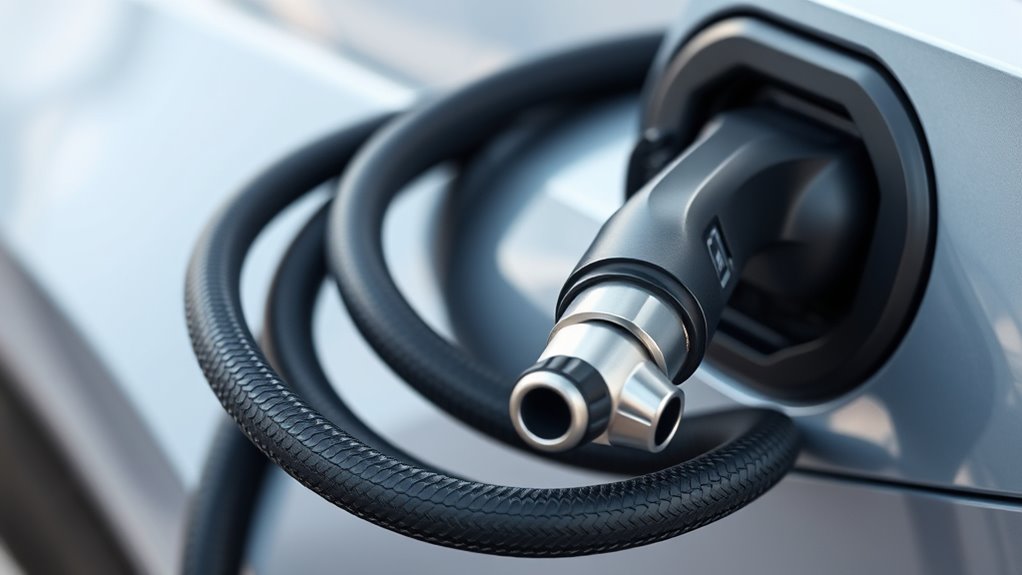
An EV charging cable is the flexible cord and connector assembly used to link your electric vehicle to electric vehicle supply equipment, often called EVSE. In everyday speech, many people call the whole setup a charger, but the terms are not exactly the same.
The charging station or EVSE manages the safe power supply. The cable carries power and communication signals. The connector is the plug end that fits your vehicle’s charging port.
For AC charging, the vehicle’s onboard charger converts AC power into DC power for the battery. For DC fast charging, the conversion happens in the station, so DC power goes to the battery much faster. The U.S. Department of Energy’s Alternative Fuels Data Center explains that charging time depends on battery size, state of charge, vehicle charger capacity, charging level, charger output, and electrical service specifications.
You can review the DOE’s charging-level overview here: Alternative Fuels Data Center EV charging stations guide.
Note: A cable that physically fits is not always the right cable. You still need to match the connector type, charging level, amperage rating, adapter approval, and your vehicle’s limits.
How Does an EV Charging Cable Function?
An EV charging cable does more than carry electricity. It also helps the vehicle and charging equipment communicate before full power flows. This communication confirms that the connector is seated, the vehicle is ready, the cable can handle the current, and the charging equipment can supply power safely.
When you plug in, the system checks the connection first. Then the charger and vehicle agree on how much current can flow. If the vehicle is full, the connector is loose, the cable overheats, or a fault is detected, the charging session can slow down or stop.
Key Components Explained
The most important parts of an EV charging cable are the conductors, insulation, connector body, safety ground, and signal pins. Together, they allow charging to start, continue, slow, or stop safely.
| Component | What It Does | Why It Matters |
|---|---|---|
| Conductors | Carry electrical current | Must be sized for the cable’s amperage rating |
| Insulation and jacket | Protect against shock, abrasion, moisture, and heat | Cracks, cuts, swelling, or melted spots mean the cable should not be used |
| Connector | Fits the vehicle charge port | Determines compatibility with J1772, CCS, J3400/NACS, Type 2, CCS2, or CHAdeMO |
| Control pilot and proximity signals | Help the vehicle and EVSE communicate | Support safe current limits and connection detection |
| Grounding path | Provides a protective path during faults | A poor ground can create serious shock risk |
Types of Charging Cables
Charging cables are usually grouped by charging level and connector. For most drivers, the simplest split is AC home charging versus DC public fast charging.
- Level 1 AC cables: These use a 120-volt household outlet in North America and are usually part of a portable cordset. They are slow, but they can work for short commutes or plug-in hybrids.
- Level 2 AC cables: These use 240-volt residential service or 208-volt commercial service. They are much faster than Level 1 and are common at homes, workplaces, apartments, and public parking areas.
- DC fast charging cables: These are usually attached to the charging station. Common systems include CCS, CHAdeMO, and J3400/NACS in North America.
- Region-specific cables: North America and Europe use different common connector families. Always check your vehicle’s market, model year, and manual before buying a cable or adapter.
Safety Features Included
Quality EV charging cables and EVSE units include safety features such as ground-fault protection, overcurrent protection, temperature monitoring, secure latching, insulation, and communication checks. These systems help prevent unsafe charging when the cable is damaged, the plug is not seated, the connector overheats, or the electrical supply cannot safely support the load.
Warning: Do not repair a cracked, cut, melted, or overheated EV charging cable with tape. Stop using it and replace it with a cable or EVSE approved for your vehicle and charging setup.
Key Components of EV Charging Cables
The best EV charging cable for you is not simply the longest or highest-powered option. It needs to fit your vehicle, match the charging equipment, handle the expected current, and survive the environment where you charge.
Before choosing a cable, check these details:
- Vehicle inlet: Look at your owner’s manual and charge-port label. Do not rely only on the shape of the plug.
- Charging level: Level 1 and Level 2 are AC. DC fast charging uses different station-side equipment and often a different connector.
- Amperage rating: The cable must be rated for the current your EVSE can deliver. A lower-rated cable can overheat.
- Cable length: Choose enough reach for your parking setup without creating a tripping hazard or tight pull on the connector.
- Outdoor rating: If you charge outside, use equipment rated for outdoor exposure.
- Safety certification: Prefer equipment that is safety-listed by a recognized testing laboratory.
- Adapter approval: Use only adapters approved by your automaker, charging network, or equipment maker.
Pro Tip: For a home Level 2 setup, choose the charger location before choosing cable length. A slightly better charger location can be safer than buying an overly long cable that crosses walkways or gets dragged across the ground.
Different Types of EV Charging Cables and Their Uses
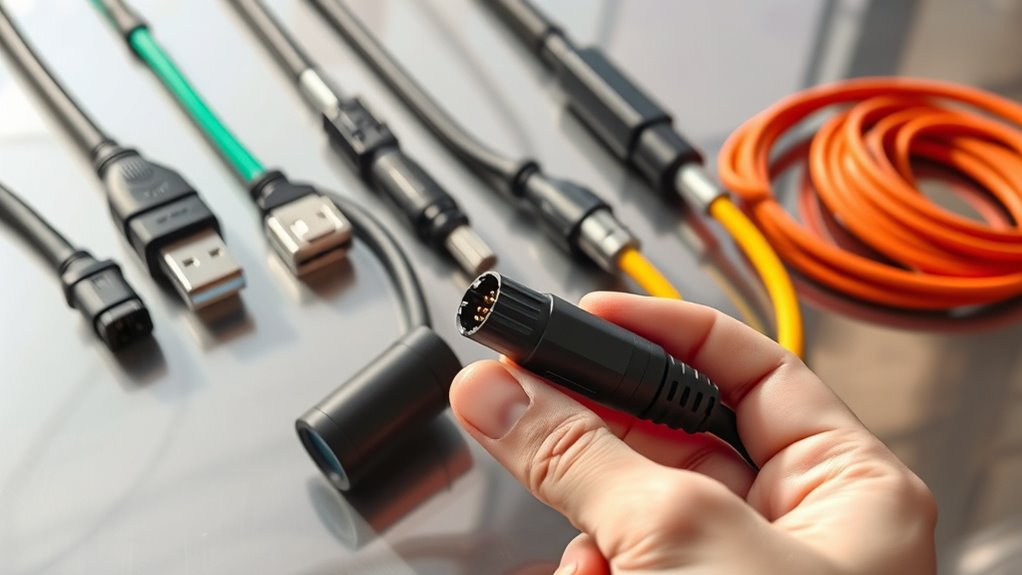
Understanding the main EV charging cable types helps you avoid buying the wrong cord or arriving at a station your car cannot use. The exact connector depends on region, vehicle brand, model year, and whether the charging session is AC or DC.
EV Charging Cable Types
| Connector | Common Use | What to Know |
|---|---|---|
| SAE J1772 | Level 1 and Level 2 AC charging in North America | Common on non-Tesla EVs and plug-in hybrids. Tesla vehicles often use it with an adapter. |
| CCS1 | DC fast charging in North America | Combines a J1772-style AC inlet with two larger DC pins. |
| J3400 / NACS | AC and DC charging on Tesla vehicles and newer compatible North American EVs | Based on Tesla’s connector design and standardized through SAE as J3400. |
| Type 2 | AC charging in Europe and many other markets | Often supports single-phase or three-phase AC depending on the vehicle and station. |
| CCS2 | DC fast charging in Europe and several other regions | Built around the Type 2 connector shape with added DC pins. |
| CHAdeMO | Legacy DC fast charging on some older Japanese EVs | Still important for some older Nissan Leaf models and a few other vehicles, but less common on new North American EVs. |
Cable Compatibility Considerations
To confirm compatibility, start with your vehicle, not the charging station. Your owner’s manual tells you which AC connector, DC fast connector, adapter, and maximum charging rate your EV supports.
For example, a North American EV with a J1772 inlet may use Level 1 and Level 2 AC charging, while the same vehicle may use CCS1 for DC fast charging. A Tesla or J3400/NACS-equipped EV may use one compact connector for both AC and DC charging. A European EV may use Type 2 for AC and CCS2 for DC fast charging.
Adapter use is now common because the North American market is moving through a connector transition. That does not mean every adapter is safe for every vehicle. Use only adapters that your vehicle maker, charging network, or EVSE manufacturer approves.
What Are the Differences Between AC and DC Charging Levels?
The main difference between AC and DC charging is where the power conversion happens. With AC charging, your car’s onboard charger converts AC power to DC for the battery. With DC fast charging, the station converts the power first and sends DC power directly to the battery.
| Charging Type | Typical Power | Best Use | Connector Examples |
|---|---|---|---|
| Level 1 AC | Often about 1.4 to 1.9 kW | Overnight charging, low daily mileage, plug-in hybrids | J1772, J3400/NACS with proper equipment |
| Level 2 AC | About 2.9 to 19.2 kW, depending on equipment and vehicle | Home, workplace, apartment, hotel, and public destination charging | J1772, Type 2, J3400/NACS |
| DC fast charging | Can range from lower-power fast chargers to high-power equipment up to 500 kW | Road trips, quick stops, highway corridors, fleet charging | CCS1, CCS2, CHAdeMO, J3400/NACS |
DC fast charging is not always fast for the whole session. Charging often slows as the battery gets fuller, especially after roughly 80%, and speed can also drop in very hot or cold conditions. Your vehicle’s battery system decides how much power it can safely accept at any moment.
A high-power public charger does not guarantee high-speed charging. The vehicle, battery temperature, state of charge, cable, connector, and station all affect the final charging rate.
Safety Features of EV Charging Cables
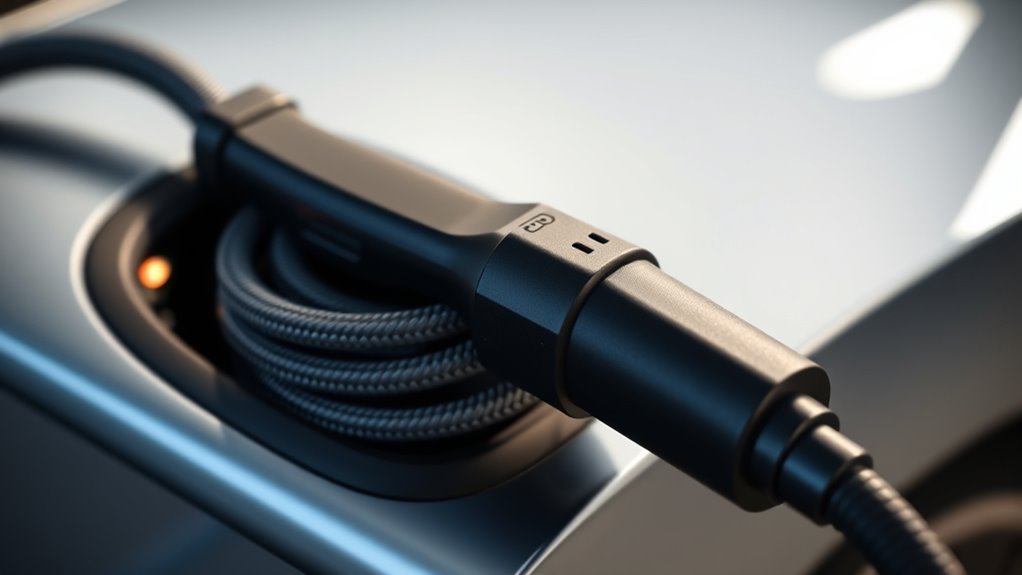
EV charging cables are built for repeated high-current use, so safety matters. A good cable should resist heat, abrasion, moisture, and bending stress. It should also work with the EVSE and vehicle to prevent charging when the connection is unsafe.
Key safety features can include:
- Ground-fault protection: Helps stop power if leakage current is detected.
- Overcurrent protection: Helps prevent too much current from flowing through the cable or circuit.
- Temperature monitoring: Can reduce or stop charging if the connector or cable gets too hot.
- Locking or latching: Helps keep the connector seated during charging.
- Control signaling: Allows the EVSE and vehicle to agree on safe current limits before charging begins.
- Weather resistance: Helps protect outdoor-rated equipment from normal exposure.
Look for EVSE and cable equipment that is safety-listed by a recognized testing laboratory and appropriate for your location. The AFDC notes that buyers should consider equipment features, operation, maintenance, and safety listing when selecting charging equipment.
How to Choose the Right EV Charging Cable
Choosing the right EV charging cable starts with your vehicle’s charge port and ends with your real parking setup. Use this checklist before buying a portable cable, replacement cord, adapter, or home EVSE.
- Check the vehicle manual. Confirm your AC connector, DC fast connector, onboard charger limit, and adapter rules.
- Match the connector. Do not assume J1772, CCS, J3400/NACS, Type 2, or CHAdeMO based only on the brand. Model year and region matter.
- Match the charging level. Level 1 and Level 2 are AC. DC fast charging cables are usually part of the public station.
- Check amperage. The cable and plug must be rated for the circuit and EVSE output.
- Choose the right length. A 20- to 25-foot cable can be convenient, but shorter is cleaner if your charger is well placed.
- Plan for weather. Outdoor charging requires equipment rated for outdoor use.
- Avoid bargain unknowns. High-current equipment is not the place to gamble on unclear certifications, fake ratings, or no warranty.
- Use a qualified electrician for Level 2 installation. A dedicated circuit, panel capacity, breaker size, wire size, and local code all matter.
Note: A Level 2 charger rated higher than your vehicle’s onboard charger will not force your EV to charge faster. The vehicle will only accept what it is designed to accept.
How to Keep Your EV Charging Cable in Great Shape
Maintaining your EV charging cable is simple, but it matters because the cable carries high current for long periods. A few habits can prevent wear and reduce safety risks.
- Inspect before use. Look for cuts, crushed spots, exposed wiring, melted plastic, bent pins, corrosion, or loose connector parts.
- Keep connectors clean. Wipe dry dust from the connector with a soft cloth. Do not spray water or chemicals into the plug.
- Avoid tight bends. Do not kink the cable or wrap it tightly around the EVSE body.
- Store it off the ground. Use a wall hook, reel, or cable holder to reduce tripping, puddle exposure, and tire damage.
- Do not pull from the cord. Hold the connector body when unplugging.
- Keep it away from heat and sharp edges. Hot pavement, garage doors, and metal corners can damage the jacket over time.
- Stop if it gets hot. Warm can be normal during high-current charging, but hot-to-touch plugs, burning smells, or discoloration are warning signs.
Frequently Asked Questions
What type of charger cable does a Nissan Leaf use?
Many older North American Nissan Leaf models use J1772 for Level 1 and Level 2 AC charging and CHAdeMO for DC fast charging. Newer model years and other regions can differ, so check your exact model year, market, and owner’s manual before buying a cable or adapter.
What drains an EV battery the most?
High speed, rapid acceleration, steep climbs, heavy cargo, low tire pressure, strong headwinds, very hot or cold weather, and cabin heating or air conditioning can all reduce range. Battery age and frequent high-power fast charging can also affect long-term battery performance.
What EV charger does Volvo recommend?
Volvo recommendations depend on the model, market, and model year. Some Volvo EVs use CCS/J1772-style charging in North America, while newer models may support J3400/NACS access through native ports or approved adapters. Use your Volvo manual or dealer guidance before buying a home charger or adapter.
What kind of charger does the Hyundai Kona Electric use?
Many North American Hyundai Kona Electric models use J1772 for Level 1 and Level 2 AC charging and CCS1 for DC fast charging. Because connector transitions are happening across the EV market, confirm your exact model year and region before buying an adapter or replacement cable.
Can I use an extension cord with an EV charging cable?
Do not use an extension cord unless your EVSE and vehicle manufacturer clearly allow it. EV charging creates long, high-current loads, and the wrong cord can overheat. A properly installed outlet or hardwired Level 2 charger is safer than stretching a cable with an extension cord.
Is a Level 2 cable always better than a Level 1 cable?
Level 2 is faster, but it is not always necessary. Level 1 may be enough for low daily mileage or a plug-in hybrid. Level 2 is usually better for full battery-electric vehicles, longer commutes, and drivers who need to recover range overnight.
Can I buy a higher-amp EV cable to charge faster?
Only if the EVSE, circuit, and vehicle can support the higher current. A higher-amp cable does not override your vehicle’s onboard charger limit. It also does not make an undersized circuit safe.
Why will my EV charging cable not start charging?
Common causes include a loose connector, locked charge-port door, charger network error, tripped breaker, payment or app issue, adapter mismatch, vehicle charging schedule, battery temperature limit, or a fault detected by the EVSE. Unplug, inspect the connector, check the app or dashboard message, and try a known working charger if needed.
Conclusion
Understanding EV charging cables helps you charge faster, safer, and with fewer compatibility problems. Match the cable and connector to your vehicle, charging level, region, and amperage needs. For home charging, Level 2 is often the most practical upgrade, but it should be installed with the right circuit and safety-listed equipment. For public fast charging, focus on the connector your vehicle supports and use only approved adapters during the J3400/NACS transition.
Sources
- U.S. Department of Energy Alternative Fuels Data Center: Electric Vehicle Charging Stations — charging levels, connector definitions, power ranges, and DC fast charging overview
- SAE International: J1772 Conductive Charge Coupler Standard — North American AC charging connector standard reference
- SAE International: J3400 North American Charging System Standard — J3400/NACS standard reference
- AFDC Equipment Selection and Safety-Listing Guidance — EVSE selection, certified charger resources, and maintenance considerations