
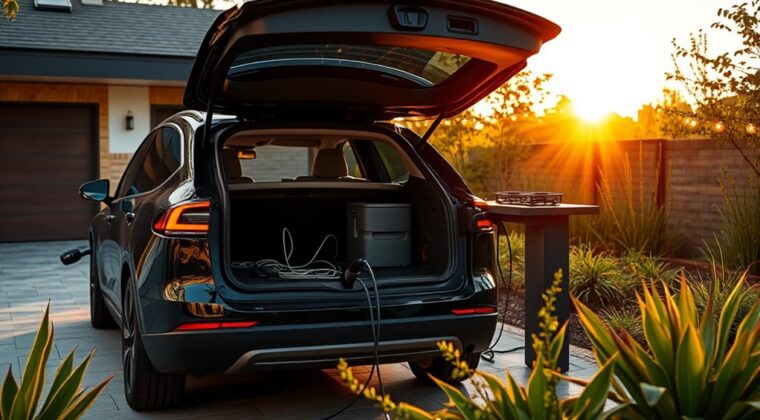
Vehicle-to-Load (V2L) technology lets a compatible electric vehicle share power with plug-in devices, tools, camping gear, and some emergency loads. Instead of using a small gas generator, you can use energy stored in the EV battery through a built-in outlet or a manufacturer-approved V2L adapter.
Quick Answer
Vehicle-to-Load (V2L) lets a compatible EV send power from its high-voltage battery to external devices through an onboard inverter, built-in outlet, or charge-port adapter. Most passenger EV V2L systems are best for small appliances, tools, camping gear, and emergency charging, not for hardwired whole-home backup.
Key Takeaways
- V2L converts stored EV battery energy into AC power for plug-in devices.
- Output depends on the vehicle, trim, market voltage, adapter, and software settings.
- Many passenger EV V2L systems are useful for laptops, lights, fridges, camp gear, and some tools.
- Set a battery discharge limit before using V2L so you keep enough range to drive.
- Do not backfeed your home through a wall outlet. Whole-home backup requires approved V2H, Powershare, or transfer-switch equipment.
At a Glance
| Time Required | About 5 to 10 minutes once you have the right adapter or built-in outlet |
| Difficulty | Easy for small plug-in loads, but safety rules matter |
| Tools Needed | Compatible EV, owner’s manual, manufacturer-approved V2L adapter or built-in outlet, device wattage labels, and a properly rated extension cord if allowed |
| Cost | $0 if your vehicle includes the outlet or adapter; extra adapters can cost more depending on the brand and market |
Warning: Never plug a V2L adapter, extension cord, or EV outlet into a home wall outlet to “power the house.” That is backfeeding and can create fire, shock, and utility-worker hazards. Use only approved home-backup equipment installed according to local electrical code.
What Is Vehicle-to-Load (V2L) Technology?
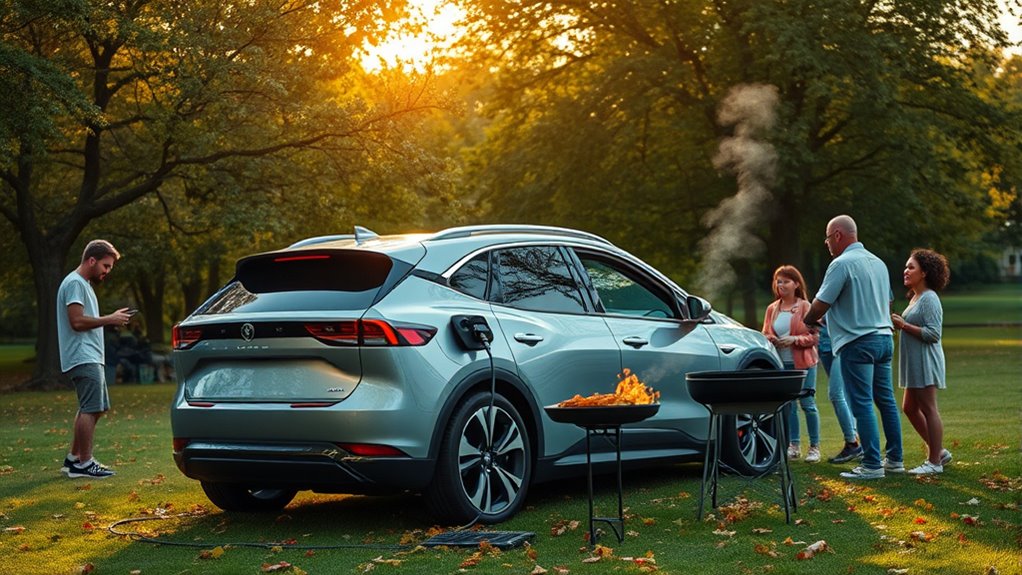
Vehicle-to-Load (V2L) is a bidirectional power feature that lets an electric vehicle send electricity out to external devices. In simple terms, your EV becomes a large portable battery.
The vehicle stores energy as DC power in its high-voltage battery. When V2L is active, the car’s onboard electronics convert that battery energy into AC power that common plug-in devices can use.
Depending on the vehicle and market, V2L may work through a built-in household-style outlet, a charge-port adapter, or both. Some systems are designed for small devices, while others can handle higher loads for camp equipment, tools, or emergency power.
The biggest benefit is convenience. You can run a laptop, lights, a portable fridge, an air pump, small kitchen appliances, or some power tools without carrying a petrol generator. The tradeoff is that every watt you use comes from the same battery that moves the vehicle.
How V2L Works
V2L works through three main parts: the EV battery, the onboard inverter, and the outlet or adapter that connects your device.
- Battery: The high-voltage battery stores the energy you will use.
- Onboard inverter: The vehicle converts battery power into usable AC electricity.
- Outlet or V2L adapter: You connect your device through a built-in socket or a manufacturer-approved adapter.
- Vehicle software: Many EVs require the car to be parked and placed in a utility, accessory, or V2L mode.
- Discharge limit: Many systems let you choose a minimum battery level so you keep enough charge to drive later.
Pro Tip: Set your battery discharge limit before plugging in devices. For camping or emergency use, many drivers keep a larger reserve than normal so they still have enough range to reach a charger.
V2L vs. V2H, V2G, and V2V
V2L is part of a larger group of bidirectional charging features, but the terms do not all mean the same thing.
| Term | What It Means | Typical Use |
|---|---|---|
| V2L | Vehicle-to-Load | Powering plug-in devices, tools, lights, camp gear, or small appliances |
| V2H | Vehicle-to-Home | Powering selected home circuits through approved home-backup hardware |
| V2G | Vehicle-to-Grid | Sending energy back to the electrical grid where utilities and equipment support it |
| V2V | Vehicle-to-Vehicle | Slowly charging or assisting another EV in limited situations |
This distinction matters because a simple V2L adapter is not a substitute for a safe home-backup installation. If you want to power home circuits, look for a vehicle and charger system that officially supports V2H or a brand-approved system such as Tesla Powershare for compatible vehicles and equipment.
Which Electric Cars Support Vehicle-to-Load (V2L)?
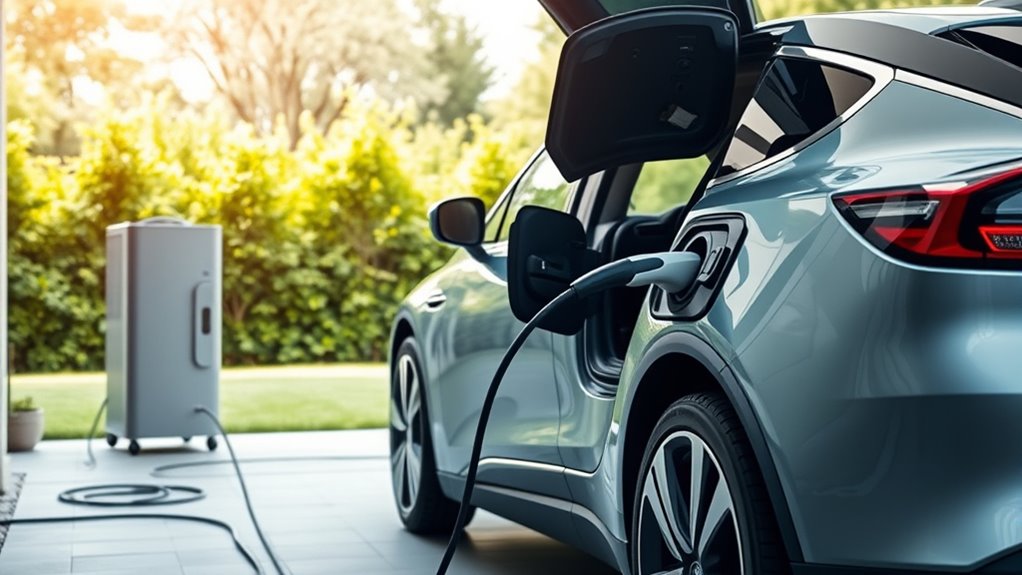
Several EVs support V2L or a similar power-export feature, but availability changes by country, model year, trim, battery option, outlet type, and adapter package. Always check the owner’s manual and the exact vehicle specification before you buy.
Supported Electric Vehicle Models
Common examples include:
- Hyundai IONIQ 5 and IONIQ 6: Often associated with V2L on E-GMP models, with equipment and output depending on market and trim.
- Kia EV6: V2L capability is available on selected versions, and some trims include the adapter in certain markets.
- Kia EV9 and other Kia EV models: V2L availability depends on trim and market.
- BYD Atto 3, Seal, and Dolphin: Often sold with Vehicle-to-Load or VTOL capability in some markets, usually through a discharge adapter.
- MG4, MG ZS EV, and MG5: Some market versions offer V2L with a compatible adapter.
- Tesla Cybertruck with Powershare: Tesla’s official bidirectional-power system can power devices, another EV, or a home when the approved hardware is installed.
Note: Do not assume every EV from a brand supports V2L. Two vehicles with the same name can have different V2L support in different countries or model years.
Power Output Specifications
V2L output is usually listed in watts or kilowatts. Many passenger EV systems are strong enough for small appliances and tools, but not every system can run high-draw heaters, welders, large compressors, or multiple devices at the same time.
| Vehicle or System | V2L / Power Export Notes | What to Check |
|---|---|---|
| Hyundai IONIQ 5 / IONIQ 6 | Available on many versions, with output and outlet setup depending on market. | Adapter, built-in outlet, voltage, trim, and discharge-limit settings |
| Kia EV6 | Selected trims and markets offer V2L capability, sometimes with an included adapter. | Trim level, adapter inclusion, outlet rating, and owner’s manual limits |
| BYD Atto 3, Seal, Dolphin | Often described as V2L or VTOL in markets where the feature is enabled. | Country-specific equipment, discharge adapter, and rated wattage |
| MG4, MG ZS EV, MG5 | Some versions support V2L for modest plug-in loads. | Adapter availability, output limit, and trim support |
| Tesla Cybertruck Powershare | Official Tesla system for powering devices, other EVs, and homes with approved equipment. | Tesla hardware, software version, Powershare Gateway, Universal Wall Connector, or outlet adapter requirements |
| Tesla Model 3 / Model Y | Do not assume simple V2L support through the charge port. | Official Tesla documentation only; avoid unsupported modifications |
Required Accessories and Adapters
To use V2L safely, you need the accessory setup designed for your exact vehicle. That may include:
- Manufacturer-approved V2L adapter: Often plugs into the vehicle’s charge port.
- Built-in outlet: Some EVs include an interior or cargo-area outlet for lower-power devices.
- Correct plug type: Plug type and voltage differ by country.
- Properly rated extension cord: Use only if the owner’s manual allows it, and match the cord rating to the load.
- Weather protection: Keep adapters, plugs, and power strips dry unless the equipment is specifically rated for outdoor wet use.
You usually do not need to buy a separate inverter for a V2L-equipped EV because the vehicle already handles the power conversion. The key is using the approved adapter or outlet and staying within the vehicle’s wattage limit.
How to Use V2L Safely
Before using V2L, check the owner’s manual for the exact steps. Most vehicles follow a process like this:
- Park safely. Put the vehicle in park and keep it in a well-ventilated, stable location.
- Check battery level. Make sure you have enough charge for both power use and driving afterward.
- Set the discharge limit. Choose the lowest battery percentage the car should allow while powering devices.
- Connect the approved adapter or outlet. Use only the accessory designed for your vehicle.
- Plug in one device first. Start with the largest load off, then add devices slowly if the system allows it.
- Watch total wattage. Add up the running watts and leave room for startup surges from compressors, pumps, and motors.
- Keep plugs dry and cool. Stop using V2L if you see heat, smell burning, hear buzzing, or get a vehicle warning.
What Can V2L Power?
V2L can power many everyday devices, but the limit is the vehicle’s maximum output. Always check the wattage label on the device, and remember that some appliances draw more power for a few seconds when they start.
| Device Type | Typical Use Case | V2L Suitability |
|---|---|---|
| Phone, tablet, laptop, camera batteries | Camping, work, travel, outage charging | Usually easy |
| LED lights, Wi-Fi router, small fan | Power outage or campsite comfort | Usually easy |
| Portable fridge or cooler | Food storage while camping or during an outage | Often suitable, but allow for startup surge |
| Kettle, microwave, toaster, induction hob | Short cooking tasks | Possible only if the device stays below the V2L rating |
| Power tools | Jobsite or DIY use | Depends on tool draw and startup surge |
| Space heater, large compressor, welder | High-draw loads | Often not suitable for basic V2L |
How Long Can V2L Run Devices?
Runtime depends on four things: battery size, current state of charge, the discharge limit you set, and the total watts your devices use.
A simple estimate is:
Usable runtime in hours ≈ usable battery kWh × 1,000 × 0.85 ÷ total device watts.
The 0.85 factor allows for inverter losses and real-world inefficiency. For example, if you allow 20 kWh of battery energy for V2L and your devices use 500 watts total, you may get roughly 34 hours of use. If you run a 1,500-watt heater, that same energy may last closer to 11 hours.
High-draw heat appliances drain the battery quickly. Lights, laptops, routers, and efficient fridges use much less energy and are usually a better fit for V2L.
Explore the Benefits of V2L
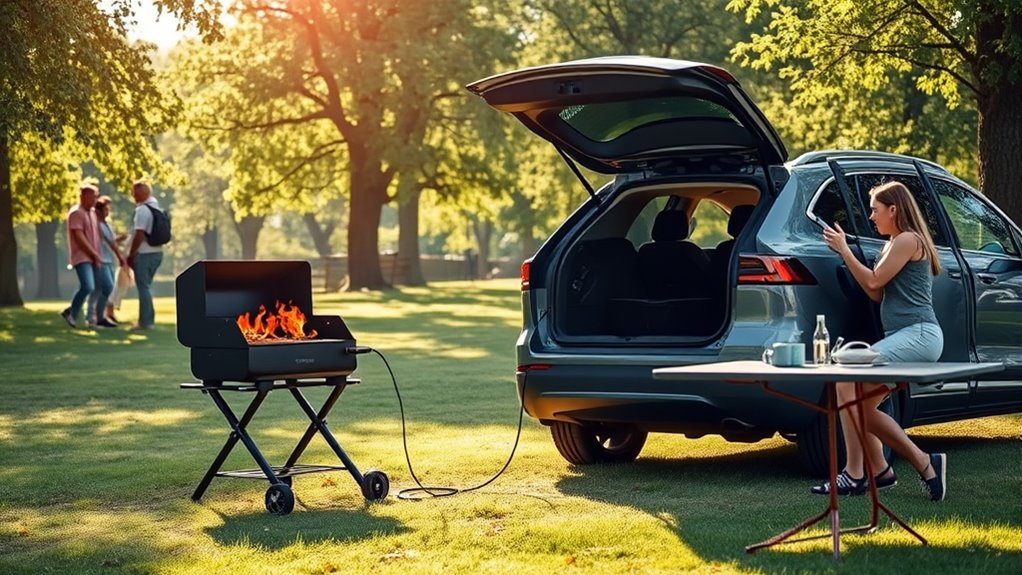
V2L makes an electric vehicle more useful when you are away from a wall outlet. It can reduce the need for a small generator, help during power cuts, and make camping or outdoor work easier.
The main benefits include:
- Quiet power: V2L is much quieter than a petrol generator.
- No exhaust at the point of use: This is helpful at campsites, events, and driveways.
- Large energy reserve: An EV battery holds far more energy than a small portable power station.
- Emergency usefulness: You may be able to keep phones, lights, a fridge, or internet equipment running during an outage.
- Flexible use: V2L can support road trips, picnics, jobsite tasks, and limited EV-to-EV assistance.
For many drivers, V2L is not the main reason to buy an EV. But once you have it, it can become one of the most useful features in day-to-day life.
Limitations and Considerations for V2L
V2L is useful, but it has clear limits. Treat it like a portable power source, not a full electrical system.
Power Output Limitations
The maximum V2L output can limit what you run. A laptop and lights are easy. A kettle, heater, compressor, or large tool may be too much, especially if another device is already plugged in.
- Check the device’s running watts before plugging it in.
- Allow extra headroom for startup surge.
- Do not run multiple high-draw appliances at once unless the total load is safely below the vehicle’s rating.
- Stop if the adapter, cord, plug, or outlet becomes hot.
Adapter Requirements
Some EVs include a V2L adapter. Others require you to buy one separately. Some vehicles use an interior outlet for lower-power loads and a charge-port adapter for higher output.
Use the adapter made or approved for your vehicle. A plug that physically fits is not enough. The vehicle, adapter, cable, and device must all be rated for the load.
Vehicle Compatibility Issues
Compatibility is not brand-wide. It can depend on:
- Model year
- Battery size
- Trim level
- Software version
- Country or region
- Outlet voltage and plug type
- Whether the V2L adapter is included, optional, or unavailable
If V2L matters to you, verify it on the exact vehicle before purchase. Ask the dealer to show the V2L menu, the adapter, the outlet rating, and the owner’s manual section.
Real-World Applications of V2L Technology
V2L is most useful when you need modest power away from a normal outlet. Good real-world uses include:
- Camping: Power lights, a cooler, an air pump, a laptop, or a small cooking device.
- Power outages: Keep phones, a router, LED lights, and a fridge running for a limited time.
- Outdoor work: Run some corded tools or charge tool batteries where no outlet is nearby.
- Events and tailgating: Power speakers, small screens, lighting, or food-prep equipment.
- Emergency EV assistance: In some setups, V2L can provide a slow charge to another EV, but it is not a replacement for roadside charging.
For medical devices, do not rely on V2L as your only backup unless the device maker and your healthcare provider confirm the setup is appropriate. Some devices need clean, uninterrupted power and a dedicated backup plan.
Troubleshooting V2L Problems
If V2L does not work, check the simple causes first.
| Problem | Likely Cause | What to Try |
|---|---|---|
| V2L will not start | Vehicle not in the right mode | Put the EV in park and activate V2L, utility, or accessory mode as the manual directs. |
| Power shuts off quickly | Battery level is below the discharge limit | Raise the battery charge level or adjust the discharge limit if safe to do so. |
| Vehicle shows overload warning | Device draw is too high | Unplug high-draw devices and restart with a smaller load. |
| Adapter does not fit or connect | Wrong adapter type or market version | Use the manufacturer-approved adapter for your exact vehicle and region. |
| Device turns on, then stops | Startup surge or unstable load | Try one device at a time and avoid high-surge appliances. |
Frequently Asked Questions
Can V2L power a house?
Basic V2L can power selected plug-in devices, but it should not be used to backfeed a house through a wall outlet. Whole-home or circuit-level backup requires approved V2H, Powershare, generator-inlet, or transfer-switch equipment installed according to local electrical code.
What is the V2L function?
The V2L function lets a compatible EV export battery power to external devices. The vehicle converts DC battery energy into AC electricity through onboard electronics, then sends it through a built-in outlet or a V2L adapter.
Which vehicles have V2L?
Examples include many Hyundai IONIQ 5 and IONIQ 6 versions, selected Kia EV6 and EV9 versions, some BYD and MG models, and Tesla Cybertruck through Powershare. Availability depends on market, model year, trim, adapter, and software, so always check the exact vehicle manual.
Is V2L worth it?
V2L is worth it if you camp, work outdoors, want quiet emergency power, or need to charge devices away from outlets. It is less important if you rarely need off-grid power or if the vehicle requires an expensive adapter you will not use.
How long can an EV run appliances with V2L?
Divide usable battery energy by the total device load. As a rough estimate, usable battery kWh × 1,000 × 0.85 ÷ device watts gives runtime in hours. Low-power devices can run a long time, while heaters, kettles, and other high-draw appliances drain the battery quickly.
Does V2L damage the EV battery?
Normal occasional V2L use should be treated like using battery energy for driving: it adds some battery cycling, but it is part of the vehicle’s designed function when used correctly. Avoid deep discharge, heat, overloads, and unsupported accessories to reduce stress on the battery and electronics.
Conclusion
Vehicle-to-Load technology can turn a compatible EV into a practical portable power source. It is most useful for camping, outdoor work, emergency device charging, and running selected small appliances during an outage. The key is knowing your vehicle’s exact rating, using the right adapter, setting a discharge limit, and staying within safe power limits.
V2L is not the same as whole-home backup, and it should never be used to backfeed a house through a normal outlet. Used correctly, though, it adds real everyday value to an electric vehicle and gives you more flexibility when power is not available nearby.
Sources
- Kia Global EV Lineup — backs general Vehicle-to-Load use cases such as powering laptops, camping equipment, and outdoor devices.
- Kia UK EV6 — backs EV6 V2L availability and adapter details by trim and market.
- Tesla Powershare Support — backs Tesla Cybertruck bidirectional power features, device power, EV charging, and home-backup hardware requirements.
- Hyundai USA IONIQ 5 — official current vehicle information for the IONIQ 5 model family.