
Choosing between a 40 amp and 50 amp EV charger comes down to your daily mileage, your vehicle’s onboard AC charging limit, and what your home electrical system can safely support. The most important detail is that charger output amps and breaker amps are not the same. A 40 amp charging output usually needs a 50 amp circuit, while a true 48 amp home charging output usually needs a hardwired 60 amp circuit.
Quick Answer
Choose a 40 amp EV charger output if you drive normal daily mileage and want a lower-cost Level 2 setup. Choose a true 48 amp output only if your EV can accept it, your panel has capacity, and you want faster overnight recovery for long commutes or multiple EVs.
Key Takeaways
- A 40 amp EV charger output delivers about 9.6 kW at 240 volts, which is enough for most overnight home charging.
- A true 48 amp output delivers about 11.5 kW, but it usually needs a hardwired 60 amp circuit and a vehicle that can use that much AC power.
- A “50 amp charger” can mean different things. Some units use a 50 amp circuit but charge at 40 amps continuous.
- Your EV’s onboard charger, not just the wall unit, limits the final charging speed.
- Have a licensed electrician confirm panel capacity, permits, breaker size, wiring, grounding, and voltage drop before installation.
At a Glance
| Time Required | 10 to 20 minutes to compare EV specs; 30 to 60 minutes for an electrician to review the panel and installation route. |
| Difficulty | Easy for charger selection; professional-level for wiring, breaker sizing, load calculation, and permitting. |
| Tools Needed | EV owner’s manual, charger spec sheet, electrical panel information, utility rate details, and a licensed electrician for installation planning. |
| Cost | Varies widely by charger, distance from panel, wiring method, permits, load management, and whether a panel or service upgrade is needed. |
How to Choose the Right Amperage for Your EV Charger
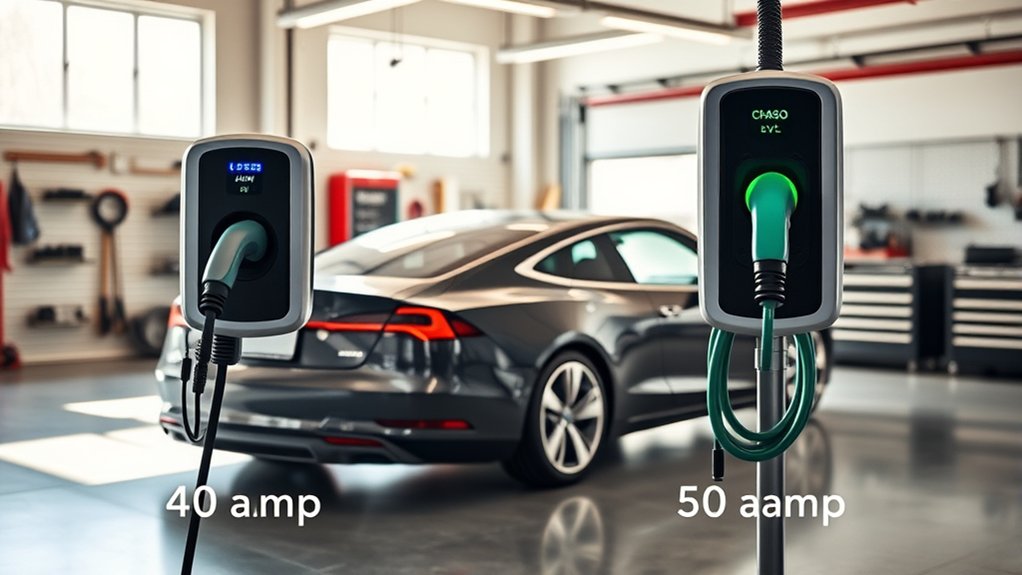
To choose the right amperage, start with three questions: how many miles you drive each day, how fast your EV can accept AC charging, and how much electrical capacity your home has available.
A 40 amp Level 2 charger output supplies about 9.6 kW at 240 volts. For many EVs, that can add roughly 25 to 38 miles of range per hour, depending on vehicle efficiency. A true 48 amp charger output supplies about 11.5 kW and can add more range per hour, but only if your car’s onboard charger can use it.
Level 2 charging in North America is commonly based on SAE J1772 or the North American Charging Standard connector system, depending on the vehicle and charger. These wall units are technically EVSE, meaning they supply AC power to the vehicle. The car’s onboard charger then converts that AC power into DC power for the battery.
Note: A wall charger does not force your EV to charge faster than the vehicle allows. If your EV’s onboard AC charger maxes out at 32 amps, installing a 40 amp or 48 amp charger will not make that car charge above 32 amps.
Charger Amps vs. Breaker Amps
This is the part that causes the most confusion. A charger’s output amperage is not always the same as the circuit breaker size. EV charging is treated as a long, continuous electrical load, so the circuit normally has to be rated above the charger’s continuous output.
| Common Label | Typical Continuous Charging Output | Common Circuit Need |
| 40 amp charger output | 40 amps, about 9.6 kW at 240 volts | Usually a properly sized 50 amp circuit |
| 50 amp circuit or NEMA 14-50 setup | Usually limited to 40 amps continuous | 50 amp breaker, correct receptacle, and code-compliant wiring |
| 48 amp charger output | 48 amps, about 11.5 kW at 240 volts | Usually a hardwired 60 amp circuit |
Warning: Do not install a 48 amp charger on a 50 amp breaker unless the charger is configured to limit output to 40 amps or less. Always follow the charger manual, NFPA 70 National Electrical Code, local amendments, permit rules, and your electrician’s load calculation.
How Many Miles Do You Drive Daily?
Your daily driving distance is the best starting point because most home charging happens overnight. If you drive 30 to 50 miles per day, a 40 amp charging output is usually more than enough. It can replace a typical commute in a short evening charging session and can refill a larger battery overnight.
If you regularly drive 70 to 100 miles per day, share one charger between two EVs, or need to recover quickly after a long trip, a higher-output charger may be worth considering. The upgrade only helps if your EV can accept the higher AC rate and your home can safely support the circuit.
Use this simple estimate:
Charging power in kW = volts × amps ÷ 1,000. Estimated range per hour = charging kW × your EV’s miles per kWh.
For example, a 40 amp output at 240 volts is 9.6 kW. If your EV averages 3.2 miles per kWh, that is about 31 miles of range per hour before normal charging losses. A 48 amp output at 240 volts is about 11.5 kW, which could add about 37 miles per hour at the same efficiency.
How Fast Can You Charge With a 40 Amp Charger?
A 40 amp EV charger output can deliver up to 9.6 kW on a 240 volt circuit. For many EVs, that means about 25 to 38 miles of range per hour, depending on the vehicle’s efficiency, battery temperature, state of charge, and charging losses.
This speed is strong enough for most drivers because the car sits parked for many hours at night. Even if you only charge for four hours, a 40 amp output can often replace a full day of commuting.
Charging Speed Overview
At 40 amps, a Level 2 charger gives you a practical balance of speed, cost, and installation complexity. It is faster than a basic 120 volt Level 1 outlet and avoids the added circuit demands of a true 48 amp setup.
- Power: about 9.6 kW at 240 volts.
- Range added: often about 25 to 38 miles per hour, depending on the EV.
- Best use: overnight home charging for normal daily driving.
- Circuit planning: commonly installed on a properly sized 50 amp circuit when configured for 40 amp output.
Daily Driving Needs
A 40 amp charger output works well if your daily driving is predictable. If you drive to work, run errands, and park at home overnight, this setup usually gives you more than enough recovery time.
It also works well for many plug-in hybrids and EVs with smaller onboard AC chargers. If the vehicle cannot accept more than 32 or 40 amps on AC, a larger wall unit may not improve charging speed.
Cost-Effectiveness Analysis
A 40 amp output is often the better value because it can use less demanding installation hardware than a true 48 amp setup. The final cost still depends on your panel location, conductor run, wall type, permit fees, local labor rates, and whether load management is needed.
The lower-cost choice is not always the smallest charger. The best value is the fastest charger your EV and home can safely use without unnecessary panel upgrades.
Speed Comparison: 40 Amp vs. 50 Amp Charging Rates
When people compare 40 amp vs 50 amp EV charging, they often mean one of two comparisons: 40 amp output versus 48 amp output, or a 40 amp charger versus a charger installed on a 50 amp circuit. These are not the same.
| Setup | Power at 240 V | Estimated Range Added | Best For |
| 32 amp output | 7.7 kW | About 19 to 31 miles per hour | Short commutes, smaller EV batteries, plug-in hybrids |
| 40 amp output | 9.6 kW | About 24 to 38 miles per hour | Most home EV charging |
| 48 amp output | 11.5 kW | About 29 to 46 miles per hour | Long commutes, larger EVs, shared home chargers |
The higher-output setup can shorten charging time, but the difference is not always important. If your car sits plugged in for eight to ten hours overnight, both 40 amp and 48 amp outputs may leave you with a full or near-full battery by morning.
What Are the Cost Implications of EV Chargers?
The cost difference between a 40 amp and higher-output EV charger is not only the charger price. Installation can matter more than the unit itself. A longer wire run, finished walls, trenching, panel limitations, permit fees, or a needed service upgrade can change the total cost quickly.
Initial Installation Costs
A 40 amp output installation may cost less because it commonly uses a 50 amp circuit rather than the larger circuit often needed for 48 amp output. A 48 amp setup is usually hardwired and may require a 60 amp circuit, which can increase material and labor costs.
If your panel is close to the garage or driveway, installation is usually simpler. If the panel is far away, on the opposite side of the home, full, outdated, or already heavily loaded, the project becomes more complex.
Long-Term Energy Expenses
A faster charger does not automatically use less electricity for the same battery refill. If your EV needs 40 kWh, it needs about 40 kWh before charging losses whether you refill it slowly or quickly. The main difference is time.
Where you can save money is with scheduling. If your utility offers time-of-use rates, a smart charger or vehicle app can charge during lower-cost hours. Smart charging can also help reduce peak demand when utility programs support it.
Pro Tip: Before buying a higher-output charger, check your utility’s EV rate plan. A 40 amp charger scheduled during off-peak hours may be more valuable than a faster charger used during expensive peak hours.
Maintenance and Repair Considerations
Home EV chargers have fewer moving parts than many appliances, but the electrical connections still matter. Heat, loose terminals, damaged cords, weather exposure, nuisance trips, and worn receptacles can create problems over time.
Hardwired chargers reduce one common failure point by removing the plug and receptacle. Plug-in units can be convenient, but the receptacle must be high quality, correctly installed, and rated for the load. Your electrician should also confirm GFCI requirements, grounding, weather rating, and whether local code requires a specific installation method.
Can Your Home Handle a 40 Amp or 50 Amp Charger?
To know whether your home can handle a 40 amp or higher-output EV charger, you need more than an open breaker slot. A licensed electrician should perform a load calculation and review your service size, existing major loads, panel condition, conductor route, grounding, and local code requirements.
A home with a 200 amp service may have enough room for Level 2 charging, but that is not guaranteed. A home with a 100 amp service may still support EV charging if the charger output is reduced or a listed load-management device is used. The right answer depends on the full electrical load, not only the panel label.
If your panel cannot support a 48 amp charger output, you still have options:
- Set the charger to a lower output, such as 24, 32, or 40 amps.
- Use load management, where the charger reduces power when the home is using too much electricity.
- Install a dedicated lower-amperage circuit, which may still cover your daily driving.
- Upgrade the panel or service, if your long-term electrical needs justify it.
Understanding Breaker Ratings and Safety Factors
Breaker ratings protect the wiring, not the charger. That is why the breaker, conductor size, charger setting, receptacle or hardwired connection, and installation method all have to match.
For EV charging, the common rule of thumb is that the circuit should be rated at 125% of the charger’s continuous output. That is why a 40 amp charging output commonly pairs with a 50 amp circuit, and a 48 amp charging output commonly pairs with a 60 amp circuit.
Do not rely on wire gauge advice from a single online answer. Wire size can change based on copper versus aluminum, insulation rating, terminal temperature rating, conduit fill, ambient temperature, and run length. Long runs also need voltage-drop review. For example, a 200 foot run may require larger conductors than a short garage-wall installation even when the breaker size is the same.
Hardwired vs. NEMA 14-50 Plug-In Installation
Many homeowners compare a hardwired charger with a plug-in charger that uses a NEMA 14-50 receptacle. Both can work, but they are not equal in every situation.
A NEMA 14-50 plug-in charger is convenient if you want the option to remove the charger or use the outlet for a different compatible device. In most EV charging setups, a 50 amp receptacle circuit means the charger output is limited to 40 amps continuous.
A hardwired charger is often the better fit for higher output, outdoor use, and permanent installations. Many 48 amp chargers require hardwiring. Hardwiring can also reduce heat and wear issues linked to lower-quality receptacles.
Choose the setup based on your charger manual, local code, weather exposure, panel capacity, and whether you need portability or maximum output.
Is a 50 Amp Charger Worth the Investment?
A higher-output charger is worth it when it solves a real problem. If you drive long distances every day, have a large battery EV, share one charger between two vehicles, or need quick recovery after late-night trips, the extra charging speed can be useful.
If your daily use is modest, a 40 amp output is usually the smarter value. It is already fast enough for most overnight home charging and may avoid more expensive electrical work.
Charging Speed Comparison
The difference between 40 amps and 48 amps is about 1.9 kW at 240 volts. In range terms, that might be roughly 5 to 8 extra miles per hour of charging for many EVs. That can matter if you have a short charging window, but it may not matter if the car is parked all night.
Ask yourself this: do you need the battery full faster, or do you just need it ready by morning? If morning readiness is the goal, a 40 amp output usually does the job.
Future-Proofing Potential
Future-proofing can make sense if you plan to buy larger EVs, add a second EV, or install solar, battery storage, or load-managed charging later. Newer Level 2 equipment can also support advanced features such as dynamic load balancing, energy tracking, and bidirectional charging on compatible vehicles and systems.
Still, future-proofing should be practical. Paying for a panel upgrade just to gain a few extra miles per charging hour may not be worth it if your current EV and driving habits do not need the extra power.
Real-World Charging Scenarios
Instead of thinking only in amps, match the charger to your actual use case.
- Short commute, one EV: A 24 to 32 amp setup may be enough, but a 40 amp output gives extra flexibility.
- Average commute, one full EV: A 40 amp output is usually the best balance of speed and cost.
- Long commute or frequent road trips: A 48 amp output can help if your EV supports it and your home can safely handle the circuit.
- Two EV household: Consider load sharing, dual chargers, or a higher-output hardwired setup if the panel has capacity.
- Limited electrical panel capacity: A lower-amperage charger with smart scheduling may be safer and cheaper than a panel upgrade.
Key Takeaways for Selecting Your EV Charger
For most EV owners, the best choice is a 40 amp charging output on a correctly sized circuit. It is fast, practical, and usually enough for overnight home charging.
Choose a true 48 amp output if your EV can use it, your panel has capacity, and the faster recovery time solves a real need. Do not choose it only because the number is bigger.
Before installation, confirm these five items:
- Your EV’s maximum AC charging rate.
- The charger’s adjustable output settings.
- Your home’s available electrical capacity.
- The required breaker, wiring, and installation method.
- Current utility, state, or federal incentives, including guidance from the IRS Alternative Fuel Vehicle Refueling Property Credit page.
Frequently Asked Questions
What size breaker do I need for a 50 amp EV charger?
It depends on what “50 amp charger” means. If the charger is on a 50 amp circuit, it is usually limited to 40 amps continuous. If you mean a charger output near 48 amps, it usually needs a hardwired 60 amp circuit. Always follow the charger manual and local electrical code.
What amp should my EV charger be?
A 40 amp output is the best fit for many home EV owners because it is fast enough for overnight charging and often easier to install than a true 48 amp setup. Choose a lower output if your panel is limited, or a higher output if your EV, panel, and driving needs justify it.
What size wire do I need for 50 amps at 200 feet?
Do not choose wire size from a generic answer. At 200 feet, voltage drop can require larger conductors than a short run. Wire size also depends on conductor material, insulation, conduit, temperature rating, breaker terminals, and local code. Have an electrician calculate it for your exact installation.
How many watts is 50A at 240V?
The raw math is 50 amps × 240 volts = 12,000 watts, or 12 kW. For continuous EV charging, though, a 50 amp circuit is commonly limited to 40 amps output, which is 9.6 kW at 240 volts.
Is a 48 amp EV charger much faster than a 40 amp charger?
It is faster, but not dramatically faster for every driver. A 48 amp output gives about 11.5 kW, while a 40 amp output gives about 9.6 kW. The difference may add only several extra miles of range per hour, depending on your EV’s efficiency.
Can I install a 50 amp EV charger myself?
In most cases, no. EV charger installation involves high-current 240 volt wiring, permits, grounding, breaker sizing, and load calculations. Some areas also require a licensed electrician. Even if local rules allow owner work, a professional installation is the safer choice.
Conclusion
Choosing between a 40 amp and 50 amp EV charger is really about matching charging speed to your vehicle, daily mileage, and home electrical capacity. A 40 amp output is enough for most EV owners because it can add a useful amount of range every hour and easily supports overnight charging.
A higher-output setup can be worth it if you drive long distances, share charging between multiple EVs, or want faster recovery after heavy use. Just make sure you are comparing the right numbers. A 50 amp circuit usually supports 40 amps continuous charging, while a true 48 amp charger output usually needs a hardwired 60 amp circuit. Confirm the setup with your charger manual, your EV specs, and a licensed electrician before installation.
Sources
- SAE International J1772 Standard — backs Level 2 AC charging standards and EV connector context.
- NFPA 70 National Electrical Code — backs electrical-code and installation-safety guidance.
- U.S. Department of Energy: Electric Vehicles — backs home charging and EV energy-use context.
- IRS Alternative Fuel Vehicle Refueling Property Credit — backs incentive-checking guidance for EV charging equipment.
- The Untapped Potential of Smart Charging — backs smart charging cost and emissions context.